
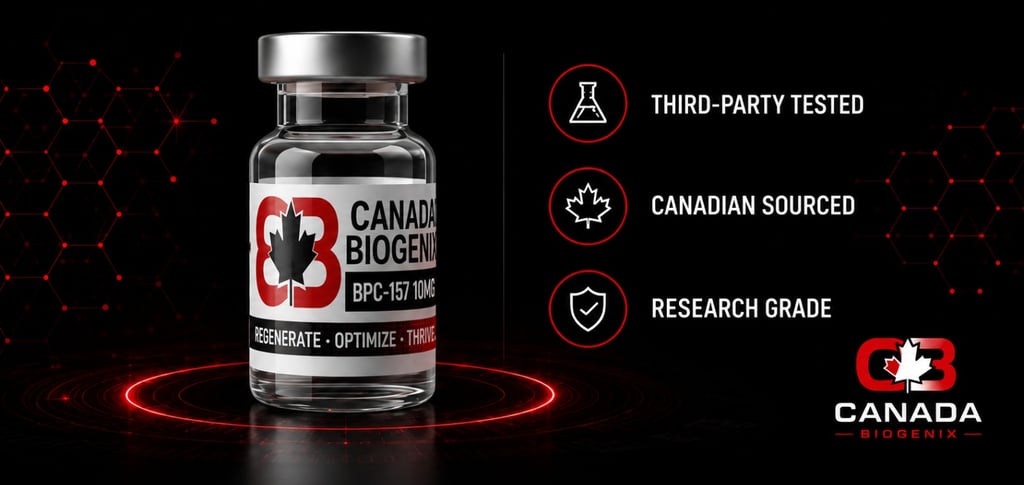
The market for research peptides in Canada has grown dramatically in 2026 and so has the number of suppliers competing for your attention. Some of them are excellent. Some are not. Knowing the difference between a trustworthy, quality-verified Canadian peptide supplier and one that cuts corners on purity, testing, or transparency can make a significant difference to your research outcomes.
This guide gives you a practical, step-by-step framework for sourcing research peptides in Canada based on what actually matters: documentation, purity, transparency, and honest communication
Research Purposes Only: All peptides discussed in this guide are for laboratory and scientific research purposes only. Nothing here constitutes medical advice. Canada Biogenix supplies research-grade peptides strictly for research use.
Q: Is it safe to buy research peptides in Canada?
→ Yes when you source from a verified Canadian supplier that provides independent third-party COA documentation, maintains 98%+ purity standards, and clearly positions products for research use only.
The safety of buying peptides in Canada depends almost entirely on the quality of your supplier — not on the compounds themselves. Research peptides sourced from reputable, independently tested Canadian suppliers come with documented purity levels, transparent manufacturing information, and clear research-use positioning.
The risk enters when buyers prioritize price over documentation, choose overseas suppliers without COA verification, or source from vendors making exaggerated claims. In these cases, compound identity, purity, and concentration cannot be reliably confirmed which directly impacts research integrity and safety.
Key Principle: Safe peptide sourcing in Canada is about supplier verification — not just product selection. Your supplier’s documentation standards matter as much as the compound you are ordering.
Q: Are research peptides legal in Canada?
→ Research peptides are available in Canada for laboratory and scientific research purposes. They are not approved by Health Canada as pharmaceutical drugs for human therapeutic use. Purchasing them for research is legal when sourced from suppliers that maintain research-use-only positioning.
This is one of the most common questions Canadians ask and it deserves a direct, honest answer.
In Canada, compounds exist in different regulatory categories. Pharmaceutical drugs approved by Health Canada go through a rigorous clinical approval process for human therapeutic use. Research compounds including synthetic peptides occupy a distinct category: available for laboratory and scientific study, not approved for human therapeutic application.
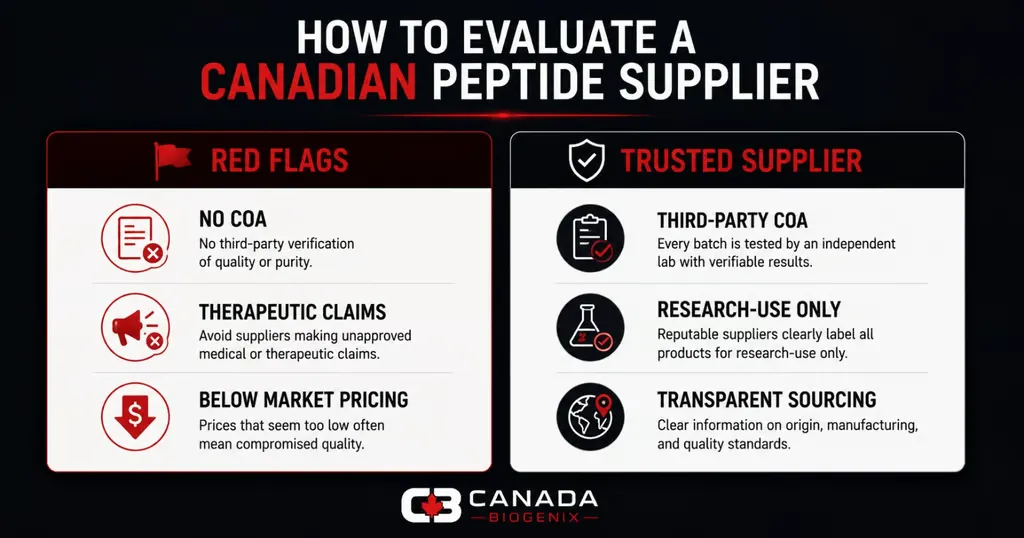
Canadians sourcing research peptides are purchasing compounds intended for research purposes — not for personal therapeutic use. Reputable suppliers make this clear through consistent research-use-only language across their entire platform. Any supplier that makes therapeutic claims — suggesting their peptides treat or cure conditions is operating outside appropriate boundaries and should be avoided.
Health Canada regulates drugs and health products in Canada. Compounds being sold with therapeutic claims require regulatory approval. Research peptide suppliers that make no therapeutic claims and position their products clearly for research use operate in a separate, legitimate research compound space.
Regulatory Note: Canada Biogenix supplies research peptides strictly for laboratory and scientific research. We make no therapeutic claims. Our research-use-only positioning is consistent across every product, every page, and every communication.
Q: What is a research peptide?
→ A research peptide is a synthetic, lab-manufactured chain of amino acids studied for how it interacts with biological systems, receptors, and pathways. Research peptides are not pharmaceutical drugs — they are compounds used in laboratory and scientific research settings.
Peptides are short chains of amino acids — the same building blocks that form proteins. Synthetic research peptides are laboratory-manufactured versions of naturally occurring compounds, created for study in controlled research environments.
In Canada, the most actively researched peptides include BPC-157, CJC-1295, Ipamorelin, TB-500, GHK-Cu, and IGF-1 LR3 — each studied in preclinical models for different biological pathway interactions. Quality and purity are critical regardless of which compound you are sourcing.
Q: What should I check before buying peptides in Canada?
→ Check for: (1) independent third-party COA, (2) 98%+ purity standard, (3) transparent sourcing information, (4) domestic Canadian shipping, (5) research-use-only positioning, and (6) honest communication without therapeutic claims.
Here is your complete pre-purchase checklist the six non-negotiable factors every Canadian researcher should verify before placing an order:
A Certificate of Analysis (COA) from an independent, accredited laboratory is the single most important document in peptide quality verification. This is not a document produced by the manufacturer about their own product it is verification from an outside laboratory confirming the compound’s identity, purity, and concentration.
Research-grade peptides should meet a minimum 98% purity standard. Some premium suppliers verify 99%+ purity. Lower purity means more unknown contaminants or synthesis byproducts in your research compound — directly affecting research reliability.
A trustworthy Canadian supplier knows exactly where their compounds are manufactured and tested. They should be able to tell you the country of manufacture, the testing laboratory used, and the quality control process applied. Vague or evasive answers about sourcing are a significant concern.
Domestic Canadian shipping means faster delivery, no customs complications, no import uncertainty, and domestic accountability. A Canadian-based supplier with Canadian fulfillment is subject to Canadian standards and has a physical presence in the country where you are purchasing.
Every page of a legitimate research peptide supplier’s website — product pages, blog posts, about pages, and support communications — should consistently use research-use-only language. If a supplier’s marketing language suggests personal therapeutic use, health outcomes, or medical benefits, this is both a regulatory concern and a quality signal.
Contact the supplier before ordering. Ask about their COA process, their sourcing, their purity standards. A legitimate, quality-focused supplier will answer these questions clearly and directly. Evasion, scripted non-answers, or pressure tactics are red flags.
Q: What is a COA and how do I read it?
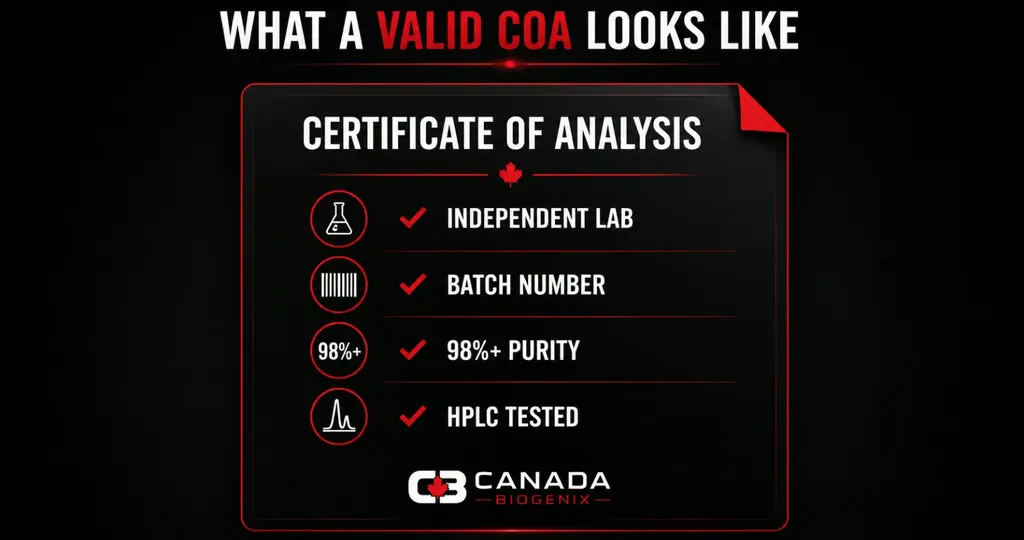
→ A Certificate of Analysis (COA) is a document from an independent laboratory confirming a peptide’s identity, purity percentage, and concentration. To verify it: check the issuing lab is independent (not the manufacturer), confirm the purity percentage meets 98%+, match the batch number to your order, and verify the test date is current.
HPLC (High Performance Liquid Chromatography) is the most reliable method for peptide purity testing. It separates compounds in a sample and measures what percentage is the intended peptide versus impurities. A legitimate COA will specify HPLC as the test method. Mass spectrometry (MS) for identity confirmation is an additional positive signal.
Canada Biogenix COA Standard: Every batch we supply comes with a third-party COA from an independent, accredited laboratory using HPLC analysis. Batch numbers are traceable and COAs are current not recycled from previous production runs.
Q: How do I spot a fake or unreliable peptide supplier in Canada?
→ Key red flags include: no independent COA available, purity below 98%, therapeutic or medical claims on product pages, pricing significantly below market rate, no Canadian address or domestic shipping, and pressure tactics or exaggerated marketing language.
The Canadian peptide research market has grown quickly and not every supplier that has entered this space maintains acceptable quality standards. Here are the red flags to watch for:
Price Warning: Research peptide pricing reflects the cost of quality manufacturing and independent testing. Prices significantly below market rate almost always indicate compromised purity, unverified sourcing, or recycled COA documentation. In research, compound quality directly affects result reliability.
Q: How are research peptides shipped in Canada?
→ Reputable Canadian suppliers ship peptides in temperature-controlled, discreet packaging with reliable tracking. Domestic Canadian suppliers offer faster delivery typically 2 to 5 business days with no customs complications. Peptides are typically shipped as lyophilized (freeze-dried) powder for stability.
Research peptides are most commonly shipped in lyophilized (freeze-dried) powder form. This is the most stable shipping format lyophilized peptides are less sensitive to temperature fluctuations during transit than reconstituted solutions. Reputable suppliers ship in this format with clear reconstitution guidance for research use.
Quality Canadian suppliers package peptides to maintain stability during transit — typically with appropriate insulation and desiccant packaging. Some suppliers include cold packs for temperature-sensitive compounds on longer shipping routes. Check your supplier’s packaging standards before ordering.
Q: How should research peptides be stored in Canada?
→ Lyophilized peptide powder should be stored at -20°C (freezer) for long-term stability, or at 4°C (refrigerator) for short-term use up to a few weeks. Keep away from light and moisture. Once reconstituted, store at 4°C and use within the timeframe specified in your research protocol.
Proper storage is essential for maintaining peptide integrity and research reliability. Temperature fluctuations, light exposure, and moisture are the primary factors that degrade peptide compounds over time.
Q: Why should I buy peptides from a Canadian supplier instead of overseas?
→ A domestic Canadian supplier offers faster shipping (2–5 days vs weeks), no customs complications, Canadian business accountability, domestic quality standards, and direct communication in your time zone. For research reliability, domestic sourcing also means fewer transit variables affecting compound stability.
The case for sourcing research peptides from a domestic Canadian supplier extends beyond convenience. Here is a practical breakdown of the key advantages:
Q: What makes Canada Biogenix a trusted Canadian peptide supplier?
→ Canada Biogenix provides independently third-party tested research peptides with full COA documentation, 98%+ purity standards, transparent sourcing, domestic Canadian shipping, and research-use-only positioning backed by a personal commitment to quality built from a family’s own cancer research journey.
Canada Biogenix was not founded by a corporation with a marketing team and investor targets. It was founded by a Canadian family that went through a deeply personal health journey and discovered firsthand how difficult it is to find a peptide supplier that is genuinely trustworthy one that prioritizes quality over profit and honesty over hype.
That personal experience is the foundation of every standard we hold ourselves to:
We understand that for some Canadians, researching peptides is not purely academic it is personal. That weight is something we carry with us in every sourcing decision, every product we carry, and every communication we have with our customers.

Q: Is it legal to buy research peptides in Canada?
→ Yes research peptides are available in Canada for laboratory and scientific research purposes. They are not approved pharmaceutical drugs for human therapeutic use. Source from suppliers that maintain consistent research-use-only positioning.
Q: What purity level should research peptides be?
→ Research-grade peptides should be a minimum of 98% purity, verified by independent third-party HPLC testing. Premium suppliers verify 99%+ purity. Never accept purity below 95% for research use.
Q: How do I verify a Canadian peptide supplier is legitimate?
→ Request their COA documentation confirm it is from an independent lab, batch-specific, and current. Check that their website uses research-use-only language throughout. Verify they have a Canadian address and domestic shipping. Contact them directly and assess the quality of their response.
Q: What is the difference between a COA from the manufacturer vs a third-party lab?
→ A manufacturer COA is self-reported the company testing their own product. A third-party COA is issued by an independent, accredited laboratory with no financial interest in the result. Only third-party COAs provide reliable, unbiased quality verification.
Q: How long does peptide shipping take in Canada?
→ Domestic Canadian suppliers typically deliver within 2 to 5 business days across Canada. International suppliers can take 1 to 4 weeks, with additional customs risk and temperature control uncertainty.
Q: How should I store research peptides when they arrive?
→ Store lyophilized peptide powder at -20°C for long-term stability. For short-term use within weeks, 4°C refrigeration is acceptable. Keep sealed, protected from light and moisture, and away from temperature fluctuations.
Q: Why are some peptides priced much lower than others?
→ Significantly lower pricing usually reflects compromised manufacturing standards, lower purity levels, unverified sourcing, or recycled COA documentation. In research, compound quality directly affects result reliability price should not be the primary selection factor.
Q: Does Canada Biogenix ship across all of Canada?
→ Yes. Canada Biogenix provides domestic Canadian shipping to customers across the country from British Columbia to Nova Scotia with reliable tracking and research-appropriate packaging.
The Canadian research peptide market in 2026 offers more options than ever before — which makes the ability to evaluate suppliers accurately more important than ever before.
The framework is straightforward: independent COA documentation, verified purity standards, transparent sourcing, domestic shipping, and honest research-use positioning. Suppliers that meet all six criteria are worth your trust. Suppliers that fall short on any of them warrant caution regardless of how compelling their marketing may be.
At Canada Biogenix, we built our sourcing standards around what we would want to find as buyers ourselves because that is exactly how this company started. Not with a business plan, but with a personal need for a supplier we could actually trust.
Explore our full range of independently tested, research-grade peptides at canadabiogenix.com trusted by Canadian researchers, built on transparency.
DISCLAIMER: This content is for educational and informational purposes only and does not constitute medical advice. All peptides supplied by Canada Biogenix are intended strictly for laboratory and scientific research purposes and are not approved by Health Canada for human therapeutic use. Canada Biogenix makes no medical or therapeutic claims about any product. Always consult a qualified healthcare professional for health-related decisions.