
Interest in peptides in Canada has grown dramatically in recent years. Whether you are a researcher, a fitness focused individual, or simply someone who keeps hearing the word ‘peptide’ and wants to understand what it actually means this guide is for you.
In this pillar guide, we cover everything you need to know about research peptides in Canada from the science behind what peptides are, to how they are studied, what the Canadian regulatory landscape looks like, and what separates a trustworthy Canadian supplier from the rest.
For Research Purposes Only: “All content in this guide is educational and informational. Canada Biogenix supplies peptides strictly for laboratory and research purposes. Nothing here constitutes medical advice”
If you have ever heard the word ‘peptide’ and felt confused, you are not alone. The term sounds technical, but the concept is actually straightforward.
A peptide is a short chain of amino acids the same building blocks that make up proteins. The key difference between a peptide and a full protein is length: peptides are typically made of 2 to 50 amino acids, while proteins are longer and more complex.
Think of amino acids as individual letters of the alphabet. A peptide is like a short word precise, targeted, and specific in what it does. A protein is like a full paragraph.
Peptides exist naturally throughout the human body and in many foods. Some are produced by the body itself as signalling molecules tiny messengers that tell cells what to do. Others have been identified in nature and then synthesized in laboratories for research purposes.
In a research context, scientists create synthetic peptides lab-made versions of naturally occurring compounds to study how they interact with biological systems in controlled settings.
This is one of the most common questions among Canadians new to the space. Peptides are not steroids. Steroids are fat-soluble compounds that work by directly affecting gene expression. Peptides are water-soluble amino acid chains that work by binding to specific receptors on cell surfaces a fundamentally different mechanism. Many research peptides are studied precisely because of this more targeted, receptor-specific interaction.
Key Takeaway: “A peptide is a short, targeted amino acid chain. Synthetic research peptides are lab-made compounds studied for how they interact with biological pathways they are not hormones or steroids”
Understanding how peptide research actually works is important especially in Canada, where interest in this science is growing rapidly but accurate information is sometimes hard to find.
Research often begins in a laboratory with isolated cells or tissues. Scientists expose cells to a peptide compound and observe how they respond. These studies are fast, cost-effective, and useful for identifying whether a compound is worth investigating further.
If in vitro results are promising, researchers typically move to animal studies most commonly rodent models. These studies examine how a peptide behaves in a living biological system, including questions of absorption, distribution, and effect on specific tissues or pathways. Most of the existing research on popular peptides like BPC-157 and TB-500 exists at this stage.
The final stage and the most rigorous is human clinical trials. These are tightly regulated studies involving human participants, conducted in multiple phases with increasing scale and scrutiny. Very few research peptides have completed full human clinical trials. This is why the science is described as ’emerging’ or ‘preclinical’ for most compounds.
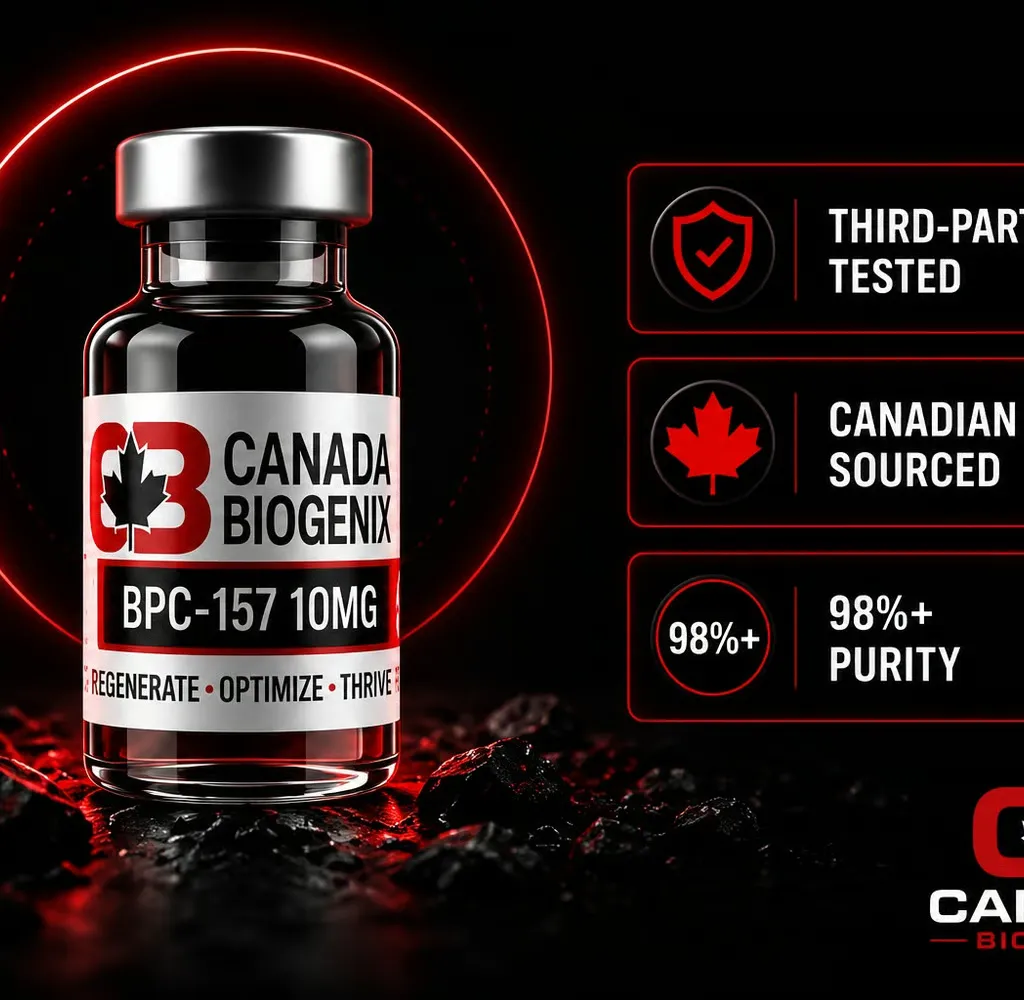
Canada has seen a notable surge in interest around research peptides over the past two to three years. Several factors are driving this trend:
Search data confirms this trend: terms like “peptides canada” and “canada peptide” have reached near-peak search volumes in 2025, reflecting a dramatic rise in public curiosity that simply did not exist five years ago.
One of the most common questions Canadians ask is: are research peptides legal in Canada?
The honest answer requires some nuance and we think Canadians deserve a clear, accurate explanation rather than vague or evasive language.
In Canada, a compound’s legal status depends largely on how it is classified and how it is being used. Pharmaceutical drugs approved by Health Canada go through a rigorous approval process for human use. Research compounds including most peptides are not approved pharmaceutical drugs. They exist in a separate category: available for laboratory research and scientific study, not approved for human therapeutic use.
Canadians purchasing research peptides should understand that they are sourcing compounds intended for laboratory and research purposes not for personal human consumption as a treatment or therapy. Reputable Canadian suppliers make this distinction clear and do not make therapeutic claims about their products.

Health Canada oversees the regulation of drugs and health products in Canada. Any compound being sold with therapeutic claims claims that it can treat, cure, or prevent a condition would fall under this regulatory framework and require approval. Research peptide suppliers that make no therapeutic claims and position their products clearly for research use operate in a distinct space.
Regulatory Note: “Canada Biogenix supplies research-grade peptides strictly for laboratory and scientific research purposes. We do not make therapeutic or medical claims about any product. Always consult a qualified healthcare professional for health-related decisions.”
The growth of the peptide research market in Canada has brought both excellent suppliers and concerning ones. Here is a practical framework for evaluating any supplier you are considering:
In the research peptide space, quality is not just a marketing word it is a scientific necessity. Here is what these terms actually mean:
Purity refers to the percentage of the compound that is actually the intended peptide as opposed to contaminants, byproducts of the synthesis process, or degraded fragments. Research-grade peptides should typically be 98% or higher in purity. Lower purity means more unknowns in your research and less reliable results.
A COA is a document from an independent laboratory that confirms the identity, purity, and concentration of a compound. A legitimate COA comes from a third-party lab not the manufacturer testing their own product. When evaluating a Canadian supplier, always ask whether their COA is from an independent, accredited laboratory.
Whether you are working in a formal research setting or conducting personal investigation, the quality of your compounds directly affects the reliability and interpretability of your results. Poorly manufactured peptides may contain contaminants, incorrect concentrations, or degraded compounds all of which introduce variables that compromise research integrity.
Quality Standard: “Canada Biogenix sources only from manufacturers who provide independent third-party testing documentation. Every batch we supply meets a minimum 98%+ purity standard because we believe researchers in Canada deserve nothing less.”

Canada Biogenix was not built by a corporation with investors to satisfy. It was built by a Canadian family that found themselves searching desperately for quality research compounds at a deeply personal moment and discovered how difficult it was to find a supplier that was truly trustworthy, transparent, and committed to quality above profit.
That experience shapes everything we do. Here is what we stand for:
We understand that for some Canadians, exploring research peptides is not academic it is personal. And that personal weight is something we carry with us in everything we do.
A research peptide is a synthetic amino acid chain manufactured for use in laboratory and scientific research settings. These compounds are studied for how they interact with biological systems, tissues, and pathways — they are not approved pharmaceutical drugs for human therapeutic use.
Research peptides are available in Canada for laboratory and research purposes. They are not approved by Health Canada as therapeutic drugs for human use. Purchasing them for research is distinct from purchasing a regulated pharmaceutical product. Always ensure you are sourcing from a supplier that clearly positions their products for research use only.
In practical terms, both refer to the same thing research peptide compounds available within Canada or supplied by Canadian sources. ‘Canada peptide’ often appears as a search term when someone is looking for a specific compound or a domestic supplier, while ‘canada peptides’ is used more broadly when exploring options or learning about the category.
Look for: independent third-party COA documentation, clear research-only positioning, transparent sourcing, domestic Canadian shipping, and honest communication. Any supplier making health claims or therapeutic promises should be approached with significant caution.
Based on search volume and scientific literature, BPC-157 is consistently the most searched and widely studied research peptide among Canadians followed closely by TB-500, GHK-Cu, and CJC-1295. All exist primarily at the preclinical research stage.
Yes. Canada Biogenix offers domestic Canadian shipping to customers across the country, with reliable packaging and tracking. Domestic sourcing means no customs complications and faster, more predictable delivery timelines.
The world of research peptides in Canada is expanding and with good reason. The science is genuinely fascinating, the questions being explored are significant, and the community of Canadians engaging with this space continues to grow.
At the same time, navigating this space well requires honest information, accurate expectations, and a supplier you can actually trust. Preclinical does not mean proven. Promising does not mean certain. And a supplier who tells you the truth about what is known and what is not is always more valuable than one who tells you only what you want to hear.
At Canada Biogenix, we are committed to being that honest, trusted presence for the Canadian research community. We carry research-grade peptides because we believe in the science and because we know firsthand how much it matters to have a source you can rely on.
Explore our full range of research-grade peptides at canadabiogenix.com trusted by Canadians, built on transparency.
DISCLAIMER: “This content is for educational and informational purposes only and does not constitute medical advice. Research peptides supplied by Canada Biogenix are intended strictly for laboratory and scientific research purposes and are not approved by Health Canada for human therapeutic use. Canada Biogenix does not make any medical or therapeutic claims about its products. Always consult a qualified and licensed healthcare professional before making any decisions related to your health”