

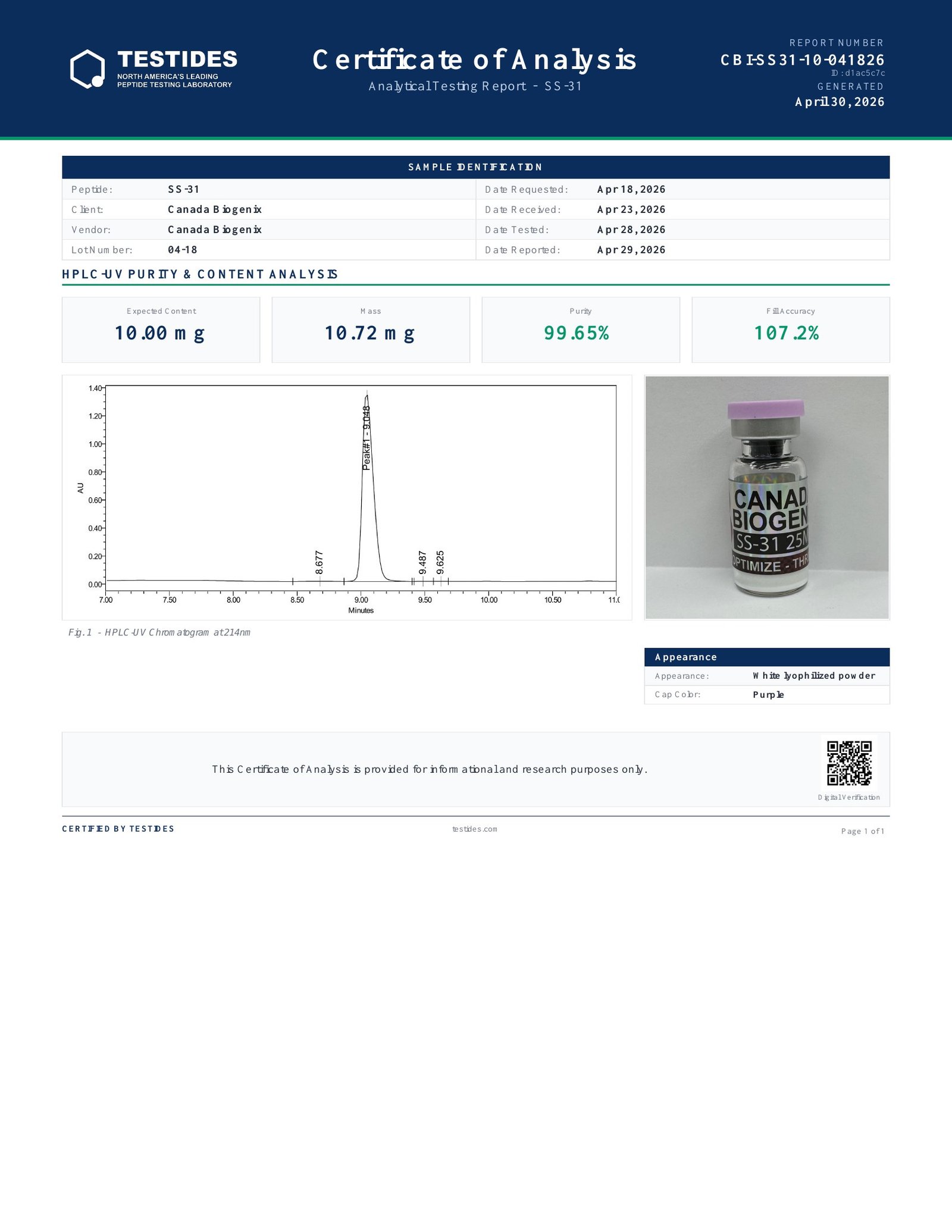
SS-31 10 mg, also known as elamipretide, is a mitochondria-targeting tetrapeptide attracting research interest for its potential influence on cardiolipin stability, electron transport, ATP production, oxidative stress and cellular resilience.

SS-31 is a synthetic peptide made from four amino-acid residues. Its research sequence is commonly written as D-Arg–dimethylTyr–Lys–Phe-NH2. It is also known in the scientific literature as elamipretide, MTP-131 and Bendavia.
Unlike compounds that act through a conventional cell-surface receptor, SS-31 rapidly localizes to the inner mitochondrial membrane. There it binds reversibly to cardiolipin, a specialized phospholipid that helps shape mitochondrial cristae and organize the electron-transport machinery used to produce ATP.
This direct membrane-level mechanism is what makes SS-31 distinctive. Rather than simply increasing the number of mitochondria, it is being studied for its ability to help existing mitochondria operate more efficiently when cardiolipin, membrane structure or electron transport has become dysfunctional.
SS-31 concentrates at the inner mitochondrial membrane and interacts with cardiolipin, placing it directly beside the machinery responsible for cellular energy production.
A randomized human study found that one elamipretide exposure rapidly increased mitochondrial ATP-production capacity in older skeletal muscle with impaired energetics.
Positive signals extend across muscle, heart, kidney, brain and metabolic models in which mitochondrial dysfunction and excess oxidative stress are central features.
| Research action | Observed biological response | Potential significance |
|---|---|---|
| Cardiolipin interaction | Supports cristae curvature and the organization of respiratory-chain supercomplexes. | May help preserve the membrane architecture required for efficient ATP production. |
| Electron-transport optimization | Improves electron flux and reduces inefficient electron leakage in dysfunctional mitochondria. | Supports greater ATP-production capacity with less damaging by-product formation. |
| Reduced excess ROS production | Limits abnormal superoxide and hydrogen-peroxide generation at its mitochondrial source. | May reduce oxidative damage, inflammatory signalling and stress-related cell dysfunction. |
| Cytochrome-c regulation | Supports cytochrome-c electron-carrier activity while reducing cardiolipin-peroxidase activity. | Links membrane preservation with energy production and cellular-survival pathways. |
| Research area | Encouraging finding | Evidence level | Interpretation |
|---|---|---|---|
| Barth syndrome | The pharmaceutical elamipretide product Forzinity received accelerated FDA approval based on improved knee-extensor muscle strength. | Human clinical and regulatory evidence | The strongest validation to date that cardiolipin targeting can produce a meaningful biological effect in mitochondrial disease. |
| Older skeletal muscle | A randomized trial in 39 older adults with impaired mitochondrial function found a rapid increase in ATP-production capacity after one exposure. | Randomized, double-blind human study | Directly demonstrated a reversible bioenergetic effect in living human muscle, although immediate fatigue resistance did not significantly improve. |
| Primary mitochondrial myopathy | A five-day dose-escalation trial reported improved six-minute walking distance without an increase in safety concerns. | Short randomized human trial | Provided an early functional signal, though a later larger trial did not meet its overall primary endpoints. |
| Cardiac aging | Eight weeks of SS-31 improved diastolic function, reduced mitochondrial proton leak and ROS, and restored treadmill endurance in old mice. | Animal research | Supports the possibility that established age-related mitochondrial dysfunction remains biologically reversible. |
| Aging kidney | Research in advanced-age mice reported improved glomerular architecture, podocyte integrity and mitochondrial structure. | Animal research | Expands cardiolipin-focused research into renal aging and mitochondrial kidney injury. |
Studying ATP-production capacity, electron-transport efficiency, respiratory coupling and mitochondrial membrane organization.
Investigating fatigue resistance, exercise tolerance, muscle energetics and recovery from mitochondrial or disuse-related dysfunction.
Exploring mitochondrial protection in cardiac aging, pressure overload, ischemia-reperfusion and age-related kidney injury.
Examining oxidative stress, mitochondrial quality, inflammatory signalling and age-related loss of cellular function.
A particularly interesting pattern in SS-31 research is that its clearest effects often appear when mitochondria are already impaired by aging, genetic disease, ischemia, pressure overload or another form of stress.
In several animal studies, SS-31 improved mitochondrial energetics and tissue performance in older or diseased subjects while producing little measurable change in young subjects with normally functioning mitochondria. Similarly, the randomized older-adult trial specifically enrolled participants with low mitochondrial ATP capacity.
This suggests a normalizing rather than indiscriminately stimulating mechanism: SS-31 appears to help repair inefficient membrane-level bioenergetics where dysfunction exists, rather than simply forcing already healthy mitochondria to produce more energy.
On September 19, 2025, the U.S. FDA granted accelerated approval to Forzinity, a proprietary elamipretide hydrochloride injection, to improve muscle strength in adults and children with Barth syndrome who weigh at least 30 kg. The approval was based on improved knee-extensor muscle strength, a measure considered reasonably likely to predict functional benefit.
The approval is an important milestone because it validates mitochondrial cardiolipin as a clinically actionable target. A confirmatory post-approval trial is still required to verify that the observed strength improvement translates into broader patient benefit.
Forzinity is a regulated prescription formulation with its own manufacturing, concentration, excipients, labelling and approved indication. Canada Biogenix SS-31 10 mg is a separate research product and is not represented as Forzinity or as a substitute for the approved medicine.
| Research product | Primary pathway | Research emphasis |
|---|---|---|
| SS-31 10 mg | Cardiolipin and inner-membrane stabilization | ATP capacity, electron transport, oxidative stress and mitochondrial resilience |
| MOTS-C 10 mg | Mitochondrial peptide and AMPK-related signalling | Metabolic flexibility, glucose handling and stress adaptation |
| SLU-PP-332 5 mg | ERRα, ERRβ and ERRγ agonism | Exercise-like transcription, oxidative metabolism and endurance research |
| NAD+ 500 mg | Redox cofactor and cellular-energy metabolism | Electron transfer, metabolic reactions and healthy-aging biology |
The 10 mg designation describes the total quantity of SS-31 supplied in the vial. It is not a dose, cycle length, treatment schedule or administration instruction.
Published SS-31 and elamipretide experiments use study-specific pharmaceutical formulations, concentrations, routes and analytical conditions. Results from a proprietary approved formulation or a particular clinical trial cannot be transferred automatically to a separate research vial.
Laboratory preparation, concentration, assay compatibility, storage and stability should be established for the specific experimental system. Canada Biogenix does not provide a human administration protocol for SS-31 10 mg.
SS-31 has a stronger translational foundation than many experimental mitochondrial peptides. Its cardiolipin mechanism is supported by biochemical and structural research, randomized human studies have demonstrated measurable mitochondrial and functional signals, and pharmaceutical elamipretide has reached a narrowly defined U.S. approval.
At the same time, results vary by population and endpoint. A short primary-mitochondrial-myopathy trial reported improved walking distance, while a larger later trial did not meet its primary outcomes. The older-adult study improved mitochondrial ATP capacity but did not produce a statistically significant immediate improvement in its primary fatigue-resistance measure.
Overall, the evidence strongly supports SS-31 as a biologically active mitochondrial research peptide. Broader claims involving general performance, longevity, neurodegeneration, cardiovascular disease or kidney disease remain areas of ongoing investigation rather than established outcomes.
SS-31 10 mg is supplied for qualified laboratory research and analytical applications. It is not represented as Forzinity or as an approved therapeutic product, and this page does not provide medical advice, a treatment recommendation or a human administration protocol.