
Last Updated: July 13, 2026
Understanding how to verify peptide purity is essential for anyone working with research compounds. Peptide authenticity directly impacts your research outcomes, regulatory compliance, and credibility. A Certificate of Analysis (COA) from a supplier is only as trustworthy as the laboratory that issued it, not all laboratories maintain the same standards, and some reports contain falsified data or reflect outdated testing methods.
Peptide purity directly affects experimental reproducibility. A contaminated sample introduces variables that compromise your data. If your peptide contains 85% of the target compound instead of 98%, your dosing calculations are wrong and results become unreliable. Regulatory bodies increasingly scrutinize the provenance and purity of research compounds, making rigorous verification mandatory for studies that may inform clinical applications or regulatory submissions.
The financial stakes are real. A contaminated peptide batch can waste weeks of laboratory time and thousands of dollars in direct costs, not counting delayed timelines.
Third-party laboratories serve as independent validators of supplier claims using standardized analytical methods. A reputable third-party lab operates under ISO 17025 accreditation, meaning their testing procedures, equipment calibration, and quality assurance processes are audited by external bodies. This accreditation ensures results are defensible and reproducible.
A Certificate of Analysis is your primary document for verifying peptide purity. The COA should contain identifying information (peptide name, batch number, testing date, laboratory name), purity percentage, and analytical methods used.
Verify that the batch number on the COA matches your physical vial. A mismatch indicates either a labeling error or potential substitution, both serious problems requiring immediate investigation.
The purity percentage, typically expressed as a percentage by weight, represents the proportion of target peptide versus contaminants. A purity of 95% or higher is standard for research-grade peptides, though sensitive assays may require 98%+.
The COA must specify the analytical methods used. HPLC (High-Performance Liquid Chromatography) is the industry standard for peptide purity assessment. Mass spectrometry (MS) results confirm molecular weight and peptide sequence identity. These two methods together constitute the minimum standard for credible peptide verification.
The purity percentage represents the proportion of target peptide in the sample. If a COA states 97% purity, the remaining 3% consists of related compounds, residual solvents, salts, or other impurities. Some labs provide an impurity profile breaking down contaminants; others provide only the total purity figure.
Batch numbers serve as traceability markers corresponding to a specific manufacturing run, testing date, and set of analytical results. Cross-reference your vial’s batch number with the COA provided by your supplier. Discrepancies warrant immediate follow-up.
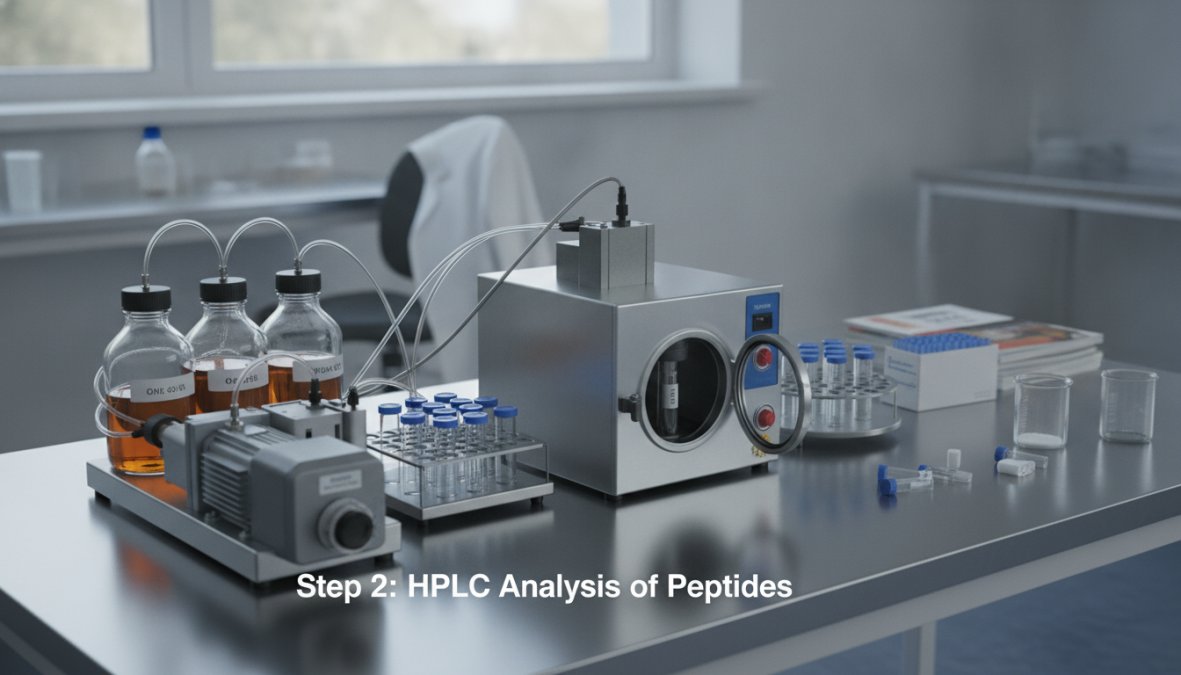
HPLC is the gold standard for measuring peptide purity. This analytical technique separates peptide molecules based on their chemical properties as they pass through a column, allowing laboratories to identify and quantify each component in a sample.
An HPLC chromatogram is a graph showing the time it takes for each compound to travel through the column (x-axis, in minutes) and detection intensity (y-axis). Each peak represents a different compound. The largest peak should correspond to your target peptide, with smaller peaks representing impurities.
The retention time is when a compound emerges from the column. Your target peptide has a characteristic retention time under specific HPLC conditions. If you see a peak at the expected retention time with high intensity and purity above 95%, the peptide identity is confirmed. Additional peaks at different retention times indicate contaminants.
A reliable COA will annotate the chromatogram, identifying each peak and explaining what it represents.
An impurity profile lists each detected contaminant, its retention time, and its percentage of the total sample. Common synthesis-related impurities include truncated peptides (shorter chains from incomplete synthesis), peptide dimers (two peptide molecules bonded together), and acetate residues. These are generally acceptable at low levels. Unexpected impurities warrant investigation into the manufacturing process.
Mass spectrometry confirms the molecular weight and peptide sequence of your sample. While HPLC indicates purity, MS confirms that the compound is actually the peptide you ordered.
In mass spectrometry, the sample is ionized and separated based on mass-to-charge ratio. For peptides, this produces a characteristic pattern allowing identification of exact molecular weight. If you ordered a peptide with a theoretical molecular weight of 1,234.56 Da (Daltons), the MS result should show a peak at or very near that mass.
MS results should include the observed molecular weight, theoretical molecular weight, and the difference between them (typically expressed as parts per million, or ppm). A difference within 5 ppm is considered excellent. Larger discrepancies suggest either a different compound or potential contamination.
Understanding which impurities are expected and which are concerning helps you evaluate COA results critically.
Truncated peptides are fragments missing one or more amino acids. Small amounts (under 2%) are normal; larger amounts suggest rushed synthesis or equipment malfunction. Peptide dimers form when two peptide molecules bond together, typically through disulfide bridges. A COA showing dimer content above 3-5% indicates inadequate purification.
Acetate and other salt residues come from synthesis and purification buffers. These are generally acceptable unless your application is sensitive to ionic strength. A COA should specify acetate content as a percentage by weight.
Residual solvents from synthesis should be present only in trace amounts. Values above 1000 ppm for any single solvent suggest incomplete purification.
Heavy metals contamination is serious for certain applications. A comprehensive COA may include ICP-MS results showing levels of metals like lead, cadmium, and mercury, which should be below 10 ppm for research-grade materials.
Endotoxins are bacterial cell wall fragments that trigger immune responses, particularly problematic for cell culture work. Endotoxin levels should be below 0.1 EU/mg for cell culture applications.
Fraudulent reports are more common than many researchers realize, particularly from suppliers operating outside regulated jurisdictions.
A legitimate COA includes the issuing laboratory’s full contact information, including physical address, phone number, and website. Labs hiding behind post office boxes are suspicious. Verify the laboratory’s existence by checking their website independently and confirming they hold current ISO certifications.
Altered COAs often show signs of digital manipulation: inconsistent fonts, misaligned text, or obvious image editing. Compare the COA format to examples from the same laboratory. Suspiciously perfect results should raise concerns, if a COA shows 99.9% purity across multiple batches with no variation, that’s unusual. Real analytical results show normal variation batch to batch (typically within 1-2 percentage points).
Before trusting a COA, verify the laboratory’s credentials independently. ISO 17025 accreditation is the gold standard. Visit the accrediting body’s website and search for the laboratory name. Legitimate labs are listed with their scope of accreditation, which should include peptide testing.
Request the laboratory’s ISO certificate directly and verify its current validity date. Expired certifications indicate the lab no longer maintains required standards.
Cross-reference your physical vial with the COA. The batch number on the vial label must match the COA. The testing date should be recent (within 6-12 months for most applications).
Examine the vial for signs of tampering or degradation. The peptide should appear as a white or off-white powder. Discoloration, clumping, or moisture inside the vial suggests storage issues or contamination. If the vial seal is broken or the label is damaged, the sample integrity is compromised.
| Verification Step | What to Check | Pass Criteria |
|---|---|---|
| Batch Number Match | Vial label vs. COA | Identical numbers, no discrepancies |
| Lab Credentials | ISO 17025 accreditation | Lab listed in accrediting body database with current certification |
| Testing Date | COA date | Within 6-12 months of receipt |
| Purity Percentage | HPLC result | 95% or higher for research grade; 98%+ for sensitive applications |
| Molecular Weight | Mass spectrometry result | Within 5 ppm of theoretical weight |
| Impurity Profile | Breakdown of contaminants | Known byproducts identified; no unexplained peaks above 2% |
| Retention Time | HPLC chromatogram | Single major peak at expected retention time |
| Solvent Residues | Specification in COA | Below 1000 ppm for any single solvent |
| Heavy Metals | ICP-MS results (if available) | Below 10 ppm for each metal tested |
| Endotoxins | Endotoxin testing (if applicable) | Below 0.1 EU/mg for cell culture applications |
| Physical Inspection | Vial appearance and seal | White/off-white powder, intact seal, no discoloration |
| COA Authenticity | Format and contact info | Consistent formatting, verifiable lab contact, no signs of digital alteration |
Establish a standard operating procedure (SOP) for peptide verification in your laboratory. Document each step, assign responsibility, and maintain records of verification results. Your SOP should specify who verifies each batch, what documentation is required, how discrepancies are handled, and who approves release for use.
Store copies of all COAs with your peptide samples. For regulatory or publication purposes, this documentation becomes essential.
The regulatory landscape for research peptides varies by jurisdiction and intended use. In the United States, research peptides sold for laboratory use are not subject to FDA approval like pharmaceuticals. However, if your research will eventually support a drug development program or clinical application, peptide quality standards become more stringent.
Many institutions require that research compounds meet USP (United States Pharmacopeia) or EP (European Pharmacopoeia) standards, even for non-clinical research. Check with your institution’s research compliance office to understand which standards apply to your work.
For international research collaborations, be aware that different countries have different standards. Request testing to the highest applicable standard to ensure your results are defensible globally.
Verifying peptide purity is non-negotiable for rigorous research. The process requires attention to detail, skepticism of supplier claims, and systematic verification of documentation. Researchers who invest time in proper verification avoid wasted experiments, maintain research integrity, and build confidence in their results.
A COA contains several critical sections: compound identity (name, molecular weight, peptide sequence), purity percentage from HPLC or mass spectrometry, batch number for traceability, testing date, and detected contaminants. Start by verifying the lab's ISO certification and the batch number matches your vial. Check the purity percentage, research-grade peptides typically range from 95-99%. Review the analytical testing methods used (HPLC, mass spectrometry) and examine the impurity profile to identify any concerning contaminants like endotoxins or heavy metals.
HPLC (High-Performance Liquid Chromatography) measures purity by separating compounds based on retention time and quantifying the percentage of your target peptide versus impurities. It answers 'how pure is it?' Mass spectrometry (MS) confirms compound identity by measuring molecular weight and analyzing the peptide sequence. It answers 'is this the right compound?' Both are complementary, HPLC ensures purity, while MS confirms you have the correct peptide. Quality COAs include results from both methods for comprehensive verification.
Common peptide synthesis impurities include incomplete peptide chains, acetate content from synthesis buffers, solvent residues (like DMF or acetonitrile), heavy metals from reagents, endotoxins from contaminated water, and related peptide sequences from side reactions. A detailed impurity profile in the COA should list these as percentages. Check the chromatogram for unexpected peaks beyond your target compound's retention time. Lyophilized powder peptides may also contain moisture or residual salts. Third-party laboratory testing ensures these contaminants are quantified and within acceptable limits for research use.
Verify lab authenticity by checking ISO certification status directly on the lab's official website, not from the COA alone. Cross-reference the batch number with the supplier's inventory system to confirm it matches your purchased vial. Look for standard operating procedure (SOP) documentation that describes their analytical testing methods. Contact the third-party laboratory directly to confirm they issued the report. Red flags include missing lab contact information, vague chromatograms, suspiciously perfect purity percentages (99.9%+), or missing quantitative analysis details. Reputable labs provide detailed, traceable documentation with specific retention times and molecular weight confirmations.
This article was written using GrandRanker