
Last Updated: July 17, 2026
Peptide purity testing methods are essential for anyone working with research compounds. Understanding these methods ensures your research maintains scientific integrity and reproducibility. A peptide sample appearing 95% pure might contain degradation products, synthesis byproducts, or counter-ions that skew your results. This guide covers the analytical methods that catch hidden contaminants, red flags in testing reports, and how to validate whether your peptide supplier is truthful about purity.
Peptide purity is the percentage of the desired peptide sequence present in a sample, measured against total mass or molar content. It differs from potency, a pure peptide can be inactive, and an impure sample might retain some functional capacity despite contamination.
This distinction matters because researchers often confuse purity with usability. A certificate stating 98% purity means the remaining 2% could be water, acetate salt, or truncated peptide fragments that behave differently in your experiment. Understanding what comprises that 2% is critical.
When testing a therapeutic hypothesis or validating a binding mechanism, impurities introduce uncontrolled variables. They alter solubility, change bioavailability, and create noise in your data. A peer-reviewed publication built on impure peptides is vulnerable to irreproducibility.
Peptide purity testing rests on three primary analytical approaches: chromatography separates peptides by chemical properties, mass spectrometry identifies molecular weight and structure, and amino acid analysis quantifies actual peptide content. Each method answers a different question.
Method selection depends on your research question. Are you validating identity? Mass spectrometry is non-negotiable. Measuring the percentage of active peptide versus salt content? Amino acid analysis provides the answer. Investigating what impurities are present? Chromatography shows the full picture.
| Testing Method | Primary Purpose | Best For | Limitations |
|---|---|---|---|
| RP-HPLC | Separation and purity percentage | Identifying impurities, monitoring consistency | Cannot confirm identity alone |
| Mass Spectrometry | Molecular weight verification | Confirming peptide identity, detecting degradation | Requires pure sample for best results |
| Amino Acid Analysis | Quantifying actual peptide content | Measuring net peptide vs. salt content | Destructive testing, time-consuming |
| Potency Assay | Biological activity | Functional validation | Expensive, assay-specific |
Reverse-phase high-performance liquid chromatography (RP-HPLC) is the most widely used method for peptide purity testing because it separates peptides based on hydrophobicity and provides a visual record of everything in your sample.
RP-HPLC passes your dissolved peptide sample through a column packed with hydrophobic particles. The mobile phase gradually increases in organic content, causing peptides to elute at different times based on binding strength. Each peak represents a different chemical species, ideally, one large peak for your desired peptide.
The gold standard is a single dominant peak representing at least 95% of total peak area. However, the percentage reported is calculated by peak area integration, not actual mass. A large peak of salt might integrate as 5% of total area while comprising 40% of actual sample mass. This is why RP-HPLC alone is insufficient, you need complementary methods.
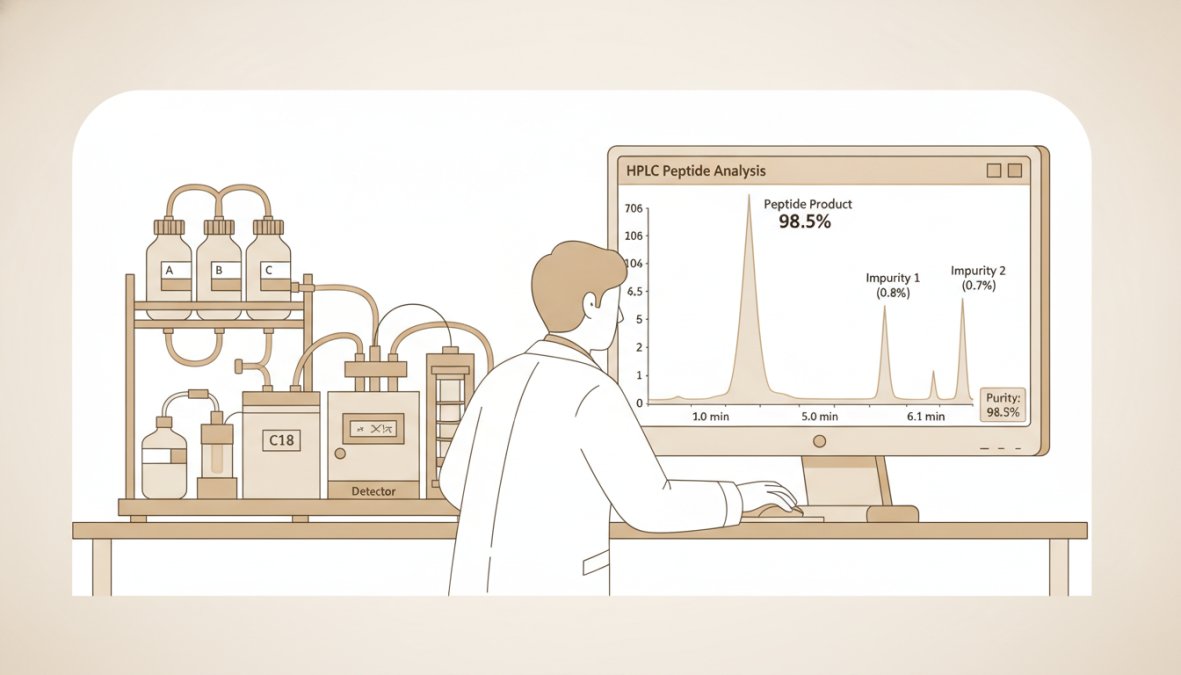
Your peptide is dissolved in weak solvent, injected onto the column, and the system gradually increases organic solvent strength. Hydrophobic peptides elute later; hydrophilic impurities elute early.
A clean chromatogram shows one sharp, symmetrical peak with a consistent retention time. A tailing peak suggests partial degradation or modification. Multiple peaks indicate impurities or different peptide forms (oxidized vs. reduced, different protonation states, or aggregates).
The purity percentage is calculated as target peak area divided by the sum of all peak areas, multiplied by 100. A sample with a main peak at 97% area is reported as 97% pure.
Focus on one dominant peak, that’s your peptide. Everything else is impurity. The x-axis shows retention time (minutes); the y-axis shows signal intensity.
A healthy chromatogram has a sharp, symmetrical main peak with minimal baseline noise and clearly separated smaller peaks. Red flags include multiple peaks of similar size (suggesting mixed batches or degradation), very broad peaks (indicating aggregation), or baseline drift (suggesting contamination).
Always request the full chromatogram image, not just the summary report. A supplier might report 98% purity, but if the "impurity" peaks are actually salt, you’re looking at 98% peptide by peak area but perhaps 80% by actual mass.
While RP-HPLC tells you the percentage of target peptide, mass spectrometry answers the critical question: Is this actually the peptide you ordered? Mass spectrometry measures exact molecular weight, and peptides have such specific sequences that even a single amino acid substitution changes the mass.
Matrix-assisted laser desorption/ionization mass spectrometry (MALDI-MS) is the standard for peptide analysis. The sample is mixed with a chemical matrix, a laser vaporizes the mixture, and resulting ions are measured by mass-to-charge ratio. For a 20-amino-acid peptide, the expected molecular weight is highly specific. If the mass spectrum shows a peak at the expected mass, you have confirmation that the peptide sequence is correct.
A pure peptide’s mass spectrum shows a single major peak at the expected molecular weight, often appearing as multiple peaks representing different charge states. These multiple peaks are normal and helpful, they confirm the presence of a peptide rather than a small molecule.
Degradation products show up as peaks at lower mass values. A peak 18 mass units lower indicates water loss, common in aged peptides. Significant peaks other than the target mass indicate degradation or contamination.
Mass spectrometry is definitive for identity. A supplier cannot fake a mass spectrum. Either the peak is at the expected mass or it isn’t.
A certificate might state "98% purity by HPLC" while another line says "75% net peptide content." These measure different things, and conflating them leads to dosing errors.
Purity by HPLC measures the percentage of target peptide relative to all peaks, is the sample one compound or a mixture?
Net peptide content measures the actual mass of active peptide in the sample, accounting for water, salts, and other non-peptide material. A sample can be 98% pure by HPLC and contain only 60% peptide by mass if the remaining 2% includes significant water and the peptide is partially hydrated.
Peptides are typically synthesized as salts (acetate, trifluoroacetic acid, or hydrochloride) to improve solubility and stability. These salts add mass without adding peptide activity.
When a peptide is synthesized, it’s often purified as a trifluoroacetic acid (TFA) salt. During lyophilization, some TFA remains bound to the peptide. A peptide synthesized as an acetate salt will have acetate ions associated with the molecules.
If you order 100 mg of a peptide with 75% net peptide content, you’re receiving 100 mg total but only 75 mg of actual peptide. The other 25 mg is water and salt. If you dose based on the 100 mg figure, you’re actually dosing 25% less peptide than intended.
Always dose based on net peptide content, not total sample weight. A good supplier provides this information clearly on the certificate of analysis.
A certificate of analysis (COA) certifies what’s in your sample. It should include the peptide sequence, molecular weight, purity percentage, net peptide content, and testing methods used.
A complete COA includes product identification, analytical results (purity %, net peptide content, water content, counter-ion content), testing methods, and batch information. The best COAs include actual chromatogram images and mass spectra, not just summary numbers.
Red flags include missing information, vague language ("high purity" without a number), or inconsistencies (98% purity reported without a chromatogram).
In-house testing means the supplier tested their own product. Third-party testing means an independent laboratory tested it. The difference in reliability is substantial.
In-house testing has inherent conflicts of interest. A supplier benefits financially from reporting high purity with no external oversight. Third-party testing introduces accountability, an independent laboratory has no financial interest in your sample passing and their reputation depends on accuracy.
The best suppliers use third-party testing for all products. When you receive a COA, check whether it’s signed by the testing laboratory or by the supplier. A signature from an independent lab is significantly more reliable. Ask your supplier directly: "Was this tested by your in-house lab or by a third party?"
Peptide samples contain predictable impurities based on synthesis method. The most common include synthesis byproducts (truncated peptides missing amino acids), oxidized peptides (where methionine or tryptophan has been oxidized), aggregates (multiple peptide molecules stuck together), and residual solvents or salts.
Synthesis byproducts are inevitable. When a peptide is synthesized, not every coupling reaction completes, producing a distribution: full-length peptide, peptides missing the last amino acid, peptides missing the last two amino acids. A typical synthesis produces 90-98% full-length product with 2-10% shorter fragments.
Oxidation occurs when methionine or tryptophan react with oxygen during storage or synthesis, changing the mass by 16 Daltons. A peptide stored at room temperature in humid conditions oxidizes faster than one stored at -20°C in a desiccated container.
Aggregation happens when peptide molecules stick together, forming dimers or larger clumps. These appear as broad peaks or baseline elevation late in the chromatogram. Aggregates are more common in hydrophobic peptides or those stored in aqueous solution.
Purity reported without a chromatogram image. A legitimate supplier provides the actual chromatogram. If they only provide a number, they’re hiding something.
Purity reported as a range rather than a specific number. "95-98% pure" is vague and suggests non-quantitative testing. Legitimate reports specify: "97.3% pure."
Missing net peptide content. If the COA reports purity but not net peptide content, the supplier is hiding salt content.
Testing date far in the past. Peptides degrade over time. A COA dated six months ago may not reflect current sample state.
No mention of testing method. A COA should specify whether purity was measured by RP-HPLC or another method.
Mass spectrometry data that doesn’t match HPLC purity. If HPLC reports 98% purity but the mass spectrum shows significant peaks at other masses, the two methods contradict each other.
Purity at synthesis doesn’t guarantee purity when you use the sample months or years later. Stability testing measures how quickly a peptide degrades under specific storage conditions.
Stability testing involves storing peptide samples under defined conditions (room temperature, 4°C, -20°C, or -80°C) and testing at regular intervals to measure purity changes. A peptide that’s 98% pure at synthesis but degrades to 85% pure within three months at room temperature is less useful than one remaining 97% pure after a year at -20°C.
Results are typically presented as a degradation curve showing purity percentage versus storage time. A steep curve indicates rapid degradation; a flat curve indicates stability. Storage condition matters enormously, a peptide at -20°C in a desiccated container might remain stable for years, while the same peptide at room temperature in aqueous solution might degrade within weeks.
Reputable suppliers conduct stability testing and provide this data proactively. Store your peptides at -20°C or -80°C in desiccated form. Avoid repeated freeze-thaw cycles. If you need solution, prepare it fresh shortly before use or store at 4°C in a sterile, sealed container.
Understanding peptide purity testing methods is the difference between research you can trust and results you’ll question. When selecting a peptide supplier, ask for the full COA with chromatograms and mass spectra, verify that testing was conducted by an independent laboratory, and confirm the net peptide content before dosing. Start your next research project with confidence by requesting a detailed COA and stability report.
High-Performance Liquid Chromatography (HPLC) is the gold standard for peptide purity testing. RP-HPLC separates peptide components based on their chemical properties, displaying results as a chromatogram where each peak represents a different compound. Peak integration calculates the percentage of the target peptide relative to all detected substances. Mass spectrometry complements HPLC by confirming molecular weight and identifying degradation products or synthesis byproducts.
A COA should clearly state the purity percentage (e.g., 95%, 98%, 99%), the testing method used (HPLC, mass spectrometry), and the impurity profile listing synthesis byproducts and degradation products. Check the retention time and peak integration values. Verify whether the COA comes from third-party testing or in-house analysis, third-party validation is more reliable. Look for the batch number, test date, and detection limits to confirm the analysis was thorough and recent.
Peptide purity measures the percentage of your target peptide relative to all detected impurities, typically determined by HPLC. Net peptide content accounts for counter-ions (such as acetate or trifluoroacetic acid/TFA) bound to the peptide molecule, which add weight but are not the active peptide itself. A peptide with 98% purity by HPLC might have only 85% net peptide content if significant counter-ion mass is present. Always request both metrics for accurate dosing.
Third-party laboratories have no financial incentive to inflate purity results, whereas manufacturers conducting in-house testing may face pressure to report favorable results. Independent testing provides an objective assessment of impurity profiles, degradation products, and molecular weight verification via mass spectrometry. For research applications where accuracy is critical, third-party COAs reduce the risk of contamination or fraudulent reporting and ensure batch consistency across suppliers.
This article was written using GrandRanker