
Last Updated: July 26, 2026
When you order high purity research peptides, the difference between a reliable supplier and an unreliable one comes down to transparency, testing rigor, and domestic operations. This guide covers what separates premium suppliers from the rest and introduces Canada’s leading high purity research peptide providers.
High purity research peptides are foundational to reproducible science. Contaminated peptides can invalidate months of work. Most reputable suppliers offer peptides at 95% purity or higher, but what that percentage means varies significantly. A peptide labeled "95% pure" could contain water, residual solvents, or related peptide fragments.
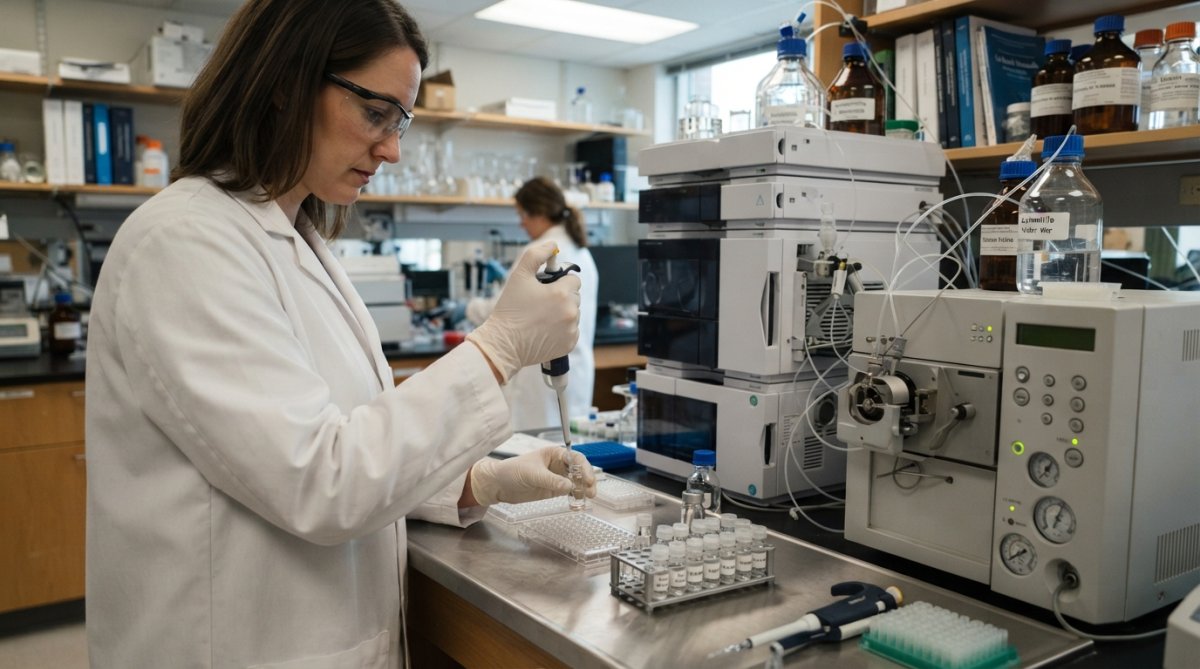
Third-party lab testing is critical. Independent verification from accredited labs using HPLC (high-performance liquid chromatography) and mass spectrometry removes the guesswork. When you see a Certificate of Analysis (CoA) from a recognized lab like Janoshik or Kovera, you’re looking at instrumental data that proves the purity claim.
Premium suppliers invest in relationships with vetted manufacturers, maintain cold-chain logistics to prevent degradation during transit, and publish their testing protocols openly. Look for suppliers who provide batch-specific CoAs with QR code access to actual lab reports, HPLC chromatograms, and mass spec data, not just summary numbers. Domestic operations eliminate cross-border delays and reduce the risk of peptide degradation during customs clearance.
| Supplier | Purity Guarantee | Third-Party Testing | Domestic Operations | Best For |
|---|---|---|---|---|
| Canada BioGenix | 95%+ | Verified partners | Yes | Researchers prioritizing transparency |
| Peptide Pro Canada | 98%+ | Dual-lab verified (Janoshik, Kovera) | Ontario facility | Maximum verification with QR access |
| NCRP | 98%+ | Limited public info | Full Canadian ops | Domestic sourcing focus |
| Vitalis Biosciences | 95%+ | Third-party verified | Yes | Cold-storage peptide stability |
| Axiom Peptide Canada | 95%+ | In-house + Testides Lab | BC facility | Fast Lower Mainland delivery |
| Canada Peptide | Custom synthesis | HPLC/MS provided | Yes | Custom synthesis and analysis |
| CanPeptide | Up to 99%+ | HPLC and Mass Spectra | Yes | Complex custom peptide projects |
Canada BioGenix serves the Canadian research community by providing premium-quality research peptides backed by carefully selected manufacturing partners. Every product meets strict purity and quality standards through partner verification. The company offers free shipping on orders over $250 CAD, accepts credit card payments, and provides batch-specific documentation.
What sets them apart is consistency. Rather than chasing the lowest price, they’ve invested in relationships with manufacturers who deliver reliable batches, ensuring batch-to-batch reproducibility without re-validating protocols with each reorder.
Peptide Pro Canada has positioned itself as the transparency leader in the Canadian market. Every production batch undergoes verification by two independent labs, Janoshik and Kovera, for mass, purity, heavy metals, and sterility testing. This dual-lab approach eliminates the risk that a single lab made an error.
Batch-specific CoAs are posted directly on product pages with QR codes linking to actual lab reports. You’re viewing the chromatogram and mass spec data yourself, not a supplier summary. Shipping from their Ontario facility typically takes one business day within Canada.
NCRP stands out for a straightforward value proposition: peptides manufactured, packaged, and shipped entirely from Canada with a guarantee of greater than 98% purity. For researchers who want to support domestic operations and avoid international shipping delays, this is compelling.
The company offers popular research peptides like BPC-157, TB500, and Tesamorelin, with pricing starting from $85 CAD for blended peptides. Contact them directly for batch-level third-party testing documentation.

Vitalis Biosciences takes peptide stability seriously. Every batch is cold-stored and shipped with temperature control to prevent degradation, and undergoes independent third-party testing for quality and safety. Pricing starts from $49.99 CAD for individual peptides like BPC-157, making them accessible for researchers testing new compounds.

Axiom Peptide Canada combines strong quality control with exceptional logistics for researchers in Western Canada. They perform in-house TAMC/TYMC testing, then verify results through Testides Laboratory for mass, purity, and endotoxin analysis.
Fast local delivery is their standout feature. If you’re in Vancouver, Surrey, Burnaby, Richmond, or the Lower Mainland, same-day or next-day delivery is possible. The Peptide Protocol Hub provides clear guides for reconstitution and handling.
Canada Peptide shifts focus from off-the-shelf peptides to custom synthesis. If you need a specific peptide variant, modified sequence, or specialized compound, they handle synthesis from conception through quality verification. They offer purity levels ranging from crude to >99%, with HPLC and Mass Spectra data provided for every order. They can synthesize peptides of any length or complexity, handle post-synthesis modifications like biotinylation and PEGylation, and scale from milligram to multigram quantities.
A Certificate of Analysis is only useful if you know what you’re looking at. Start with the lab name and accreditation. Reputable labs like Janoshik, Kovera, and Testides are recognized in the research community.
Next, look at the HPLC chromatogram. A pure peptide should show one dominant peak and minimal background noise. Compare the peak area percentage to the claimed purity, they should match. Mass spectrometry data confirms the molecular weight. The m/z value should match the theoretical mass of your target peptide within acceptable tolerance (typically ±0.1 Da).
Lyophilized peptides are most stable at -20°C in a standard laboratory freezer. Store them in airtight vials away from light and moisture. Once you reconstitute a peptide in solution, stability depends on the solvent and storage temperature. Peptides in sterile water or saline typically remain stable for 2-4 weeks at 2-8°C. Avoid repeated freeze-thaw cycles; divide peptides into single-use portions before freezing.
Research-grade peptides typically meet one of three purity standards: crude (70-80%), standard (90-95%), or high-purity (95-99%+). For basic research, 95% purity is usually sufficient. For sensitive applications like cell signaling studies, 98%+ purity reduces noise and improves signal clarity.
HPLC is the gold standard for purity verification. Mass spectrometry confirms the molecular weight, ensuring the supplier sent the correct compound. Always ask for batch-specific data, not average purity across multiple batches.
Reconstituting a lyophilized peptide means dissolving the powder in a liquid, typically sterile water, saline, or bacteriostatic water. Calculate your target concentration using this formula: desired concentration = peptide mass / volume of solvent.
Use sterile technique to prevent contamination. Work in a clean environment, sterilize your vial opening with an alcohol swab, and use a sterile syringe and needle. Let the peptide sit for 15-30 minutes at room temperature before using it.
Health Canada’s approach to research peptides depends on their intended use. Peptides marketed as treatments or with health claims are regulated as drugs or natural health products. Legitimate research peptide suppliers explicitly state "for research use only."
For academic or institutional research, peptides imported from reputable suppliers for non-clinical use generally fall outside most regulatory restrictions. However, if you’re conducting human studies or clinical trials, you’ll need to work through Health Canada’s Clinical Trial Application (CTA) process, which requires authorization before selling or importing a drug for use in a Canadian clinical trial. Peptides imported into Canada for such purposes must come from suppliers following Good Manufacturing Practice (GMP) standards or equivalent.
Third-party lab testing means an independent laboratory, not the supplier, verifies the peptide’s purity and composition. The most recognized labs are Janoshik and Kovera, both of which provide detailed analytical reports using HPLC and mass spectrometry.
When you receive a third-party CoA, verify that it includes the lab’s name and accreditation status, the peptide’s molecular weight and target mass, HPLC purity percentage with chromatogram, mass spectrometry data confirming the m/z ratio, and testing date and batch number matching your order. Batch-specific testing is critical.
HPLC chromatograms show peaks representing different compounds. Your target peptide appears as a peak at a specific retention time. In a pure sample, this peak dominates, accounting for 95%+ of total area. Impurities appear as smaller peaks at different retention times.
Mass spectrometry data confirms identity. The m/z ratio should match the theoretical mass of your peptide. For example, if your peptide has a theoretical mass of 1,234 Da and carries a +1 charge, the m/z should be 1,234. If the m/z is significantly different, the supplier sent the wrong compound.
Domestic shipping from Canadian suppliers typically takes 1-3 business days. Suppliers in Ontario can reach most of Canada within 24 hours. West Coast suppliers offer same-day or next-day delivery within their regions but may take 2-3 days for cross-country shipments.
Cold-chain logistics matter. Peptides should ship in insulated boxes with ice packs or gel packs. Ask suppliers about their shipping protocols, vague answers about temperature control are red flags. Track your package and note the delivery date. If your peptide arrives warm or shows signs of rough handling, contact the supplier immediately.
Quality control involves multiple checkpoints: raw material testing ensures amino acids and reagents meet specifications before synthesis, in-process testing monitors the synthesis reaction, and final product testing verifies purity and identity before packaging.
Batch traceability is critical. Every vial should include a batch number linking back to manufacturing date, synthesis parameters, and testing data. ISO 9001 certification indicates documented quality procedures. GMP certification is more rigorous and ensures consistent quality across batches.
Pharmaceutical-grade peptides are manufactured under strict Health Canada oversight with extensive documentation for clinical trials and approved medications. Research-grade peptides are manufactured to high standards but without full regulatory documentation required for human use.
For most Canadian researchers, research-grade peptides are appropriate and cost-effective. You get high purity and quality control without paying for pharmaceutical-grade documentation you don’t need.
| Testing Method | What It Measures | Typical Accuracy | Best For |
|---|---|---|---|
| HPLC | Purity percentage, identity | ±2-3% | Routine purity verification |
| Mass Spectrometry | Molecular weight, composition | ±0.001 Da (high-resolution) | Confirming peptide identity |
| TAMC/TYMC | Microbial contamination | Colony-forming units | Sterility verification |
| Heavy Metal Testing | Cadmium, lead, mercury, arsenic | ppm range | Safety verification |
| Endotoxin Testing | Bacterial endotoxins | EU/mL | Sterility and safety |
"I’ve been ordering from another supplier for years. Why switch?"
If your current supplier delivers reliable batches and provides third-party testing, you’re in a good position. But if you’ve never seen batch-specific CoAs or third-party verification, you’re missing transparency that’s now standard. Request third-party testing from your current supplier, if they can’t provide it, explore alternatives.
"How do I know purity claims are real?"
Request batch-specific CoAs with QR codes linking to actual lab reports. Scan the code and review the HPLC chromatogram and mass spec data yourself. If a supplier can’t provide this transparency, their claims aren’t verifiable.
"Do higher purity peptides really make a difference?"
Yes, especially for sensitive assays. The difference between 95% and 98% purity means fewer impurities interfering with your results. For binding assays or cell signaling studies, 98%+ reduces noise and improves signal clarity.
"Why is domestic shipping important?"
Shorter transit times mean less exposure to temperature fluctuations. Peptides degrade when exposed to heat, and international shipping introduces multiple temperature changes during customs clearance.
"What if my peptide arrives degraded?"
Contact the supplier immediately with photos of the package and vial condition. Reputable suppliers will replace compromised orders.
Choose a supplier based on three criteria: purity standards, testing transparency, and logistics.
Purity standards: Confirm the minimum purity guarantee for the specific peptide you’re ordering against batch-specific CoAs.
Testing transparency: Can you access batch-specific third-party test reports with HPLC chromatograms and mass spec data?
Logistics: How quickly can they ship to your location? Do they offer temperature-controlled shipping? What’s their replacement policy?
For most Canadian researchers, Canada BioGenix offers the best balance of transparency, quality, and domestic service. If you need maximum verification, Peptide Pro Canada’s dual-lab approach with QR code access is unmatched. If you want purely domestic operations, NCRP guarantees manufacturing and packaging in Canada. If you need custom synthesis, Canada Peptide handles specialized projects.
The key is avoiding suppliers who are vague about testing, manufacturing, or sourcing. In the peptide market, transparency is a proxy for quality.
The peptide research market has matured significantly. Third-party testing, batch-specific documentation, and transparent sourcing are now baseline expectations. Canadian researchers have access to suppliers meeting these standards without paying international shipping premiums or accepting delayed delivery.
When you order high purity research peptides from Canada BioGenix, you’re choosing a partner committed to transparency, consistency, and quality. Our carefully selected manufacturing partners ensure that every batch meets strict purity standards, and we provide the documentation you need to verify those claims. Get started with Canada BioGenix and experience reliable supply solutions backed by genuine quality assurance.
Most suppliers advertise peptides between 90% and 99%+ purity. For serious research applications, aim for 95% or higher. NCRP guarantees greater than 98% purity, while Peptide Pro Canada and Axiom Peptide Canada provide batch-specific third-party testing results via CoA. Your exact purity requirement depends on your research protocol, higher purity reduces variables but may cost more. Always verify claimed purity with independent third-party lab testing rather than relying on supplier claims alone.
Legitimate CoAs should include: batch-specific testing data, the independent lab name (e.g., Janoshik, Kovera, Testides), test dates, purity percentages, and contact information for the testing laboratory. Peptide Pro Canada provides QR codes linking directly to lab reports for easy verification. Cross-check the lab's credentials independently. Be cautious of vague CoAs without specific lab attribution or test dates. Request batch-specific CoAs for every order, suppliers offering only generic purity claims are a red flag.
Research-grade peptides are manufactured and tested for laboratory use under less stringent standards than pharmaceutical-grade. Research-grade typically meets 90%+ purity standards with third-party testing, while pharmaceutical-grade undergoes additional regulatory compliance and GMP (Good Manufacturing Practice) certification. Under Health Canada regulations, research peptides are intended for laboratory and academic use only, not human consumption. When ordering high purity research peptides, verify the supplier's classification to ensure it matches your intended use and regulatory requirements.
Peptide stability during transit depends on temperature control and packaging. Vitalis Biosciences uses cold-storage methods to maintain stability, while most Canadian suppliers offer fast shipping (Peptide Pro Canada ships within 1 business day from Ontario). Upon arrival, store lyophilized peptides at -20°C or below for long-term stability. Reconstituted peptides typically last 2-4 weeks refrigerated at 2-8°C. Request expedited shipping if your research requires minimal transit time, and confirm the supplier's packaging standards before ordering to prevent degradation.
Third-party testing provides independent verification that peptides meet advertised purity standards, protecting you from mislabeled or degraded products. Labs like Janoshik and Kovera use HPLC and mass spectrometry to verify purity, identity, and absence of contaminants. Suppliers like Peptide Pro Canada and Axiom Peptide Canada publish batch-specific test results, allowing you to verify quality before use. Relying solely on supplier claims without independent verification risks compromising research integrity and wasting resources on substandard materials.
This article was written using GrandRanker