
Last Updated: July 12, 2026
Peptide-based therapies have demonstrated significant potential for accelerating tissue healing across multiple injury types. This guide examines the most researched peptides for musculoskeletal recovery, how they work at the cellular level, and what practitioners should know before implementation.
Therapeutic peptides function through distinct biological mechanisms: some trigger angiogenesis and blood flow enhancement, others stimulate collagen synthesis, and still others modulate immune responses to reduce inflammation.
Therapeutic peptides are short chains of amino acids, typically 2 to 50 amino acids in length, designed to mimic or enhance the body’s natural healing processes. Their smaller molecular weights allow them to penetrate tissues more effectively and trigger specific biological responses. In tissue repair, these compounds signal cells to increase collagen production, enhance blood flow, or modulate inflammatory cascades.
The peptides discussed here are synthetic versions of naturally occurring compounds. BPC-157 is derived from gastric proteins. TB-500 mimics thymosin beta-4, a naturally occurring protein involved in cell migration and wound healing. GHK-Cu is a copper-peptide complex found in plasma and saliva. These compounds have been the focus of preclinical research for over two decades, with peer-reviewed journals in regenerative medicine documenting peptide efficacy now publishing dozens of studies annually on tissue-specific applications. The field remains largely preclinical in human contexts, with most clinical evidence coming from animal models and in vitro studies rather than large-scale human trials.
Peptides initiate tissue repair through two primary pathways: angiogenesis and extracellular matrix remodeling. Understanding these mechanisms explains why different peptides suit different injury types and why timing of administration influences outcomes.
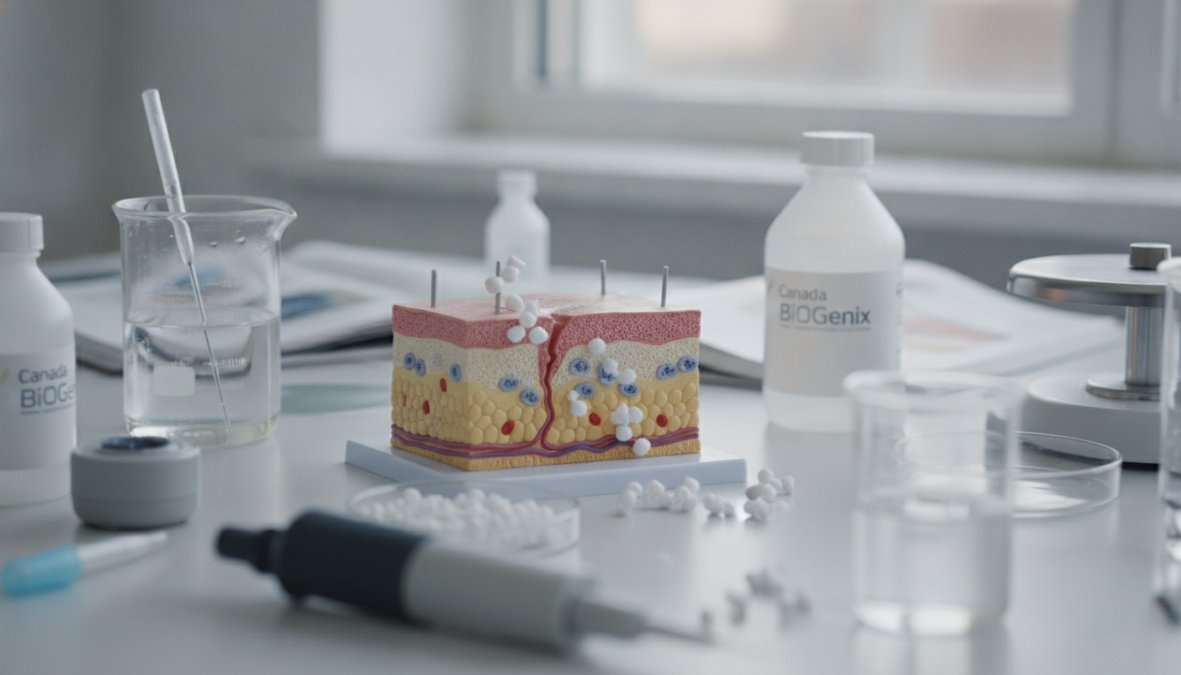
Angiogenesis, the formation of new blood vessels, is essential for delivering oxygen and nutrients to healing tissues. Several peptides, particularly BPC-157 and TB-500, promote angiogenesis through the nitric oxide system. Nitric oxide signals endothelial cells to proliferate and form new capillaries, increasing blood flow to damaged tendons, ligaments, and muscle tissue.
Injured tissues often suffer from reduced vascular supply, creating a hypoxic environment that slows healing. By enhancing angiogenesis, peptides accelerate delivery of growth factors and immune cells necessary for tissue remodeling. The process typically begins within hours of peptide administration and continues over weeks as new vessels stabilize.
TB-500 also facilitates cell migration, the movement of fibroblasts and repair cells to injury sites. This dual action makes TB-500 particularly useful for systemic recovery rather than localized injuries.
Collagen is the primary structural protein in tendons, ligaments, and connective tissue. Peptides like GHK-Cu and BPC-157 upregulate fibroblasts, cells responsible for collagen production. GHK-Cu specifically enhances both collagen I and III synthesis, making it valuable for wound healing and skin regeneration.
Extracellular matrix remodeling involves breaking down damaged collagen and replacing it with new, functional tissue. Peptides modulate this balance, ensuring new collagen deposits strengthen rather than stiffen healing tissue. Collagen remodeling timelines vary by tissue type: ligament and tendon repair typically requires 8-12 weeks for meaningful structural improvement, while muscle tissue can show functional gains within 2-4 weeks.
The research community has identified several peptides with consistent evidence for tissue repair applications. Canada BioGenix provides premium-quality research peptides meeting strict purity and consistency standards.
| Peptide | Primary Mechanism | Best Research Application | Key Characteristic |
|---|---|---|---|
| BPC-157 | Angiogenesis + collagen synthesis | Tendon and ligament repair | Rapid uptake, systemic distribution |
| TB-500 | Cell migration + angiogenesis | Systemic soft-tissue recovery | Broad tissue-type applicability |
| GHK-Cu | Collagen synthesis + fibroblast proliferation | Wound healing and dermatology | High safety profile in topical use |
| CJC-1295 | Growth hormone secretion | Long-term tissue maintenance | Extended half-life (7-8 days) |
| Ipamorelin | Selective GH stimulation | Recovery acceleration | Minimal hormonal side effects |
| Sermorelin | Natural GH-releasing hormone | Age-related recovery | Pituitary-mediated pathway |
| Thymosin Alpha-1 | Immune modulation | Inflammation control | Indirect tissue repair support |
Each peptide occupies a distinct niche. BPC-157 dominates research for localized soft-tissue injuries. TB-500 suits systemic recovery where multiple tissue types need support. GHK-Cu appears most studied for dermatological applications. Growth hormone secretagogues support broader recovery by enhancing endogenous growth hormone and IGF-1 signaling.
BPC-157 (Body Protection Compound-157) is arguably the most researched peptide for musculoskeletal repair. This synthetic pentadecapeptide derived from gastric protective proteins demonstrates strong effects across multiple tissue types in preclinical models.
BPC-157 accelerates blood vessel formation in injured tendons and ligaments, improving nutrient delivery and reducing inflammation simultaneously. The peptide also upregulates growth hormone receptors in fibroblasts, amplifying collagen synthesis signals. For ligament injuries, BPC-157 has shown particular promise in animal models of anterior cruciate ligament and collateral ligament damage, with researchers observing accelerated fiber alignment and earlier return to mechanical strength compared to untreated controls.
BPC-157 shows systemic distribution when administered subcutaneously or intramuscularly, but localized effects are stronger with direct tissue infiltration. This means the peptide benefits both the injection site and distant tissues through circulating mechanisms.
TB-500 (Thymosin Beta-4) operates through cell migration and actin-binding mechanisms, making it particularly useful for systemic recovery involving multiple tissue types. Standard research protocols employ initial loading phases followed by maintenance dosing. A common approach involves 2 mg per administration twice weekly for 4-6 weeks, followed by reduced frequency for maintenance.
Administration routes significantly influence TB-500 efficacy. Subcutaneous injection allows systemic distribution, supporting recovery across multiple tissues. Intramuscular injection concentrates effects near the injection site while providing systemic benefits.
Reconstitution protocols matter significantly for peptide stability. TB-500 should be reconstituted with bacteriostatic water rather than standard saline, as this preserves peptide integrity during storage. Reconstituted TB-500 remains stable for 2-4 weeks when refrigerated at 2-8°C.
The timeline for TB-500 effects typically shows initial improvements in pain and mobility within 7-14 days, with structural tissue changes becoming apparent after 4-6 weeks of consistent administration.
GHK-Cu (copper peptide) focuses specifically on fibroblast activation and collagen remodeling. This naturally occurring copper complex plays central roles in wound healing, skin regeneration, and connective tissue maintenance.
GHK-Cu stimulates fibroblast proliferation and upregulates collagen synthesis genes, increasing both collagen I (structural strength) and collagen III (tissue flexibility) production. The peptide also enhances elastin synthesis and exhibits potent antioxidant and anti-inflammatory properties, reducing reactive oxygen species that accumulate in injured tissues.
For connective tissue applications, GHK-Cu shows particular promise in ligament and tendon research. Studies indicate that GHK-Cu application accelerates the remodeling phase of healing, reducing the timeframe for functional recovery. The peptide works synergistically with other repair peptides, making it a common stacking partner with BPC-157 or TB-500.
Topical GHK-Cu formulations have demonstrated high safety profiles in dermatological research, with minimal adverse effects even at high concentrations.
Recovery timelines with peptide therapy depend on injury type, severity, baseline health status, and which peptides are employed. For acute soft-tissue injuries, most practitioners report initial functional improvements within 7-14 days of consistent peptide administration. Structural tissue changes require 4-8 weeks to become apparent.
Chronic injuries show slower initial responses but often produce more durable improvements. A chronically injured tendon may require 8-12 weeks of consistent peptide therapy before significant functional gains emerge.
Timeline expectations by tissue type:
Muscle tissue responds fastest, often showing functional improvement within 2-4 weeks due to strong vascular supply and high metabolic activity.
Tendon tissue requires 8-12 weeks for meaningful structural changes due to limited blood supply and slow metabolic turnover.
Ligament tissue typically follows tendon timelines, with 8-12 weeks for functional improvement and 12-16 weeks for complete structural remodeling.
Cartilage tissue shows the slowest response, requiring 12-16 weeks or longer for measurable structural changes.
Consistency matters more than intensity. Practitioners who maintain regular dosing schedules see better outcomes than those with sporadic administration.
Peptides used for tissue repair generally demonstrate favorable safety profiles in research contexts, with most adverse effects being mild and self-limiting.
The most commonly reported side effects are localized injection reactions: redness, warmth, mild swelling, or soreness at injection sites, typically resolving within 24-48 hours. Some users report transient fatigue or mild headache within hours of administration, usually subsiding within 24 hours.
GHK-Cu applied topically occasionally causes mild itching or skin irritation in sensitive individuals. Growth hormone secretagogues may cause transient increases in hunger, water retention, or joint aches, effects reflecting elevated growth hormone and IGF-1 levels.
Monitoring protocols should include baseline assessment of relevant hormones for GH secretagogues, tissue-specific function testing, and subjective symptom tracking. Monthly assessment during active treatment allows practitioners to identify adverse patterns early.
Peptides interact minimally with pharmaceutical medications, as they are broken down by digestive enzymes and metabolized through standard protein pathways.
Individuals with active malignancy should avoid peptides that enhance angiogenesis (BPC-157, TB-500, GHK-Cu), as these could theoretically support tumor vascularization.
Growth hormone secretagogues carry relative contraindications for individuals with poorly controlled diabetes, as elevated IGF-1 can influence glucose metabolism. Pregnancy and lactation represent contraindications for all peptides discussed here, as safety data in these populations is absent.
Drug interactions with common medications are minimal. Peptides do not significantly inhibit or induce cytochrome P450 enzymes, meaning interactions with drugs metabolized through these pathways are unlikely.
Finding the best peptides for tissue repair requires matching peptide mechanisms to specific injury types and understanding realistic recovery timelines. BPC-157 excels for localized tendon and ligament injuries through rapid angiogenesis and collagen synthesis. TB-500 suits systemic recovery scenarios where multiple tissues need support. GHK-Cu specializes in collagen remodeling for connective tissue applications. Growth hormone secretagogues provide broad systemic support for long-term tissue maintenance.
Canada BioGenix supplies premium-quality research peptides with strict purity standards and transparent manufacturing partnerships, essential foundations for reliable research outcomes.
BPC-157, TB-500, and GHK-Cu are among the most researched peptides for tissue repair. BPC-157 excels at tendon and ligament healing through angiogenesis and growth hormone receptor upregulation. TB-500 supports systemic soft tissue repair via cell migration and actin-binding. GHK-Cu specializes in collagen synthesis and connective tissue remodeling. The best choice depends on your specific injury type and research goals. Canada BioGenix provides premium-quality research versions of these peptides for professional researchers.
Recovery timelines vary significantly based on injury severity, peptide type, and individual factors. Preclinical evidence suggests BPC-157 may accelerate soft tissue repair within 2-4 weeks, while TB-500 supports broader systemic recovery over 4-8 weeks. GHK-Cu requires consistent application for visible collagen remodeling results. Most research protocols recommend 8-12 weeks of therapy for meaningful tissue regeneration. Individual responses differ; monitoring and adjustment of dosing protocols may be necessary for optimal outcomes.
The safety of peptides for healing depends on quality, dosing, and individual health status. Common considerations include injection site reactions, potential hormonal effects (especially with growth hormone secretagogues like CJC-1295), and drug interactions with existing medications. TB-500 is prohibited by WADA for competitive athletes. Most synthetic peptides lack large-scale human clinical trials, so medical supervision is recommended. Always source from reputable suppliers like Canada BioGenix that maintain strict quality and purity standards to minimize contamination risks.
Peptide stacking, combining complementary peptides, is a common research strategy. For example, pairing BPC-157 (direct tissue repair) with TB-500 (systemic support) or adding GHK-Cu (collagen enhancement) may create synergistic effects. Growth hormone secretagogues like Ipamorelin or CJC-1295 can be stacked with direct repair peptides to amplify recovery. However, stacking increases complexity and potential interactions. Careful protocol design, proper dosing adjustments, and medical oversight are essential when combining peptides for tissue repair research.
BPC-157 is a synthetic pentadecapeptide that promotes localized tissue repair through angiogenesis, collagen synthesis, and growth hormone receptor upregulation, ideal for tendon, ligament, and muscle injuries. TB-500 (Thymosin Beta-4) facilitates systemic tissue regeneration via cell migration and actin-binding, offering broader recovery support. BPC-157 is typically more targeted for specific injury sites, while TB-500 addresses whole-body soft tissue healing. Both are widely researched, but clinical efficacy in humans remains limited. Your choice depends on whether localized or systemic repair aligns with your research objectives.
This article was written using GrandRanker