
Last Updated: July 27, 2026
Proper peptide reconstitution is essential for maintaining the integrity and efficacy of lyophilized research compounds. Lyophilized peptides arrive in a stable, dehydrated state that extends shelf life significantly, but require careful handling during reconstitution to restore usability without introducing degradation, contamination, or loss of biological activity.
When peptides are freeze-dried, water is removed under vacuum while the product is frozen, preserving molecular structure and extending stability to months or years. However, lyophilized peptides cannot be used directly, they must be reconstituted by adding an appropriate solvent to dissolve the powder and create a liquid solution. The reconstitution process rehydrates the peptide molecules and allows them to return to their active, soluble form.
Temperature, solvent selection, vial condition, aseptic technique, mixing methodology, and target concentration all determine reconstitution success. Room temperature equilibration prevents condensation and thermal shock. Solvent choice is critical; some peptides dissolve readily in bacteriostatic water, while others require buffers or specialized diluents. Aseptic technique prevents bacterial and fungal contamination. Mixing methodology affects dissolution speed and potential degradation. Concentration calculations must be precise for reproducible results.
Creating the right conditions before touching your peptide vial is where most reconstitution success is won or lost.
Work in a laminar flow hood or biological safety cabinet if available; these provide HEPA-filtered air that removes particles and microorganisms. If unavailable, use a clean bench in a low-traffic area with heightened aseptic vigilance. Wipe your work surface with 70% isopropyl alcohol and allow it to dry completely. Gather all materials before starting: peptide vial, solvent, syringes, alcohol prep pads, and supplies. Wash your hands thoroughly, then put on clean nitrile gloves. Avoid touching your face or other surfaces once gloved.
Insulin syringes with fixed 31-gauge needles are ideal for minimizing coring and dead space. Sterile alcohol prep pads saturated with 70% isopropyl alcohol disinfect vial septa. Bacteriostatic water or sterile water for injection provides the diluent. A refrigerator or freezer maintains proper storage temperature after reconstitution; -20°C is standard for longer-term storage. An insulated peptide storage case protects vials during transport. A small benchtop centrifuge and vortex mixer are optional but useful for multiple peptides.
Choosing the right solvent is non-negotiable. The solvent you select determines whether your peptide dissolves completely, remains stable after reconstitution, and maintains biological activity.
Bacteriostatic water for injection USP contains 0.9% benzyl alcohol as a preservative, preventing bacterial and fungal growth and allowing multiple withdrawals over several days when stored in the refrigerator. However, benzyl alcohol is not compatible with all peptides. Verify compatibility before use.
Sterile water for injection USP is preservative-free, making it suitable for peptides sensitive to benzyl alcohol and for applications requiring absolute purity. The trade-off is that it must be used immediately after opening. Use sterile water for single-dose applications, benzyl alcohol-incompatible peptides, or preservative-free protocols. Use bacteriostatic water for multiple withdrawals when your peptide tolerates the preservative.
Most peptides dissolve readily in aqueous solutions. However, hydrophobic peptides require specialized solvents or additives. Common approaches include adding a small percentage of organic solvent (ethanol, DMSO, or acetonitrile), using a buffer with surfactants, or employing peptide solubilization solutions designed for lipophilic compounds. Always consult your peptide’s documentation or contact Canada BioGenix for guidance on hydrophobic peptides.
Remove your lyophilized peptide vial from the freezer and allow it to warm to ambient temperature before opening. This prevents condensation from forming inside the vial. Place the vial on your prepared workspace and wait 15-20 minutes. While the vial equilibrates, prepare your solvent and draw your calculated volume into a sterile syringe.
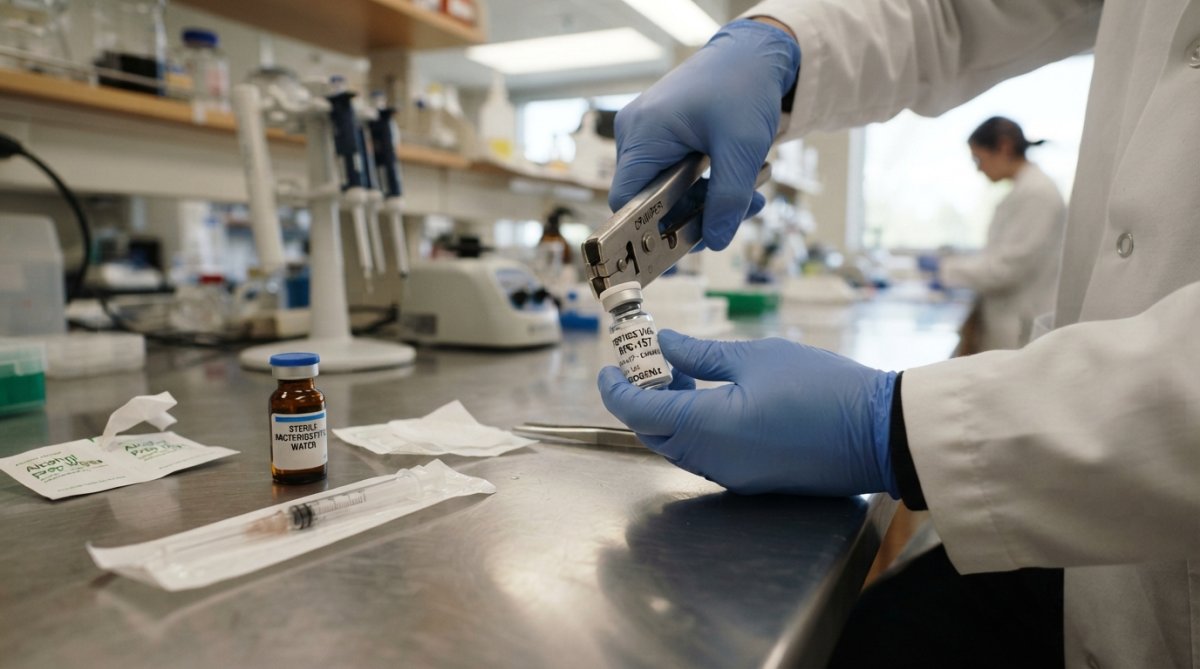
Sanitize the rubber septum by wiping the top of the vial in a circular motion with an alcohol prep pad, starting at the center and moving outward. Use firm pressure and repeat with a fresh pad. Allow the alcohol to air-dry completely (30-60 seconds). Do not touch the septum with bare hands after sanitization.
Draw your solvent using aseptic technique. If drawing from a multi-dose vial, sanitize that vial’s septum first, inject air equal to the volume you’re withdrawing, then withdraw the solvent slowly.
Insert your syringe needle through the sanitized septum at a slight angle to reduce coring. Inject the solvent slowly into the vial, aiming for the vial wall rather than directly onto the powder. Once fully injected, remove the syringe and needle carefully.
Begin mixing gently. For small volumes (under 2 mL), gentle swirling is often sufficient. Tilt the vial side to side and rotate it slowly for 1-2 minutes. If powder persists, try light vortexing at low speed for 10-15 seconds. Never shake vigorously or vortex at high speed, as this introduces air bubbles and can cause peptide aggregation.
| Mixing Method | Duration | Best For | Risk |
|---|---|---|---|
| Gentle swirling | 1-2 minutes | Most peptides | Incomplete dissolution if powder is stubborn |
| Light vortexing | 10-15 seconds | Peptides resistant to swirling | Foaming if speed is too high |
| Sonication | 30 seconds | Hydrophobic or difficult peptides | Potential degradation if prolonged |
| Heating (optional) | 5-10 minutes at 37°C | Very hydrophobic peptides | Risk of thermal degradation |
Allow the vial to sit at room temperature for 5-10 minutes. If undissolved material remains, repeat the mixing step.
The formula is: Volume = Mass ÷ Desired Concentration
Example: You have 10 mg of lyophilized peptide and want a concentration of 10 mg/mL.
Volume = 10 mg ÷ 10 mg/mL = 1 mL
Write down your calculation before beginning and double-check it. Some researchers use a peptide reconstitution calculator, a spreadsheet or online tool that reduces manual calculation errors.
After reconstitution, your peptide should appear as a clear or slightly opalescent solution. If the solution is cloudy, milky, or contains visible particles, something went wrong. Possible causes include incomplete dissolution, precipitation, or contamination.
If you observe cloudiness, attempt to re-dissolve by gentle heating to 37°C for 5-10 minutes, then mixing again. If the solution clears, proceed carefully. If cloudiness persists, the batch is likely compromised and should be discarded.
Reconstituted peptides are far less stable than their lyophilized counterparts. Store reconstituted peptides at 2-8°C (standard refrigerator) for short-term use, typically 7-14 days. For longer storage, use a -20°C freezer, which extends shelf life to several months. The most stable option is -80°C storage, which can preserve reconstituted peptides for a year or longer.
Light degrades many peptides, so store vials in a dark location or use amber vials if available. Avoid repeated freeze-thaw cycles. Always label your vial with the reconstitution date, concentration, and solvent used.
Divide your reconstituted peptide into smaller aliquots immediately after reconstitution to minimize degradation and reduce contamination risk. Use sterile syringes and needles to transfer small volumes (typically 0.5-1 mL per aliquot) into separate sterile vials. Label each aliquot clearly. When you need your peptide, thaw a single aliquot rather than the entire batch.
The most frequent problem is incomplete dissolution. First, verify you calculated your volume correctly. If you added too little solvent, add additional solvent in small increments until the powder dissolves. Second, check your solvent compatibility; some peptides require specific solvents or additives. Third, try alternative mixing methods. Gentle heat (37°C for 5-10 minutes) can accelerate dissolution. Sonication breaks up clumps and brings solvent into contact with more peptide surface. If the powder still won’t dissolve, the vial may be compromised or the peptide damaged during shipping. Contact your supplier for a replacement.
Always sanitize the septum before injection and use sterile, aseptic technique. Work in a clean environment and wear clean gloves. If you suspect contamination, visible cloudiness, unusual odor, or unexpected color change, discard the solution immediately.
Always use sterile, pharmaceutical-grade water or buffer. Never use distilled water from a non-sterile source or tap water. Never reuse a vial or syringe that has been opened or used previously.
Avoid heating above 37°C unless documentation permits. Keep your solution away from direct sunlight and bright fluorescent lights. Use gentle mixing methods rather than vigorous shaking. For oxidation-sensitive peptides, consider using a solvent with antioxidants or adding a small amount of reducing agent if documentation permits. Avoid repeated freeze-thaw cycles by dividing into aliquots.
Wear nitrile gloves at all times when handling peptides or solvents. Change gloves if they become torn or contaminated. Wear a laboratory coat to protect your clothing and skin. If working with volatile solvents, ensure adequate ventilation and consider wearing a respirator if your facility lacks a fume hood.
Wear safety glasses or goggles to protect against splashes. If using a vortex mixer or centrifuge, ensure proper guards and never operate with the lid open. Work in a designated laboratory space, not at your desk. Keep food and drinks away from your work area. Never eat, drink, or apply cosmetics while handling peptides. Wash your hands thoroughly after finishing your work.
If you accidentally ingest or inhale a peptide, or if a solution contacts your eyes, immediately flush the affected area with water for at least 15 minutes and seek medical attention.
Reconstituting lyophilized peptides properly is non-negotiable for reliable research. The steps outlined here, equilibration, sanitization, precise solvent addition, and careful mixing, are the foundation of successful peptide work. Canada BioGenix provides premium-quality lyophilized peptides with detailed documentation for each batch, ensuring you have the information needed for successful reconstitution. Our commitment to quality and purity means your reconstituted solution will be consistent and reliable, supporting your research goals without unnecessary troubleshooting or waste. Start with Canada BioGenix peptides and follow these best practices for peptide reconstitution to achieve reproducible, high-quality results in every experiment.
Peptide reconstitution is the process of dissolving lyophilized (freeze-dried) peptides in a sterile solvent to restore them to a usable liquid form. Lyophilized peptides are shelf-stable and resistant to degradation, but they must be reconstituted before use in research applications. This process requires careful attention to aseptic technique, solvent selection, and storage conditions to maintain peptide integrity and prevent contamination.
Bacteriostatic water for peptides is the preferred solvent for most applications due to its benzyl alcohol preservative, which allows multiple withdrawals from a single vial while maintaining sterility. Sterile water for injection USP is suitable for single-use applications or when peptides are sensitive to preservatives. Your choice depends on your specific peptide's compatibility and whether you need multi-dose capability. Always verify solvent compatibility with your peptide's documentation.
Use a peptide reconstitution calculator or the formula: Volume = (Peptide Weight in mg × 1000) ÷ Desired Concentration (µg/mL). For example, if you have 5 mg of peptide and want 100 µg/mL, add 50 mL of solvent. Always account for the peptide's molecular weight and desired final concentration. Verify calculations twice before adding solvent, as reconstitution is irreversible. Canada BioGenix recommends consulting your peptide's certificate of analysis for specific guidance.
Common mistakes include: failing to equilibrate vials to room temperature (causing condensation and contamination), using non-sterile equipment or improper aseptic technique, adding solvent too quickly (causing foaming and peptide degradation), and storing reconstituted peptides at incorrect temperatures. Additionally, many researchers overlook vial septum sanitization and reuse vials without proper sterilization. Avoid these errors by following a standardized protocol, maintaining sterile conditions, and allowing adequate time for proper equilibration and mixing.
Reconstituted peptides stored in bacteriostatic water at 2-8 °C typically remain stable for 7-14 days, depending on the specific peptide and storage conditions. Frozen aliquots at -20 °C can last several months, while -80 °C storage extends shelf life significantly. Always store in sterile, sealed vials away from light and atmospheric moisture. Avoid repeated freeze-thaw cycles, which can degrade peptides. Follow your peptide storage guidelines and certificate of analysis for specific recommendations on shelf life and optimal storage temperatures.
If solubility issues occur, try gentle warming to 37 °C (body temperature) for 10-15 minutes while maintaining sterile conditions. Use sonication (ultrasonic treatment) for 5-10 minutes to help dissolve hydrophobic peptides. Ensure you're using the correct solvent, some hydrophobic peptides require DMSO or other organic solvents instead of water. Verify that your solvent is appropriate for your peptide's chemical properties. If problems persist, contact your peptide supplier for solvent-specific compatibility recommendations or consider requesting a custom formulation.
Maintain aseptic technique by working in a laminar flow hood or biosafety cabinet when possible. Always sanitize vial stoppers with 70% isopropyl alcohol prep pads and allow to air-dry for 30 seconds before puncturing. Use sterile syringes and needles, never reuse them, and avoid touching sterile surfaces. Wear appropriate PPE including gloves and a lab coat. Minimize air exposure by working efficiently and keeping vials capped when not in use. Use only sterile, pyrogen-free water and maintain a clean, organized workspace to prevent contamination.
This article was written using GrandRanker