

CJC-1295 with DAC 5 mg is an albumin-binding GHRH analogue studied for its ability to produce sustained growth-hormone and IGF‑1 signalling over several days.
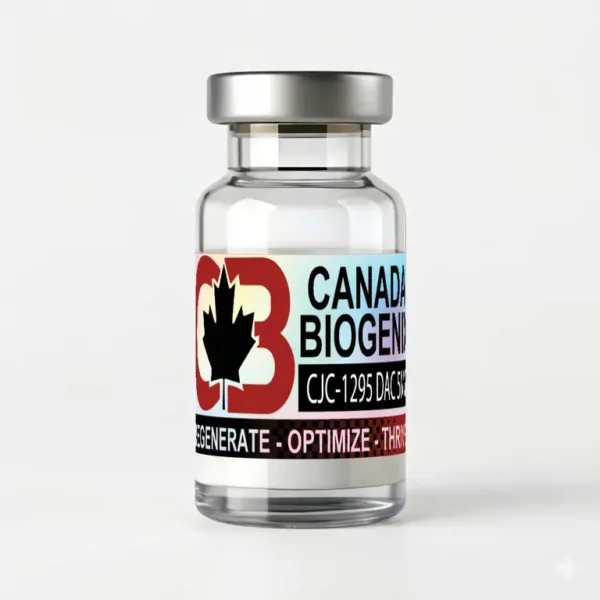
CJC-1295 with DAC is a modified analogue of growth hormone-releasing hormone, commonly abbreviated as GHRH. It was developed to resist rapid breakdown while maintaining activity at the GHRH receptor.
The Drug Affinity Complex allows the peptide to form a covalent bond with circulating albumin. Albumin binding slows clearance and produces a much longer exposure profile than the No-DAC version.
The GHRH portion of CJC-1295 with DAC binds to GHRH receptors on somatotroph cells in the anterior pituitary.
Receptor activation increases intracellular signalling associated with endogenous growth-hormone release. Growth hormone can then influence downstream IGF‑1 production and other GH-responsive pathways.
Meanwhile, the DAC component keeps the peptide associated with albumin. This supports prolonged receptor exposure while still allowing the pituitary to produce measurable GH pulses.
Early controlled studies in healthy adults found clear, dose-dependent changes in growth-hormone and IGF‑1 biomarkers after subcutaneous administration of CJC‑1295 with DAC.
Increase in mean plasma GH concentrations.
Increase in mean plasma IGF‑1 concentrations.
Mean GH concentrations remained elevated.
Mean IGF‑1 concentrations remained elevated.
Following multiple administrations, mean IGF‑1 remained above baseline for as long as 28 days. These results demonstrate strong pharmacodynamic activity, although they do not establish long-term clinical outcomes.
A common assumption is that prolonged exposure must produce completely flat growth-hormone levels. However, human research found that pulsatile GH secretion remained detectable after CJC‑1295 administration.
CJC‑1295 with DAC increased trough and mean GH concentrations while preserving measurable pulses. Therefore, its research profile is better described as sustained elevation with preserved pulsatility, rather than continuous non-pulsatile GH release.
This is the best-supported research area. Human studies demonstrated substantial and sustained biomarker changes after a single administration.
GH and IGF‑1 are connected to protein turnover, lean-tissue maintenance and lipid metabolism. Consequently, CJC‑1295 with DAC has attracted interest in body-composition research.
GH-axis signalling may influence collagen turnover and connective-tissue activity. These biological relationships support interest in recovery research, although direct outcome trials with CJC‑1295 remain limited.
Growth-hormone secretion is closely connected to sleep architecture and declines with age. This makes long-acting GHRH analogues interesting research tools. However, controlled trials have not established that CJC‑1295 improves sleep, energy or age-related symptoms.
| Feature | With DAC | No DAC |
|---|---|---|
| Common name | Long-acting CJC‑1295 | Modified GRF (1‑29) |
| Albumin binding | Yes | No |
| Duration | Multi-day exposure | Short, pulse-oriented exposure |
| Primary research interest | Sustained GH and IGF‑1 signalling | Discrete GH-pulse signalling |
| Human evidence | Early pharmacodynamic studies | Limited direct outcome research |
| Study design advantage | Long observation window | Greater timing precision |
Early human pharmacodynamic studies examined weight-based subcutaneous quantities. The clearest tolerability and biomarker results were reported at 30 and 60 mcg/kg.
These figures describe controlled research conditions. They should not be converted into a consumer protocol or assumed to establish an effective therapeutic dosage.
The 5 mg vial size describes total laboratory quantity and does not represent an individual dose.
The early healthy-adult studies reported no serious adverse reactions and described CJC‑1295 as relatively well tolerated, particularly at the 30 and 60 mcg/kg research levels.
Local injection-site reactions—including temporary discomfort, swelling and firmness—were among the most frequently reported events.
More recently, the FDA has identified reports involving increased heart rate and systemic vasodilatory reactions. Long-term safety, immunogenicity and the effects of prolonged GH-axis stimulation remain insufficiently characterized.
For short-acting, pulse-oriented GHRH research, explore
CJC-1295 10 mg No DAC.
For two-pathway GH-release research, explore the
CJC-1295 + Ipamorelin 10 mg blend.