
Last Updated: August 15, 2026
Whether it’s safe to mix peptides in one vial hinges on chemical compatibility, pH balance, and the specific peptide sequences involved. Not all peptides can be safely combined without risking degradation, cross-contamination, or reduced bioavailability. Canada BioGenix emphasizes that safe mixing depends on three critical factors: whether the peptides are chemically compatible, whether your reconstitution medium supports both compounds, and whether your storage plan maintains stability over time.
You can mix peptides in one vial, but only if you follow specific protocols and verify compatibility first. Mixing without these precautions risks wasting expensive research compounds or introducing unstable solutions into your research workflow.
Peptide degradation accelerates when multiple amino acid chains share the same solvent environment. Each peptide has its own chemical fingerprint: molecular weight, charge distribution, hydrophobicity, and susceptibility to oxidation. When two or more peptides occupy the same vial, they compete for available solvent molecules and can trigger unintended interactions.
The pH of your reconstitution medium becomes critical when mixing peptides. Most peptides are reconstituted in bacteriostatic water with a neutral pH around 5.5 to 7.0. However, different peptides have different optimal pH ranges for stability. A peptide stable at pH 6.0 might degrade rapidly at pH 7.5. When you combine two peptides with different pH preferences, you’re forced to choose a compromise pH that may be suboptimal for one or both compounds.
Molecular weight plays a role as well. Lighter peptides (under 1,000 Daltons) tend to be more soluble and stable in neutral pH solutions, while heavier peptides (over 3,000 Daltons) sometimes require slightly acidic conditions to prevent precipitation. Ion exchange interactions can occur when peptides with opposite charges share the same vial, potentially reducing the effective concentration of each and altering their pharmacokinetics.
Fresh, properly reconstituted peptides should appear as a clear or slightly opalescent solution. Cloudiness, visible particles, or color shifts (yellowing or browning) indicate degradation has begun. Particulate matter suggests precipitation, a sign that pH or osmotic balance has shifted, causing peptides to drop out of solution. Once precipitated, those peptides are no longer bioavailable and may cause injection site reactions if administered.
Mixing peptides in a single vial increases cross-contamination risk if proper sterile technique isn’t maintained. Each needle insertion introduces potential contaminants: bacteria, fungi, or particulates. With two peptides in one vial, contamination affects both compounds simultaneously.
Some peptide combinations can trigger unwanted side reactions. Peptides containing free thiol groups (cysteine residues) can oxidize and form disulfide bonds with other peptides in solution, creating dimers or polymers that behave differently than the original peptides. Adverse reactions at injection sites are more likely with mixed peptide solutions that have degraded or precipitated, as the body’s immune system may recognize aggregated or partially degraded peptides as foreign, triggering localized inflammation.
If you’ve determined that your peptides are compatible, proper reconstitution technique is non-negotiable. The goal is to dissolve both peptides completely, maintain pH stability, and prevent introduction of contaminants.
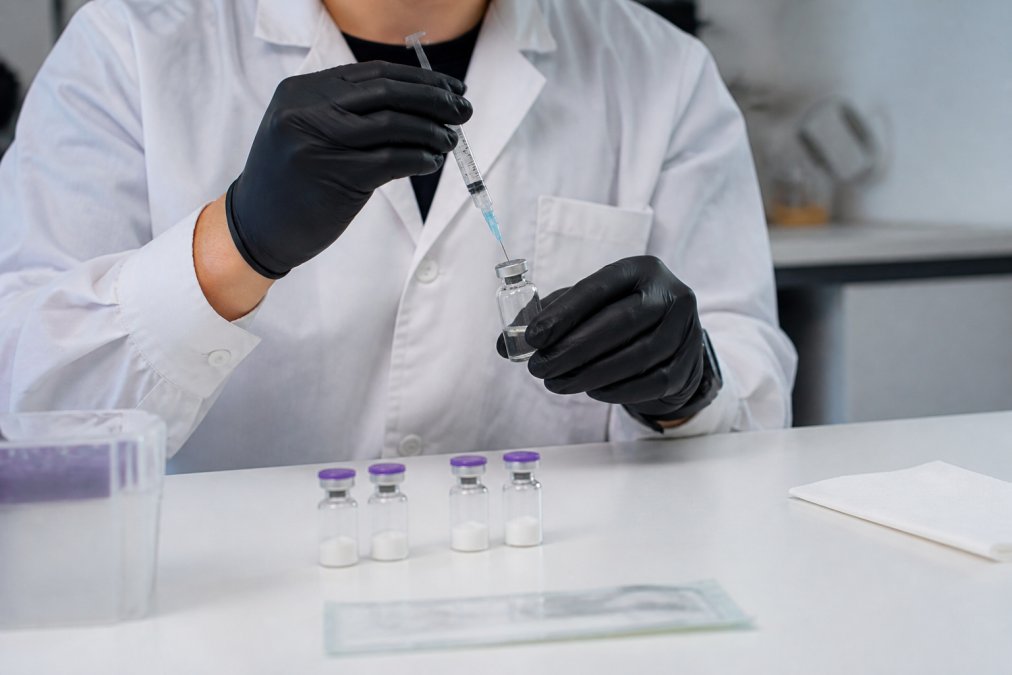
Bacteriostatic water is the standard diluent for peptide reconstitution because it contains benzyl alcohol, a preservative that inhibits bacterial growth without damaging peptide chains. When mixing peptides, always use the same batch of bacteriostatic water for both compounds. Using water from different sources introduces variables in pH and preservative concentrations.
Calculate the total volume needed before you start. If you’re mixing two 5mg peptides and each requires 1mL of bacteriostatic water for a 5mg/mL concentration, you’ll need 2mL total. Add the total calculated volume in one slow, steady pour to ensure uniform mixing.
Use a syringe with graduated markings for accuracy, typically a 3mL or 5mL syringe for most peptide volumes. The needle gauge should be 25G or smaller to minimize tissue trauma during injection. When adding bacteriostatic water to your peptide vial, use a needle to pierce the vial’s rubber stopper at a 45-degree angle to minimize coring, the process where rubber particles contaminate your solution.
For mixed peptide solutions, consider using separate syringes for each peptide before combining them in a single vial. This approach allows you to verify that each peptide dissolves properly and maintains its intended concentration before mixing.
Sanitize your work surface with 70% isopropyl alcohol and allow it to air dry completely. Use sterile gloves and change them between handling different vials. Never reuse needles between vials. Inject the bacteriostatic water slowly into the peptide vial, allowing the peptide to dissolve gradually. Rapid injection creates pressure and can cause foaming, which traps air bubbles that accelerate oxidation. After injecting the water, gently swirl the vial (don’t shake vigorously) to encourage even dissolution. This process typically takes 2-5 minutes per peptide.
Once you’ve successfully mixed your peptides, storage becomes your next critical variable. A well-reconstituted mixed peptide solution can remain stable for weeks or months under the right conditions. Temperature, light exposure, and container integrity all influence viability.
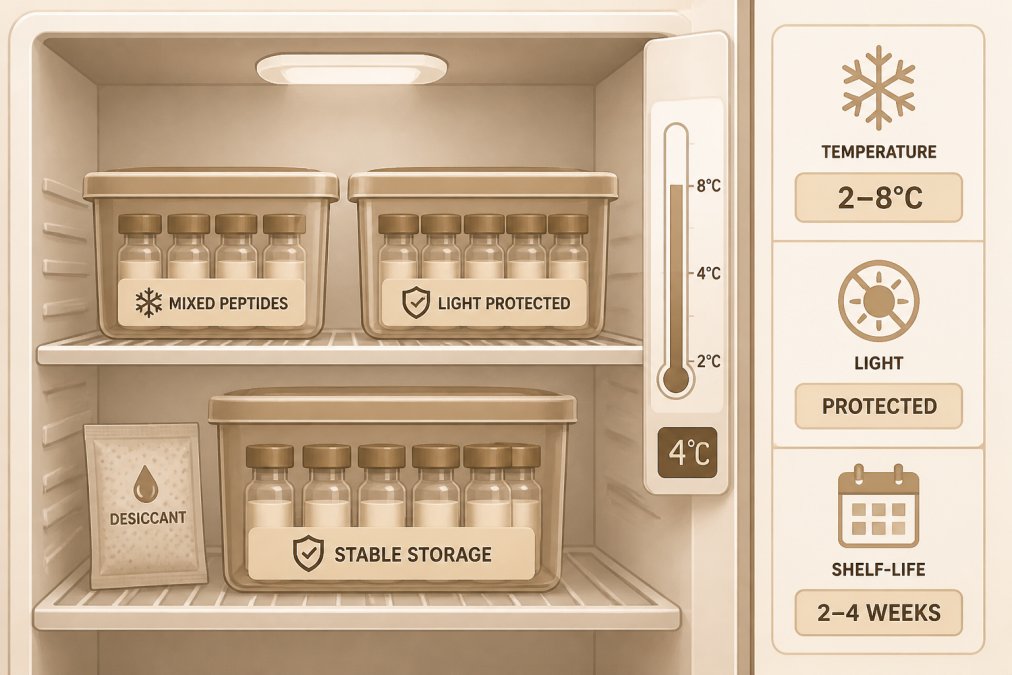
The ideal storage temperature for mixed peptide solutions is 2-8°C, standard refrigerator temperature. At this range, most peptides remain stable for 4-8 weeks, depending on the specific peptide sequence. Freezing mixed peptide solutions (below -20°C) extends shelf-life to 6-12 months, but introduces a new risk: ice crystal formation can damage peptide chains during freeze-thaw cycles. If you freeze your solution, plan to use it without thawing and refreezing.
Vial integrity is critically important. The rubber stopper should remain intact and free of cracks or punctures. After 5-10 needle insertions, the stopper’s seal begins to fail, allowing air and potential contaminants to enter. If you anticipate frequent withdrawals, consider transferring smaller aliquots to separate vials, preserving the integrity of the main batch.
If you plan to use your mixed peptides within 1-2 weeks, standard refrigeration at 2-8°C is sufficient. Store the vial in the back of your refrigerator where temperature fluctuations are minimal, away from the door. Keep the vial in a dark container or wrapped in foil to minimize light exposure.
For longer-term storage (4-12 weeks), freezing at -20°C or below is recommended. Transfer your mixed solution into a freezer-safe vial and label it clearly with the mixing date, peptide names, concentrations, and expiration date. If your mixed peptide solution will sit unused for more than 8 weeks, consider whether mixing was the right choice, as peptides stored separately often maintain stability longer.
Before you commit to mixing peptides in one vial, invest time in compatibility assessment. This step prevents wasted compounds and failed research protocols. Compatibility depends on molecular weight, charge distribution, solubility characteristics, and intended therapeutic targets.
Peptides with similar molecular weights tend to mix more successfully because they have comparable solubility profiles in bacteriostatic water. Mixing a light peptide (under 1,500 Daltons) with another light peptide usually dissolves evenly. Mixing a light peptide with a heavy peptide (over 3,000 Daltons) creates a solution where one peptide may precipitate while the other remains in solution.
Solubility is determined by the peptide’s amino acid composition. Hydrophilic peptides (water-loving, with many polar amino acids) dissolve readily in aqueous solutions. Hydrophobic peptides (water-repelling, with many nonpolar amino acids) are more challenging and may require lower concentrations or slightly different pH conditions. Research the specific amino acid sequences of your peptides. Peptides rich in aspartic acid and glutamic acid prefer neutral to slightly basic pH, while peptides rich in lysine and arginine prefer neutral to slightly acidic pH.
Mixing peptides can affect their bioavailability, the proportion of the administered dose that reaches systemic circulation. When peptides are mixed, they compete for absorption at the injection site. If one peptide has faster absorption kinetics, it may be absorbed preferentially, leaving the slower-absorbing peptide behind, creating a temporal mismatch.
If your research requires precise timing or synchronized action from both peptides, mixing in a single vial may compromise your results. Consider whether separate injections at carefully timed intervals might better serve your research goals.
Peptide stacks, combinations of multiple peptides intended to work synergistically, are increasingly common in fitness and therapeutic contexts. However, stacking introduces medical risks, especially when peptides are mixed in a single solution.
Adverse reactions become more likely with peptide stacks because the body is processing multiple compounds simultaneously. If one peptide triggers an immune response, you can’t easily isolate which compound is responsible. With separate injections, you could identify the culprit and discontinue it.
Injection site reactions are more pronounced with mixed peptide solutions, particularly if degradation or precipitation has occurred. Medical supervision is advisable when using peptide stacks, particularly for therapeutic applications. A healthcare provider can monitor for systemic effects and verify that the mixed solution is performing as intended. Health Canada’s guidelines on biopharmaceuticals apply to peptide use in clinical settings, and following these principles reduces medical risk.
Mixing peptides in one vial is acceptable only when you’ve verified chemical compatibility, chosen an appropriate diluent, maintained strict aseptic technique, and established a realistic storage plan. The decision should be driven by research necessity, not convenience.
The risks, degradation, cross-contamination, reduced bioavailability, and adverse reactions, are real but manageable with proper planning. Before mixing, consult the chemical specifications of your peptides, verify pH compatibility, and confirm that your storage conditions will maintain stability throughout your intended use period.
Canada BioGenix provides premium-quality research peptides with rigorous purity standards and transparent quality documentation. When you’re working with high-quality, verified compounds from a trusted supplier, the mixing process becomes safer and more predictable. Access our product documentation and technical resources to make informed decisions about peptide compatibility and reconstitution protocols that align with your research goals.
Mixing peptides in one vial requires careful attention to chemical compatibility, pH balance, and storage conditions. When done correctly with quality-verified peptides from established Canadian research suppliers and following biopharmaceutical handling guidelines, mixed peptide solutions can remain stable for weeks. However, the risks of degradation and cross-contamination mean that separate storage is often the safer approach. Canada BioGenix supports your research journey with premium-quality compounds and the technical guidance you need to make the right choice for your specific protocols.
Mixing different peptides in one syringe is possible but requires careful consideration of compatibility. Peptides with similar pH ranges, molecular weights, and solubility profiles are more likely to remain stable together. However, some amino acid chains interact unpredictably, potentially causing precipitation or reduced bioavailability. Always verify that the peptides you plan to combine are chemically compatible before mixing them in a single syringe. When in doubt, use separate syringes to eliminate cross-contamination risk and ensure dosage accuracy.
Mixing peptides in one vial can accelerate degradation if the peptides have incompatible pH requirements or if the combined solution creates an unstable environment. Chemical interactions between different amino acid chains may produce precipitate or reduce the shelf-life of the solution. Bacteriostatic water helps slow degradation, but stability depends on proper storage temperature, vial integrity, and the specific peptides involved. Most mixed peptide solutions remain viable for 2-4 weeks when refrigerated, though individual peptide stability after mixing varies significantly.
Combining peptide compounds carries several risks: cross-contamination between different preparations, adverse reactions if peptides interact negatively, reduced therapeutic efficacy if molecular interactions interfere with bioavailability, and increased degradation if pH balance is disrupted. Additionally, combining peptides makes it harder to identify which compound caused an adverse effect if one occurs. Medical risks include unpredictable pharmacokinetics and potential subcutaneous injection site reactions. Always consult clinical guidelines and verify peptide compatibility before stacking compounds.
After reconstitution with bacteriostatic water, store peptides in a refrigerator between 2-8°C to maintain stability and extend shelf-life. Keep vials in a dark environment to protect against light-induced degradation. Ensure vial integrity by checking seals before and after use. Mixed peptide solutions should be used within 2-4 weeks for optimal potency, though individual peptides may have different timelines. Label vials with the reconstitution date and contents. Never freeze reconstituted peptides, as this can damage the molecular structure and reduce bioavailability.
This article was written using GrandRanker