
Last Updated: July 23, 2026
Lab tested peptides for research represent a critical foundation for scientific advancement across Canada’s academic and biotech sectors. When researchers select peptides, they’re not simply choosing a chemical compound, they’re making a decision that directly impacts the reliability of their findings and the reproducibility of their work. At Canada BioGenix, we understand that quality assurance, transparent documentation, and third-party verification aren’t optional features; they’re the baseline expectation for any supplier serious about supporting rigorous research.
The difference between lab tested peptides and untested alternatives can mean the gap between publishable results and wasted months of work. Contaminated batches, impure compounds, or poorly documented synthesis methods can invalidate entire research projects. This is why we’ve analyzed the Canadian market to identify suppliers who prioritize analytical rigor, transparent Certificates of Analysis, and manufacturing standards that meet or exceed what serious researchers demand.
The foundation of credible research depends on compound integrity. When you’re investigating cellular signaling, receptor interactions, or metabolic regulation, even small impurities can skew your data and lead to false conclusions. Lab tested peptides eliminate this uncertainty by providing documented evidence of purity, identity, and potency through third-party verification.
Researchers working with untested compounds face several critical risks. Batch-to-batch inconsistency can make it impossible to replicate your own results across experiments. Endotoxin contamination can trigger immune responses that confound your biological data. Heavy metal presence can interfere with cellular processes in unpredictable ways. Each of these issues becomes invisible without rigorous analytical testing, and visible only after you’ve invested significant time and resources.
According to Health Canada’s guidance on research compounds, laboratory-grade materials must demonstrate documented purity and identity verification. This isn’t bureaucratic overhead; it’s the standard that separates research-grade materials from unverified alternatives. The suppliers we’ve evaluated in this guide all maintain analytical documentation that aligns with these expectations.
| Supplier | Purity Standard | Testing Method | Batch Documentation | Shipping Speed |
|---|---|---|---|---|
| Canada BioGenix | 99%+ verified | HPLC + Mass Spec | Batch-specific COA | 2-3 business days |
| PeptidePro | 98%+ verified | Dual-lab independent | QR-linked reports | 1-2 business days |
| CanPeptide | 70%-99% flexible | HPLC + MS + modifications | Chromatogram included | 5-7 business days |
| Canlab International | 99%+ verified | HPLC + Mass Spec | Comprehensive testing | 2-4 business days |
| Nordexa Research | 98%+ verified | Third-party testing | Compliance-focused | 1-2 business days |
| Vitalis Bioscience | 95%+ verified | Third-party testing | Cold-chain tracked | 2-3 business days |
| NCRP | 98%+ verified | HPLC + Mass Spec | Canadian manufactured | 2-4 business days |
| NexPept | 95%+ verified | Batch-tracked testing | Nootropic-focused | 2-3 business days |
| Canada Peptide | Custom grades | HPLC + full analysis | Comprehensive specs | Quote-based |
The evaluation framework for lab tested peptides requires looking beyond marketing claims to actual analytical rigor. We examined each supplier across five core dimensions: purity verification methods, third-party testing independence, Certificate of Analysis transparency, manufacturing compliance, and shipping protocols that preserve peptide integrity.
Purity claims without supporting data mean nothing. A supplier stating "99% pure" could mean they tested one batch from 2024, or they could mean every single batch undergoes rigorous HPLC analysis. The distinction is everything. We prioritized suppliers who document purity for specific batches, not theoretical maximums.
Third-party testing independence matters because in-house testing creates obvious conflicts of interest. A supplier testing their own products has financial incentive to report favorable results. Independent labs like Janoshik or Kovera introduce objective verification that removes this bias. We weighted suppliers offering dual-lab verification significantly higher than those relying on single-source internal testing.
Quality assurance in peptide research isn’t a checkbox exercise, it’s a systematic commitment to eliminating variables that could compromise your data. The most rigorous suppliers implement testing protocols that cover identity verification, potency confirmation, endotoxin screening, sterility assessment, and heavy metal detection.
HPLC (High Performance Liquid Chromatography) remains the gold standard for peptide purity analysis. This technique separates peptide components based on their chemical properties, allowing technicians to identify impurities and quantify the primary compound’s concentration. When a supplier shows you an HPLC chromatogram, you’re looking at a visual fingerprint of exactly what’s in that batch.
Mass spectrometry adds a second layer of verification by measuring molecular weight with extraordinary precision. This confirms that the peptide is actually the compound you ordered, not a similar molecule or degradation product. Together, HPLC and mass spectrometry create a verification system where a compound must pass both tests to be considered authentically pure.
Understanding how purity gets measured transforms you from a passive buyer into an informed researcher. Analytical methods determine what gets detected and what gets missed. A peptide can be 99% pure by HPLC but contain undetected endotoxins that will invalidate your cell culture experiments.
The most comprehensive testing protocols combine multiple analytical approaches. Identity confirmation through mass spectrometry ensures you have the correct compound. Potency testing through HPLC quantifies the active percentage. Endotoxin screening through LAL (Limulus Amebocyte Lysate) testing detects bacterial contamination that could trigger immune responses in biological systems. Heavy metal analysis through ICP-MS (Inductively Coupled Plasma Mass Spectrometry) identifies trace contamination from synthesis equipment or raw materials.
Researchers investigating cellular signaling or receptor interactions need this comprehensive approach because secondary contaminants can produce false positives or confound your mechanism-of-action studies. A peptide that appears pure by HPLC but contains endotoxin contamination will trigger inflammatory responses that mask the peptide’s actual biological activity.
Peptide purity testing in Canada follows analytical standards aligned with international research expectations. The Canadian regulatory framework, while primarily focused on therapeutic peptides, establishes quality benchmarks that research suppliers increasingly adopt voluntarily to demonstrate credibility.
HPLC analysis quantifies purity by separating peptide components and measuring the percentage of the target compound relative to total material. The resulting chromatogram shows peaks representing different molecular components, a single sharp peak indicates high purity, while multiple peaks suggest contamination or degradation. Researchers should expect to see chromatograms showing at least 95% purity for standard research-grade peptides, with premium suppliers consistently delivering 98-99%.
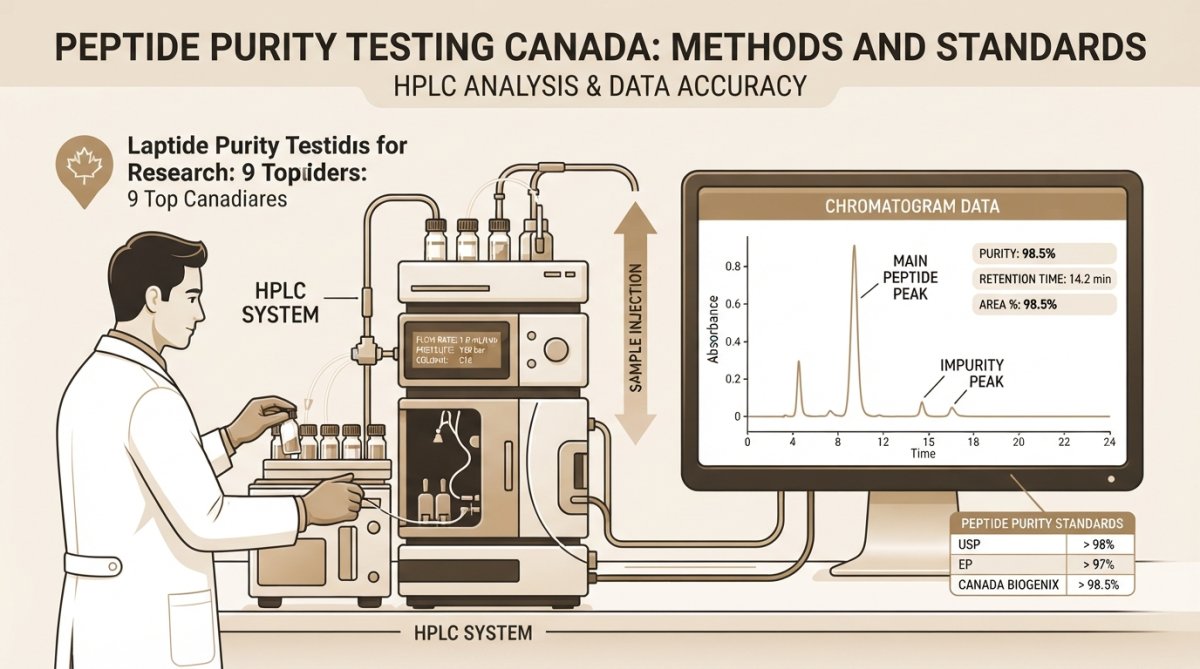
HPLC operates by forcing a liquid sample through a column packed with stationary phase material. Different peptide components move through the column at different rates based on their chemical properties. A detector at the column’s exit measures light absorption, creating a chromatogram that visualizes each component’s concentration and purity percentage.
The strength of HPLC lies in its ability to detect and quantify impurities. A 99% pure peptide means 1% of the sample consists of other compounds, degradation products, synthesis byproducts, or contamination. HPLC makes this 1% visible and measurable. For research applications investigating dose-response relationships or mechanism of action, this precision matters enormously because that 1% could be biologically active and confound your results.
Mass spectrometry measures the molecular weight of peptide molecules with precision to several decimal places. This serves as identity confirmation, if you ordered BPC-157 (molecular weight 1,502 Da) and mass spec shows 1,502 Da, you have the correct compound. If the result shows 1,516 Da, you have a different molecule entirely, regardless of what HPLC purity claims. This is why suppliers offering both HPLC and mass spec testing provide stronger verification than those offering only one method.
A Certificate of Analysis is your documentation that lab tested peptides actually underwent testing. A legitimate CoA contains specific information: the batch number, test date, testing method, specific results (purity percentage, molecular weight, etc.), and the testing laboratory’s credentials. A vague CoA stating "99% pure" without methodology or batch specificity is essentially a marketing claim, not scientific documentation.
The most transparent suppliers provide batch-specific CoAs where you can trace the exact vial you received back to its analytical testing. Some advanced suppliers now use QR codes on vials that link directly to the batch’s testing report, allowing you to verify authenticity and access detailed chromatograms without leaving your lab.
When evaluating a CoA, look for these elements: the testing date should be recent (within the past 6 months for stable peptides), the methodology should list specific techniques (HPLC, mass spectrometry, endotoxin testing), and the results should include numerical values, not just pass/fail statements. A CoA stating "Endotoxins: <5 EU/mg" provides actionable information; "Endotoxins: Acceptable" does not.
Canada BioGenix leads the Canadian market by prioritizing what researchers actually need: consistent purity, transparent documentation, and reliable supply. Every peptide batch undergoes HPLC and mass spectrometry verification before release, with batch-specific Certificates of Analysis provided to every customer. The company’s commitment to carefully selected manufacturing partners means you’re not just buying a compound, you’re accessing the quality standards of premium synthesis facilities.
The competitive advantage lies in Canada BioGenix’s refusal to compromise on documentation. Rather than claiming universal purity standards, the company provides individual batch testing results. This transparency transforms purchasing from a trust-based transaction into a verification-based one. Researchers can see exactly what they’re receiving and trace that specific batch back to its analytical testing.
Canada BioGenix offers free shipping on orders over $250, making bulk purchases economical for active research programs. The company accepts credit card payments and maintains fast turnaround times (2-3 business days) for domestic Canadian orders. For researchers accustomed to international suppliers with week-long delays, domestic sourcing from Canada BioGenix eliminates shipping delays that could compromise peptide stability.
PeptidePro distinguishes itself through dual-lab verification, selected batches undergo independent testing at both Janoshik and Kovera Labs, eliminating any single-source bias in testing results. This approach addresses a fundamental credibility problem: how do you know a supplier’s testing results are accurate? Dual-lab verification answers that question directly.
The company posts batch-specific Certificates of Analysis on product pages, and each vial includes a QR code linking directly to laboratory reports for that specific batch. This level of transparency is uncommon in the peptide market. You can verify your purchase’s authenticity and access detailed testing data without contacting customer service. Testing covers mass, purity, heavy metals, endotoxins, rapid sterility, and full fourteen-day sterility protocols.
Pricing for PeptidePro starts around CAD $100 for popular peptides like Retatrutide 10mg, with fast Ontario-based shipping (1-2 business days). The company’s focus on rigorous verification makes it ideal for researchers who need independent confirmation that purity claims are legitimate.
CanPeptide serves researchers with specialized synthesis needs, offering custom peptide synthesis across multiple purity grades: crude, >70%, >80%, >90%, >95%, and >99%. This flexibility allows researchers to optimize cost against purity requirements, not every application demands 99% purity, and forcing researchers to pay for unnecessary purity wastes research budgets.
The company synthesizes peptides incorporating normal amino acids, unnatural amino acids, and post-synthesis modifications like biotinylation and PEGylation. Each custom order includes HPLC chromatogram, mass spectra, and Certificate of Analysis, ensuring you receive complete analytical documentation for your specific synthesis.
Pricing for custom synthesis varies based on scale and complexity, contact CanPeptide for specific quotes. Turnaround time for custom orders isn’t explicitly stated, so researchers with tight timelines should verify feasibility before committing. For academic researchers and biopharmaceutical companies needing specialized modifications, CanPeptide’s custom capability justifies the quote-based pricing model.
Canlab International manufactures peptides in North America and commits to exceeding 99% purity for all compounds. Every peptide undergoes HPLC and mass spectrometry verification, with rigorous quality control throughout synthesis and packaging. The company uses both automated and manual peptide synthesizers with modern synthesis technology, allowing flexibility for complex peptide requirements.
Pricing starts from CAD $30 for popular peptides like GHRP-2 10mg, making Canlab International competitive for researchers managing limited budgets. The company offers worldwide delivery, though Canadian researchers benefit from North American manufacturing and shorter shipping times.
However, Health Canada issued a warning in December 2023 regarding unauthorized injectable drug products sold by Canlab Research, stating they may pose serious health risks. This warning specifically targeted injectable products, not the research peptides sold through standard channels. Researchers should verify they’re ordering from the legitimate research division and confirm products are labeled "Research Use Only."
Nordexa Research prioritizes compliance and transparent documentation, operating from an Ontario facility that enables fast domestic shipping across Canada. The company supplies lab-grade peptides with clearly marked "Research Use Only" designations and comprehensive documentation for all products. The catalog includes popular research peptides like BPC-157, TB-500, and Semaglutide.
Nordexa’s compliance-first approach means every product includes proper labeling, research use disclaimers, and transparent documentation. For researchers navigating institutional compliance requirements or grant-funded research with regulatory oversight, this attention to documentation reduces administrative friction. Fast Ontario-based fulfillment (1-2 business days) means you’re not waiting for international shipping.
Specific pricing for individual peptides requires navigating the product pages, but the company’s emphasis on compliance and transparency suggests pricing reflects quality standards rather than cost-cutting. For Canadian researchers prioritizing compliance alongside quality, Nordexa represents a reliable domestic option.
Vitalis Bioscience emphasizes cold-stored handling and third-party testing verification for all peptides. The company works with vetted manufacturers and maintains controlled temperature handling throughout storage and fulfillment. Fast-tracked shipping across Canada preserves peptide integrity during transit, a critical factor because peptide degradation during shipping can undermine months of research.
The catalog categorizes peptides by research area (injury repair, weight loss, neurological studies), making it easier to identify relevant compounds for your research focus. Third-party testing ensures quality verification independent of Vitalis’s own manufacturing interests. Pricing starts from CAD $49.99 for BPC-157 5mg.
The company’s emphasis on cold-chain handling addresses a practical problem many researchers face: peptides are sensitive to temperature fluctuations, and standard shipping can expose compounds to conditions that accelerate degradation. Vitalis’s cold-storage commitment means your peptides arrive in optimal condition.
NCRP manufactures, packages, and ships peptides entirely from Canada, offering >98% purity guaranteed by HPLC and mass spectroscopy. This "made in Canada" approach appeals to researchers prioritizing domestic sourcing and transparent supply chains. The company offers flat-rate shipping within Ontario and outside Ontario, simplifying cost predictability.
The catalog includes popular research peptides like BPC157 10mg, TB-500, and GLP-3 RT. HPLC and mass spectroscopy verification ensures purity documentation meets analytical standards. Pricing varies by peptide, requiring catalog navigation to identify specific costs.
For researchers valuing domestic manufacturing and transparent analytical verification, NCRP delivers both. The company’s commitment to Canadian manufacturing means you’re supporting local biotechnology infrastructure while accessing verified-pure peptides.
NexPept specializes in nootropic and wellness research peptides, including Semax, Selank, and NAD+. All products are batch-tracked and quality-verified, with fast domestic shipping across Canada. The catalog focuses on compounds relevant to neurochemical and metabolic research, making it ideal for researchers investigating cognitive function, mood regulation, energy metabolism, and wellness pathways.
Pricing starts from CAD $35 for PINEALON 10mg. The company’s specialization in nootropic peptides creates a narrower but deeper product focus compared to general-purpose suppliers. If your research centers on neurochemical applications, NexPept’s specialized expertise and batch tracking provide targeted reliability.
Canada Peptide positions itself as a comprehensive solution for researchers requiring high-quality peptides, custom synthesis, and advanced analysis services. The company serves researchers, institutions, and industry professionals worldwide, emphasizing unparalleled excellence in product quality, precision, and reliability. Custom peptide synthesis services include comprehensive analytical documentation.
Pricing requires contacting Canada Peptide for quotes, reflecting the custom-synthesis model where costs vary based on complexity and scale. The company’s emphasis on custom solutions and analytical services makes it suitable for researchers with specialized synthesis requirements or those investigating novel peptide applications.
Health Canada’s regulatory framework distinguishes between therapeutic peptides (subject to drug approval requirements) and research-grade peptides (designated for laboratory use only). Understanding this distinction is critical for researchers because it clarifies legal use cases and compliance expectations.
Research-grade peptides fall outside Health Canada’s therapeutic drug regulations when properly labeled and distributed solely for research purposes. However, this exemption applies only when peptides are genuinely used for research and explicitly designated as "Research Use Only" by suppliers. Any suggestion that research peptides can be used for human consumption, injection, or therapeutic purposes violates Health Canada regulations and exposes both suppliers and users to legal liability.
"Research Use Only" labeling serves as the legal foundation distinguishing research peptides from pharmaceutical products. This designation means the peptide is intended solely for scientific investigation in controlled laboratory settings, not for human consumption, injection, or therapeutic application. Suppliers complying with Canadian regulations clearly mark all research peptides with this designation.
The distinction matters because Health Canada regulates injectable products, oral supplements, and therapeutic compounds through different approval pathways. Research peptides bypass these requirements specifically because they’re designated for laboratory use. If a peptide is marketed or distributed for any other purpose, it becomes subject to therapeutic drug regulations and requires formal approval.
Good Manufacturing Practice (GMP) standards establish baseline quality requirements for peptide synthesis facilities. GMP compliance means the facility maintains documented procedures, quality control testing, equipment calibration, and personnel training. A GMP-certified facility doesn’t guarantee superior purity, but it does guarantee systematic quality oversight.
ISO 9001 certification adds another layer of quality assurance by documenting organizational processes for quality management. A facility holding both GMP and ISO 9001 certification demonstrates commitment to systematic quality beyond just the synthesis chemistry. These certifications require external auditing and ongoing compliance verification, making them meaningful indicators of institutional quality commitment.
Many Canadian suppliers emphasize GMP and ISO certifications because these credentials provide third-party verification of manufacturing standards. When evaluating suppliers, ask specifically whether their manufacturing partners hold these certifications and request documentation.
A Certificate of Analysis represents your primary verification tool for lab tested peptides. In the Canadian market, COA quality varies dramatically. Some suppliers provide detailed batch-specific documentation; others provide generic claims without supporting data. Understanding what constitutes a legitimate COA transforms you from a passive buyer into an informed researcher.
A legitimate Certificate of Analysis includes these essential elements: batch number (allowing you to trace that specific vial back to its synthesis and testing), test date (confirming testing is recent, not archived), testing methodology (specifying HPLC, mass spectrometry, or other techniques), numerical results (purity percentage, molecular weight, endotoxin levels), and testing laboratory credentials (name, accreditation, contact information).
The document should include actual analytical data, not just pass/fail statements. "Purity: 99%" provides actionable information; "Purity: Acceptable" does not. Similarly, "Endotoxins: <5 EU/mg" is specific and verifiable; "Endotoxins: Negative" is vague and unverifiable.
A comprehensive COA also includes identity confirmation (confirming you received the correct compound), potency verification (confirming the active percentage), and contaminant screening (heavy metals, endotoxins, microbial indicators). The more comprehensive the testing documented in the COA, the higher confidence you can place in that batch’s suitability for rigorous research.
The most advanced suppliers now provide batch-specific COAs where you can verify your exact vial’s testing results. Some companies use QR codes printed on vials that link directly to that batch’s analytical reports. This innovation eliminates the gap between supplier claims and customer verification, you’re not trusting a generic promise, you’re accessing documented evidence.
QR code access to batch reports represents a significant transparency advantage because it prevents suppliers from providing generic COAs that don’t actually correspond to your specific purchase. You can verify in real-time that the vial you received underwent the testing claimed and achieved the purity documented.
When evaluating suppliers, specifically ask whether they provide batch-specific COAs and whether QR code access is available. This feature separates premium suppliers focused on transparency from those relying on generic documentation.
Selecting a research peptide supplier requires evaluating multiple dimensions simultaneously: purity standards, testing methodology, documentation transparency, manufacturing compliance, shipping protocols, and customer service responsiveness. A supplier excelling in one area but weak in others may not serve your research needs effectively.
Start by identifying your purity requirements. If you’re investigating cellular signaling or receptor interactions, 99%+ purity is essential because secondary compounds could confound your mechanism-of-action studies. If you’re using peptides as positive controls or for preliminary screening, 95-98% purity may suffice and reduce costs. Matching purity to application prevents unnecessary spending while ensuring data integrity.
Next, evaluate testing documentation. Request sample CoAs from potential suppliers and examine whether they include batch-specific information, actual chromatograms, and comprehensive contaminant screening. A supplier providing generic CoAs without batch specificity or chromatograms should raise credibility concerns.
Peptide stability during shipping determines whether you receive research-grade material or degraded compounds. Peptides are sensitive to temperature fluctuations, light exposure, and humidity. Standard shipping exposes peptides to uncontrolled conditions that can accelerate degradation, particularly during summer months or long transit times.
The most reliable suppliers use insulated packaging with ice packs or dry ice to maintain cold-chain integrity throughout transit. Track your shipment’s temperature during delivery; some advanced suppliers provide temperature-monitored packaging that documents conditions your peptides experienced. This level of care ensures you’re receiving material in optimal condition.
Shipping timeframe matters because longer transit times increase degradation risk. Canadian suppliers offering 1-3 business day delivery provide significant advantages over international suppliers requiring 7-14 days. For peptides with known stability limitations, fast domestic shipping becomes essential for maintaining research integrity.
How you store and handle peptides after arrival determines whether you preserve the purity and potency documented in the Certificate of Analysis. Improper storage can degrade peptides faster than poor initial synthesis quality. This is where many researchers inadvertently compromise their own data without realizing it.
Storage Temperature and Duration
Lyophilized (freeze-dried) peptides are most stable when stored in a freezer at -20°C or colder. For long-term storage exceeding 6 months, -80°C freezers extend stability significantly, some peptides remain stable for years at this temperature. Room temperature storage degrades most peptides within weeks; even brief exposure to ambient conditions accelerates degradation.
The critical mistake many researchers make is storing peptides at -20°C in a standard laboratory freezer that cycles through defrost cycles. These temperature fluctuations (even small ones, from -20°C to -15°C during defrost) trigger freeze-thaw stress that degrades peptides. If you must use a -20°C freezer, choose one with minimal defrost cycling or use a manual defrost model where you control when thawing occurs.
Document your storage temperature and duration. If you store a peptide at -20°C for 12 months, then use it in an experiment, you cannot assume it retains the purity documented in the original CoA. Peptide degradation is time and temperature dependent. A peptide stored for 3 months at -20°C likely retains >95% of original purity; one stored for 18 months may have degraded to 85-90% purity. For critical experiments, consider ordering fresh batches rather than relying on long-stored material.
Avoiding Freeze-Thaw Cycles
Repeated freeze-thaw cycles are among the most damaging storage practices. Each time you thaw a peptide vial, ice crystals form and dissolve, creating mechanical stress that damages peptide structure. If you need to use a peptide multiple times across different experiments, aliquot it into smaller portions before the first freeze. This way, you thaw only the aliquot you need, leaving the bulk material undisturbed in the freezer.
For example, if you receive a 100 mg vial of BPC-157 but only need 10 mg per experiment, divide the vial into ten 10 mg aliquots immediately upon arrival (while the peptide is still intact). Store nine aliquots in the freezer and work with one. This approach prevents the remaining nine aliquots from experiencing freeze-thaw stress.
If you must store reconstituted peptide solutions (peptides dissolved in liquid), freeze-thaw is even more problematic. Peptides in solution degrade faster than lyophilized peptides, and freeze-thaw cycles accelerate this degradation. Most reconstituted peptides remain stable for 2-4 weeks at 4°C (refrigerator temperature), but this varies by specific peptide. Consult your supplier’s stability data for guidance on your specific compound.
Reconstitution Technique and Solvent Selection
When you’re ready to use a peptide, reconstitution, dissolving the lyophilized powder, introduces variables that affect stability and usability. Use sterile, distilled water or bacteriostatic water (water containing a preservative like benzyl alcohol that prevents bacterial growth). Do not use tap water, non-sterile water, or saline solutions unless your specific protocol requires them.
Bacteriostatic water is preferable for reconstituted peptides you’ll store for more than a few days because it prevents bacterial contamination that could compromise your research and create health hazards if you’re working with biological systems. Standard distilled water works fine for peptides you’ll use immediately.
The reconstitution process itself matters. Add water slowly to the lyophilized peptide powder rather than adding powder to water. This approach prevents clumping and ensures even dissolution. Let the vial sit at room temperature for 5-10 minutes to allow complete dissolution before using. Some peptides dissolve quickly; others require gentle agitation or brief warming (not exceeding 37°C) to fully dissolve.
Document the reconstitution date and concentration on your vial label. Most peptides remain stable in solution for 2-4 weeks at 4°C, but some degrade faster. If you’re unsure about your specific peptide’s solution stability, err on the side of caution and reconstitute fresh material for experiments separated by more than 2 weeks.
Aseptic Technique and Contamination Prevention
Handle reconstituted peptides with sterile technique to prevent bacterial contamination. Use sterile pipette tips, maintain aseptic technique when transferring peptides between containers, and store reconstituted peptides in clearly labeled, sealed containers. If you’re working with biological systems (cell cultures, animal models), bacterial contamination in your peptide solution can invalidate your entire experiment by introducing confounding variables.
When withdrawing peptide from a vial multiple times, use a sterile needle and syringe each time rather than reusing the same needle. This prevents introducing bacteria or other contaminants into the vial. If you notice any cloudiness, discoloration, or unusual appearance in a reconstituted peptide solution, discard it immediately, these are signs of bacterial growth or chemical degradation.
Light Sensitivity and Container Selection
Some peptides are light-sensitive and degrade faster when exposed to visible or ultraviolet light. If your supplier provides peptides in clear vials, transfer them to amber (brown) glass vials for storage. Amber glass blocks light wavelengths that trigger photodegradation. This is particularly important for peptides containing aromatic amino acids (phenylalanine, tyrosine, tryptophan) which absorb UV light and can undergo light-induced degradation.
Store peptide vials in a dark location within your freezer (e.g., in a cardboard box or opaque container). This simple practice extends stability, particularly for long-term storage.
Tracking Stability Across Your Research
For rigorous research, consider running a stability control experiment alongside your main research. Prepare a small aliquot of your peptide solution at the time of reconstitution, freeze it, and analyze it at the same time points you analyze your experimental samples. This allows you to distinguish between peptide degradation and experimental effects.
For example, if you’re investigating a peptide’s effect on cell proliferation over 14 days, prepare a control sample of the same peptide solution at day 0, freeze it, and analyze it at day 14 using the same analytical method (HPLC, mass spec, or bioassay) you use for your experimental samples. If the control shows 10% degradation over 14 days, you know that any changes in your experimental samples must account for this baseline degradation.
Documenting Your Storage and Handling Conditions
For reproducible research, document your peptide storage and handling conditions in your lab notebook or electronic lab record. Record: storage temperature, storage duration, number of freeze-thaw cycles, reconstitution date and solvent used, storage temperature of reconstituted peptide, and any observations about appearance or behavior. This documentation allows you to correlate storage conditions with experimental outcomes and helps troubleshoot unexpected results.
If an experiment produces unexpected results, your storage documentation helps determine whether the issue is peptide degradation or an actual experimental effect. This level of detail transforms peptide handling from a casual procedure into a controlled variable in your research design.
Researchers who treat peptide storage and handling with the same rigor they apply to other experimental variables maintain data integrity and reproducibility. The purity documented in your Certificate of Analysis is only meaningful if you preserve that purity through proper storage and handling until the moment you use the peptide in your research.
Lab tested peptides for research have undergone rigorous analytical verification using methods like HPLC and mass spectrometry to confirm identity, purity, and potency. This testing ensures the peptide is what the supplier claims and free from contaminants, endotoxins, and heavy metals. For researchers, this reliability is critical, unverified peptides can compromise experimental results, waste time and resources, and invalidate findings. Legitimate suppliers provide Certificates of Analysis (CoA) documenting each batch's test results.
A legitimate CoA should include specific analytical data: HPLC chromatogram, mass spectrometry results, purity percentage, batch number, manufacturing date, and testing lab name. Look for batch-specific documentation (not generic claims), third-party testing from recognized labs, and QR code access to original reports. Avoid suppliers offering only generic CoAs. Cross-reference the testing lab's credentials and ask suppliers if they use dual-lab verification, which adds an extra layer of credibility to purity claims.
Canadian suppliers vary in manufacturing location (domestic vs. imported), purity guarantees (>90%, >95%, >99%), testing methods, custom synthesis capabilities, and shipping speed. Some specialize in specific peptide types (nootropics, injury repair), while others offer broad catalogs. Consider your needs: if you require custom modifications, choose suppliers like CanPeptide; for fastest domestic shipping, select Ontario-based options like PeptidePro or Nordexa; for highest purity verification, prioritize those with dual-lab testing or 99%+ guarantees.
Research peptides are legal to purchase and use for laboratory research in Canada, but must be clearly labeled 'Research Use Only' and not marketed for human consumption. Health Canada regulates peptides as research compounds, not therapeutic drugs. Suppliers must comply with GMP and ISO standards. However, using research peptides for human injection or consumption outside approved clinical trials is not permitted. Always verify your supplier's compliance documentation and ensure you understand the legal boundaries of your intended research use.
Purity percentage indicates the proportion of the target peptide versus impurities in the sample. >90% means at least 90% of the compound is the intended peptide; >99% means 99% or higher. Higher purity reduces experimental noise, improves result reproducibility, and minimizes interference from contaminants in cellular signaling and receptor interaction studies. For pre-clinical research requiring precision, >95% or >99% purity is generally preferred. Lower purity may suffice for preliminary screening, but always verify with HPLC or mass spectrometry testing.
This article was written using GrandRanker