
Last Updated: July 12, 2026
A certificate of analysis (COA) is a detailed laboratory document that certifies the identity, purity, and composition of a peptide sample. It contains specific analytical results from third-party laboratory testing, including HPLC data, mass spectrometry findings, and measurements of contaminants or impurities. The document typically lists the peptide sequence, molecular weight, batch number, manufacturing date, and expiration information. Without a COA, you’re purchasing a compound blindly, trusting the supplier’s word rather than verifiable evidence.
Research teams depend on COAs to validate that their experimental materials meet exact specifications required for reproducible results. A documented purity of 98.5% provides quantifiable assurance that experiments will yield consistent data. A contaminated peptide batch discovered mid-experiment forces you to restart work, delay publications, and question earlier results. A well-documented COA with clear analytical data allows you to troubleshoot confidently, knowing the compound itself isn’t the source of unexpected findings.
A certificate of analysis provides the traceability and documentation necessary to establish that a peptide batch is free from dangerous contaminants like endotoxins, heavy metals, and microbial impurities. This is particularly critical for research involving animal models or human subjects, where contamination could cause serious adverse effects.
The integrity of a peptide batch is verified through multiple analytical testing methods documented in the COA. Each test confirms that the manufacturing process met established standards. A comprehensive COA also serves as legal protection, if research outcomes are questioned, the COA provides documented proof that the starting material met specifications. Regulatory bodies and institutional review boards often require COAs as part of the research record.
High-Performance Liquid Chromatography (HPLC) and Mass Spectrometry (MS) answer different questions about your peptide. HPLC measures purity by separating compounds based on their chemical properties, while Mass Spectrometry confirms the exact molecular weight and identity of the peptide.
HPLC results appear as a chromatogram, a graph showing peaks that represent different compounds in your sample. The largest peak represents your target peptide, while smaller peaks indicate impurities or degradation products. The COA typically reports the area under the curve (AUC) percentage for the main peak, which directly translates to purity percentage.
A typical HPLC report includes the retention time, the point during analysis when your peptide elutes from the column. The retention time is specific to each peptide and serves as preliminary identity confirmation. If you order the same peptide repeatedly, the retention time should remain consistent across batches. A significant shift signals potential contamination or incorrect synthesis.
Look for chromatograms with sharp, well-defined peaks and flat baselines, which indicate reliable data. Jagged baselines or elevated noise suggest instrument problems or sample degradation.
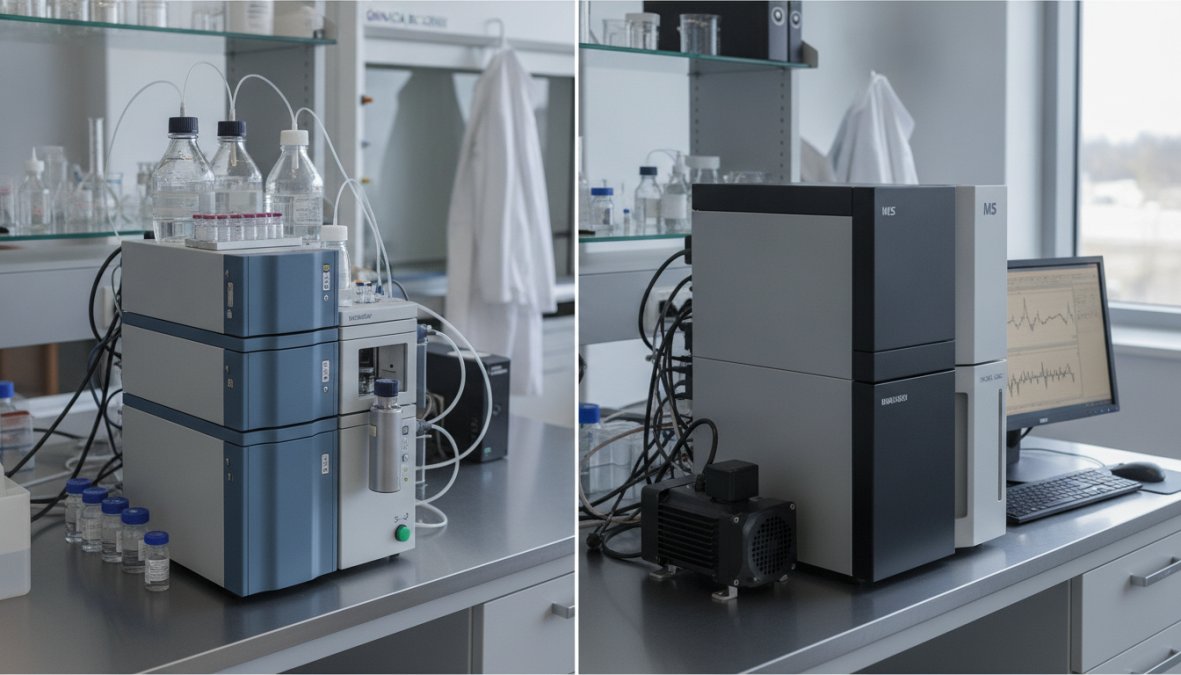
Mass Spectrometry provides definitive confirmation that you received the correct peptide by measuring its exact molecular weight. Every peptide has a specific molecular weight based on its amino acid sequence, and MS data proves that the compound matches this theoretical value.
MS results are reported as a mass-to-charge (m/z) ratio, which corresponds to the molecular weight when the charge state is known. A quality COA will show the observed molecular weight and compare it to the theoretical molecular weight. If these values match within acceptable tolerance (typically within 0.1%), you have strong evidence that the correct peptide was synthesized.
Some COAs include additional MS data such as isotope patterns or fragmentation data, which provide extra confirmation of identity and can reveal unexpected chemical modifications.
Not all COAs are equally reliable. Fraudulent or altered certificates circulate in the research compound market. The most effective approach combines checking lab credentials, verifying batch traceability, and validating the technical content of the report itself.
A legitimate testing laboratory should display ISO 17025 accreditation or equivalent certification. ISO 17025 is the international standard for laboratory competence and ensures rigorous quality control, regular instrument calibration, and established standard operating procedures. Check the COA for the lab’s accreditation number and verify it through the appropriate regulatory body in their country.
The laboratory’s contact information should be complete and verifiable. A genuine lab includes a physical address, phone number, and email contact. Cross-check this information independently by calling the lab directly and confirming that they issued the COA for your specific batch. This simple step catches many fraudulent documents.
Every peptide batch should have a unique batch number that appears on both the COA and the product vial. This batch number creates traceability, the ability to link your specific product back to the manufacturing run and testing records. When you receive a peptide, verify that the batch number on the vial matches the batch number on the COA.
Some suppliers maintain online batch verification systems. Enter your batch number into their database and confirm that the COA matches their records. Request the manufacturing date and expiration date from the COA. Lyophilized peptides stored properly typically remain stable for 2-3 years. If the COA lists a manufacturing date older than 3 years, inquire about storage conditions and whether the peptide has been re-tested for stability.
Peptides rarely achieve 100% purity. Common impurities include unreacted starting materials, truncated peptides, oxidized forms, and acetate salts from the synthesis process. Acetate content deserves special attention because it directly affects the peptide’s molecular weight and behavior in experiments. A COA should explicitly state the acetate content percentage.
Endotoxin levels matter significantly for research involving cells or animals. Endotoxins are bacterial byproducts that trigger immune responses and confound experimental results. A quality COA reports endotoxin levels in endotoxin units per milligram (EU/mg). For cell culture or in vivo work, endotoxin levels should be below 1 EU/mg.
Fraudulent COAs often contain subtle inconsistencies that reveal their illegitimacy. Look for spelling errors, inconsistent formatting, or data that doesn’t align logically. If a COA lists 98% purity but shows a chromatogram with multiple large peaks of similar size, the numbers don’t match the visual data.
Compare the chromatogram quality across multiple COAs from the same supplier. Legitimate labs maintain consistent image quality and formatting. Verify the theoretical molecular weight calculation independently using an online peptide calculator. If the COA’s reported molecular weight deviates significantly from this calculation, question the data.
Purity and identity are distinct concepts that a COA addresses separately. Purity measures how much of your sample is the desired peptide versus contaminants. Identity confirms that the compound present is actually the peptide you ordered, regardless of how pure it is. A peptide can be 99% pure but still be the wrong peptide entirely if identity wasn’t verified.
HPLC primarily addresses purity by showing the percentage of the sample that consists of your target compound. Mass Spectrometry primarily addresses identity by confirming that the main compound matches the theoretical weight of your intended peptide.
A comprehensive COA includes both HPLC for purity assessment and MS for identity confirmation. If a COA provides only one type of data, request the missing analysis before using the peptide. When troubleshooting experimental failures, knowing whether the problem is impurity or identity directs your investigation quickly.
Research institutions and regulatory bodies increasingly require COAs as part of standard operating procedures. The FDA, EMA, and other regulatory agencies expect researchers to document the quality of starting materials used in studies, especially those involving human subjects or marketed products.
Institutional review boards (IRBs) and animal care committees often request COAs before approving research protocols. They use these documents to assess whether materials meet safety and quality standards appropriate for the planned research. Without a COA, your protocol review may be delayed or rejected.
A COA provides evidence that the starting material met specifications, protecting both the researcher and the institution from liability claims. Research published in peer-reviewed journals increasingly requires authors to disclose the source and quality documentation of materials used. Without this documentation, your manuscript may face rejection during peer review.
Understanding peptide certificate of analysis is the foundation of reliable research. A comprehensive COA provides the analytical evidence you need to trust your materials and produce reproducible results. When selecting a peptide supplier, prioritize those who provide detailed, verified certificates of analysis from accredited laboratories. Canada BioGenix delivers premium-quality research peptides with transparent, complete COAs that meet institutional and regulatory standards.
A peptide certificate of analysis (COA) is a detailed lab report documenting the identity, purity, and quality of a research peptide. It includes results from analytical testing methods like HPLC and mass spectrometry, batch numbers, and manufacturing dates. You need one to verify that your peptide meets expected standards, confirm compound identity, and ensure the product is free from harmful contaminants before using it in research.
Verify authenticity by checking the third-party laboratory's ISO certification and credentials, confirming the lab's contact information is legitimate, cross-referencing the batch number with the supplier's records, and looking for standard operating procedure (SOP) references. Authentic reports include detailed analytical data like retention time values, molecular weight confirmation, and impurity profiles. Be suspicious of vague reports lacking technical specifics or those from unverifiable labs.
HPLC (High-Performance Liquid Chromatography) measures purity percentage by separating peptide components and quantifying each. It shows the retention time and relative abundance of the main compound versus impurities. Mass spectrometry (MS) confirms compound identity by measuring the exact molecular weight and peptide sequence. Together, they provide both quantitative analysis (purity) and qualitative analysis (what the compound actually is), ensuring the peptide matches specifications.
Common impurities include endotoxins, heavy metals, solvent residues, acetate content variations, and synthesis byproducts. The impurity profile section of your COA should list these with concentration levels. For lyophilized powder peptides, check for moisture content and vial integrity notes. A reputable third-party laboratory will quantify all significant impurities and compare them against acceptable limits, helping you assess whether the peptide is suitable for your research application.
This article was written using GrandRanker