
Last Updated: July 25, 2026
When comparing peptide manufacturing quality standards across Canadian suppliers, the difference between a 90% pure peptide and a 95% pure one can determine whether your research succeeds or fails. This guide from Canada BioGenix covers the critical distinctions in how manufacturers approach quality control, regulatory compliance, and analytical verification. The stakes are high: degraded peptides waste time and money, while substandard purity masks real results.
Quality standards in peptide manufacturing define what "acceptable" means, and acceptable varies dramatically depending on whether you’re ordering research-grade compounds or pharmaceutical-grade APIs. Two suppliers claiming 95% purity might have arrived at that number through completely different analytical approaches.
A manufacturer’s willingness to explain their testing methodology, share raw analytical data, and stand behind their claims is often more telling than the purity percentage alone. The cost-quality relationship isn’t linear: moving from 90% to 95% purity typically costs 15-25% more, while moving from 95% to 99% can double the price. The question isn’t always "what’s the highest purity I can afford," but rather "what purity level do I actually need for my application?"
The quality of your peptide directly affects the validity of your research results. A degraded or impure peptide introduces confounding variables that you can’t control for. Health Canada doesn’t regulate research-grade peptides the way it regulates pharmaceutical APIs, creating a gap where manufacturer standards vary widely. Some follow GMP principles voluntarily; others follow minimal quality controls.
Stability during shipping and storage compounds the purity issue. A peptide might leave the manufacturer at 95% purity but arrive at your lab at 92% after weeks in transit. Manufacturers that use proper packaging, temperature monitoring, and accelerated stability data help you understand what to expect.
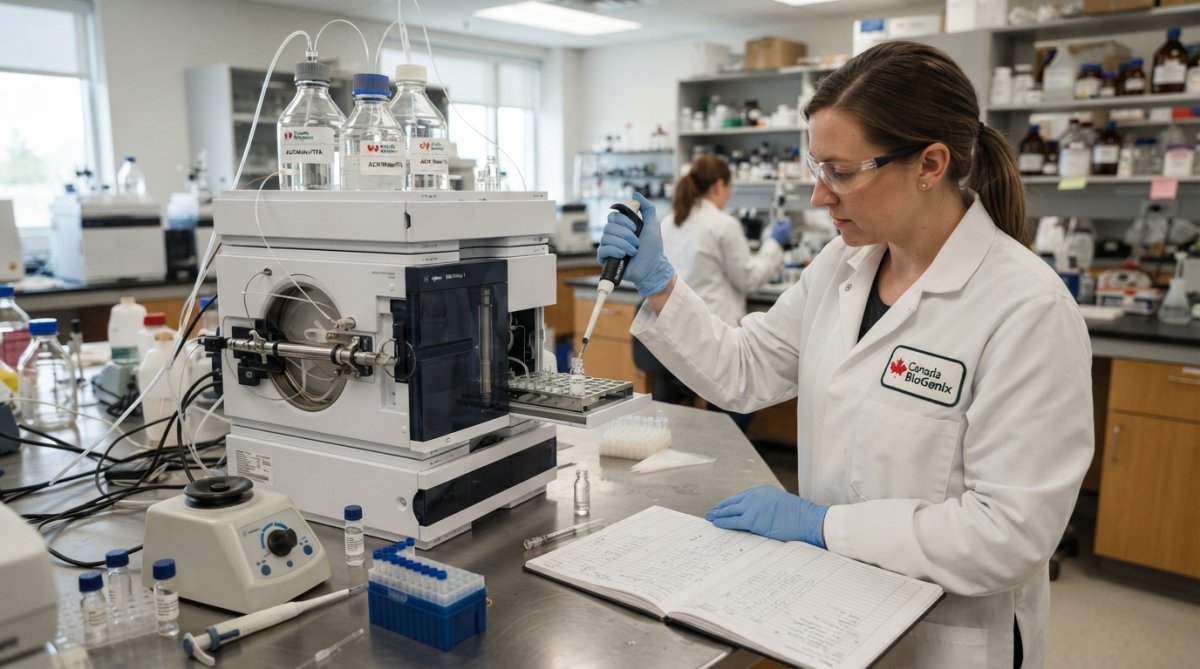
Higher purity costs more because purification is labor-intensive and requires more sophisticated equipment. A manufacturer achieving 90% purity might use a single HPLC purification step, while reaching 95% requires two steps plus additional verification, and 99% requires multiple steps and stricter quality gates.
The cost difference also reflects analytical testing (99% purity requires impurity profiling), documentation (batch records and stability data), equipment validation (annual instrument validation), and batch consistency (tighter process controls). What you’re paying for with a premium peptide supplier is reproducibility: a 99% pure peptide from a reliable manufacturer will behave consistently from batch to batch.
GMP (Good Manufacturing Practice) compliance in Canada is governed by Health Canada’s Pharmaceutical Drugs Directorate (formerly the Therapeutic Products Directorate) and Biologic and Radiopharmaceutical Drugs Directorate (BRDD). These regulations apply strictly to pharmaceutical manufacturers but are voluntary for research-grade suppliers. GMP-compliant facilities must follow detailed standard operating procedures for every manufacturing step, validate equipment, document processes, and maintain batch records for years.
Many high-quality research suppliers maintain GMP-level quality without formal certification. The key is asking whether they follow specific GMP elements relevant to your needs. Health Canada’s regulatory requirements depend on intended use: a peptide for human clinical use requires full pharmaceutical approval, while a research peptide doesn’t. However, if research peptides later become part of a clinical candidate, all manufacturing must be documented and compliant, making traceability essential.
Health Canada requires peptide manufacturers to meet specific CMC (Chemistry, Manufacturing, and Controls) standards when submitting drug applications. These standards define drug substance characterization (identity, purity, potency, stability), manufacturing process description, analytical method validation, stability data, reference standards, and batch records.
For research-grade peptides, manufacturers don’t need to submit this data to Health Canada. However, suppliers who maintain CMC-level documentation even for research products demonstrate a commitment to quality beyond regulatory minimum. When evaluating manufacturers, ask whether they maintain this level of documentation.
Purity testing relies on two primary analytical techniques: HPLC (High-Performance Liquid Chromatography) and mass spectrometry (MS). HPLC separates peptide molecules by size and charge, measuring what fraction is the target peptide versus impurities. Mass spectrometry measures exact molecular weight and confirms the target peptide has the correct mass while identifying impurities.
The best manufacturers use both methods together. HPLC tells you the purity percentage; mass spectrometry tells you what the impurities actually are. Interpreting purity claims requires knowing the testing method used, since HPLC purity can vary based on mobile phase, column, and detection wavelength.
The practical difference between purity tiers depends entirely on your application. 90% purity is appropriate for structural studies and preliminary screening. 95% purity is standard for binding assays, dose-response studies, and most academic research. 99% purity is necessary for potency assays, regulatory submissions, and sensitive bioassays.
The gap between 90% and 95% is often clinically meaningful, removing the most abundant impurities like truncated or misfolded peptides. The gap between 95% and 99% usually removes trace impurities that matter only in highly sensitive applications.
| Purity Level | Testing Method | Typical Cost Premium | Best For |
|---|---|---|---|
| 90% | HPLC (single wavelength) | Baseline | Preliminary screening, structural studies |
| 95% | HPLC (multiple wavelengths) | +20-25% | Binding assays, dose-response, academic research |
| 99% | HPLC + MS/MS | +50-100% | Potency assays, regulatory submissions, sensitive bioassays |
A Certificate of Analysis (CoA) is your proof that a peptide meets claimed quality standards. A legitimate CoA should contain batch number and analysis date, HPLC chromatogram, molecular weight confirmation, impurity profile, test methods, analyst signature, and reference standards used.
Many suppliers provide CoAs listing only the purity percentage with no supporting data, a red flag. Third-party verification adds credibility; some manufacturers have peptides tested by independent analytical labs like [ResolveMass Laboratories Inc., a Canadian CRO offering peptide characterization services | resolvemass.ca] or [ARSI Canada, providing analytical services including peptide testing | arsicanada.com].
When evaluating a peptide supplier, use this checklist:
Certain patterns should trigger skepticism: generic CoAs with no batch specificity, purity claims without supporting data, no expiration date or stability information, missing reference standard information, inconsistent purity across batches with no explanation, and no contact information for questions.
Research-grade peptides are sold for laboratory use with no claims about human safety or efficacy. Health Canada doesn’t regulate their manufacture, and there’s no legal requirement for GMP compliance, stability testing, or batch documentation. Pharmaceutical-grade peptides are manufactured for human use and must meet GMP standards, undergo stability testing, and be documented in detail.
If your research might eventually lead to clinical development, start with pharmaceutical-grade peptides from the beginning. Switching later creates documentation gaps that regulators will question.
Canadian peptide manufacturers operate under Health Canada’s framework, which aligns closely with international standards like those from the International Council for Harmonisation of Technical Requirements for Pharmaceuticals for Human Use (ICH). Health Canada’s CMC guidance emphasizes complete characterization, process validation, stability commitment, and traceability. These requirements make Canadian manufacturers well-positioned to supply peptides for both Canadian and US research.
When comparing Canadian manufacturers to international suppliers, consider regulatory oversight, documentation standards, stability data relevant to Canadian conditions, and supply chain transparency. Canadian suppliers have the advantage of regulatory alignment and government oversight.
Incomplete synthesis produces truncated peptides (missing final amino acids) or branched peptides. Oxidation and degradation affects peptides containing methionine or cysteine residues. Aggregation occurs when peptides stick together, forming dimers or larger structures. Contamination with salts and solvents affects peptide solubility and activity.
Common signs of peptide degradation include discoloration (oxidation), precipitation or cloudiness (aggregation), odor changes, loss of activity, and new peaks on HPLC. Manufacturers provide stability data showing how peptides degrade under specified conditions. Temperature control during shipping is critical; reliable manufacturers use insulated packaging with temperature monitoring.
Batch-to-batch consistency is a hallmark of quality manufacturing. A reliable manufacturer maintains raw material records, manufacturing logs, testing records, and deviation reports. When evaluating a manufacturer, ask: "Can you provide complete traceability for a specific batch?" If they hesitate, their quality system is weak.
When evaluating manufacturers, assess: analytical capability (HPLC, MS, impurity identification), documentation standards (batch-specific CoAs with chromatograms), regulatory alignment (GMP principles, certification), stability data, batch consistency, shipping and storage practices, and technical support availability.
Purity measures what fraction is the target peptide versus impurities. Potency measures whether the peptide is actually active, determined through bioassays or binding assays. Identity confirms you received the correct peptide, verified through mass spectrometry. Sterility applies to peptides for injection or cell culture.
For most research applications, purity and potency are critical. For clinical development or injectable applications, identity and sterility become equally important.
Canada BioGenix has helped Canadian researchers navigate these decisions by carefully selecting manufacturing partners who meet rigorous quality standards. Our approach ensures every peptide comes with complete analytical documentation, batch-specific traceability, and technical support from experienced chemists.
Comparing peptide manufacturing quality standards requires understanding the analytical methods, regulatory frameworks, and documentation practices that distinguish reliable manufacturers from those cutting corners. By using the evaluation framework and checklists in this guide, you can identify manufacturers whose standards align with your research needs.
When you’re ready to source peptides with confidence, Canada BioGenix provides premium-quality research peptides with complete analytical documentation and batch-specific traceability. We’ve built relationships with manufacturing partners who maintain GMP-level quality standards even for research-grade products, ensuring that every batch meets our strict purity and consistency requirements.
Canadian peptide manufacturers must adhere to GMP principles, Health Canada regulatory guidelines, and ICH standards for analytical characterization. Key standards include purity profiling via HPLC, identity verification through mass spectrometry, sterility and endotoxin testing, stability studies, and comprehensive batch documentation. Reputable manufacturers provide detailed Certificates of Analysis (CoA) with validated methods, impurity profiles, and traceability data. The specific requirements depend on whether peptides are research-grade or pharmaceutical-grade, with pharmaceutical-grade peptides requiring stricter compliance and more rigorous quality control systems.
Peptide purity testing in Canada generally aligns with Health Canada and ICH guidelines, which closely mirror international standards but may have specific documentation and traceability requirements for Health Canada submissions. Canadian testing typically uses HPLC for purity determination and mass spectrometry for identity confirmation. The main difference is regulatory focus: Canadian manufacturers emphasize compliance with Health Canada's CMC (Chemistry, Manufacturing, and Controls) requirements. Testing protocols, validation methods, and reporting formats must meet Health Canada's expectations for regulatory submissions, though the analytical techniques themselves (HPLC, MS, NMR) are internationally standardized.
A legitimate Certificate of Analysis should include: (1) batch-specific identification and manufacturing date, (2) HPLC chromatogram showing purity percentage with impurity profile, (3) mass spectrometry data confirming molecular weight and identity, (4) sterility and endotoxin test results (if applicable), (5) moisture content and counter-ion analysis, (6) stability data or shelf-life recommendations, (7) validated analytical methods with reference standards used, and (8) signature and accreditation information from the testing laboratory. Red flags include missing chromatograms, vague purity claims without supporting data, no reference to analytical methods, or unsigned/undated documentation. Third-party testing from accredited labs (like ResolveMass or ARSI Canada) adds credibility beyond manufacturer-generated certificates.
Purity claims vary based on synthesis methods, purification techniques, and testing standards used. Some manufacturers may report HPLC purity at 214 nm (which can overestimate), while others use mass spectrometry or multiple wavelengths for accuracy. To verify claims: (1) request the actual HPLC chromatogram and method details, (2) check if testing was performed by an independent third-party laboratory, (3) compare impurity profiles, higher purity often means lower impurity peaks, (4) ask about reference standards used (USP or custom), and (5) request batch-specific data rather than general specifications. Be cautious of claims like '99% purity' without supporting analytical data. Canada BioGenix and similar reputable suppliers provide detailed, batch-specific CoAs with complete analytical documentation to support their quality claims.
Reputable Canadian peptide suppliers like Canada BioGenix should have clear quality guarantees and return policies. Upon receipt, verify the batch number matches your order and the CoA. If analytical results show purity below stated specifications, potency issues, or stability problems: (1) document the issue with photos and test results if you have access to analytical equipment, (2) contact the supplier immediately with batch number and CoA reference, (3) request a replacement batch or refund depending on the supplier's policy, (4) ask for root cause analysis from the manufacturer, and (5) request independent third-party testing if disputes arise. Transparent suppliers will typically offer replacement or credit; if they refuse, this signals quality control issues. Always confirm return policies and testing verification procedures before purchasing, especially for larger orders.
This article was written using GrandRanker