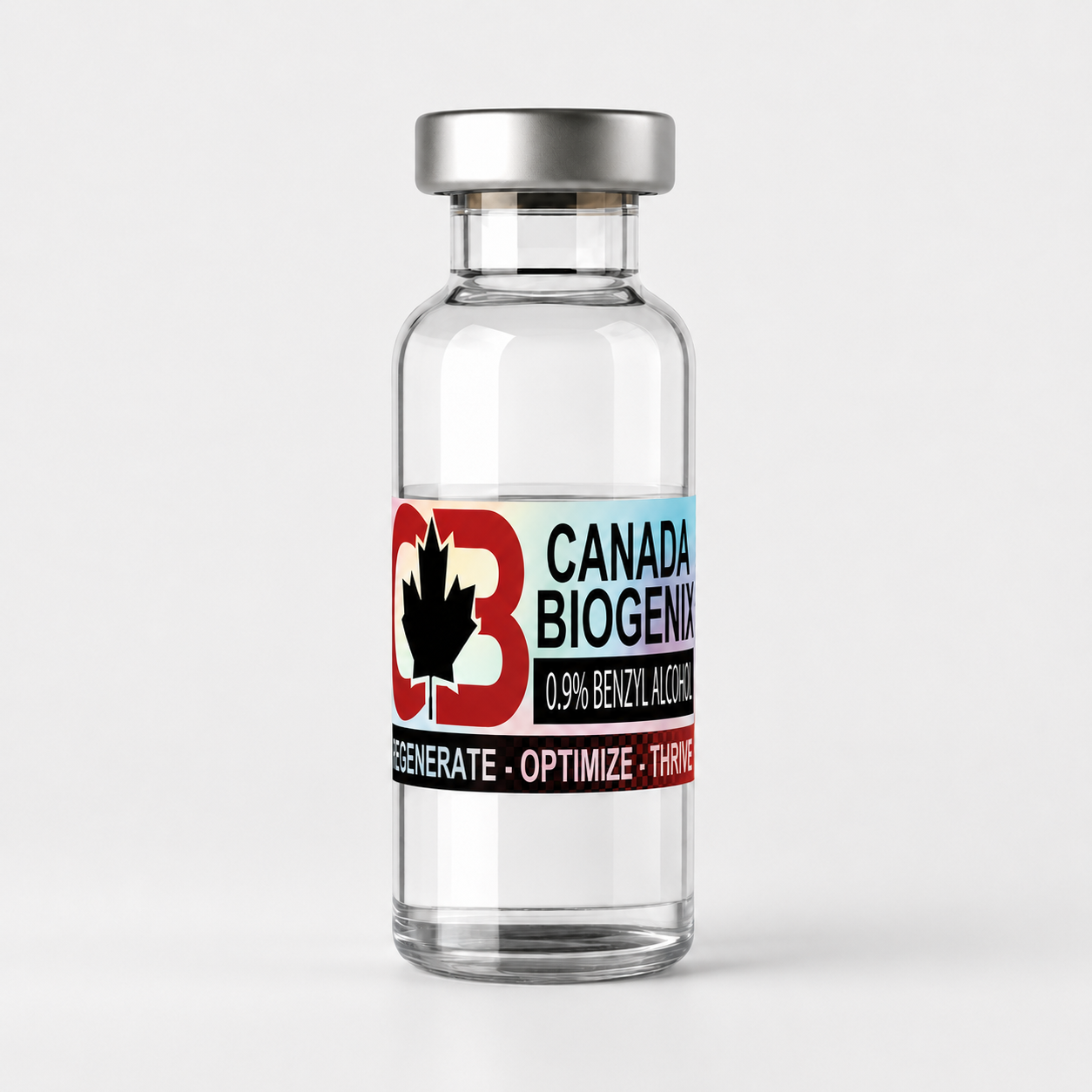
Bacteriostatic water is a sterile water preparation containing 0.9% benzyl alcohol as a bacteriostatic preservative. It is valued in controlled research workflows because the preservative helps limit bacterial growth during repeated vial access when proper aseptic handling is maintained.

Bacteriostatic water is sterile water containing 0.9% benzyl alcohol, equal to 9 mg/mL. Benzyl alcohol acts as a preservative that helps inhibit the growth of many contaminating bacteria after a vial has been entered.
This preservative makes bacteriostatic water different from preservative-free sterile water, which is generally supplied for single-use applications. The multiple-entry format can make laboratory solution preparation more organized and efficient when the product remains compatible with the compound being studied.
However, “bacteriostatic” does not mean self-sterilizing. The preservative helps control bacterial growth; it does not eliminate every microorganism, neutralize viruses or replace clean technique.
The unopened product begins as a clear sterile water preparation when its container and seal remain intact.
The 0.9% benzyl alcohol preservative helps inhibit the growth of many bacteria that could otherwise multiply after vial entry.
A multiple-dose closure permits more than one withdrawal when each entry uses appropriate clean technique and new sterile equipment.
The vial is dated at first entry and discarded at the labelled beyond-use date—or sooner if quality or sterility becomes questionable.
| Diluent | Typical composition | Common format | Key distinction |
|---|---|---|---|
| Bacteriostatic water | Sterile water with 0.9% benzyl alcohol | Multiple-dose container | Preservative helps limit bacterial growth during repeated access. |
| Sterile water | Sterile water without an antimicrobial preservative | Frequently single dose | Useful when a preservative is unsuitable, but unused contents are generally not retained after entry. |
| 0.9% sodium chloride | Water with sodium chloride | Single- or multiple-dose products | Provides sodium and chloride ions, which may affect compound compatibility and experimental conditions. |
| Specialized buffers | Defined salts, buffers or stabilizers | Application specific | Selected when pH, ionic strength or protein stability requires a validated formulation. |
No diluent is universally interchangeable. Always confirm the requirements of the compound, analytical method or validated protocol before preparation.
A known diluent volume supports accurate concentration calculations and reproducible preparation across experiments.
Sterile starting material, intact packaging and clean handling help prevent contamination from becoming an uncontrolled experimental variable.
Preservatives, pH and ionic content can affect solubility or stability. A suitable diluent must be selected for the specific material under study.
Recording vial lot, first-entry date, volume and prepared-solution details improves auditability and repeatability.
| Vial state | General approach | Main concerns | Best practice |
|---|---|---|---|
| Unopened | Store according to the product label. Many official bacteriostatic-water products specify controlled room temperature. | Heat, freezing, damaged packaging and expired material | Keep the seal intact and retain the labelled lot and expiration information. |
| After first entry | Date the vial and follow the manufacturer’s opened-vial storage and beyond-use instructions. | Repeated entry, stopper damage and environmental contamination | Keep it in a clean storage area and minimize unnecessary handling. |
| Prepared solution | Use the stability and storage requirements of the dissolved compound—not the water vial alone. | Hydrolysis, oxidation, aggregation, adsorption and microbial growth | Label the preparation immediately and follow compound-specific stability data. |
Visual inspection is important, but it cannot prove sterility, potency or chemical purity. Those qualities require validated manufacturing controls and suitable analytical testing.
Bacteriostatic water is not the correct vehicle for every compound or experimental system. Benzyl alcohol may be incompatible with some materials, cell-based assays or validated formulations. Prepared solutions can also require specific pH, tonicity, light protection, temperature and time limits.
The presence of a preservative does not make contaminated material safe. In addition, official product labelling warns that benzyl-alcohol-containing solutions are unsuitable for neonates and that bacteriostatic water should not be used alone as a fluid replacement.
Therefore, product documentation and compound-specific instructions should determine compatibility, storage and use. This page explains general research handling principles rather than providing medical or administration instructions.
Not automatically. Many official unopened products are labelled for controlled room-temperature storage. After first entry, follow the exact product label. Once another compound is dissolved, its own stability requirements determine whether the prepared solution needs refrigeration.
Do not freeze it unless the manufacturer specifically authorizes frozen storage. Freezing can stress the container and is unnecessary for products labelled for room-temperature storage.
A common multi-dose-vial standard is 28 days after first puncture unless the manufacturer provides a different opened-vial period. Date the vial immediately and never extend use beyond the original expiration date.
Yes. It should normally appear clear and colourless, without visible particles. Do not use a vial that appears cloudy, discoloured, damaged or otherwise questionable.
No. It helps inhibit the growth of many bacteria, but it does not replace aseptic technique and does not provide complete protection against bacteria, viruses or other contaminants.
The correct mixing method depends on the compound. Sensitive peptides and proteins are often mixed by gentle swirling rather than vigorous shaking because agitation can promote foaming or aggregation.
Many unopened products are labelled for controlled room-temperature storage and do not require a frozen cold chain. Shipping conditions should still remain within the manufacturer’s permitted range, and the vial should be inspected on arrival.
No. Both begin as sterile water preparations, but bacteriostatic water contains an antimicrobial preservative and is supplied for multiple entry. Preservative-free sterile water is commonly packaged for single use.
No. Solubility, pH, ionic strength and preservative compatibility vary. Always follow validated compound-specific preparation information.
Explore available vial sizes and multipack formats for controlled Canada Biogenix research workflows.
Research-use notice: This bacteriostatic-water overview is presented for laboratory research, solution-preparation education and analytical discussion. Always follow the product label, safety documentation and compound-specific compatibility information. It is not medical advice or an administration guide.