
Last Updated: July 24, 2026
Understanding research peptide purity standards Canada is essential for any researcher working with synthetic peptides in Canada. At Canada BioGenix, we recognize that peptide quality directly impacts research reproducibility, and purity is the cornerstone of reliable results. The difference between a 90% pure peptide and a 98% pure peptide can mean the difference between publishable data and months of wasted effort.
Peptide purity refers to the percentage of the desired peptide sequence within a synthesized batch, measured as a ratio of target peptide to total impurities and contaminants. A peptide labeled as 95% pure contains 95% of the intended amino acid sequence and 5% undesired byproducts. Even small percentages of contaminants can skew binding assays, alter cellular responses, or introduce artifacts into quantitative experiments.
Impurities accumulate through multiple synthesis pathways: incomplete coupling during solid-phase peptide synthesis (SPPS), deletion peptides from failed amino acid attachment, oxidation of methionine or tryptophan residues, and deamidation of asparagine and glutamine. Each impurity type behaves differently in your assay system. A deletion peptide may still bind receptors but with altered affinity. Oxidized variants can trigger unexpected immune responses in cell-based studies.
Research peptides are typically offered in several purity grades. Crude peptides (50-70% pure) serve as cost-effective starting material for further purification. Standard research-grade peptides range from 80% to 95% purity and work well for many in-vitro bioassays. High-purity research peptides (95-99%) are the industry standard for most published research. Ultra-high purity (99%+) peptides are reserved for the most demanding applications: receptor binding kinetics, structural biology, and regulatory submissions.
The cost difference between grades is substantial. Choosing lower purity to save money often backfires, researchers frequently report that switching to higher-purity peptides resolved previously unexplained variability in their results, eliminating months of troubleshooting.
Health Canada oversees research peptides through the Therapeutic Products Directorate (TPD) and the Biologic and Radiopharmaceutical Drugs Directorate (BRDD) when peptides are intended for human use or regulatory submissions. For research-use-only peptides, suppliers must comply with Good Manufacturing Practices (GMP) standards and maintain detailed batch documentation.
Research peptides sold in Canada must be clearly labeled as "Research Use Only" and cannot be marketed for human consumption, diagnostic purposes, or therapeutic applications. Suppliers must maintain certificates of analysis (COAs) for every batch, including analytical data from HPLC, mass spectrometry, and amino acid analysis.
The "Research Use Only" designation means the peptide is sold exclusively for laboratory research and is not approved for human administration, clinical diagnosis, or therapeutic use. Reputable Canadian suppliers maintain GMP-compliant facilities and follow ISO/IEC 17025 accreditation standards for their analytical testing.
When selecting a supplier, verify that their manufacturing facility operates under documented quality systems. Request information about their accreditations and audit history. Ask whether they perform in-house testing or use third-party laboratories for analytical verification. Suppliers who outsource testing to independent labs often provide more objective COAs because the testing laboratory has no financial incentive to misrepresent results.
High-Performance Liquid Chromatography (HPLC) is the gold standard for determining peptide purity. HPLC separates peptide molecules based on their chemical properties, hydrophobicity, charge, and molecular weight as they pass through a column under high pressure. The instrument detects peptides using UV absorbance at 214 nm (peptide bond) or 280 nm (aromatic amino acids), generating a chromatogram that displays distinct peaks for each molecular species.
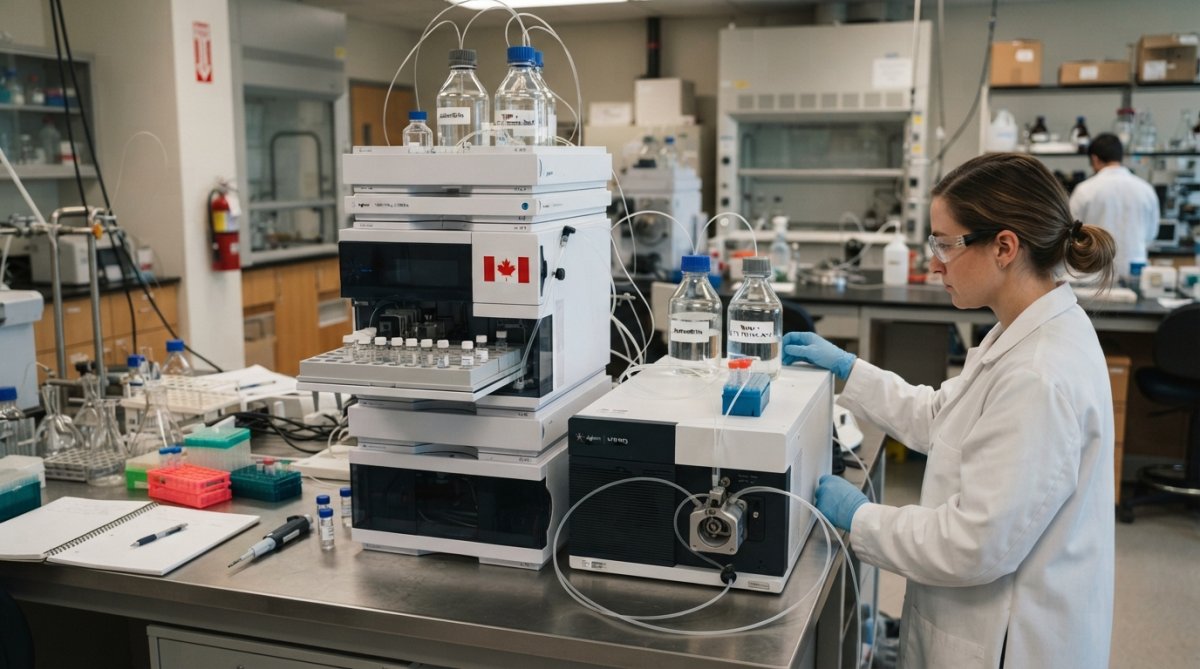
A legitimate HPLC purity report shows the retention time of the target peptide, the area under each peak quantified as a percentage of total area, and the identity of major impurities when possible. The purity percentage is calculated by dividing the peak area of the desired peptide by the sum of all peak areas. However, HPLC alone cannot confirm that a peak represents the correct amino acid sequence.
The HPLC chromatogram visually separates all molecular species in your peptide batch. Each peak represents a distinct molecule with a unique combination of charge, hydrophobicity, and size. The main peak (ideally 95% or higher) represents your target peptide. Smaller peaks represent impurities including deletion peptides, synthesis byproducts, oxidized variants, and aggregated forms. Experienced analysts can often identify impurity types by comparing retention times to known standards. However, HPLC purity alone does not prove molecular identity, which is why reputable suppliers combine HPLC with mass spectrometry.
Mass spectrometry (MS) measures the exact molecular weight of peptides with extraordinary precision. Liquid chromatography-tandem mass spectrometry (LC-MS/MS) is most common for peptide analysis. The instrument ionizes peptides, separates them by mass-to-charge ratio, and fragments them into smaller pieces. The pattern of fragments is compared to theoretical fragmentation patterns for your target sequence. A match confirms identity. The combination of HPLC purity data and MS confirmation provides strong evidence that your peptide batch contains the correct sequence at the stated purity level.
A Certificate of Analysis is a document issued by the supplier or an independent testing laboratory that reports the analytical results for a specific batch of peptides. A legitimate COA is batch-specific, dated, and includes raw analytical data, not just a summary statement.
A comprehensive COA for research peptides should contain:
A weak COA might state only "Purity: 95%" without showing the chromatogram, omit mass spectrometry data, or lack batch-specific information.
Third-party testing laboratories add credibility because they have no financial incentive to misrepresent results. Many Canadian research institutions and pharmaceutical companies require third-party testing for peptides used in regulatory submissions or published research. Organizations like ResolveMass Laboratories Inc., based in Canada, specialize in peptide characterization for regulatory compliance using orthogonal analytical techniques including HPLC, mass spectrometry, NMR, and capillary electrophoresis.
A research team studying a novel cancer-targeting peptide ordered 95% pure material to conduct receptor-binding assays. Their dose-response curves showed unexpected biphasic behavior. Upon examining the full HPLC chromatogram, they discovered a significant deletion peptide peak that had lower affinity for the target receptor but still bound, creating a second, weaker binding population. Switching to 98% pure material resolved the issue.
In another case, a team conducting phosphorylation studies received a synthetic peptide substrate with a serine residue at position 12. Their kinase assay showed dramatically lower phosphorylation rates than expected. Mass spectrometry revealed that approximately 8% of the batch contained oxidized methionine residues at position 8, which altered the local charge distribution and reduced accessibility of the serine to the kinase active site. Switching to a supplier who included antioxidants during synthesis resolved the issue.
These cases underscore why purity matters. A 5-10% impurity level can completely invalidate your results if the impurity interacts with your experimental system in unexpected ways.
Evaluating a peptide supplier requires examining manufacturing quality, analytical rigor, documentation practices, and customer support. Canada BioGenix exemplifies a supplier committed to these standards, with carefully selected manufacturing partners and transparent batch-specific documentation.
A reliable supplier openly shares information about their manufacturing processes and quality systems. Request answers to these questions:
Suppliers who refuse to answer these questions transparently may cut corners on quality. Canada BioGenix maintains detailed documentation for every batch and partners with accredited testing laboratories to ensure that purity claims are independently verified.
Peptide stability during storage and shipping directly impacts the purity you receive. A good supplier provides detailed storage instructions, protective packaging with desiccant packs, reconstitution guidance including recommended solvents and pH buffers, and stability data. Many researchers fail to achieve expected purity levels not because the supplied peptide was impure, but because they reconstituted it incorrectly or stored it improperly after receipt. Canada BioGenix offers free shipping on orders over $250 and includes comprehensive reconstitution guidance with every shipment.
Peptide pricing depends on sequence length, purity grade, synthesis scale, and urgency. Understanding these cost drivers helps you make economically sound decisions without compromising quality.
Sequence length is the primary cost driver. A 10-amino acid peptide costs far less than a 50-amino acid peptide. Purity grade adds cost through additional purification and analytical testing. Moving from 95% to 98% purity typically increases cost by 30-50%. Synthesis scale affects per-milligram pricing; ordering 10-50 mg can reduce per-milligram cost by 40-60% compared to 1-5 mg. Rush orders incur premium charges of 50-100% more for expedited synthesis.
For initial screening assays, 90-95% purity is often adequate. For dose-response studies, binding kinetics, or cell-based assays, 95-98% purity is recommended. For receptor-ligand interaction studies, epitope mapping, or published work, 98%+ purity is the industry standard. For regulatory submissions, 99%+ purity with comprehensive analytical documentation is essential.
| Application | Recommended Purity | Rationale |
|---|---|---|
| Preliminary screening | 90-95% | Cost-effective for initial validation |
| Dose-response studies | 95-98% | Reduces impurity interference in curves |
| Binding kinetics | 98%+ | Requires accurate quantitation of active peptide |
| Regulatory submissions | 99%+ | Meets Health Canada expectations |
| Epitope mapping | 98%+ | Impurities can mask or mimic true epitopes |
| In-vitro bioassays | 95-98% | Balances cost and reliability for most assays |
Ultra-high-performance liquid chromatography (UHPLC) operates at higher pressures and flow rates than conventional HPLC, reducing analysis time from 30-60 minutes to 5-15 minutes while improving resolution. Native mass spectrometry preserves non-covalent interactions during ionization, allowing researchers to study peptide aggregation states and protein-peptide complexes directly. Capillary electrophoresis (CE) separates peptides based on charge and size using an electric field, requiring smaller sample volumes and generating less waste than HPLC.
Automated peptide synthesis platforms with integrated quality control are reducing human error and improving reproducibility. Artificial intelligence and machine learning are beginning to be applied to chromatogram interpretation and impurity identification, accelerating root-cause analysis when impurities are detected.
Peptide purity standards are non-negotiable for rigorous research. Whether you’re conducting receptor-binding studies, developing therapeutic candidates, or publishing findings, the purity and identity of your peptides directly determine the reliability of your conclusions. Canada BioGenix provides premium-quality research peptides with batch-specific certificates of analysis, third-party analytical verification, and transparent manufacturing partnerships. By choosing a supplier committed to quality and transparency, you invest in research reproducibility and reduce the risk of unexpected results downstream.
Research peptide purity standards in Canada typically range from 90% to 99%+, depending on the application. For general research, 95% purity is often sufficient. However, for sensitive applications like receptor-ligand interactions, epitope mapping, or phosphorylation studies, 98%+ purity is recommended. The specific requirement depends on your experimental design and tolerance for impurities. Always consult your supplier's Certificate of Analysis to confirm batch-specific purity levels.
Health Canada treats research-use-only peptides differently from pharmaceutical-grade peptides. While research peptides are not subject to the same regulatory scrutiny as drug products, suppliers must still comply with Good Manufacturing Practices (GMP) standards and provide accurate analytical documentation. Health Canada expects transparency in labeling, proper identity verification, and accurate purity reporting. For peptides intended for preclinical research, ensure your supplier maintains ISO/IEC 17025 accreditation for their testing methods.
The primary methods for peptide purity testing in Canada are HPLC (High-Performance Liquid Chromatography) and mass spectrometry (MS). HPLC measures purity by separating peptide components and analyzing chromatograms to identify impurities and contaminants. Mass spectrometry confirms molecular weight and identity. Many Canadian suppliers also use complementary techniques like Capillary Electrophoresis (CE) and NMR for complex peptides. Third-party testing through ISO/IEC 17025 accredited laboratories provides independent verification and strengthens the credibility of your analytical data.
A reputable Canadian peptide supplier should provide a batch-specific Certificate of Analysis (COA) that includes: HPLC chromatogram with retention time data, mass spectrometry results confirming molecular weight, amino acid sequence verification, purity percentage, lot/batch number, and synthesis date. The COA should reference the analytical methods used and include contact information for the testing laboratory. For maximum credibility, verify that the testing was performed by an ISO/IEC 17025 accredited facility and request third-party verification if your research requires it.
Low-purity peptides introduce synthesis byproducts, deletion peptides, oxidation products, and deamidation contaminants that can compromise research outcomes. These impurities may interfere with binding assays, skew quantitative results, or produce irreproducible data across batches. In receptor-ligand interaction studies or antibody development, even 1-2% impurity can significantly affect results. Additionally, low-purity batches may have inconsistent storage stability, leading to further degradation during transit or storage. Investing in higher-purity peptides ensures data reproducibility and reduces the risk of failed experiments.
[EXTERNAL_LINK: Health Canada Therapeutic Products Directorate guidance on biologic drug submissions | canada.ca]
[EXTERNAL_LINK: ISO/IEC 17025 standard for laboratory accreditation and competence | iso.org]
[EXTERNAL_LINK: ResolveMass Laboratories peptide characterization services for regulatory compliance | resolvemass.ca]
This article was written using GrandRanker