
Last Updated: September 22, 2026
Tesamorelin mechanism of action starts with a simple distinction: it is not growth hormone. It is a synthetic peptide that tells the pituitary to release the body’s own growth hormone. That difference shapes everything about how the compound behaves, from its pulsatile signalling to its safety profile. This guide from Canada BioGenix breaks down the full pathway, step by step, for researchers and fitness-focused readers who want more than a surface-level summary.
Growth hormone-releasing hormone is produced naturally in the hypothalamus and travels to the pituitary to trigger GH release. Tesamorelin copies that signal. Because it works upstream, the body’s own feedback inhibition stays intact, which is a meaningful difference from injecting growth hormone directly.
The tesamorelin mechanism unfolds in a clear sequence at the pituitary. Below is the numbered pathway researchers use to describe it:
Somatotropic cells in the anterior pituitary carry GHRH receptors. Tesamorelin binds these with high receptor affinity, mimicking the endogenous ligand. Binding triggers a signalling cascade that opens calcium channels and releases stored GH granules.
Here is a gap most summaries skip. Endogenous GH secretion is pulsatile, meaning it comes in bursts. A GHRH analogue supports that natural rhythm rather than overriding it. Sustained, flat exposure, by contrast, is associated with receptor desensitization over time. This distinction matters for how researchers design study protocols.
Once GH enters the bloodstream, the liver responds by producing insulin-like growth factor 1, or IGF-1. IGF-1 levels are the downstream marker researchers watch most closely, because they reflect whether the hormonal axis is responding. This feedback loop is part of normal endocrine regulation, and it is why the body does not simply produce unlimited GH.
Tesamorelin’s most studied metabolic effect is on visceral adipose tissue, but the mechanism is more layered than a simple “GH spike burns fat” summary. The pathway runs through the GH/IGF-1 axis and then branches into several downstream effects that researchers track separately.
When GH binds its receptor on adipocytes, it activates hormone-sensitive lipase (HSL) and adipose triglyceride lipase (ATGL). These enzymes hydrolyze stored triglycerides into free fatty acids and glycerol, which are then released into circulation for oxidation. This is the core lipolytic step, and it is why triglyceride reduction shows up consistently in the literature.
Visceral adipose tissue has a higher density of GH receptors and greater blood flow than subcutaneous fat, which helps explain why the lipolytic response is more pronounced in the visceral depot. This selectivity is one of the reasons the compound is studied in the context of central adiposity rather than general weight loss.
This is where most summaries stop, and where the real depth lives. GH is counter-regulatory to insulin: it reduces glucose uptake in peripheral tissues and increases hepatic glucose output (pubmed.ncbi.nlm.nih.gov). That means a GHRH analogue can raise GH and IGF-1 while simultaneously affecting glucose handling.
Tesamorelin half-life is relatively short, and that short half-life is not a limitation. It is the feature that makes the pulsatile mechanism work. A compound that clears quickly produces a discrete pulse of GH release rather than a flat, continuous elevation, which is closer to how the body naturally secretes GH.
After subcutaneous administration, the peptide is absorbed into circulation, reaches the anterior pituitary, and is cleared by proteolytic degradation and renal filtration. The practical consequence is a GH pulse that rises and falls within a window of hours, not days.
| Parameter | What It Describes | Why It Matters |
|---|---|---|
| Half-life | Time for half the dose to clear | Sets dosing frequency and pulse width |
| Bioavailability | Fraction reaching circulation | Affects effective dose after subcutaneous delivery |
| Clearance rate | Speed of elimination | Shapes how discrete the GH pulse is |
| Receptor affinity | Binding strength at pituitary GHRH receptors | Influences signal strength per pulse |
| Time to peak | Interval from administration to peak plasma level | Determines when GH release is highest |
Endogenous GH secretion is pulsatile, with the largest bursts occurring during deep sleep (pubmed.ncbi.nlm.nih.gov). A GHRH analogue with a short half-life mimics that rhythm by creating a defined pulse rather than a sustained plateau. Sustained, flat exposure is associated with receptor desensitization over time, which is why the pharmacokinetic profile and the pulsatile mechanism are two sides of the same coin.
Endogenous GHRH is also short-acting, but it is released in a coordinated rhythm with somatostatin, the hormone that suppresses GH. Tesamorelin does not replicate that somatostatin interplay; it provides the GHRH signal directly. The result is a GH pulse that is more predictable in timing but less integrated with the body’s own inhibitory feedback. That distinction is why researchers track IGF-1 as a downstream marker rather than assuming the axis is behaving identically to natural secretion.
Because the half-life is short, dosing schedules matter more than total weekly dose. A protocol that spaces administration to preserve pulse separation is generally described as more physiologically aligned than one that stacks doses into a sustained exposure pattern. Consistency in timing, route, and reconstitution is what keeps pharmacokinetic variability low enough for results to be interpretable.
Tesamorelin dosage protocols vary by study design, and no single schedule fits every research question. What matters is consistency: the same dose, the same timing, and the same administration route across a study so results stay comparable. Subcutaneous administration is the standard route in published research.
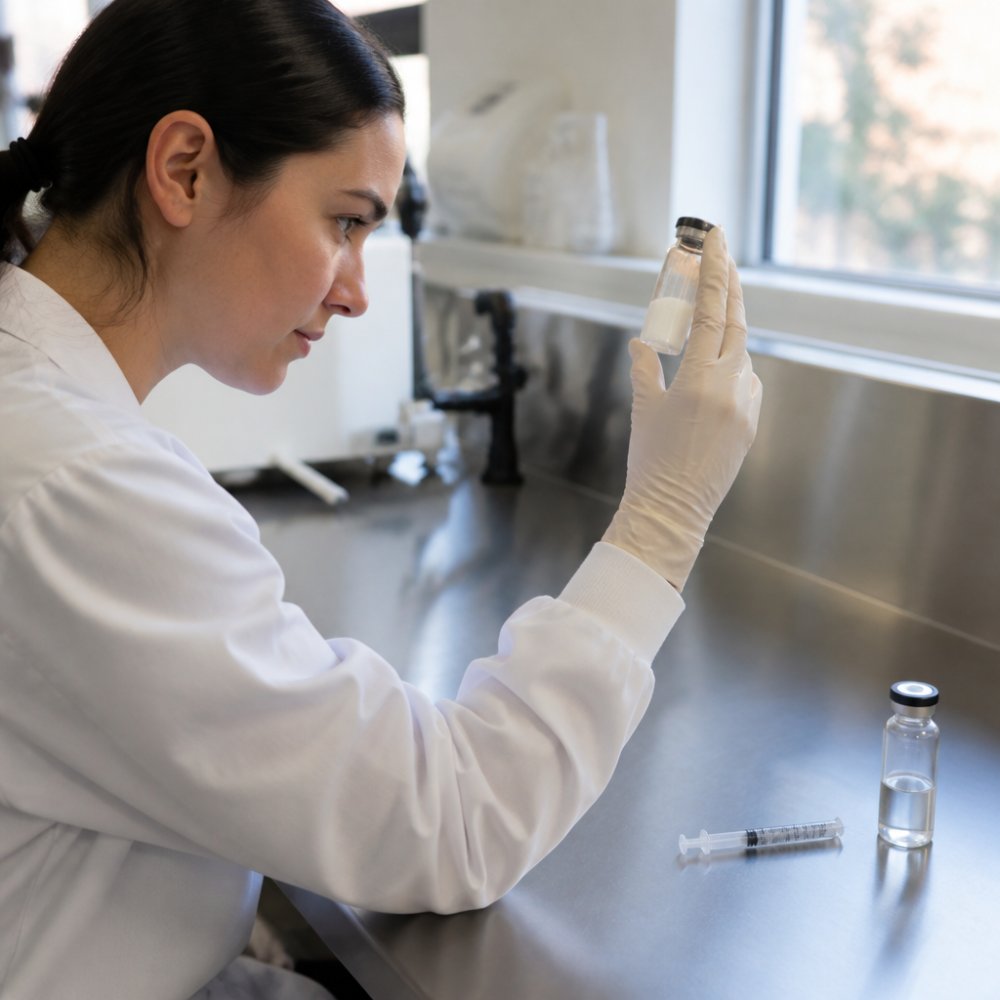
Reconstitution of research peptides is where a lot of good work gets undone. Lyophilized powder is stable until mixed, but once reconstituted, the peptide is far more sensitive to heat, light, and agitation. Use a compatible diluent, add it slowly down the vial wall rather than blasting the powder, and store the reconstituted solution cold.
Two long-term concerns deserve attention. The first is receptor desensitization: constant stimulation of the same receptor can reduce its responsiveness over time. The second is feedback inhibition, where rising IGF-1 levels signal the body to dial back GH release. Both are why pulsatile dynamics matter, and both are reasons researchers avoid treating a GHRH analogue like a flat, continuous infusion.
Tesamorelin binds to growth hormone-releasing hormone receptors on somatotropic cells in the anterior pituitary. That receptor binding triggers signal transduction that prompts the pituitary to release its own stored growth hormone in pulses. Because it works through the body’s existing GHRH pathway rather than delivering GH directly, it supports endogenous secretion and preserves feedback inhibition at the hypothalamic level. This is why researchers describe it as a GHRH analogue rather than a growth hormone replacement.
Direct GH administration adds exogenous hormone to the bloodstream, which can suppress the pituitary’s own output through feedback inhibition. Tesamorelin acts upstream, stimulating the pituitary to release GH in its natural pulsatile pattern. That difference matters for the hormonal axis: endogenous secretion stays intact, IGF-1 levels rise more gradually, and the body’s own regulatory loops remain engaged. Researchers studying tesamorelin mechanism of action often focus on this upstream action as the key distinction from exogenous GH.
Tesamorelin has a short plasma half-life, measured in minutes rather than hours, which is consistent with its pulsatile mechanism. A short half-life means the compound clears quickly, so tesamorelin dosage protocols typically involve once-daily subcutaneous administration timed to mimic the body’s natural overnight GH surge. The rapid clearance rate also limits sustained receptor exposure.
Yes. Tesamorelin works by amplifying the pituitary’s own release of growth hormone rather than replacing it. Because the compound acts as a GHRH analogue at the receptor level, endogenous secretion continues and the normal feedback loop between the hypothalamus, pituitary, and IGF-1 levels stays functional. This is one of the main reasons researchers distinguish tesamorelin from exogenous GH, which can blunt the pituitary’s natural output over time.
Understanding the tesamorelin mechanism is only half the equation. Reliable results depend on consistent, high-purity compounds and proper handling at every step. Canada BioGenix supports researchers with premium-quality research peptides, carefully selected manufacturing partners, and a focus on quality and purity, backed by free shipping on orders over $250 and credit card payment. Get started with Canada BioGenix and keep your research supply dependable from first vial to last.