
Last Updated: August 12, 2026
Temperature is one of the most critical factors determining peptide effectiveness and stability. Even small fluctuations can trigger degradation pathways that compromise molecular integrity and research outcomes. At Canada BioGenix, we are dedicated to supporting your research journey through a commitment to transparency, consistency, and exceptional customer service.
Thermal denaturation occurs when heat exposure causes peptides to unfold and lose their functional three-dimensional structure. The peptide backbone remains chemically intact at moderate temperatures, but the secondary and tertiary structures that enable biological activity collapse.
As temperature rises, molecular motion increases and non-covalent interactions, hydrogen bonds, van der Waals forces, hydrophobic interactions, become unstable. These weak bonds break randomly, disrupting the precise folding required for function. Room temperature (20-25°C) poses manageable risk for days or weeks. At 37°C, degradation rates climb noticeably. Above 40°C, structural breakdown becomes rapid and severe.
The Q10 rule states that most chemical reaction rates double (or increase by a factor of 2-3) for every 10°C temperature increase. For peptide degradation, Q10 typically ranges from 2 to 3, meaning a 10°C rise can double or triple degradation speed.
Moving from 25°C to 35°C doesn’t increase degradation by 10 percent, it accelerates it by 100 to 200 percent. A peptide stable for six months at 4°C might degrade significantly in two to three months at room temperature, or within weeks at 37°C. Small temperature differences create exponential differences in shelf life. Consistency matters more than hitting a single perfect number.
Peptides come in two primary forms: lyophilized (freeze-dried powder) and reconstituted (dissolved in solution). Each has distinct stability characteristics.
Lyophilized peptides are significantly more stable than reconstituted forms because water accelerates hydrolysis and aggregation. Removing water through freeze-drying dramatically slows degradation.
Refrigerated storage (2-8°C) works well for peptides you’ll use within 6-12 months. Most research-grade lyophilized peptides remain stable for at least one year. The advantage is convenience; the trade-off is reduced shelf life.
Frozen storage (-20°C) extends stability to 2-5 years for most peptides. Ultra-cold storage (-80°C or liquid nitrogen) preserves peptides for a decade or more. The cost is justified only for high-value compounds or long-term inventory.
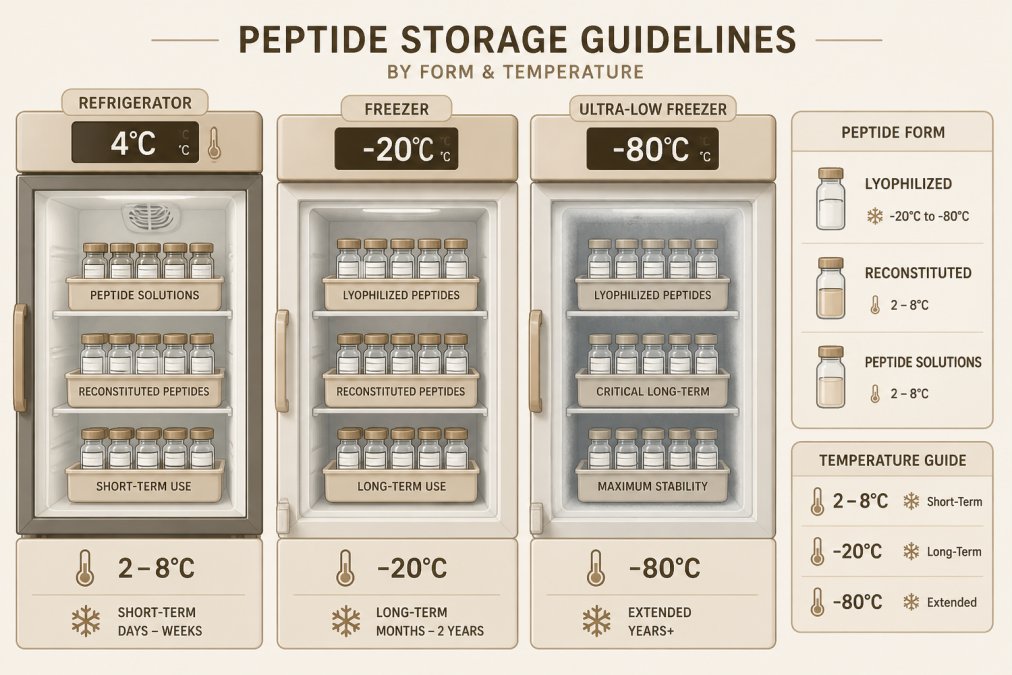
Canada BioGenix provides detailed stability data with every shipment. Always check your Certificate of Analysis for peptide-specific guidance. The container matters as much as temperature: vials must be sealed tightly and stored in a desiccated environment. Use airtight containers with desiccant packets, replacing them periodically if the vial is opened frequently.
Once reconstituted, the clock starts ticking faster. Shelf life depends on temperature, buffer composition, and the peptide’s susceptibility to hydrolysis and aggregation.
At 2-8°C, most reconstituted peptides remain stable for 2-4 weeks. At room temperature, expect 3-7 days. At 37°C, many degrade noticeably within 24-48 hours. Buffer pH and ionic strength dramatically influence stability; buffers too acidic or alkaline accelerate hydrolysis, while high salt concentrations promote aggregation. Canada BioGenix provides recommended reconstitution buffers chosen to maximize stability for each compound.
Reconstitute only what you need for immediate use, then store remaining lyophilized powder. If you must store reconstituted peptides, keep them at 2-8°C in sterile, sealed containers within the timeframe specified on product documentation.
Melting temperature (Tm) is the temperature at which 50 percent of peptide molecules have unfolded or lost native secondary structure. It’s critical for predicting thermal stability.
Tm is determined experimentally using differential scanning fluorimetry (DSF) or circular dichroism (CD) spectroscopy. A peptide with Tm of 45°C shows significant unfolding near 40°C. One with Tm of 65°C remains structurally sound well into the 50°C range.
For most research peptides, Tm values range from 35°C to 75°C depending on size, amino acid composition, and stabilizing elements like disulfide bonds. Longer peptides and those with more structured secondary elements have higher Tm values. Canada BioGenix provides product specifications that can help in understanding the behavior of the compounds.
Secondary structure refers to localized folding patterns: alpha helices, beta sheets, and random coils, held together by hydrogen bonds. Heat disrupts these bonds directly. As temperature rises, increased molecular motion breaks hydrogen bonds faster than they reform, causing loss of secondary structure while the primary backbone remains chemically intact.
Different secondary structures have different thermal sensitivities. Alpha helices tend to be more stable than extended beta structures. Peptides with disulfide bonds, covalent cross-links between cysteine residues, are far more heat-resistant than those stabilized only by non-covalent interactions, giving them significantly higher Tm values.
Degradation progresses silently until performance drops noticeably or visual changes appear.
Lyophilized peptides should appear as fine, homogeneous powder. Discoloration, yellowing, browning, or clumping indicates oxidative stress, advanced degradation, or moisture infiltration. Reconstituted peptides should remain clear and colorless. Cloudiness, precipitation, or visible particles indicate aggregation.
Performance changes are often the first practical indicator. If your peptide shows reduced activity in assays where it previously performed consistently, degradation is likely. If binding affinity drops or expected reactions don’t occur, thermal damage to secondary structure is probable.
Hydrolysis breaks covalent bonds in the peptide backbone through reaction with water, accelerated by heat, pH extremes, and certain amino acids like aspartic acid and asparagine. Aggregation occurs when hydrophobic residues become exposed and peptide molecules clump into insoluble clusters, once started, it’s irreversible. Oxidative stress occurs when peptides containing methionine or cysteine react with oxygen, modifying amino acid side chains and reducing function.
All three pathways are accelerated by elevated temperature. Control temperature, and you control all three simultaneously.
Temperature stability during storage is only half the battle. Peptides must survive transit and inevitable temperature fluctuations.
Every freeze-thaw cycle stresses peptides. Ice crystal formation can physically disrupt molecules. Thawing creates osmotic stress. Most peptides tolerate 2-3 cycles without significant degradation; beyond that, damage accumulates.
Minimize freeze-thaw cycles by ordering quantities you’ll use in a single experiment. If you must freeze reconstituted peptides, divide into single-use aliquots before freezing. Kinetic stability, the rate at which peptides remain functional under real-world conditions, differs from thermodynamic stability. Lower temperatures slow the kinetic processes driving degradation.
Peptides from Canada BioGenix arrive in insulated packaging with ice packs designed to maintain 2-8°C throughout transit. However, shipments can experience temperature excursions during handling, especially in warm climates.
When your shipment arrives, check packaging immediately. Ice packs should be cold or cool to the touch. If warm, the shipment experienced a significant temperature excursion; contact Canada BioGenix before using the peptides. Store incoming peptides immediately in your designated storage environment. Don’t leave them on a bench while processing paperwork.
For critical shipments or during warmer months, consider expedited shipping or specialized temperature-controlled courier services. The extra cost is minimal compared to losing an expensive batch.
A peptide’s response to temperature depends on duration and magnitude of exposure.
Most lyophilized peptides tolerate brief room-temperature exposure (20-25°C) without significant degradation. A vial left on a bench for an hour during unpacking typically suffers minimal damage. Even a few hours is usually acceptable.
As duration extends from hours to days, degradation accelerates exponentially. A peptide stable for 24 hours at room temperature might show visible degradation after 48 hours. Reconstituted peptides are far less forgiving; brief exposure (minutes to an hour) is usually acceptable, but beyond that degradation becomes problematic.
Accelerated aging studies predict long-term stability by exposing peptides to elevated temperatures for shorter periods. A peptide at 25°C for one month might show degradation equivalent to 6-12 months at 4°C. Analytical validation using HPLC or mass spectrometry confirms purity and identity, revealing the percentage of intact peptide versus degradation products.
Canada BioGenix uses accelerated aging and analytical validation to establish shelf life claims. When we state a peptide remains stable for 24 months at 2-8°C, that claim is backed by actual data. Request stability data and analytical validation methods from any supplier to understand what "stable" means for your compound.
Understand your peptide’s fundamental properties before storage. Molecular weight and amino acid sequence determine thermal sensitivity and optimal storage conditions.
Larger peptides (above 30 amino acids) generally have complex secondary structures and are more thermally sensitive. Peptides rich in hydrophobic amino acids aggregate more readily. Disulfide bonds dramatically increase thermal stability. Free cysteines are prone to oxidative damage. Methionine is sensitive to oxidation. Asparagine and aspartic acid are prone to hydrolysis.
Your Certificate of Analysis includes this information. Review it carefully before designing storage protocols. Contact Canada BioGenix if you need help interpreting the data.
Match storage conditions to your peptide’s properties. Stability data specifies recommended temperatures, buffer compositions, and expected shelf life at each temperature.
Document your chosen storage conditions. Create a simple log noting storage temperature, date received, and date opened. This documentation is invaluable if performance issues arise later.
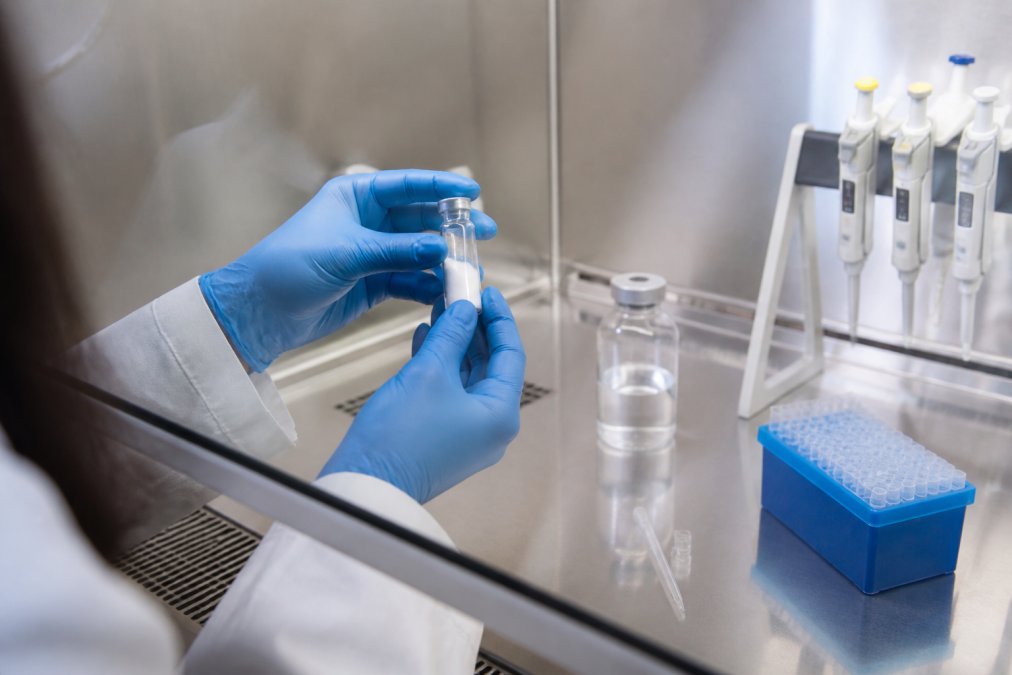
Moisture accelerates degradation, particularly for lyophilized compounds. Water enables hydrolysis and promotes aggregation. Store lyophilized peptides in sealed vials with desiccant packets. Replace packets periodically, especially if containers are opened frequently. Silica gel packets change color as they absorb moisture; replace when saturated.
For reconstituted peptides, use sterile, sealed containers. Minimize headspace to reduce water evaporation and oxidation. Store in amber or opaque vials to reduce light exposure, which accelerates oxidative degradation.
Temperature consistency matters more than hitting a single perfect number. Use a thermometer or temperature data logger in your storage environment to verify consistency. Check built-in freezer and refrigerator thermometers regularly. If you notice significant fluctuations, investigate and address the cause.
Document batch performance over time. Note the date each peptide batch was received, stored, and used. Compare performance of multiple batches of the same peptide. If newer batches consistently outperform older ones, storage degradation is occurring and you may need to adjust your approach or order more frequently in smaller quantities.
Maintaining peptide integrity through proper temperature control is foundational to reliable research. Small investments in storage infrastructure and attention to handling protocols pay dividends through consistent, reproducible results. Canada BioGenix provides detailed stability guidance with every shipment, and our team is available to answer questions about storage, handling, or reconstitution protocols specific to your compounds.
Yes, peptides degrade significantly at room temperature due to thermal denaturation and hydrolysis. The rate depends on the peptide's amino acid sequence, molecular weight, and secondary structure. Most lyophilized peptides remain stable for weeks at ambient temperature, but degradation accelerates rapidly, often following the Q10 rule, where every 10°C increase roughly doubles the degradation rate. For long-term stability, refrigerated or frozen storage is essential.
Reconstituted peptides are most stable between 2-8°C in a standard refrigerator for short-term use (typically 1-4 weeks). For extended storage beyond one month, freezing at -20°C or lower significantly extends reconstituted peptide shelf life by slowing hydrolysis and aggregation. Buffer compatibility and the presence of cryoprotectants also influence stability. Always verify the specific storage recommendations provided with your batch's Certificate of Analysis.
Visual indicators of peptide degradation include discoloration, cloudiness in solution, or visible precipitate formation. Performance-based signs include reduced potency in assays, unexpected results in mass spectrometry analysis, or loss of expected biological activity. At the molecular level, heat causes thermal denaturation of secondary structure, hydrolysis of the peptide backbone, and aggregation, all reducing functionality. If a batch shows these degradation signs, it should not be used for research.
Relative humidity is a critical factor in lyophilized peptide stability. Moisture absorption triggers hydrolysis of covalent bonds in the peptide backbone and promotes aggregation through non-covalent interactions. Lyophilized peptides should be stored in low-humidity environments (typically below 40% relative humidity) in sealed, desiccant-containing vials. Exposure to moisture accelerates degradation even at cold temperatures, so proper container sealing and desiccant replacement are essential maintenance steps.
This article was written using GrandRanker