
Last Updated: August 23, 2026
Visible changes in appearance signal peptide degradation. Lyophilized powder that develops discoloration, yellowing, browning, or darkening indicates oxidative or thermal damage. Turbidity in reconstituted solution, cloudiness instead of transparency, often points to aggregation or precipitation of damaged peptide chains.
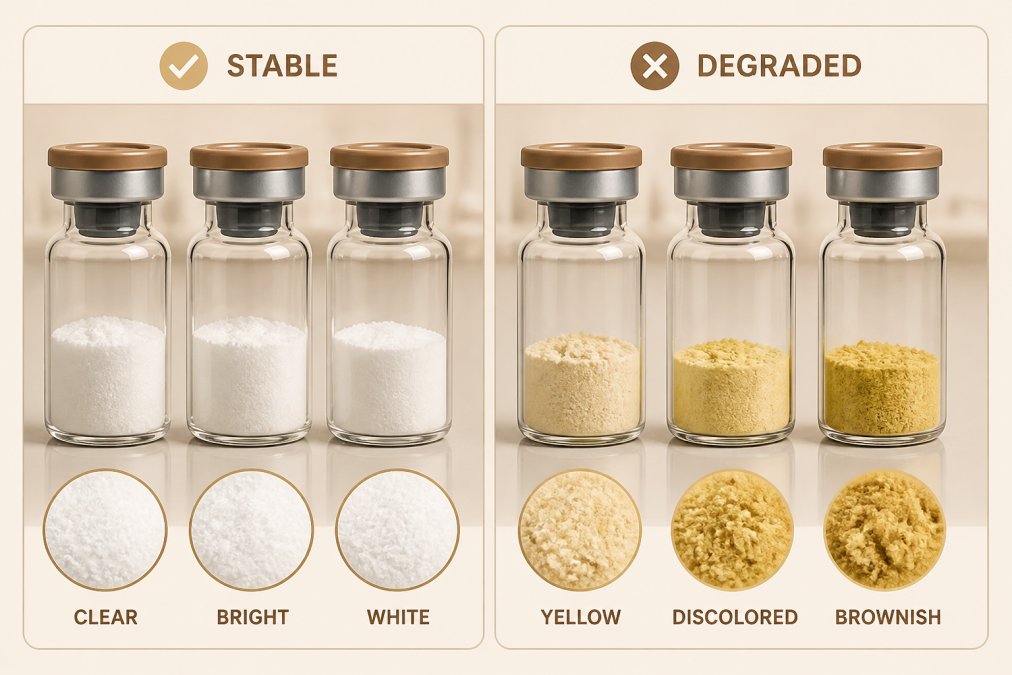
These visual cues are often the first warning sign without specialized equipment. A batch that looks wrong usually is wrong. Discoloration or cloudiness upon reconstitution indicates the peptide’s molecular structure has been compromised and is no longer suitable for reliable research.
Precipitate formation, visible particles settling at the bottom or floating in solution, indicates peptide molecules have lost solubility. This happens when hydrolysis breaks peptide bonds or oxidation creates cross-linked aggregates too large to remain dissolved.
Canada BioGenix emphasizes visual inspection as a first-line quality check. Before using any peptide batch, examine the lyophilized powder and reconstituted solution under good lighting. Any deviation from expected appearance warrants further investigation.
Peptide degradation follows distinct chemical pathways, each producing different breakdown products. Understanding these mechanisms explains why certain storage conditions matter.
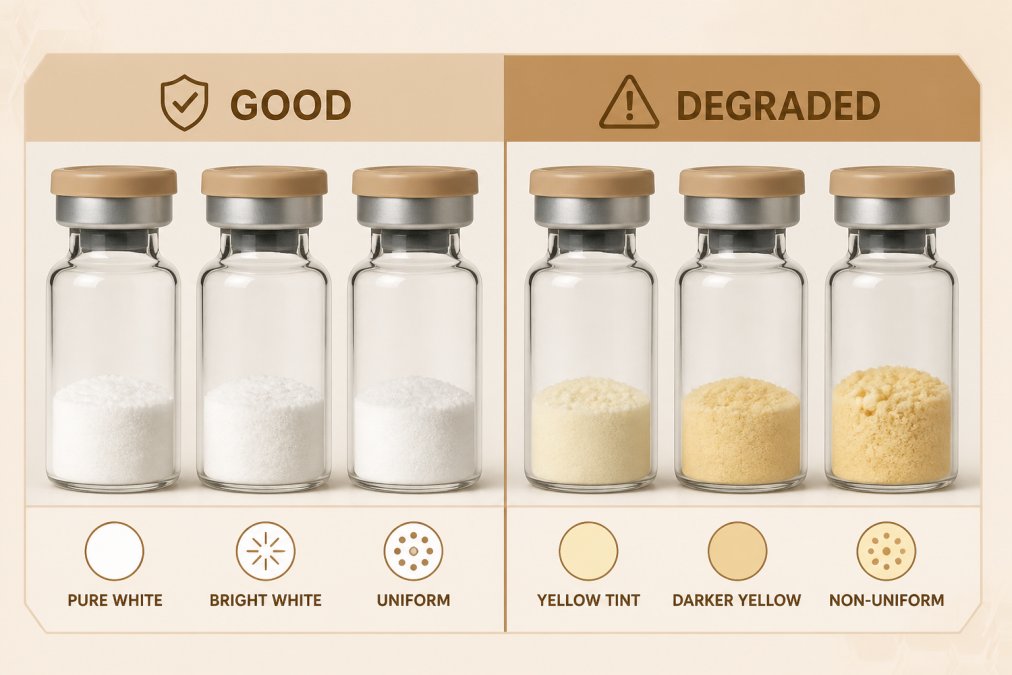
Oxidation is one of the most common degradation forms. When amino acid residues, particularly methionine, tryptophan, tyrosine, and histidine, encounter oxygen or peroxides, their side chains are chemically modified, altering the peptide’s structure and rendering it inactive.
Early-stage oxidation may not show visible changes, but biological activity is already compromised. A peptide can look fine but perform poorly in experiments. Mass spectrometry or HPLC analysis reveals oxidized amino acid variants that visual inspection cannot detect.
Peroxides in solvent, particularly bacteriostatic water stored too long or exposed to light, accelerate oxidation. The water used to reconstitute peptides matters as much as peptide storage itself. Contaminated or degraded reconstitution medium can damage a perfectly preserved peptide during reconstitution.
Hydrolysis breaks peptide bonds linking amino acids together. Water molecules attack the bonds, splitting the chain into smaller fragments. This process accelerates in acidic or basic environments and with heat. A peptide stored in solution at room temperature hydrolyzes far faster than lyophilized powder in a freezer.
Hydrolosis produces smaller peptide fragments and free amino acids, changing solution pH and creating new impurities. A Certificate of Analysis tracking purity and related substances will detect hydrolysis. If purity declines across multiple batches, hydrolysis during storage or transit is likely.
Hydrolysis accelerates with temperature. Every 10-degree Celsius increase roughly doubles the hydrolysis rate (peer-reviewed research). This is why cold chain management during shipping and frozen storage at -20°C or -80°C is essential.
Deamidation removes the amide group from asparagine and glutamine residues, leaving aspartate or glutamate in their place. The peptide’s charge distribution shifts, potentially altering function and creating molecular weight variants.
Deamidation happens slowly at low temperatures but accelerates significantly above 20°C. It’s pH-sensitive, proceeding fastest in neutral to slightly basic conditions. A peptide stored at room temperature in neutral pH buffer gradually deamidates, producing a heterogeneous mixture that degrades research reproducibility.
Deamidation often produces no visible sign. The solution remains clear and the powder looks normal, but peptide composition has shifted. This is why stability-indicating assays and regular testing are essential for long-term storage verification.
Aggregation occurs when peptide molecules cluster together, forming larger, insoluble complexes through hydrophobic interactions, hydrogen bonding, or surface adsorption to container walls.
Denaturation describes the unfolding or loss of the peptide’s secondary and tertiary structure. Heat, pH extremes, and mechanical stress can denature peptides, rendering them inactive even if the amino acid sequence remains intact.
Racemization converts amino acids from L-form to D-form, altering stereochemistry. This occurs slowly at room temperature but accelerates with heat and alkaline pH. A racemized peptide has the same molecular weight but different three-dimensional shape.
Surface adsorption happens when peptides bind to container walls, reducing active peptide concentration in solution. Stabilizing excipients like mannitol or trehalose protect peptides during freeze-drying and storage. Chelators like EDTA prevent metal-catalyzed oxidation.
Proper storage minimizes exposure to heat, oxygen, light, and reactive contaminants while maintaining pH stability.
Temperature is the single most influential factor in peptide stability. Lyophilized peptides should be stored at -20°C or colder (peer-reviewed research). Many remain stable for years at -20°C, but long-term storage beyond 2-3 years benefits from -80°C conditions. Every degree above recommended temperature accelerates degradation exponentially.
During transit, maintaining cold chain integrity is critical. If peptides thaw during shipping, ice crystal formation upon refreezing damages the lyophilized structure through osmotic stress. Reputable suppliers use insulated packaging with ice packs or dry ice. Confirm your supplier’s shipping protocol before ordering.
Reconstituted peptide solutions are far more temperature-sensitive. Store at 2-8°C for short-term use or -20°C for longer storage. Never leave reconstituted peptides at room temperature.
Reconstitution is a critical step where degradation can accelerate rapidly. The choice of solvent matters enormously. Bacteriostatic water is the standard reconstitution medium, but its quality directly affects peptide stability.
Use fresh bacteriostatic water from a reputable source. Opened bottles degrade over time as preservatives deplete and oxygen dissolves. Old or contaminated reconstitution medium can introduce peroxides or bacterial metabolites that trigger degradation immediately upon reconstitution. Buy smaller bottles and replace them frequently rather than keeping large stock.
Some peptides benefit from reconstitution in acidic solutions (pH 3-4) or with added stabilizing excipients. Your supplier should provide reconstitution instructions specific to each peptide. Follow these exactly. If instructions are missing, contact the supplier before reconstituting.
Plan reconstitution timing carefully. Reconstitute only the amount you’ll use in the near term, and store the remainder as lyophilized powder.
A Certificate of Analysis (COA) is your window into peptide purity and stability. The COA should list molecular weight, calculated purity percentage, and analytical method used (typically HPLC or mass spectrometry). Purity of 90% or higher is standard for research-grade peptides.
Look for the "related substances" or "impurities" section. A small percentage is normal, but a sudden spike compared to previous batches suggests degradation. If your current batch shows 8% impurities but previous batches showed 2-3%, something went wrong in manufacturing, storage, or shipping.
The analysis date on the COA is crucial. If dated months before you receive the peptide, degradation may have occurred between analysis and delivery. Request COAs dated close to shipment. Canada BioGenix provides batch-specific COAs with current analysis dates.
Check whether the COA includes mass spectrometry (MS) data or just HPLC purity. MS provides molecular weight confirmation and detects subtle structural changes. A comprehensive COA includes both methods.
Reconstituting peptides correctly minimizes degradation during dissolution and immediately after.
Prepare your workspace. Use a clean, cool environment away from direct sunlight and heat sources. Have all materials ready before opening the peptide vial.
Choose the correct solvent. Use bacteriostatic water or the solvent specified in the peptide’s documentation. Verify the solvent is fresh and unopened.
Add solvent slowly. Add solvent gradually while gently swirling the vial. Vigorous shaking creates air bubbles and mechanical stress that damage peptides.
Allow time for dissolution. Let the peptide sit for 5-15 minutes and gently swirl occasionally. Forcing dissolution through aggressive mixing causes denaturation.
Store reconstituted solution correctly. Store at 2-8°C or -20°C depending on timeline. Label with reconstitution date and peptide name. Most reconstituted peptides remain stable for 1-2 weeks at 4°C or several months at -20°C.
Prepare aliquots for repeated use. Divide the solution into small aliquots immediately after reconstitution. Freeze each separately to prevent repeated freeze-thaw cycles.
Visual inspection and COA review catch obvious degradation, but advanced testing reveals subtle changes affecting research reproducibility.
HPLC analysis separates peptide components by chromatography, revealing purity and identifying impurities or degradation by-products. If you suspect degradation, HPLC confirms whether purity has declined or whether new peaks indicate breakdown products.
Mass spectrometry determines exact molecular weight, confirming it matches expected structure. If oxidation, hydrolysis, or deamidation has occurred, molecular weight shifts. MS is particularly valuable for detecting subtle structural changes.
Stability-indicating assays are designed to detect degradation by-products relevant to your peptide. If your research depends on precise functionality, work with your supplier to establish a stability-indicating assay protocol.
Home-testing methods are limited but useful for initial screening. Reconstitute a small amount and observe under good lighting. A clear, colorless solution suggests acceptable quality. Cloudiness, discoloration, or visible particles warrant further investigation before proceeding.
Peptide degradation is preventable through informed storage practices, careful reconstitution, and batch quality verification. Visual signs, discoloration, turbidity, precipitate, are your first alert. Chemical pathways, oxidation, hydrolysis, deamidation, explain why specific storage conditions matter. Physical mechanisms, aggregation, denaturation, racemization, demonstrate why temperature control and proper handling are essential.
When selecting a peptide supplier, prioritize those who provide detailed COAs with current analysis dates, maintain rigorous cold chain protocols during shipping, and respond transparently to batch quality questions. Canada BioGenix maintains these standards by carefully selecting manufacturing partners and committing to transparency in quality documentation. Access high-quality research compounds with confidence that every batch has been tested to verify purity and stability. Get started with Canada BioGenix and ensure your research peptides arrive in optimal condition, ready for reliable results.
Visual signs of peptide degradation include discoloration, turbidity, or precipitate formation in lyophilized powder or reconstituted solutions. Discoloration may appear as yellowing or browning, while turbidity indicates aggregation or particle formation. For lyophilized powder, look for moisture, clumping, or changes in texture. Check the Certificate of Analysis for baseline purity and compare against current batch results if available. If you notice any of these signs, the peptide stability has been compromised and should not be used.
Temperature fluctuations, light exposure, humidity, and oxygen are primary degradation accelerators. Heat speeds oxidation, hydrolysis, and deamidation processes. Ultraviolet light triggers photolysis, breaking peptide bonds. Humidity promotes hydrolysis, especially in reconstituted solutions. Oxygen causes oxidation of amino acid residues, particularly methionine and tryptophan. Proper peptide storage guidelines require freezing at -20°C or lower, protecting from light, maintaining low humidity, and using inert gas or bacteriostatic water during reconstitution to minimize exposure to these factors.
Degraded peptides produce unreliable results because degradation by-products alter molecular composition and biological activity. Oxidized peptides, aggregates, and hydrolysis fragments change the impurity profile and effective concentration, skewing dose-response data. Your research outcomes may not be reproducible, and results could be misattributed to the peptide itself rather than degradation. This compromises data integrity and wastes time and resources. Always verify peptide quality before use through visual inspection and by reviewing the Certificate of Analysis to confirm purity and stability metrics.
A legitimate Certificate of Analysis includes specific data: exact purity percentage (ideally above 90%), HPLC or mass spectrometry results, batch-specific identification, manufacturing date, and stability-indicating assay results. Cross-check the COA against the product received, batch numbers must match. Look for third-party testing notation if available. Canada BioGenix provides batch-specific COAs with every order, ensuring transparency and allowing you to verify consistency across purchases. Request independent verification if you have concerns, and compare COA results against stability-indicating assays to identify potential degradation pathways before use.
This article was written using GrandRanker