

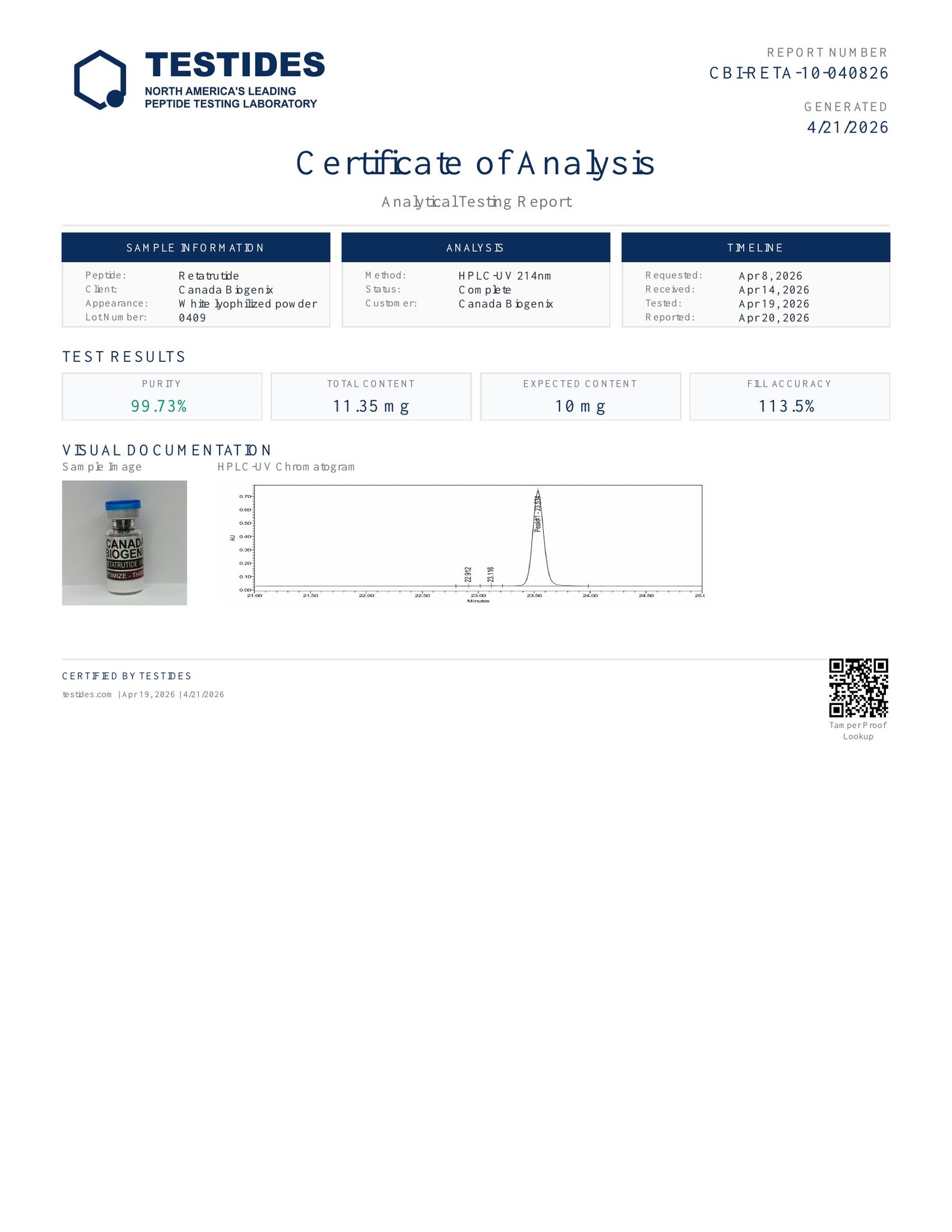
Retatrutide 10 mg is a single-molecule GIP, GLP-1 and glucagon receptor agonist attracting exceptional research interest for its potential influence on body weight, glucose regulation, liver fat, energy balance and obesity-related complications.

Retatrutide is an investigational peptide engineered to activate three metabolically important receptors within one molecule: the glucose-dependent insulinotropic polypeptide receptor (GIPR), glucagon-like peptide-1 receptor (GLP-1R) and glucagon receptor (GCGR). For this reason, researchers describe it as a triple agonist.
The design builds on established incretin research while adding glucagon-receptor activity. GLP-1 and GIP signalling may support satiety and glucose-dependent insulin response, while carefully balanced glucagon signalling may increase energy expenditure and lipid mobilization. Together, these complementary pathways are being studied as an integrated approach to weight and metabolic regulation.
Retatrutide is sometimes informally called a “GLP-3,” but this is not a scientific receptor name. The accurate description is a GIP/GLP-1/glucagon triple-receptor agonist.
Higher-dose Phase 3 groups have reported average weight reductions of approximately 28% in adults with obesity—among the strongest results yet reported for an investigational metabolic medicine.
GIPR, GLP-1R and GCGR activity brings appetite, insulin response, nutrient handling, lipid mobilization and energy expenditure into one research model.
Studies have also produced positive signals involving A1C, liver fat, waist circumference, knee pain, physical function and sleep-apnea severity.
| Target | Research role | Potential contribution |
|---|---|---|
| GLP-1 receptor | Satiety, delayed gastric emptying and glucose-dependent insulin secretion | Reduced energy intake and improved glucose regulation |
| GIP receptor | Insulin response and nutrient-sensitive metabolic signalling | Complementary incretin activity and metabolic flexibility |
| Glucagon receptor | Hepatic energy metabolism, lipid mobilization and energy expenditure | An added energy-output component beyond incretin-only signalling |
The clinical program has now produced positive results across five Phase 3 studies. The figures below describe specific trial populations and investigational pharmaceutical preparations; they are not guaranteed outcomes for every person or every formulation.
| Study | Population | Encouraging result | Evidence context |
|---|---|---|---|
| TRIUMPH-1 | Adults with obesity or overweight without diabetes | At 80 weeks, the 12 mg group averaged 28.3% weight reduction; 45.3% lost at least 30%. | Randomized Phase 3 topline results, May 2026 |
| TRIUMPH-4 | Obesity with knee osteoarthritis | At 68 weeks, the 12 mg group averaged 28.7% weight reduction, with substantial pain improvement. | Randomized Phase 3 topline results, December 2025 |
| TRANSCEND-T2D-1 | Adults with type 2 diabetes | At 40 weeks, higher-dose groups showed A1C reductions up to 2.0 percentage points and average weight reduction up to 16.8%. | Randomized Phase 3 results presented in 2026 |
| TRIUMPH-2 | Obesity or overweight with type 2 diabetes | At 80 weeks, the highest-dose group averaged 20.8% weight reduction and a 1.6-point A1C reduction. | Company topline results announced July 23, 2026; publication pending |
| TRIUMPH-3 | Severe obesity with established cardiovascular disease | At 80 weeks, the highest-dose group averaged 22.6% weight reduction. | Company topline results announced July 23, 2026; publication pending |
| Phase 2 obesity trial | Adults with obesity or overweight | At 48 weeks, the highest-dose group averaged 24.2% weight reduction, without a clear plateau. | Peer-reviewed randomized trial in The New England Journal of Medicine |
A randomized Phase 2 substudy reported more than 80% mean relative liver-fat reduction in higher-dose groups, with many participants reaching liver-fat levels below the steatosis threshold.
In Phase 3 obesity and knee-osteoarthritis research, higher-dose groups reported pain reductions of up to 73.1%, alongside improved physical function.
Phase 3 findings reported up to a 60.6% reduction in obstructive sleep-apnea severity, measured by apnea-hypopnea events per hour.
Type 2 diabetes trials have shown clinically meaningful A1C reductions together with substantial weight change, supporting the value of the combined incretin pathways.
These findings suggest that the research value of Retatrutide 10 mg extends beyond a single scale measurement and into the broader biology connecting obesity with metabolic and mechanical complications.
| Compound | Receptor activity | Research distinction |
|---|---|---|
| Semaglutide | GLP-1 receptor agonist | Established single-incretin model for appetite and glucose regulation |
| Tirzepatide | GIP and GLP-1 dual agonist | Adds complementary GIP signalling to the GLP-1 pathway |
| Retatrutide 10 mg | GIP, GLP-1 and glucagon triple agonist | Adds a glucagon-linked energy-expenditure component to dual-incretin signalling |
Cross-trial percentages should not be treated as a direct head-to-head comparison. Study populations, durations, titration schedules and statistical methods differ, and dedicated comparative trials are required to establish relative performance.
The breadth of the development program reflects the molecule’s potential to influence several connected aspects of metabolic health. Current and planned investigations include:
The 10 mg designation identifies the total research material contained in this vial. It is not a recommended dose, injection amount, cycle length or administration schedule.
Human trials have used sponsor-controlled pharmaceutical preparations with gradual, protocol-specific escalation and medical monitoring. Those clinical schedules belong to the investigational drug program and cannot be transferred directly to a third-party research vial.
Canada Biogenix does not provide a human dosing, reconstitution or administration protocol for Retatrutide 10 mg. Experimental design should be determined by qualified researchers using validated laboratory methods and institutionally approved procedures.
The overall human evidence is highly encouraging, while several important questions remain active areas of study. Gastrointestinal effects—particularly nausea, diarrhea, vomiting and constipation—have been the most commonly reported trial events and have generally been most noticeable during dose escalation.
Researchers are also evaluating long-term weight maintenance, body composition, cardiovascular outcomes, gallbladder and pancreatic events, resting heart rate and the safest balance among the three receptor pathways. In the early trials, heart rate rose initially and then moved back toward baseline over time.
Retatrutide remains investigational and is not yet an approved therapeutic product. The strong Phase 2 and Phase 3 findings support continued optimism, but clinical outcomes from sponsor-manufactured trial material should not be represented as guaranteed effects of a research product.
| Research product | Primary pathway | Research emphasis |
|---|---|---|
| Retatrutide 10 mg | GIP + GLP-1 + glucagon | Triple-agonist weight and metabolic research |
| Retatrutide 20 mg | GIP + GLP-1 + glucagon | Larger total vial quantity of the same research compound |
| Tirzepatide 10 mg | GIP + GLP-1 | Dual-incretin metabolic signalling |
| Semaglutide | GLP-1 | Single-incretin appetite and glucose research |
| MOTS-C 10 mg | Mitochondrial stress signalling | Cellular energy and metabolic-flexibility research |
Retatrutide 10 mg is supplied for qualified laboratory research and analytical applications. It is not represented as an approved therapeutic product, and this page does not provide medical advice, a treatment recommendation or a human administration protocol.