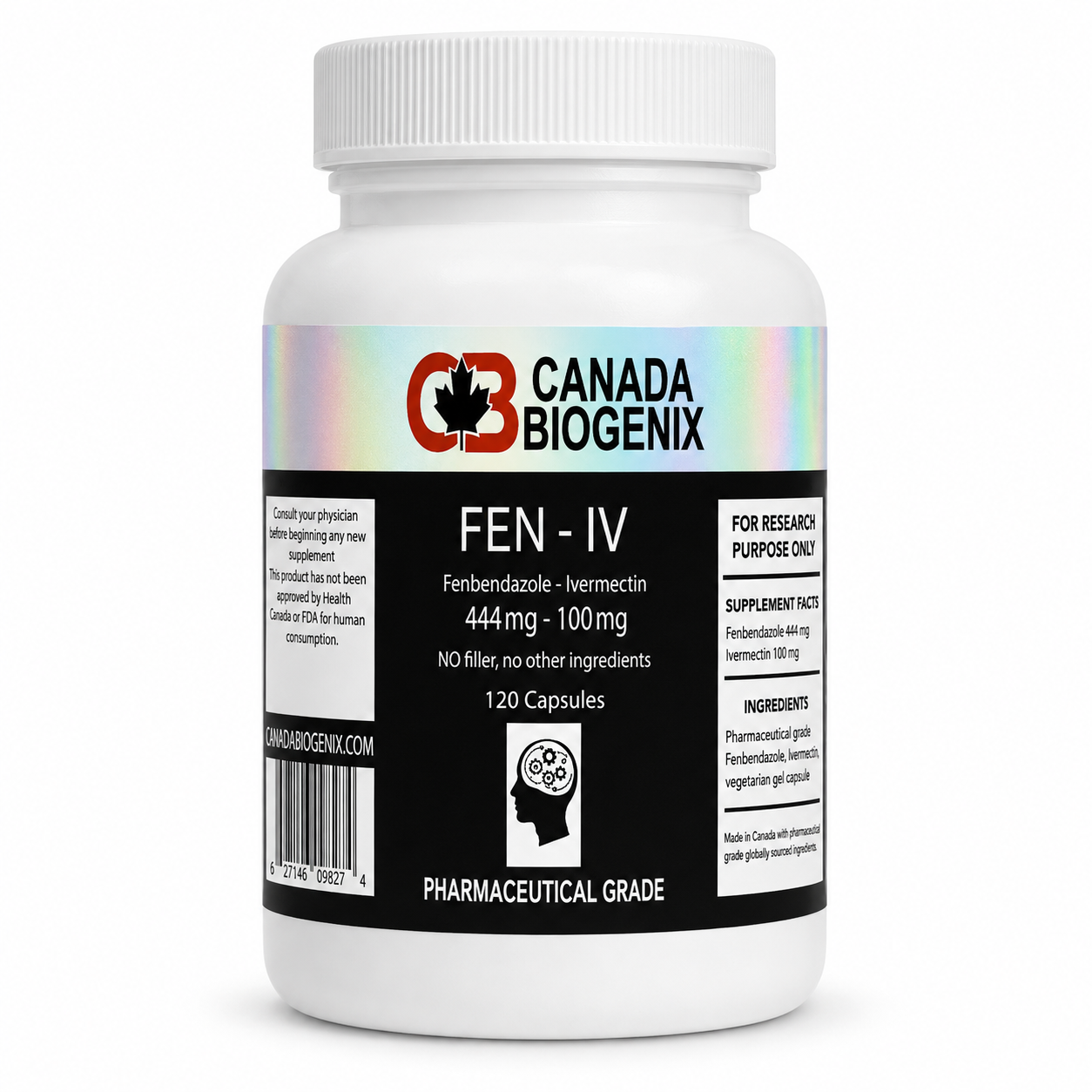
Fenbendazole 444 mg + Ivermectin 100 mg combines two established antiparasitic research classes with distinct biological targets. The pairing is also attracting drug-repurposing interest for its potential influence on microtubules, ion-channel signalling, cellular metabolism, mitochondrial stress and programmed cell death in preclinical cancer models.
Fenbendazole 444 mg + Ivermectin 100 mg combines two small-molecule anthelmintics—not peptides. Fenbendazole is a benzimidazole carbamate with established veterinary applications. Ivermectin is a macrocyclic lactone used in both veterinary medicine and approved human pharmaceutical products for specific parasitic infections.
The compounds approach susceptible parasites differently. Fenbendazole disrupts β-tubulin-dependent microtubules and energy use. Ivermectin acts primarily through invertebrate glutamate-gated chloride channels, increasing chloride movement and impairing parasite nerve and muscle function.
These separate targets create a compelling dual-pathway research concept. Beyond parasitology, each compound has independently generated positive preclinical cancer findings involving cellular proliferation, metabolism, stress signalling and cell-death pathways.
Affinity for susceptible helminth β-tubulin interferes with the assembly of microtubules required for cellular structure and transport.
Microtubule disruption impairs glucose uptake, secretion and intracellular movement, progressively depleting energy in susceptible parasites.
Ivermectin activates glutamate-gated chloride channels found in invertebrate nerve and muscle cells, increasing membrane chloride conductance.
Sustained hyperpolarization can produce paralysis and loss of parasite viability under susceptible, validated conditions.
Fenbendazole has a long record as a broad-spectrum veterinary anthelmintic against susceptible nematodes and selected other parasites. Ivermectin is widely used in veterinary parasite control and is also an approved human prescription ingredient for specific infections, including intestinal strongyloidiasis and onchocerciasis in the United States.
Comparative primate research has reported that both fenbendazole and ivermectin were effective against Trichuris infection in African green monkeys. This supports the biological relevance of both classes in parasitology, but it does not establish that combining fixed amounts is superior to selecting a validated single agent for a particular parasite.
Parasite species, developmental stage, host, formulation, exposure and resistance all influence results. The pairing is therefore most accurately presented as a dual-mechanism research formulation rather than a universal deworming solution.
Cancer cells rely on tightly coordinated division, mitochondrial function, nutrient use and survival signalling. Fenbendazole and ivermectin have independently influenced several of these systems in laboratory models:
Fenbendazole has shown moderate microtubule-destabilizing activity in cancer models, supporting research into mitotic stress and disrupted cell division.
Ivermectin studies have reported altered mitochondrial respiration, membrane potential and reactive-oxygen signalling in selected cancer models.
Both compounds have been associated with cell-cycle arrest in laboratory studies through different model-dependent signalling pathways.
Apoptosis, oxidative stress and other regulated cell-death pathways have been observed across fenbendazole and ivermectin cell studies.
Ivermectin research has examined WNT/TCF, Akt/mTOR, STAT3, PAK1 and YAP-related pathways, depending on the tumour model.
Each agent has shown positive signals in selected resistant-cell or combination-treatment models, encouraging further study of repurposed-drug strategies.
| Research model | Encouraging observation | Evidence level | Important context |
|---|---|---|---|
| Fenbendazole multiple-pathway study | Researchers reported microtubule disruption, p53 activation, altered glucose use and cancer-cell death, with activity in a mouse model. | Cancer cells and animals | Promising preclinical evidence does not determine human efficacy, safety or exposure. |
| Fenbendazole tumour-delivery study | A PLGA nanoparticle formulation reduced tumour weight in ovarian cancer xenograft models. | Cells and animal xenografts | Unformulated oral fenbendazole did not reduce tumour growth in that study, showing the importance of delivery. |
| Ivermectin ovarian cancer models | Cell and mouse studies reported reduced growth, altered cell-cycle signalling and apoptosis-related activity. | Cells and animals | Experimental concentrations and exposure may not translate to achievable or safe human use. |
| Ivermectin renal cancer models | Researchers observed preferential effects on renal cancer cells associated with mitochondrial dysfunction and oxidative stress. | Cancer cells and animals | Selectivity in a model is not proof of clinical tumour selectivity. |
| Ivermectin combination research | Synergistic laboratory findings have been reported with proteasome inhibitors in multiple-myeloma models and with gemcitabine in pancreatic-cancer models. | Cells and animal models | Those studies tested different combinations—not ivermectin with fenbendazole. |
| Fenbendazole + ivermectin | Their distinct mechanisms provide a rational basis for controlled combination research. | Research hypothesis | Direct synergy, cancer efficacy, safety and optimal exposure for this exact pairing have not been established. |
The strongest rationale is mechanistic breadth. Fenbendazole research centres on tubulin, microtubules, nutrient transport and mitosis. Ivermectin reaches a different set of systems, ranging from invertebrate chloride channels in parasitology to mitochondrial function and multiple signalling networks in cancer models.
In principle, compounds that affect non-identical biological targets may produce additive, complementary, antagonistic or entirely independent responses. Researchers determine which pattern is present through concentration matrices, single-agent controls, combination-index analysis, pharmacokinetics and toxicity testing.
The responsible positive conclusion is that the pairing creates a credible multi-pathway research hypothesis. It is not yet evidence that the fixed combination outperforms either component alone.
William Makis, a Canadian-trained physician and former radiologist, has become a prominent advocate for studying repurposed antiparasitic compounds in oncology. He has publicly described a large international clientele using protocols that feature ivermectin and benzimidazoles such as mebendazole or fenbendazole, and he has shared individual reports of favourable cancer outcomes.
This advocacy has helped increase public and scientific interest in formally evaluating these compounds. However, a client count is not a cure count. Testimonials and practitioner-reported outcomes cannot determine how many people improved, whether standard cancer treatment produced the result, how many did not respond, or whether adverse outcomes were fully captured.
No independently audited dataset or controlled clinical trial currently verifies a claim that ivermectin cured thousands of cancer patients. A three-patient fenbendazole case series co-authored by Makis was published in 2025 but subsequently retracted, so it should not be treated as reliable confirmation of efficacy.
Positive cell findings require adequate exposure at the intended biological site. Fenbendazole has low aqueous solubility and variable absorption, while ivermectin is highly lipophilic, extensively protein bound and actively handled by transport proteins such as P-glycoprotein.
Those differences affect distribution, metabolism, interaction potential and the relationship between a laboratory concentration and an achievable biological concentration. A fixed mass ratio does not guarantee equal target exposure or predictable combined activity.
The 444 mg fenbendazole and 100 mg ivermectin figures identify the labelled amounts associated with the product unit. They do not establish a human dose, cancer protocol, administration schedule or equivalent exposure to any published study.
Fenbendazole has approved veterinary uses, while pharmaceutical ivermectin has approved human and veterinary uses for specific parasites and formulations.
Both compounds have produced encouraging results across selected preclinical tumour models and mechanistic pathways.
Controlled human evidence has not established cancer benefit, a safe cancer dose, synergy or a validated schedule for this pairing.
Evidence attached to an approved single-ingredient drug does not transfer automatically to this combination. Pharmaceutical ivermectin has defined indications, formulation standards and weight-based prescribing information. Fenbendazole remains primarily a veterinary drug, and published reports have described liver injury during self-directed human use.
Ivermectin exposure can be influenced by other medicines and transport proteins; excessive exposure may cause significant neurological toxicity. The safety, interactions and pharmacokinetics of this fixed combination have not been established as a human cancer regimen.
The research rationale is scientifically interesting and worthy of controlled investigation. It should not be presented as a replacement for evidence-based cancer care, medical evaluation or appropriately selected antiparasitic treatment.
No. Fenbendazole is a benzimidazole carbamate and ivermectin is a macrocyclic lactone. Both are small-molecule antiparasitic compounds.
Their targets are different. Fenbendazole disrupts parasite microtubules and energy use, while ivermectin acts primarily through invertebrate chloride channels. This creates a useful dual-mechanism research model.
No. Susceptibility depends on parasite species, developmental stage, host, resistance, formulation and exposure. A combination should not be assumed to provide universal coverage.
Fenbendazole has attracted interest for microtubule, cell-cycle and metabolic effects. Ivermectin has been investigated for mitochondrial stress, apoptosis and several survival-signalling pathways. These findings create a multi-target repurposing hypothesis.
No. Most oncology findings for either compound come from cells and animals. Controlled human trials have not established efficacy, safety, synergy or a validated cancer protocol for this exact combination.
Personal reports can generate research questions, but they cannot separate the effect of a compound from standard treatment, disease variation, selection bias or incomplete reporting. Controlled studies are needed to determine cause and effect.
No. Approval applies to a specific drug, formulation, strength, indication and manufacturing standard. It does not transfer to a combination product or an oncology use.
They identify the labelled quantities of fenbendazole and ivermectin associated with the product unit. They are not a human dose, administration schedule or treatment recommendation.
No. Visual inspection may reveal obvious damage or contamination, but suitable analytical testing and lot documentation are required to assess identity, strength and purity.
Review the Canada Biogenix product page for current product details and availability.
Research and evidence notice: Fenbendazole 444 mg + Ivermectin 100 mg is discussed here for scientific and educational purposes. Both compounds have established antiparasitic evidence in specific approved contexts; oncology investigation remains predominantly preclinical, and the exact combination has not been established as a human cancer treatment. This page does not provide medical advice, a human dosing protocol or support replacing standard cancer or antiparasitic care.