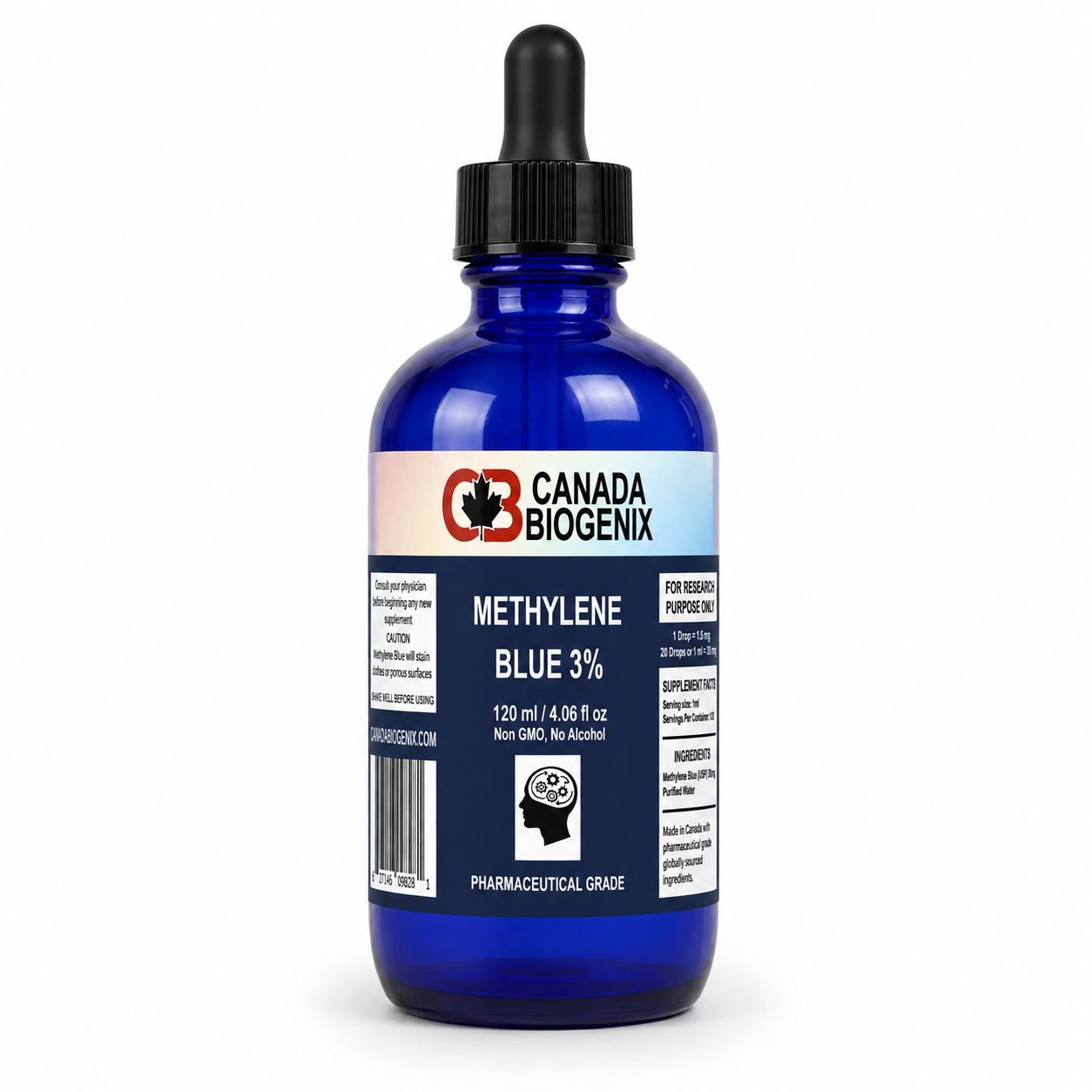
Methylene Blue 10 mg is a redox-active research compound attracting substantial interest for its potential influence on mitochondrial electron transfer, cellular energy, memory networks, protein-clearance pathways and light-activated antimicrobial research.
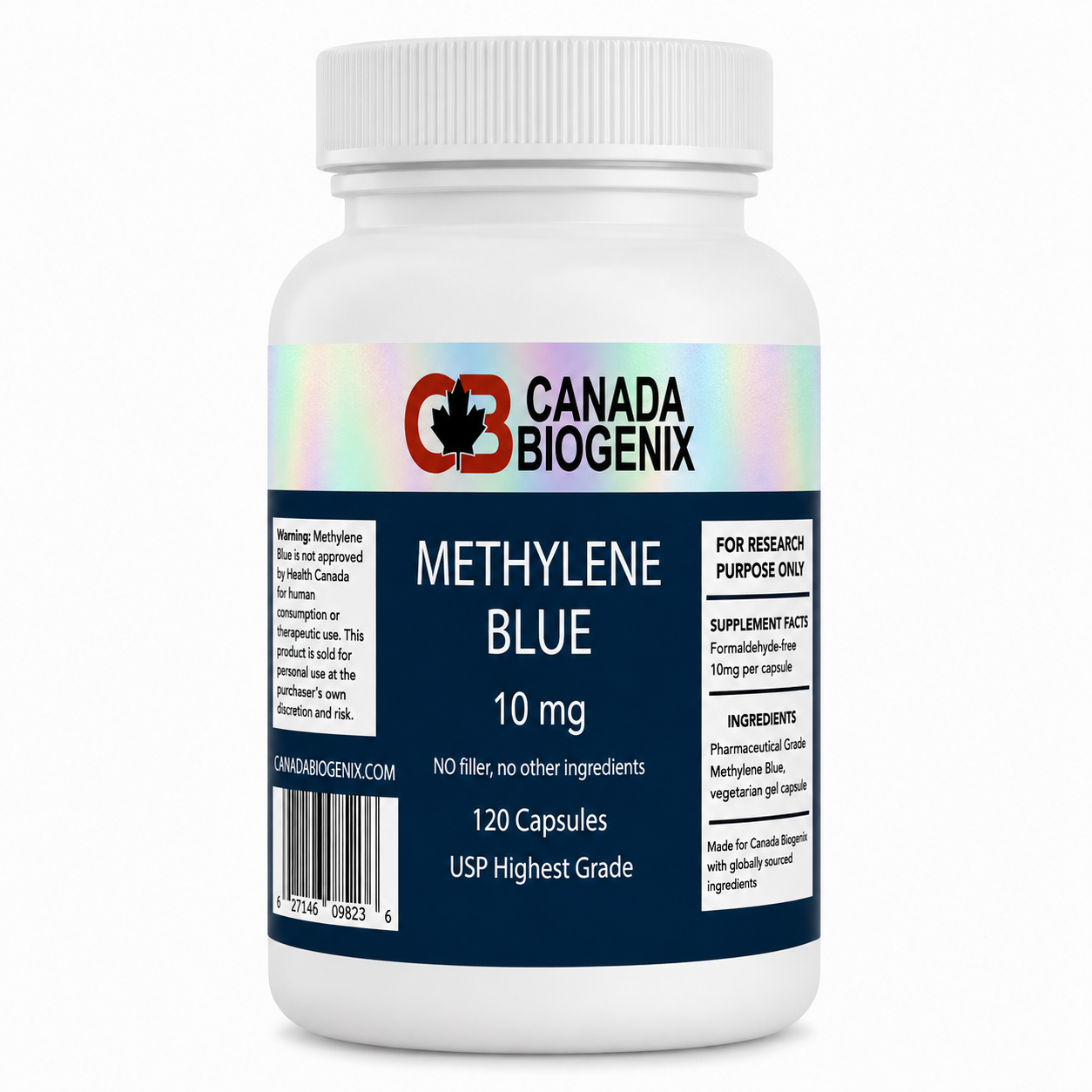
Methylene blue, also called methylthioninium chloride, is a synthetic thiazine dye with an unusually broad scientific history. It has been used as a biological stain, redox indicator, photosensitizer and pharmaceutical compound.
Its most distinctive property is reversible redox cycling. The blue oxidized molecule can accept electrons and become reduced leucomethylene blue, a nearly colourless form. It can then transfer those electrons and return to its oxidized state. This repeatable cycle makes the compound especially interesting in mitochondrial and cellular-metabolism research.
A pharmaceutical intravenous formulation has an established medical role in acquired methemoglobinemia. However, research involving mitochondria, cognition, neurodegeneration, longevity or antimicrobial photodynamic activity represents a separate evidence track and should not be treated as an established use for this product.
Oxidized methylene blue can accept electrons from reduced cellular molecules such as NADH-related systems.
After accepting electrons, it converts to leucomethylene blue while retaining the capacity to be reoxidized.
The reduced form can pass electrons toward cytochrome c and other acceptors, creating an alternative route for experimental electron flow.
Reoxidation completes the cycle, allowing the molecule to participate repeatedly in redox reactions under suitable conditions.
Cell and animal studies suggest that low experimental concentrations may support electron flow, cytochrome-c-oxidase activity, oxygen consumption and ATP-related bioenergetics.
A small randomized functional-MRI study in healthy adults reported changes in brain-network activity during attention and memory tasks, together with improved memory retrieval.
Preclinical models have examined tau aggregation, autophagy and protein-clearance pathways, creating a compelling rationale for continued neurodegeneration research.
Human skin-cell and reconstructed-tissue studies have reported encouraging mitochondrial, oxidative-stress and cellular-senescence findings.
When activated by suitable light, methylene blue can generate reactive oxygen species that researchers use to investigate localized antimicrobial activity and biofilm disruption.
Its concentration-dependent effects on oxidation, nitric-oxide signalling and cellular enzymes make it a useful probe across many experimental systems.
| Research area | Encouraging observation | Evidence level | Important context |
|---|---|---|---|
| Mitochondrial energy | Primary astrocyte research reported increased oxygen consumption, glucose uptake and ATP production under oxygen-glucose stress. | Cell study | Bioenergetic effects are concentration and model dependent. |
| Attention and memory | A randomized study reported increased task-related fMRI activity and enhanced memory retrieval in healthy adults after a single exposure. | Small human study | One study does not establish sustained cognitive enhancement or treatment of cognitive disease. |
| Tau and autophagy | Brain-slice, cell and mouse work reported changes in autophagy markers and reduced abnormal tau forms. | Preclinical models | Larger trials of methylene-blue-related tau compounds have produced mixed results. |
| Cellular aging and skin | Cultured human fibroblasts and reconstructed skin models showed positive findings involving reactive oxygen species, mitochondrial function and senescence markers. | Laboratory tissue research | These findings do not establish whole-body anti-aging effects. |
| Antimicrobial photodynamics | Methylene-blue-plus-light systems have produced substantial reductions in selected bacterial isolates and biofilm models. | In-vitro and application-specific research | Results depend strongly on light wavelength, exposure, concentration, organism and delivery site. |
| Methemoglobin reduction | Its redox chemistry can convert methemoglobin toward functional hemoglobin through an established pharmaceutical mechanism. | Established prescription use | This applies to an approved intravenous drug and does not establish other uses or equivalence for this product. |
Mitochondria normally move electrons through a series of protein complexes to create the gradient used for ATP production. Under stress, electron-transfer efficiency may decline and reactive oxygen species may rise. Methylene blue is being studied as a redox shuttle that may accept electrons from reduced cellular molecules and transfer them toward downstream components such as cytochrome c.
This alternative-electron-cycling hypothesis is especially attractive because it connects several measurable outcomes: oxygen consumption, cytochrome-c-oxidase activity, ATP production, oxidative-stress balance and cellular resilience.
At the same time, newer experiments show that methylene blue does not behave as a simple universal bypass for every blocked respiratory complex. The most useful interpretation is that it is a powerful, context-dependent redox modulator—precisely why it remains such an active research compound.
Brain tissue has unusually high energy requirements, making mitochondrial efficiency a central theme in cognitive and neurodegeneration research. Preclinical work has examined whether methylene blue can support cellular respiration under metabolic stress and influence neural systems involved in memory.
A small randomized fMRI study in healthy adults reported greater activity during sustained-attention and short-term-memory tasks, together with improved memory retrieval. Separate cell, brain-slice and animal studies have explored tau aggregation and autophagy, the cellular recycling pathway involved in clearing damaged proteins.
These findings form a positive research foundation. However, clinical trials of methylene-blue-derived tau-aggregation inhibitors have not produced consistently conclusive outcomes. Therefore, the compound remains an intriguing research candidate rather than an established cognitive or neurodegenerative therapy.
Methylene blue absorbs visible red light and can act as a photosensitizer. When exposed to a suitable wavelength, the excited molecule transfers energy to surrounding oxygen and generates reactive oxygen species. Researchers are studying whether this localized chemistry can damage microbial membranes, proteins and nucleic acids.
Positive findings have been reported across selected bacteria, fungi and biofilm models, including antibiotic-resistant isolates. Because photodynamic action attacks several cellular targets at once, it offers an appealing research strategy where conventional single-target resistance is a concern.
Results are highly protocol dependent. Light wavelength, intensity, exposure time, methylene-blue concentration, oxygen availability and microorganism all influence activity. These studies investigate specialized light-activated systems and do not imply that an unactivated capsule has the same antimicrobial effect.
Methylene blue frequently displays a hormetic or biphasic pattern. Lower experimental concentrations may support electron cycling and antioxidant-like effects, while higher concentrations can promote oxidation, inhibit enzymes or disrupt cellular systems.
This means that more is not automatically better. Cell type, purity, concentration, exposure time, redox state, route and interacting compounds can change the direction of an experimental result.
The 10 mg designation identifies the amount associated with each capsule. It is not a treatment recommendation, research protocol or evidence that one quantity is appropriate across different experimental models.
The characteristic blue colour is not enough to prove identity. Suitable analytical methods are required to distinguish methylene blue from related dyes and degradation products.
Industrial, textile, aquarium and biological-stain grades may have different impurity limits and are not interchangeable with carefully controlled research or pharmaceutical material.
Lot information, composition and analytical documentation help make experimental findings more reproducible and easier to interpret.
Methylene blue is biologically active and is a potent reversible inhibitor of monoamine oxidase. Official pharmaceutical labelling warns of potentially serious serotonin syndrome when methylene-blue-class products are combined with serotonergic medicines or certain opioids. Relevant categories include SSRIs, SNRIs, MAO inhibitors, some other antidepressants, linezolid, dextromethorphan and selected opioids.
Pharmaceutical methylene blue is also contraindicated in glucose-6-phosphate dehydrogenase deficiency because of the risk of severe hemolysis. Additional concerns include pregnancy, kidney impairment, hypersensitivity, phototoxicity and interference with some monitoring devices or laboratory tests.
These established pharmacological risks reinforce why promising mitochondrial, cognitive, longevity and antimicrobial findings should remain research observations rather than self-directed medical claims or administration guidance.
No. Methylene blue is a small synthetic phenothiazinium compound with reversible redox and dye properties.
Its oxidized and reduced forms can exchange electrons. Researchers are investigating whether this cycling can support electron transport, cellular respiration and ATP-related bioenergetics under specific experimental conditions.
No definitive cognitive benefit has been established. A small randomized healthy-adult study reported encouraging memory and fMRI findings, while broader disease-treatment evidence remains mixed and incomplete.
It is the reduced, nearly colourless form of methylene blue. Reversible cycling between these redox states is central to the compound’s electron-transfer chemistry.
The molecule absorbs red light and can transfer energy to oxygen, generating reactive species that researchers use to study localized antimicrobial, biofilm and photodynamic effects.
Its behaviour is context dependent. Some low-concentration models show antioxidant-like or respiration-supporting effects, while other conditions produce pro-oxidant effects. Describing it as a redox modulator is more accurate.
Yes. Pharmaceutical labelling carries a serious warning about serotonin syndrome with serotonergic medicines and certain opioids. This is a major evidence-based safety consideration, not a theoretical concern.
No. It identifies the amount associated with the capsule. It is not a human dosing recommendation, medical protocol or guarantee of a particular experimental outcome.
Different grades may have very different impurity specifications. Colour and concentration alone cannot establish suitability, identity or purity for a research application.
Review the Canada Biogenix product page for current product details and availability.
Research and evidence notice: Methylene Blue 10 mg is presented for laboratory research and scientific discussion. Emerging mitochondrial, cognitive, neurodegeneration, longevity and antimicrobial findings do not establish medical benefits for this product. This content is not medical advice or an administration guide.