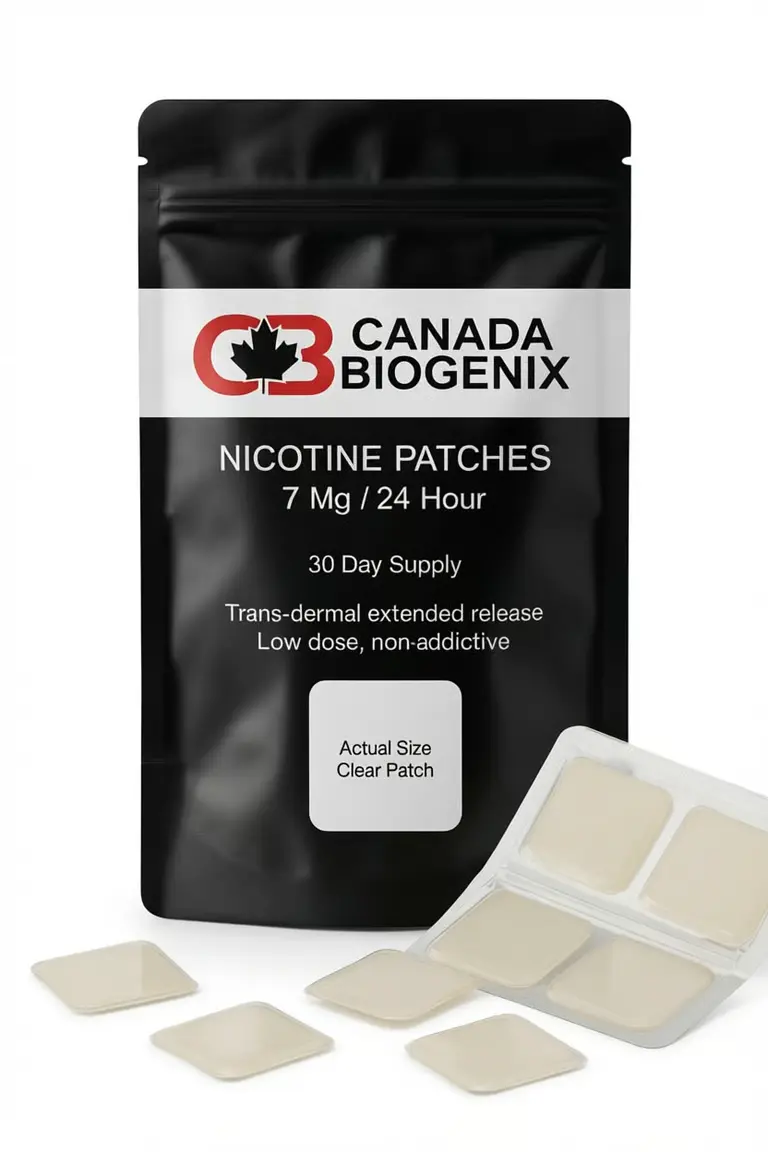
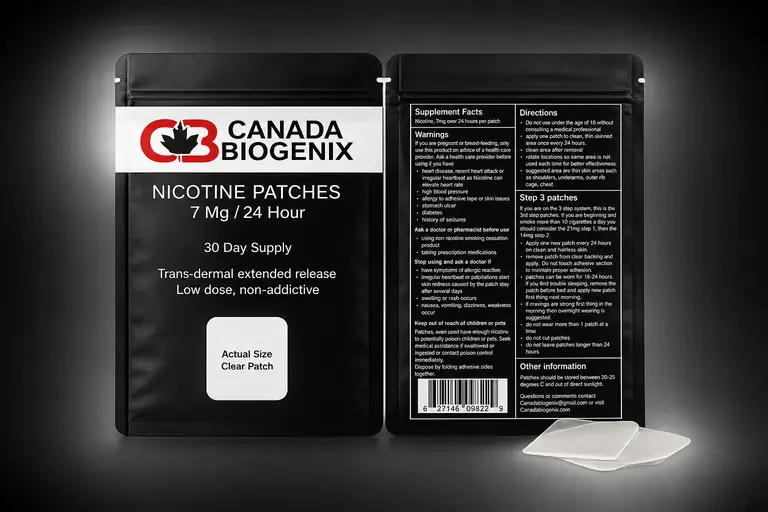

Our nicotine patches combine natural tobacco extract with a blend of botanical oils and peppermint powder.
Contains nicotine. See the product label for full composition and the safety information below.
Nicotine Patches 7 mg provide gradual transdermal delivery over 24 hours. In addition to their established role in nicotine-replacement therapy, nicotine patches are attracting research interest for their potential influence on attention, memory networks, nicotinic acetylcholine receptors, neuroinflammatory signalling and the cholinergic anti-inflammatory pathway.
Nicotine Patches 7 mg are extended-release transdermal systems designed to deliver nicotine gradually through the skin over approximately 24 hours. The patch avoids combustion and therefore does not expose the user to the tar, carbon monoxide and thousands of smoke constituents responsible for most smoking-related disease.
Nicotine acts as an agonist at nicotinic acetylcholine receptors, often abbreviated nAChRs. These receptors are found throughout the nervous system and on several immune-cell populations. Their activity influences attention, sensory processing, neurotransmitter release, autonomic signalling and inflammatory regulation.
The 7 mg strength is commonly recognized as the lower step in nicotine-replacement systems. Its slow delivery produces a much more gradual blood-level profile than inhaled nicotine, reducing the rapid reinforcement associated with cigarettes or vaping while maintaining sustained receptor exposure.
Nicotine crosses the skin at a controlled rate, producing slower and steadier exposure than inhaled delivery.
Nicotine binds receptor subtypes including α4β2 and α7, changing neuronal excitability and intracellular signalling.
Acetylcholine, dopamine, glutamate and other transmitter systems can be modulated in attention, memory and cognitive-control networks.
Repeated exposure can desensitize and upregulate receptors, making dose, duration, baseline nicotine use and withdrawal status important.
Controlled research has found positive signals in sustained attention, reaction-time consistency and task-focused information processing.
Selected studies have reported encouraging effects on episodic memory, delayed recall and novelty detection, particularly in populations with measurable cognitive deficits.
α7 nicotinic receptors help connect vagal cholinergic signalling with immune-cell control of cytokines such as tumour-necrosis factor.
Microglia, astrocytes and other neural cells express nicotinic receptors, creating promising targets for studying inflammatory signalling in the brain.
Mild cognitive impairment studies examine whether steady nicotinic stimulation can strengthen attention and memory systems before more advanced decline.
By supporting smoking cessation without combustion exposure, nicotine-replacement therapy can contribute to one of the most important modifiable cancer-risk reductions.
| Research area | Encouraging observation | Evidence level | Important context |
|---|---|---|---|
| Smoking cessation | Large systematic reviews find that nicotine-replacement therapy increases long-term quit rates by approximately 50–60% relative to control conditions. | High-certainty human evidence | The strongest established role for patches is reducing withdrawal and supporting cessation. |
| Mild cognitive impairment | A six-month randomized pilot reported improvements in a primary attention measure and selected memory outcomes in nonsmoking adults with MCI. | Small human randomized trial | Global clinical improvement was not statistically significant, and the study was not proof of disease modification. |
| Attention and memory | A meta-analysis found a significant positive effect on attention, while the pooled memory effect was not significant. | Systematic review and meta-analysis | Benefits vary with population, task, baseline performance, nicotine history and exposure. |
| Inflammatory signalling | α7 nicotinic-receptor activation can inhibit macrophage TNF release and alter NF-κB-associated cytokine signalling. | Mechanistic and preclinical evidence | A receptor mechanism does not establish nicotine patches as a general anti-inflammatory treatment. |
| Neuroinflammation | Cell and animal studies report reduced pro-inflammatory microglial activity and neurotoxic signalling after α7-pathway activation. | Preclinical evidence | Many studies use selective α7 agonists rather than transdermal nicotine itself. |
| Cancer risk and NRT | Long-term follow-up of a smoking-cessation cohort did not find evidence that nicotine-replacement exposure increased cancer risk. | Human observational follow-up | This supports NRT safety; it does not mean nicotine treats an existing cancer. |
Nicotinic acetylcholine receptors help tune the brain’s response to incoming information. α4β2 receptors are strongly involved in attention and reinforcement, while α7 receptors influence sensory filtering, synaptic plasticity, memory formation and interactions among acetylcholine, glutamate and dopamine.
The six-month MCI pilot by Newhouse and colleagues provides one of the most encouraging patch-specific signals. Nicotine-treated participants improved on a continuous-performance attention measure and selected episodic-memory outcomes. The larger Phase 2 MIND study subsequently enrolled 348 participants and has been completed, although results had not been posted publicly when this page was prepared.
Research in healthy nonsmokers is less consistent. Some studies report improved attention, novelty detection or memory, while others find no benefit or even reduced working-memory accuracy. This suggests nicotine is better described as a context-dependent cognitive modulator than a universal performance enhancer.
“Nootropic” therefore describes an active research direction—not an approved indication or a guarantee that a patch will improve cognition in every user.
The nervous and immune systems communicate continuously. In the inflammatory reflex, vagal cholinergic signalling can restrain excessive cytokine production. Landmark research identified the α7 nicotinic acetylcholine receptor as a key part of acetylcholine-mediated inhibition of macrophage tumour-necrosis factor release.
When α7 receptors are engaged, intracellular signalling can reduce NF-κB-associated inflammatory activity and alter cytokine output. This pathway has inspired research across inflammatory bowel disease, sepsis, arthritis, metabolic inflammation and tissue-injury models.
Transdermal-nicotine trials in ulcerative colitis produced a real human proof-of-concept that nicotinic signalling can affect inflammatory disease symptoms. Results and tolerability varied, and the findings do not make nicotine a broad anti-inflammatory therapy, but they strengthen the biological rationale for continued receptor-focused research.
Microglia are the brain’s resident immune cells. When appropriately activated, they help clear debris and respond to injury. When activation becomes prolonged or dysregulated, microglia can release cytokines and reactive molecules that contribute to neuronal stress.
α7 nicotinic receptors are expressed on microglia, astrocytes and other neural cells. Laboratory studies suggest that activating this pathway may reduce pro-inflammatory microglial signalling, limit inflammatory neurotoxicity and influence neuronal-survival pathways.
These mechanisms are relevant to research on Alzheimer’s disease, Parkinson’s disease, brain injury, stroke and age-related cognitive decline. However, much of the positive evidence comes from cells, animals or selective α7 compounds. Clinical nicotine-patch studies have produced mixed outcomes, including a negative controlled Parkinson’s trial.
The strongest interpretation is that nicotinic signalling is a promising neuroimmune target. It has not yet established a nicotine patch as a treatment for brain inflammation or neurodegenerative disease.
Nicotine is not the principal carcinogen responsible for smoking-related cancer. Combustible tobacco exposes the body to numerous DNA-damaging chemicals, while regulated nicotine-replacement therapy provides nicotine without smoke, tar or carbon monoxide. Long-term follow-up studies have not demonstrated that NRT causes lung cancer.
For people who smoke, the patch’s most meaningful anticancer contribution is indirect but substantial: helping end exposure to combustible tobacco. Systematic reviews show that NRT meaningfully improves quit rates, and smoking cessation lowers the risk of developing and dying from several cancers over time.
Nicotine should not be called an anticancer compound, however. Cancer cells can express nicotinic receptors, and laboratory models have linked nicotine exposure with proliferation, angiogenesis, migration, resistance to apoptosis or treatment response. Other models find no tumour-initiation or progression effect at NRT-comparable exposures, and a recent systematic review described the preclinical progression evidence as inconsistent.
Cigarettes and inhaled nicotine deliver a rapid rise in brain nicotine levels, closely pairing the dose with sensory cues and reward. This rapid pharmacokinetic pattern strongly reinforces repeated use.
A patch delivers nicotine much more slowly. The gradual rise produces less intense reinforcement and steadier receptor exposure, which is why transdermal systems are useful for controlling withdrawal throughout the day.
Slower delivery lowers abuse potential relative to inhaled nicotine, but it does not make nicotine non-addictive or risk-free. Baseline nicotine dependence, duration of use and individual sensitivity remain important.
Keep each patch sealed in its pouch until needed and follow the storage conditions printed on the packaging.
Do not use a patch from an open or damaged pouch. Do not cut patches unless the manufacturer specifically confirms that the system permits it.
Used patches retain nicotine. Fold adhesive sides together, return them to the pouch and keep them away from children and pets.
Nicotine is pharmacologically active, toxic in excessive amounts and capable of producing dependence. It can increase heart rate and blood pressure. Product labelling advises medical guidance for people with recent heart problems, irregular heartbeat, uncontrolled hypertension, seizure history, diabetes, skin disease, pregnancy or breastfeeding.
Nicotine exposure is particularly inappropriate for children and adolescents because the developing brain is more vulnerable to addiction and lasting neurobiological effects. Patches must be stored and discarded where children and pets cannot reach them.
Smoking cessation is the established use. Cognitive enhancement, neuroinflammation, inflammatory disease and oncology are research areas rather than approved indications for this product.
Nicotine is the main addictive ingredient, but it is not the primary cause of smoking-related cancer. Combustion creates or delivers many carcinogens that are not present in regulated nicotine-replacement patches.
They have not been shown to treat cancer. Their strongest cancer-related benefit is helping people stop smoking, thereby ending exposure to combustible-tobacco carcinogens and progressively lowering future cancer risk.
Nicotinic receptors influence attention, sensory filtering, memory formation and cognitive-control networks. Positive attention and memory findings have been reported, but outcomes are context dependent and not universally beneficial.
A small randomized MCI trial reported improvements in selected attention and memory measures. Meta-analysis found a significant attention effect but not a significant pooled memory effect, so a general memory-enhancement claim is not established.
It is a neuroimmune control system in which cholinergic signalling—particularly through α7 nicotinic receptors—can restrain the release of selected inflammatory cytokines.
No clinical treatment claim has been established. Cell and animal research involving microglia and α7 receptors is encouraging, but selective receptor compounds and transdermal nicotine are not interchangeable.
Patches deliver nicotine slowly and do not create the rapid brain spike associated with inhalation, giving them substantially lower reinforcement and abuse potential. Nicotine still produces dependence and must be used responsibly.
No. The labelled 7 mg is delivered gradually over approximately 24 hours rather than as a single rapid dose.
Do not cut a patch unless its manufacturer explicitly confirms that the particular design can be divided. Cutting may damage the delivery system or make the dose unpredictable.
A used patch can retain enough nicotine to cause poisoning. Fold it adhesive-side inward, return it to its pouch and dispose of it according to the package directions.
Review the Canada Biogenix product page for current product details and availability.
Evidence notice: Nicotine Patches 7 mg are presented with smoking cessation as their established purpose. Findings involving cognition, attention, neuroinflammation, inflammatory disease and nicotinic receptors in cancer are active research areas and do not establish approved benefits for those uses. This page is educational and does not replace the product label or professional medical advice.