
Last Updated: September 27, 2026
Bacteriostatic water peptides require a specific solvent to maintain stability and efficacy during storage and use. Bacteriostatic water is sterile water for injection that contains benzyl alcohol as a preservative, designed to inhibit microbial growth while keeping reconstituted peptides viable for extended periods. This distinction matters because standard sterile water lacks antimicrobial protection, leaving peptide solutions vulnerable to contamination and degradation over time.
When you reconstitute lyophilized peptide powder, the choice of diluent directly affects how long your compound remains stable and effective. Many researchers overlook this detail, assuming any sterile water will suffice. The reality is that without proper preservation, bacterial and fungal growth can compromise your research results within days.
Benzyl alcohol serves as the critical antimicrobial agent in bacteriostatic water, typically present at 0.9% w/v concentration. This preservative suppresses bacterial suppression by creating an environment where microorganisms cannot replicate, even if the vial is opened multiple times during your research protocol.
The mechanism is straightforward: benzyl alcohol disrupts microbial cell membranes and interferes with metabolic processes. This means your reconstituted peptide solution remains sterile across multiple withdrawals, a practical advantage when you’re running repeated tests or administering injections over several weeks. Without this preservative, each time you access the vial, you introduce contamination risk.
One thing most guides miss is that benzyl alcohol also helps stabilize the peptide solution itself by reducing oxidative stress. This dual role makes it far more valuable than simply preventing bacterial growth.
The reconstitution process determines whether your peptide maintains full potency or degrades prematurely. Here’s the step-by-step approach used by experienced researchers:
Step 1: Prepare Your Workspace, Use a clean, dust-free environment. Wipe down your work surface with an alcohol-based disinfectant. Gather your lyophilized peptide vial, bacteriostatic water, sterile syringes, and alcohol prep pads.
Step 2: Calculate Your Desired Concentration, Determine how many micrograms per milliliter you need. If your vial contains 10 milligrams and you want 100 micrograms per milliliter, you’ll need 100 millilitres of bacteriostatic water. Write this calculation down to avoid errors.
Step 3: Draw Bacteriostatic Water Into a Sterile Syringe, Use a fresh, sterile syringe. Draw the exact volume you calculated. Keep the needle sterile by capping it immediately.
Step 4: Inject Into the Peptide Vial, Wipe the rubber septum of the peptide vial with an alcohol prep pad. Allow it to dry completely. Insert the needle at a slight angle and inject the bacteriostatic water slowly into the vial. Do not force the water in rapidly, as this can cause foaming and denature the peptide.
Step 5: Allow Dissolution, Let the vial sit undisturbed for 5-10 minutes. The peptide will gradually dissolve. You may gently roll the vial between your palms to speed dissolution, but avoid shaking vigorously.
Step 6: Verify Complete Dissolution, The solution should be clear and free of particles. If cloudiness persists after 15 minutes, the peptide may have been compromised before reconstitution.
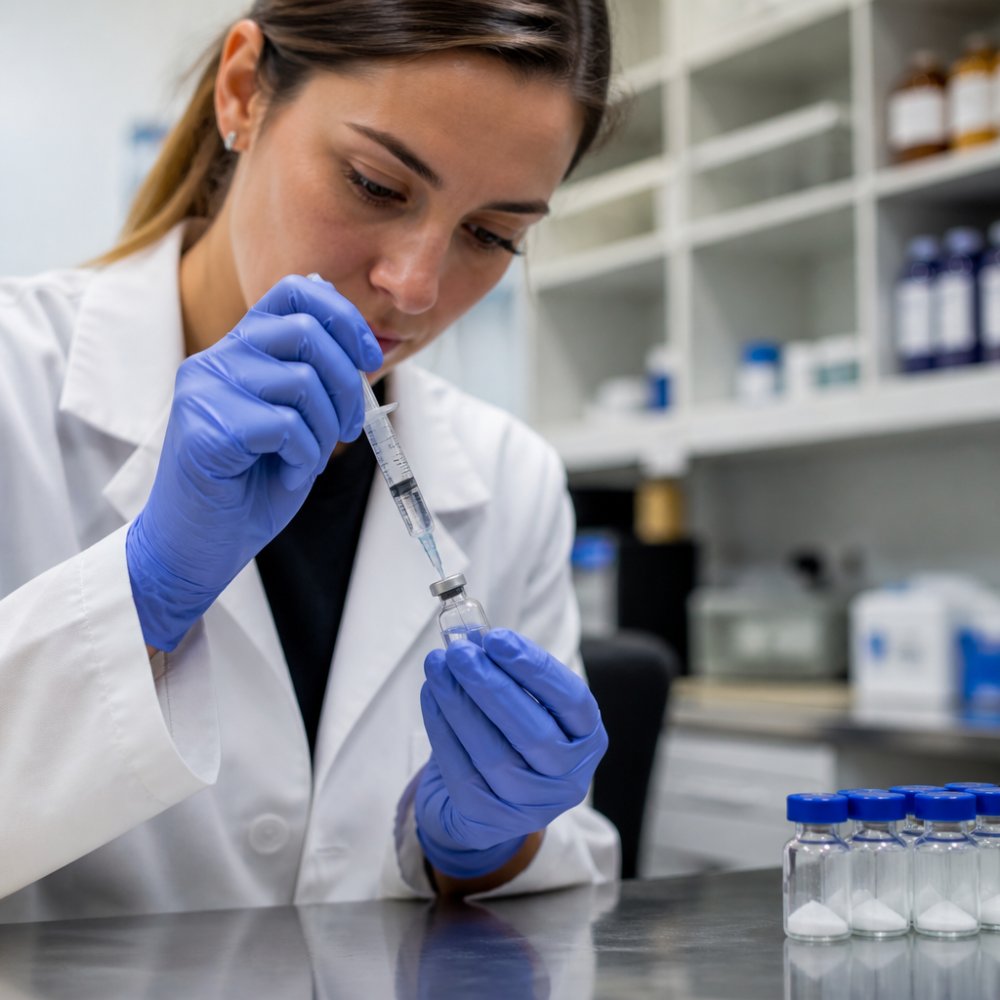
Aseptic technique prevents contamination during every step of reconstitution and administration. This means working with sterile equipment, maintaining a clean environment, and minimizing exposure of the solution to non-sterile air.
Proper aseptic technique also extends shelf life. Every time you access the vial with a non-sterile needle or in an uncontrolled environment, you introduce contamination risk. Using fresh sterile needles for each withdrawal and maintaining a clean injection site ensures your reconstituted peptide remains viable for the full duration of your protocol.
The shelf life of reconstituted peptides with bacteriostatic water typically extends 14-28 days when stored correctly. This is significantly longer than reconstitutions using standard sterile water, which often degrade within 3-7 days due to microbial contamination.
The benzyl alcohol preservative is what enables this extended window. Once you open a vial and begin withdrawals, the preservative actively suppresses any microorganisms introduced through the needle puncture. This allows you to run multi-week research protocols without needing to reconstitute fresh batches constantly.
Temperature and light exposure affect how quickly degradation occurs. A reconstituted peptide stored at 2-8°C (refrigerated) will remain stable longer than one kept at room temperature. Exposure to direct sunlight or UV light accelerates peptide degradation regardless of the preservative, so dark storage is essential.
Many researchers make the mistake of assuming bacteriostatic water extends shelf life indefinitely. It does not. Even with benzyl alcohol protection, peptides gradually degrade through normal chemical processes. After 28 days, potency begins to decline noticeably, and by 30-35 days, most peptides have lost measurable efficacy. Mark your vial with the reconstitution date and plan your research timeline accordingly.
Sterile water for injection contains no preservatives. It is pyrogen-free and sterile when you open the vial, but it offers no ongoing protection against microbial growth. Once you puncture the rubber septum and begin withdrawals, bacteria and fungi can colonize the solution.
Bacteriostatic water includes the 0.9% benzyl alcohol preservative. This active ingredient suppresses microbial growth throughout the vial’s open lifespan, allowing multiple withdrawals without contamination risk. For peptide research where you need repeated access to your reconstituted solution, bacteriostatic water is the standard choice.
The practical difference emerges quickly. A vial of reconstituted peptide in sterile water may become cloudy or show visible contamination within a week of opening. The same peptide in bacteriostatic water remains clear and potent for weeks. If your research requires only a single withdrawal, sterile water is sufficient and more economical. If you need multiple doses from one vial, bacteriostatic water is the only reliable option.
Cost and availability also differ slightly. Sterile water is widely available and inexpensive because it requires no preservative. Bacteriostatic water costs more due to the addition and testing of the benzyl alcohol component, but the extended usability typically justifies the expense for active research protocols.
Using bacteriostatic water for peptide reconstitution delivers several measurable advantages that directly impact research quality and efficiency.
Extended Usability Window, A single reconstituted vial remains viable for 14-28 days instead of 3-7 days. This eliminates the need to reconstitute fresh batches multiple times within a single research protocol, saving time and reducing waste.
Reduced Contamination Risk, The benzyl alcohol preservative actively suppresses bacterial and fungal growth. Each time you access the vial, the preservative continues protecting your solution, allowing safe multiple withdrawals without sterile technique degradation.
Improved Dosage Accuracy, Because the solution remains stable longer, you can maintain consistent concentration across all doses throughout your protocol. Degraded or contaminated solutions introduce variability that compromises data integrity.
Better Injection Comfort, The benzyl alcohol acts as a mild local anesthetic, reducing injection site irritation and burning sensations. This matters for protocols involving repeated injections or human subject research.
Simplified Storage and Logistics, You need fewer vials and less frequent reconstitution, reducing inventory management complexity and lowering overall costs despite the slightly higher per-unit price of bacteriostatic water.
The pH of your reconstituted solution directly influences peptide stability. Most peptides maintain optimal stability at a pH range of 7.0-7.4, which closely matches physiological pH. Bacteriostatic water is formulated to maintain this neutral pH range, protecting your peptide from acid or alkaline degradation.
Peptide degradation accelerates in acidic or basic environments. If your diluent is even slightly acidic (pH below 6.5), the peptide backbone begins breaking down through hydrolysis. This process happens silently, the solution may look clear and uncontaminated while the peptide itself disintegrates at the molecular level. By the time you notice reduced potency, significant degradation has already occurred.
Bacteriostatic water’s formulation supports pH stability by buffering against minor fluctuations. This means your reconstituted peptide maintains consistent molecular integrity throughout the storage period. When you withdraw a dose at day 7 and another at day 21, both contain peptides at comparable potency levels.
Temperature fluctuations also affect pH stability. Peptides stored in environments with temperature swings (such as a standard refrigerator that cycles through defrost cycles) experience pH drift that accelerates degradation. Maintaining constant refrigeration temperature (ideally 2-8°C) combined with bacteriostatic water’s pH-stabilizing properties provides the best protection.
Proper storage conditions are non-negotiable for maintaining peptide viability. Bacteriostatic water helps, but storage environment determines whether your investment remains protected.
Temperature, Store reconstituted peptides at 2-8°C in a standard laboratory refrigerator. This temperature range dramatically slows peptide degradation while still allowing the benzyl alcohol preservative to function effectively. Do not freeze reconstituted solutions, as ice crystal formation damages peptide structure.
Reconstitution problems usually stem from technique, water quality, or peptide handling before reconstitution. Here’s how to identify and resolve the most common issues.
Bacteriostatic water serves as a diluent that reconstitutes lyophilized peptide powder into an injectable solution. Its benzyl alcohol content suppresses microbial growth, preventing contamination during storage and multiple extractions. This preservative action extends the usable shelf life of reconstituted peptides significantly compared to sterile water alone, maintaining solution sterility and peptide integrity over time.
Bacteriostatic water contains 0.9% benzyl alcohol, an antimicrobial preservative that inhibits bacterial and fungal growth. Sterile water for injection lacks this protection, making reconstituted peptides vulnerable to contamination after the vial is opened. For researchers requiring multiple extractions or extended storage, bacteriostatic water maintains solution sterility and peptide stability far longer, reducing waste and improving dosage accuracy across repeated use.
Shelf life depends on storage conditions and handling. When refrigerated at 2-8°C and stored in sealed vials using proper aseptic technique, reconstituted peptides in bacteriostatic water typically remain stable for weeks to months. However, exact duration varies by peptide type and environmental factors. Always follow manufacturer guidance and observe the solution for signs of degradation, cloudiness, or discolouration before use.
Yes. The antimicrobial preservative in bacteriostatic water allows multiple extractions from a single reconstituted vial without compromising sterility, provided aseptic technique is maintained. Each time you access the vial, use a sterile needle and syringe to minimize contamination risk. This reusability makes bacteriostatic water cost-effective and practical for ongoing research protocols requiring repeated dosing.