

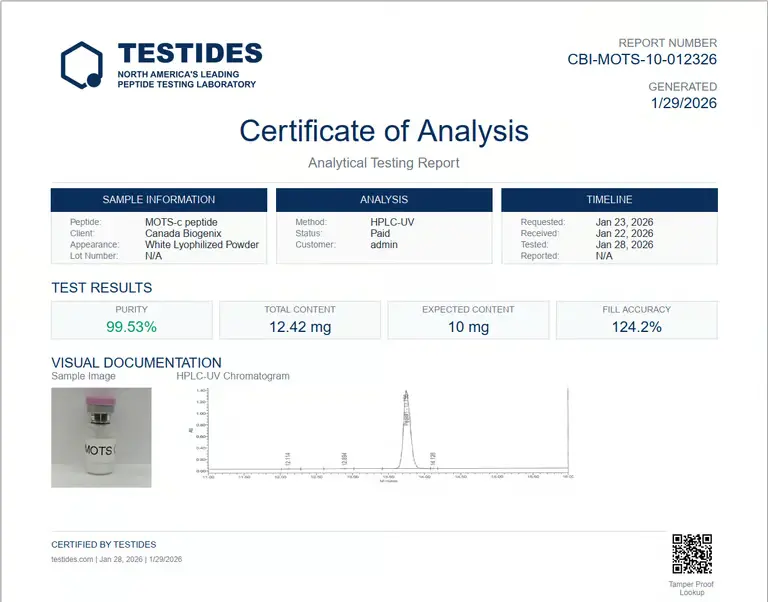
MOTS-C 10 mg is a mitochondrial-derived research peptide
attracting interest for its potential influence on cellular
energy, AMPK signalling, glucose metabolism and physical
performance pathways.

MOTS-C stands for mitochondrial open reading frame of the
12S rRNA type-c. It is a naturally occurring 16-amino-acid
peptide encoded within mitochondrial DNA.
Most peptides and proteins are encoded by DNA inside the cell
nucleus. In contrast, MOTS-C originates from genetic information
within the mitochondria. Therefore, researchers view it as a
communication signal between cellular-energy systems and the
rest of the cell.
MOTS-C appears to help cells respond to changes in energy demand.
For example, endogenous MOTS-C levels have been observed to rise
following exercise in human research participants.
In addition, preclinical research connects MOTS-C with AMPK
signalling, glucose use and skeletal-muscle metabolism. AMPK acts
as a cellular energy sensor. As a result, it helps cells adjust
when energy availability changes.
MOTS-C may act as a signal between mitochondria and
nuclear gene-response pathways.
AMPK helps regulate cellular energy use, glucose uptake
and metabolic adaptation.
Researchers are examining how MOTS-C may help cells
adapt to changing fuel and energy demands.
Early research has produced encouraging findings across several
metabolic and performance-related models.
Based on its mitochondrial origin and early findings, MOTS-C is
being explored across several connected research fields.
Preclinical research suggests MOTS-C may support glucose
uptake and insulin response, particularly within skeletal
muscle.
MOTS-C may help cells switch between available energy
sources. Consequently, it has become a compelling target
in metabolic research.
Animal findings suggest potential effects on endurance,
running capacity and adaptation to physical stress.
Because mitochondrial function changes with age,
researchers are exploring MOTS-C in models of age-related
metabolic and physical decline.
MOTS-C is unusual because mitochondrial DNA encodes it. Therefore,
its biology connects mitochondrial energy sensing with wider
cellular-response pathways.
Research indicates that the body’s natural MOTS-C levels respond
to exercise. In addition, animal studies suggest that administered
MOTS-C can influence some pathways associated with physical
activity and metabolic stress.
For further context, browse the Canada Biogenix
Weight Management & Metabolism collection
.
Researchers interested in mitochondrial function can also explore
SS-31 10 mg
.
Meanwhile, the
NAD+ 500 mg
page provides another related cellular-energy pathway.
In addition to MOTS-C 10 mg, Canada Biogenix offers
MOTS-C 20 mg
and
MOTS-C 40 mg
for different laboratory research requirements.
However, combination research remains preliminary. Controlled
human studies have not established specific research-compound
combinations.
MOTS-C has a growing research foundation. Nevertheless, most
studies involving administered MOTS-C have used laboratory or
animal models.
Human research has identified relationships between naturally
occurring MOTS-C, exercise and metabolic markers. However, human
safety, effectiveness and long-term outcomes for administered
MOTS-C have not been established.
MOTS-C represents a promising direction in mitochondrial,
metabolic and physical-performance research. Early studies
suggest potential effects on glucose metabolism, insulin response,
fat accumulation and physical capacity.
Furthermore, its mitochondrial origin and exercise-responsive
behaviour make it different from many conventional research
peptides. As a result, MOTS-C remains a compelling compound for
continued scientific investigation.
Research Use Only
This product is intended exclusively for laboratory research.
Not for human consumption, therapeutic use or veterinary use.
The information presented is educational and does not constitute
medical advice.