
Last Updated: July 31, 2026
Lyophilized peptides are freeze-dried compounds where water has been removed under vacuum, creating a stable powder form. However, this stability is only maintained with precise storage conditions. The fundamental challenge is that freeze-drying removes 95-99% of water but leaves trace moisture and chemical reactivity intact. Residual water, oxygen exposure, and temperature fluctuations trigger degradation pathways that compromise the peptide’s molecular structure. Understanding these vulnerabilities is essential for implementing proper storage that preserves potency and purity over months or years.
Lyophilized peptides exist in a delicate equilibrium. Trace moisture trapped within the powder matrix absorbs additional moisture from air through hygroscopic behavior. When humidity penetrates the storage container, water molecules interact with the peptide structure, initiating hydrolysis that breaks peptide bonds and fragments the compound into smaller, inactive pieces. A vial stored in humid conditions can lose significant potency within weeks, even at refrigerated temperatures.
Oxygen exposure compounds the problem through oxidation. Amino acids like methionine and tryptophan are particularly susceptible to oxidative damage when exposed to air. This is why proper storage emphasizes hermetic sealing and, in many cases, inert atmosphere packaging. Without oxygen barriers, the peptide degrades gradually regardless of temperature control.
Three primary degradation mechanisms affect stored lyophilized peptides: hydrolysis (water breaking peptide bonds), oxidation (oxygen reacting with susceptible amino acids), and deamidation (asparagine and glutamine residues losing amide groups). Temperature is the master variable controlling reaction rates. For every 10°C increase, reaction rates typically double. A peptide stored at room temperature might degrade 50% in months, while the same peptide at -80°C might retain 90% potency after years.
Light exposure accelerates all three degradation pathways by providing energy that drives chemical reactions. This is why amber or opaque vials are essential, and why storage in dark freezers outperforms storage in transparent containers.
Temperature management is the cornerstone of proper storage for lyophilized peptides. The choice between -20°C and -80°C storage determines whether your peptides remain viable for research or degrade into unusable material.
The -80°C ultrafreezer represents the gold standard for long-term lyophilized peptide storage. At this temperature, molecular motion slows dramatically, reducing reaction rates to nearly negligible levels. Peptides stored at -80°C can maintain 85-95% potency for 2-5 years or longer, depending on the specific compound and storage conditions.
The -20°C conventional freezer is acceptable for short-term storage, typically 6-12 months. At -20°C, hydrolysis and oxidation continue at measurable rates, with peptides typically losing 10-20% potency over a year. For research requiring maximum stability, -20°C is a compromise solution suitable only when ultrafreezer access is unavailable.
Temperature stability matters as much as absolute temperature. Freezers that cycle through temperature swings cause repeated freeze-thaw damage even at -80°C. Invest in a dedicated ultrafreezer with minimal temperature fluctuation, or verify that your freezer maintains ±2°C stability.
Room temperature storage of lyophilized peptides is indefensible for any research application. At 20-25°C, degradation accelerates exponentially, with peptides losing potency rapidly, often 30-50% within weeks. The freeze-drying process creates a metastable state that requires continuous cold storage to maintain. Once removed from the freezer, degradation begins immediately. The only exception is short-term handling during reconstitution; a vial removed for 15-30 minutes experiences minimal damage, but leaving peptides at ambient temperature for hours or days causes irreversible potency loss.
Freeze-thaw cycles are among the most damaging stressors for lyophilized peptides. Every time a vial is removed from the freezer, warmed, and refrozen, the peptide structure suffers mechanical and chemical stress.
When a lyophilized peptide vial thaws, ice crystals melt and cause mechanical stress within the powder matrix. As ice melts, residual moisture concentrates in microscopic pockets, creating localized high-water-content zones that accelerate hydrolysis and oxidation. Repeated temperature swings also destabilize the peptide’s tertiary structure; peptides that form secondary structures can partially unfold during thawing and refold incorrectly upon refreezing, reducing biological activity. A peptide thawed once loses roughly 5-10% potency; after five thaw cycles, potency loss becomes severe.
The solution is aliquoting: dividing a large peptide batch into smaller, single-use portions before storage. Instead of removing a 100 mg vial repeatedly, prepare 10-20 smaller vials containing 5-10 mg each. Each aliquot is used once, then discarded, while remaining aliquots stay sealed and undisturbed.
Aliquoting requires aseptic technique to prevent contamination. Work in a biosafety cabinet or laminar flow hood using sterile, pyrogen-free tubes and pipette tips. Dissolve the original peptide in sterile buffer solution (typically PBS or acetate buffer), then distribute into sterile vials. Allow aliquots to freeze completely before storage at -80°C. This approach eliminates repeated freeze-thaw damage, preserving peptide potency across your entire research project.
Once a lyophilized peptide is dissolved in buffer solution, it enters a new storage phase with different challenges. Reconstituted peptides are more vulnerable to degradation than their lyophilized counterparts.
Phosphate-buffered saline (PBS) is the standard for most applications, maintaining pH around 7.4. For extended storage, supplemented buffers are superior. Add bacteriostatic agents like sodium azide (0.02%), benzyl alcohol, or phenol to prevent microbial contamination. For maximum stability, add antioxidants such as ascorbic acid, EDTA, or dithiothreitol (DTT) to reduce oxidative degradation. EDTA is particularly valuable because it chelates metal ions that catalyze oxidation reactions. A reconstituted peptide stored in supplemented buffer at -20°C can remain stable for 3-6 months, compared to 1-2 weeks in unsupplemented PBS.
Maintain pH between 6.5 and 7.5, as reconstituted peptides are vulnerable to hydrolysis at pH extremes. Monitor pH regularly for long-term storage.
Contamination during reconstitution can render an entire batch unusable. Work in a biosafety cabinet or laminar flow hood using sterile, pyrogen-free materials. Sterilize all equipment by autoclaving or purchase pre-sterilized items. Use commercially prepared, sterile buffers rather than in-house solutions.
After reconstitution, immediately aliquot the solution into sterile vials rather than storing the entire batch in a single container. Store reconstituted aliquots at -20°C or -80°C, never at 4°C for extended periods, as microbial growth accelerates at refrigeration temperatures.
Long-term storage of lyophilized peptides spanning months to years demands systematic protocols that ensure consistent quality.
Lyophilized peptides stored at -80°C in properly sealed vials typically retain 85-95% potency for 2-5 years. Hydrophobic peptides and those with oxidation-prone amino acids degrade faster than others. Establish a monitoring protocol by testing peptide potency at defined intervals (6 months, 1 year, 2 years) using the same analytical method each time. HPLC is the standard for purity and potency assessment. Track results in a database and investigate if potency declines faster than expected.
Document batch-specific shelf life based on your monitoring data. For reference peptides used in quality control, establish stricter standards requiring 95%+ potency and test quarterly.
Shipping peptides across Canada requires maintaining cold chain integrity. Partner with shipping providers experienced in biological material transport and verify they use insulated packaging with phase-change materials maintaining -20°C or lower throughout transit. Use temperature monitoring devices in each shipment to confirm the cold chain was maintained.
Insulated boxes with dry ice maintain -78°C for 48 hours. Always ship overnight or 2-day delivery to minimize transit time. Upon arrival, immediately place peptides in -80°C storage and document receipt time and condition. If packaging is damaged or wet, test peptide integrity before use.
The physical container and seal are your first line of defense against moisture and oxygen infiltration.
Glass vials with rubber septum caps and aluminum seals are the standard. The rubber septum must be pharmaceutical-grade; Teflon-lined septa are superior because Teflon is inert. Verify that vials are borosilicate glass, which resists chemical interaction with peptides. The aluminum seal must crimp tightly, creating a hermetic seal that prevents air and moisture infiltration. Inspect seals visually before storage; a dented or loose seal is a failure point.
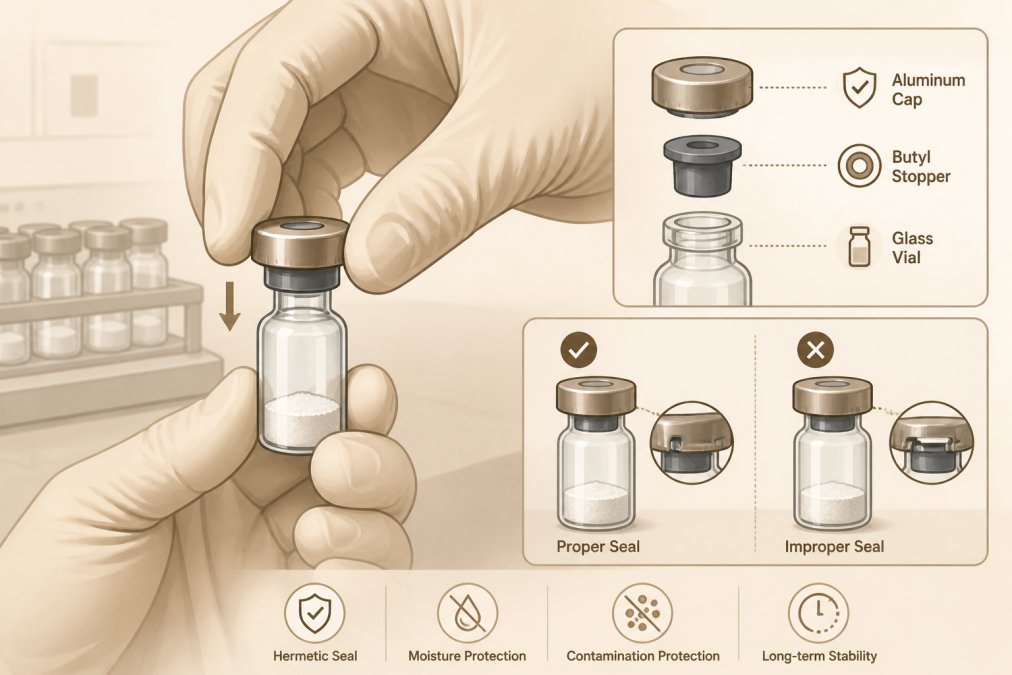
For long-term storage beyond 2-3 years, plan to transfer peptides to fresh vials with new septa, as rubber septa can harden or crack over time. Test seal integrity using pressure testing or helium leak detection if available.
Even with hermetic sealing, trace moisture can accumulate inside vials over time. Include silica gel packets or molecular sieves in the storage container or freezer box where peptides are stored. Color-changing silica gel indicates saturation (typically after 6-12 months) and should be replaced regularly. Molecular sieves are superior for long-term storage because they don’t saturate as quickly.
Improper storage practices are common in research environments. Understanding these mistakes prevents peptide loss and protects laboratory personnel.
Use aseptic technique when opening vials. Work in a biosafety cabinet, sterilize the vial exterior with 70% ethanol before opening, and never touch the septum with bare hands. After withdrawing peptide, immediately recap the vial and return it to storage.
Store peptides separately from other laboratory materials in a dedicated freezer if possible. Monitor for visible contamination; lyophilized peptides should appear as uniform powder, and reconstituted peptides should be clear or slightly cloudy. If contamination is suspected, isolate the affected vial immediately and discard if contamination is confirmed.
Store peptides in amber or opaque vials whenever possible. Place freezers in dark areas of the laboratory, away from windows and bright overhead lighting. For reconstituted peptides, use light-blocking storage boxes or cabinets. Implement an antioxidant strategy for peptides containing oxidation-prone amino acids by including EDTA, ascorbic acid, or DTT in buffer solutions.
Quality assurance protocols ensure that stored peptides meet your research standards.
Every peptide batch should include a Certificate of Analysis (COA) from the supplier documenting purity, potency, and identity. Store COAs alongside physical peptides and create a digital archive for easy reference. When testing peptide potency after long-term storage, compare results against the original COA to quantify degradation. For peptides stored longer than 2 years, consider requesting a fresh COA test from the supplier.
Calibrate your -20°C and -80°C freezers quarterly using calibrated thermometers. Document results in a maintenance log; if temperature deviates more than ±2°C from the setpoint, contact the equipment service provider. Place humidity monitors in storage areas; lyophilized peptide freezers should maintain relative humidity below 30%.
For HPLC or other analytical equipment used to test peptide potency, establish a monthly calibration schedule with known standards. Maintain equipment logbooks recording maintenance dates, calibrations, temperature readings, and anomalies.
Proper storage for lyophilized peptides is non-negotiable for research integrity. Temperature control at -80°C, hermetic sealing, moisture management, and aseptic handling are foundational practices that preserve peptide potency and ensure reliable research results. Canada BioGenix provides premium-quality research peptides backed by batch-specific Certificates of Analysis and comprehensive storage guidance, ensuring your compounds arrive and remain viable throughout your research timeline.
| Storage Condition | Temperature | Shelf Life | Best Use | Key Requirement |
|---|---|---|---|---|
| Lyophilized, -80°C | -80°C | 2-5 years | Long-term research | Ultrafreezer + hermetic seal |
| Lyophilized, -20°C | -20°C | 6-12 months | Short-term research | Standard freezer + seal |
| Reconstituted, -80°C | -80°C | 3-6 months | Extended studies | Supplemented buffer + seal |
| Reconstituted, -20°C | -20°C | 1-2 weeks | Immediate use | Bacteriostatic buffer |
| Room temperature | 20-25°C | Days | Avoid entirely | Not suitable |
Lyophilized peptides are best stored at -80°C for maximum long-term stability, though -20°C is acceptable for shorter storage periods. Freezer temperature slows molecular degradation significantly. Avoid ambient temperature storage, as peptides degrade rapidly at room temperature due to hydrolysis, oxidation, and microbial activity. Ensure your ultrafreezer maintains consistent temperature without fluctuations.
Repeated freeze-thaw cycles cause ice crystal formation that disrupts peptide molecular structure, leading to denaturation and loss of solubility. Each thaw cycle increases oxidation risk and promotes hydrolysis. Prevent damage by aliquoting your peptides into smaller, single-use portions before freezing. This way, you thaw only what you need, avoiding repeated exposure and maintaining the integrity of remaining stock.
Yes, lyophilized peptides should be stored in a desiccator or sealed vial with desiccant packets to control moisture. Peptides are hygroscopic, they absorb water from the air, which triggers hydrolysis and degrades the amino acid sequence. A hermetic seal combined with desiccant ensures minimal moisture exposure. Check desiccant condition periodically and replace if saturated to maintain vial integrity and shelf life.
A legitimate Certificate of Analysis should include batch-specific purity percentage (ideally above 90%), HPLC or mass spectrometry results, amino acid sequence confirmation, and manufacturing date. Verify the COA matches your vial's batch number. Request independent third-party testing results if available. Reputable suppliers like Canada BioGenix provide detailed, batch-specific documentation to confirm quality standards and ensure you're receiving the purity promised.
This article was written using GrandRanker