
Last Updated: August 27, 2026
Third-party testing is the practice of sending research peptides to an independent laboratory facility for unbiased analysis and verification of quality, purity, and composition. Rather than relying solely on the manufacturer’s internal quality assurance processes, third-party testing provides an external validation layer that confirms what’s actually in the product.
For researchers working with peptides, this distinction matters enormously. A manufacturer has financial incentive to report favorable results. An independent lab has no stake in the outcome, their reputation depends on accuracy. This separation creates the foundation for genuine confidence in what you’re purchasing and using in your research.
Canada BioGenix understands this principle deeply. We partner with carefully selected manufacturing facilities that embrace transparent testing protocols because we believe researchers deserve to know exactly what they’re working with. When you source research peptides from a supplier committed to third-party testing, you’re not just buying a product, you’re gaining access to verified data that supports reproducible research outcomes.
The core value of third-party testing lies in its independence. It answers a fundamental question every researcher asks: Is this product what the supplier claims it is? Without that verification, you’re operating on trust alone. With it, you’re operating on evidence.
Unbiased validation transforms your supply chain from a potential weak link into a controlled variable. When you receive a batch of research peptides without third-party verification, you’re accepting unknown risk. The peptides might be exactly as specified. They might be degraded, contaminated, or mislabeled. You won’t know until you use them, and by then, your experiment may already be compromised.
Third-party testing eliminates that uncertainty by introducing an external checkpoint. A qualified independent laboratory applies standardized analytical methods to your samples and documents the results in a format you can understand and verify. This creates an audit trail that protects both your research integrity and your supplier relationship.
Many researchers initially assume their suppliers have already validated everything internally. That’s a reasonable assumption, but it’s incomplete. Internal quality assurance catches obvious problems. Third-party testing catches the subtle ones: slight purity degradation, trace contaminants, inconsistent potency across batches. These issues won’t show up in casual observation, but they absolutely affect research outcomes.
The importance of unbiased validation becomes especially clear when you’re comparing suppliers or scaling your research program. Which supplier should you trust with larger orders? Which batches are genuinely consistent? Third-party testing data answers these questions objectively. You’re no longer relying on marketing claims or your supplier’s word, you’re comparing actual analytical results.
A Certificate of Analysis (CoA) is a formal laboratory document that reports the analytical testing results for a specific batch of research peptides. It’s your proof of what was actually tested and what the results showed. Understanding how to read and interpret a CoA is essential for verifying that your peptides meet your research requirements.
The CoA typically includes several key sections. The header identifies the batch number, testing date, and the laboratory that performed the analysis. This information matters because it creates traceability, you can match the batch number on your shipment to the batch number on the CoA, confirming you’re looking at results for the exact product you received.
The analytical results section is where the actual data lives. This is where you’ll see purity percentages, identity confirmation, and any detected contaminants. For research peptides, purity is usually expressed as a percentage, for example, "Purity: 98.5% by HPLC (peer-reviewed research)." This tells you that 98.5% of the sample is the intended peptide, and 1.5% is other material (residual solvents, water, synthesis byproducts, or other compounds).
Many CoAs also include a specifications section that compares the actual results against the supplier’s claimed specifications. If the supplier claims 95% minimum purity and the lab found 98.5%, that’s a pass. If the lab found 92%, that’s a fail, and you need to know that before using the product in your research.
The signature or certification section at the bottom of the CoA indicates that the laboratory stands behind the results. This is where you verify that the testing was performed by a qualified facility with appropriate accreditations. A legitimate CoA includes the laboratory’s contact information and sometimes their accreditation status.
Understanding peptide Certificate of Analysis means recognizing that it’s not just a piece of paper, it’s your direct line to what actually happened when your product was tested. When you compare CoAs from different batches or suppliers, you’re comparing objective data, not marketing language.
HPLC (High-Performance Liquid Chromatography) and MS (Mass Spectrometry) are the analytical workhorse methods used to verify research peptide quality. Understanding what these methods do helps you interpret lab reports and recognize when a supplier is using legitimate testing versus cutting corners.
HPLC separates the components in a peptide sample by passing it through a column filled with specialized material (peer-reviewed research). Different compounds travel through the column at different speeds, creating a chromatogram, essentially a visual map of what’s in your sample. The peaks on the chromatogram represent individual compounds. The largest peak should be your intended peptide. Smaller peaks represent impurities or byproducts. HPLC tells you: What’s actually in this sample, and how much of each component is present?
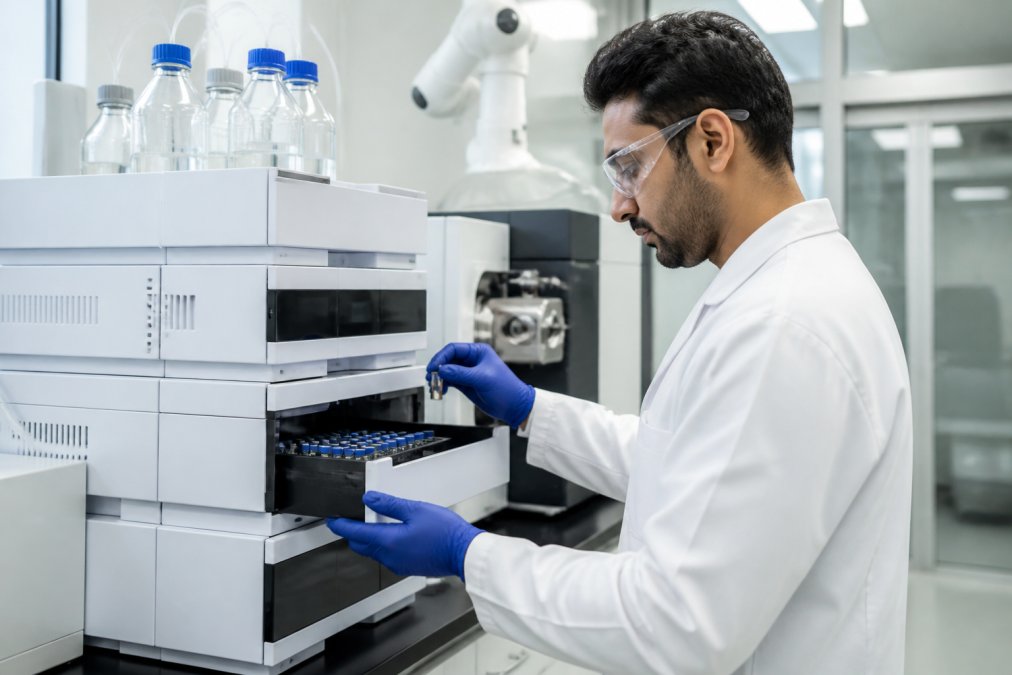
Mass spectrometry takes the analysis deeper. It measures the molecular weight of compounds in your sample with extreme precision. This matters for peptides because the molecular weight is like a fingerprint, it confirms you have the right compound, not something similar that happens to look similar under HPLC. MS also detects trace contaminants that might be present at very low levels. Together, HPLC and MS provide complementary information: HPLC shows you the overall composition and purity, while MS confirms the identity of the main compound and catches subtle contaminants.
When you see a CoA that includes both HPLC and MS results, you’re looking at genuinely thorough testing. HPLC alone can tell you purity percentage, but it can’t definitively confirm that the peak you’re seeing is actually your intended peptide, it could be a different compound with similar properties. MS removes that ambiguity. The combination of both methods represents the industry standard for rigorous peptide verification.
Many suppliers claim to use HPLC testing, which is good. But the difference between basic HPLC and HPLC combined with MS is the difference between a general description and a detailed specification. If you’re working with research peptides and making decisions based on purity claims, insist on seeing both methods in the CoA.
Reading a lab report for research peptides requires knowing what to look for and what each number actually tells you about your product. Start with the header section to verify that the batch number matches what’s on your shipment. If the batch numbers don’t match, stop, you’re looking at results for a different product.
Next, locate the purity percentage. This is typically expressed as a single number with a percentage sign. For example, "Purity: 97.2% by HPLC." This tells you that 97.2% of the sample is the intended peptide. The remaining 2.8% is everything else, which could be residual solvents, water, synthesis byproducts, or trace contaminants. When comparing suppliers or batches, this percentage is your primary quality metric.

Look for the analytical methods section. This tells you exactly which techniques were used to generate the results. HPLC, MS, Karl Fischer (for water content), and elemental analysis are common methods. The presence of multiple methods indicates more thorough testing. If the CoA only lists one method, that’s a red flag, you’re getting an incomplete picture of the sample.
Check the specifications versus results section. This is where the lab compares the actual findings against the supplier’s claimed specifications. Every line should show a "Pass" or "Within Specification" notation. If you see "Fail" or "Out of Specification," that batch doesn’t meet the supplier’s own claims, which means it shouldn’t be used for research.
Pay attention to any detected impurities section. This lists specific contaminants found in the sample and their concentrations. Common impurities in peptide samples include residual solvents (like acetonitrile or TFA), water content, and related peptide sequences from incomplete synthesis. The lab should quantify these, not just say "trace amounts" but give you actual percentages or parts per million.
The testing date matters. If the CoA is months old and your shipment just arrived, the peptides may have degraded during storage. Fresh CoAs (ideally generated within weeks of shipment) indicate better quality control practices.
Finally, verify the laboratory’s credentials. Look for accreditation information, contact details, and the signature of the analyst or lab director. Legitimate labs proudly display their qualifications. If the CoA is vague about who performed the testing or how to verify their credentials, that’s a warning sign.
Research peptides exist in a complex regulatory environment. While specific peptides may not be approved for human consumption in most jurisdictions, the standards for manufacturing quality, purity, and safety still apply, especially if your research involves any work that could eventually lead to therapeutic applications or if you’re working in a regulated research environment.
Third-party testing creates a compliance foundation. When you can demonstrate that your peptides have been tested by an independent laboratory and meet defined purity and safety standards, you’re building documentation that supports regulatory compliance. This matters if your research is subject to institutional review, if you’re working with a regulatory body, or if you’re eventually moving research compounds toward any kind of clinical application.
Many research institutions now require proof of third-party testing before researchers can use compounds in their work (aaalac.org). This isn’t bureaucratic overhead, it’s a recognition that research integrity depends on knowing what you’re actually studying. If your institution has these requirements, sourcing from suppliers who embrace third-party testing makes your work significantly easier.
Canada BioGenix takes this seriously by working with manufacturing partners who maintain rigorous quality standards and support transparent third-party verification. This commitment means you can work with confidence that your research compounds meet the standards your institution expects and that your research documentation will stand up to scrutiny.
The regulatory landscape around research compounds continues to evolve. Suppliers who invest in third-party testing today are positioning themselves, and their customers, for compliance with stricter requirements tomorrow. This forward-looking approach protects your research program from future disruptions.
Trust in research compounds isn’t built on promises, it’s built on evidence. When you source peptides that have been independently verified through third-party testing, you’re making a statement about your commitment to research quality. This matters not just for your own work, but for how your research is received by the broader scientific community.
Peer reviewers, institutional review boards, and collaborators increasingly ask: Where did you source your compounds? How do you know they’re pure? What’s your quality assurance process? Having a clear answer backed by third-party testing documentation strengthens your position in every one of these conversations.
Independent verification also protects your reputation. If you publish research based on compounds that later turn out to be impure or contaminated, the credibility of your entire study is compromised. Third-party testing prevents this scenario by catching quality issues before they affect your work.
For suppliers like Canada BioGenix, commitment to third-party testing is a direct statement about brand integrity. We’re saying: We’re confident enough in our quality that we’ll have it verified by someone with no financial interest in the outcome. This confidence resonates with researchers who understand that their work depends on knowing exactly what they’re working with.
Consumer trust in research compounds is ultimately built on transparency. Suppliers who embrace third-party testing, publish their results openly, and stand behind their quality claims are the ones researchers return to. It’s not about having perfect results, it’s about having honest results that you can verify yourself.
Third-party testing provides unbiased validation that your peptides meet purity, potency, and safety standards. Independent laboratory analysis identifies contaminants, heavy metals, and microbial presence that internal quality control alone may miss. This verification protects your research integrity, ensures compliance with industry standards, and gives you confidence that the product performs as intended. For researchers ordering from Canadian suppliers, third-party testing creates an audit trail that demonstrates due diligence and reduces supply chain risk.
A Certificate of Analysis (CoA) documents the results of third-party testing on a specific batch of peptides. It typically includes purity percentage (often achieved through HPLC or mass spectrometry), identity confirmation, moisture content, and screening for contaminants such as heavy metals and microbial presence. The CoA shows the testing date, the lab's credentials, and batch-specific information so you can trace exactly what was tested. A legitimate CoA from an independent laboratory serves as proof that the product meets stated specifications and provides the documentation needed for regulatory compliance.
Internal quality control is performed by the manufacturer and helps ensure consistency during production. Third-party testing is conducted by an independent laboratory with no financial interest in the product's outcome, making it unbiased. Independent labs follow standard operating procedures and industry benchmarks, and their results carry more weight for regulatory compliance and risk mitigation. Third-party testing also provides an objective audit trail that protects both the researcher and the supplier, whereas internal testing alone cannot guarantee the same level of transparency or credibility to external stakeholders or regulators.
Verify that the lab holds recognized accreditation and follows validated testing protocols for analytical chemistry. Check whether they test specifically for research compounds and understand industry benchmarks for peptide purity and potency. Ask for their standard operating procedures and whether they maintain an audit trail for each batch. Confirm they use appropriate methods such as HPLC and mass spectrometry for identity and purity verification. Request references or examples of Certificates of Analysis from other researchers. A reputable lab will be transparent about their methods, turnaround times, and how they handle batch-specific documentation.
Ready to source research peptides you can trust? Canada BioGenix provides premium-quality research peptides with batch-specific Certificates of Analysis from independent laboratories. Every product is backed by our commitment to transparency and quality verification. Explore our full catalog of tested research compounds and experience the difference that genuine third-party validation makes in your research program.
This article was written using GrandRanker