
Last Updated: August 9, 2026
Research involving peptides demands precision at every step. A single error in reconstitution, storage, or handling can compromise months of work and invalidate results. Canada BioGenix has identified patterns in what goes wrong: improper reconstitution protocols, temperature mismanagement, inadequate documentation, and overlooking purity verification. These are preventable oversights that happen when researchers skip steps they think are optional.
The stakes are real. A peptide that degrades before use produces unreliable results. Inconsistent dosing introduces uncontrollable variables. Poor storage degrades amino acid chains faster than expected. This guide covers reconstitution protocols, storage conditions, purity verification, regulatory compliance, and documentation practices. By the end, you’ll understand not just what to do differently, but why each step matters.
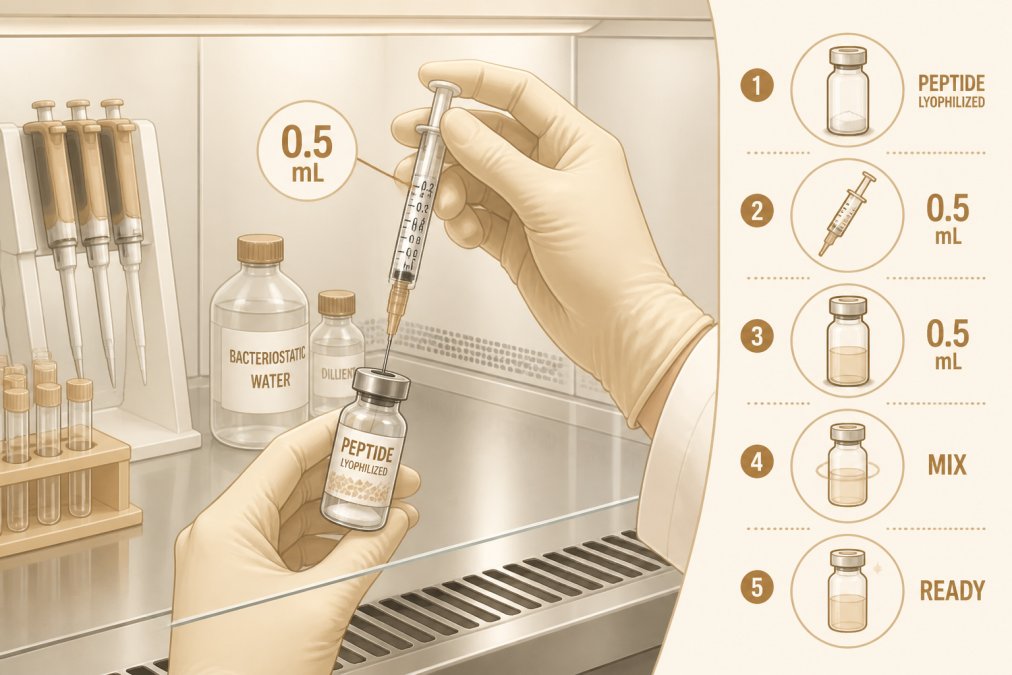
Reconstitution is where most peptide research goes wrong. A lyophilized peptide is inert and stable. The moment you add liquid, you’re reactivating it. How you do this matters enormously.
The biggest mistake is treating reconstitution as a simple mix-and-go step. Many researchers add bacteriostatic water to a vial, shake it, and assume they’re done. This introduces multiple problems: incomplete dissolution, air bubbles that degrade the peptide, and no verification of a usable solution.
Start by checking your Certificate of Analysis (COA). It specifies the exact peptide weight, purity level, and special handling notes, information that determines solvent amount and concentration. Choose the correct solvent (bacteriostatic water is standard, but some peptides require acetic acid or other carriers). Temperature control matters: cold solvent can cause the powder to clump. Let the solvent warm slightly before adding it.
After adding solvent, wait at least 15-30 minutes for complete dissolution. Gentle agitation helps, but vigorous shaking introduces air that degrades the polypeptide. Don’t draw up the solution immediately after mixing.
(/best-practices-peptide-reconstitution/) and Common Errors]
Once reconstituted, every tool that touches your peptide becomes part of quality control. Contamination at this stage ruins everything downstream.
Use sterile syringes, sterile needles, and sterile alcohol pads for every draw. Bacteria and microorganisms degrade peptides, introduce endotoxins, and compromise research. If injecting into living systems, contamination becomes a safety issue.
After reconstitution, keep the rubber stopper intact. Each puncture degrades the rubber; over multiple draws, particles shed into your solution. Use a new sterile needle for each draw and insert at a slight angle rather than straight in to reduce rubber degradation. Keep the vial cap on between draws to prevent exposure to light, air, and dust.
How you store peptides after reconstitution determines viability. Temperature fluctuations are one of the most underestimated degradation factors.
Standard recommendation is storage at 2-8°C (refrigeration). A research-grade refrigerator maintains tighter control than a home unit. For serious research, the difference matters.
Freeze-thaw cycles degrade peptides significantly. When you freeze a solution, ice crystals form and damage the peptide structure. Reconstitute only what you’ll use in a short timeframe, or divide reconstituted peptide into smaller aliquots immediately after reconstitution. Store each separately and use one, then return others to the freezer.
Long-term storage at -20°C is acceptable for most peptides, but -80°C is significantly better. The colder temperature dramatically slows molecular degradation. Keep a log of your freezer’s temperature. If it fluctuates significantly, the freezer needs servicing or your storage location isn’t suitable.
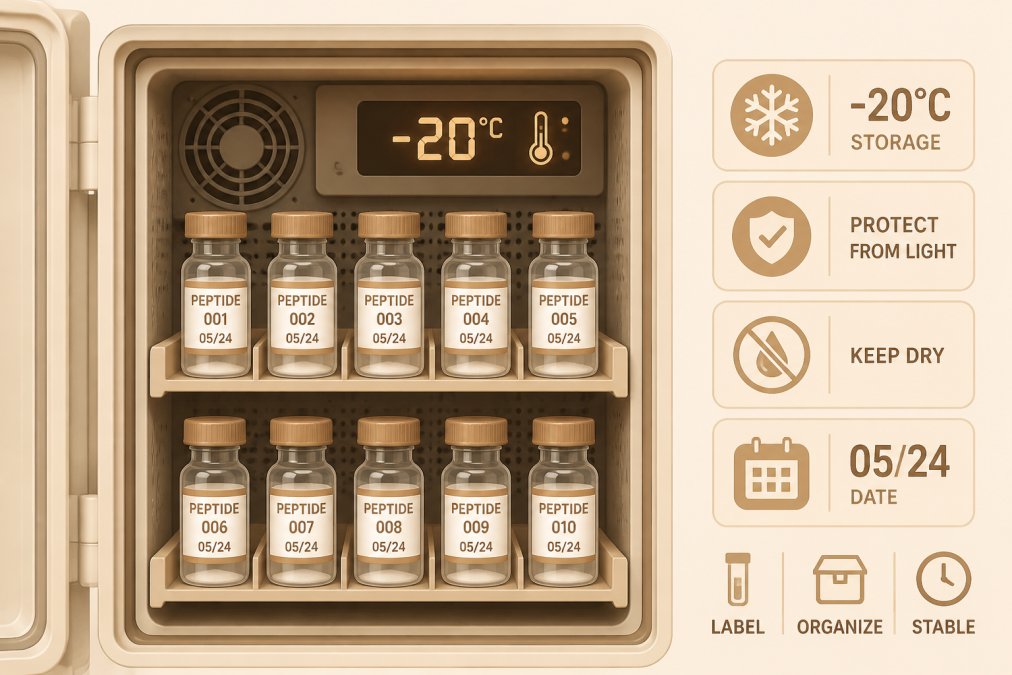
Peptides are sensitive to light, particularly UV light. Prolonged exposure degrades the polypeptide structure, reducing purity and efficacy.
Store peptides in amber or opaque vials, not clear glass. If your supplier ships in clear vials, transfer to amber containers immediately. Keep them in a dark location, not on a bench under fluorescent lights. Minimize light exposure during use.
Inspect vials carefully upon arrival. Small cracks or damage to the rubber stopper allow air and moisture to enter, degrading your peptide over time. The seal between vial cap and rubber stopper should be airtight.
A Certificate of Analysis (COA) is your proof of quality. Many researchers make critical mistakes by not reading it carefully or understanding what it tells them.
A proper COA includes: peptide sequence, molecular weight, purity percentage, testing methods used, and analysis date. It should specify what "purity" means, HPLC purity, mass spectrometry purity, or both. These aren’t the same thing.
HPLC (High-Performance Liquid Chromatography) purity tells you what percentage of the sample is the target peptide versus impurities. Mass spectrometry analysis provides different information, confirming molecular weight and identifying specific contaminants. Complete verification uses both methods.
Ask these questions: Who performed testing? Is it an independent laboratory or the supplier’s internal lab? When was testing done relative to delivery? Canada BioGenix emphasizes transparency in quality verification. Your COA should be batch-specific, not generic, and include batch number, testing date, and actual test results.
Verify that the amino acid sequence on the COA matches your order. A single amino acid substitution changes the entire compound’s properties.
The amino acid sequence is your peptide’s fundamental identity. It determines how the peptide folds, what it binds to, how your body processes it, and what side effects might occur.
A peptide is a chain of amino acids linked together. The specific order and chain length matter. A 10-amino-acid peptide is fundamentally different from an 11-amino-acid version, even if only one position differs.
Mass spectrometry tells you the molecular weight precisely. If your peptide’s theoretical weight is 1,234 Da (Daltons) and mass spec shows 1,235 Da, that’s acceptable. If it shows 1,200 Da, you have a problem, the peptide is degraded or you received the wrong compound.
Tandem mass spectrometry (MS/MS) fragments your peptide and analyzes fragments, confirming sequence. This is the gold standard but is more expensive and time-consuming than simple mass spectrometry. Understanding molecular weight helps you calculate accurate doses, as a 1,000 Da peptide versus a 5,000 Da peptide produces very different molar concentrations at the same mass.
Research peptides fall under Health Canada’s regulatory framework for research chemicals. Understanding these regulations is essential for legal and safe operation.
Health Canada classifies research chemicals differently depending on intended use. Peptides used for in vitro research (test tubes, cell cultures) have different requirements than those for animal or human studies. Know which category applies to your work.
For research conducted in Canada, Health Canada requires compounds be sourced from suppliers maintaining proper documentation and quality standards. If your research involves animal testing, additional regulations apply. You’ll need institutional approval and documentation of sourcing.
Keep records of where you sourced peptides, when received, batch numbers, and COAs. If your research is questioned or audited, this documentation proves you used verified, quality-controlled compounds. Canada BioGenix maintains compliance with Health Canada standards for all products. Sourcing from a compliant supplier builds a defensible research record, whether publishing results, seeking funding, or defending methodology to regulatory bodies.
Consistency in dosing is where research often falls apart. A perfectly reconstituted and stored peptide can still produce unreliable results if dosing is inconsistent.
The mistake most researchers make is treating dosing as approximate. They estimate how much to inject and proceed. This introduces variability making it impossible to know if results reflect actual peptide effects or inconsistent dosing.
Proper dosing starts with calculation. Determine exact concentration of your reconstituted solution. If you reconstituted 2mg of peptide in 2mL of bacteriostatic water, your concentration is 1mg/mL. For a 100mcg dose, you need 0.1mL. Use a tuberculin syringe (marked in 0.01mL increments) for accuracy.
Injection timing matters. If comparing results across multiple injections, timing between doses should be consistent. Document every injection: date, time, location, dose amount, and observations. Without this record, you can’t troubleshoot problems or explain result variations. Rotate injection sites to reduce irritation, scarring, or localized degradation that might confound results.
Poor record-keeping is one of the most common, and most easily preventable, mistakes in peptide research.
Create a simple log capturing: date and time of injection, peptide name and batch number, dose amount, injection site, and observations. Include environmental factors: room temperature, storage conditions, any deviations from normal protocol. If you used a different syringe or solvent, note it.
Record batch-specific documentation. When receiving new peptides, note batch number, COA, date received, and storage conditions. If you later discover a batch problem, this documentation identifies which research sessions were affected.
Digital logging is better than paper. Use a spreadsheet or dedicated research notebook software. Digital records are searchable, harder to lose, and easier to organize. Keep logs organized by peptide and date. If running multiple protocols simultaneously, separate logs prevent confusion.
Peptide degradation happens through multiple mechanisms: oxidation, hydrolysis, freeze-thaw damage, light exposure, and temperature fluctuations.
Oxidation occurs when peptides are exposed to oxygen. Some peptides come with inert gas (nitrogen or argon) in the vial. If yours includes this, maintain the inert atmosphere. Hydrolysis is water-driven degradation. Cold storage is essential, at freezing temperatures, hydrolysis slows dramatically.
pH affects stability. Most peptides are stable at neutral pH (around 7). Bacteriostatic water is pH-neutral, which is why it’s standard. Temperature consistency matters more than absolute temperature. A freezer fluctuating between -15°C and -25°C is worse than one holding steady at -20°C. Proper handling extends peptide viability. Each step, reconstitution, storage, preparation, injection, should minimize degradation.
Common peptide research mistakes are preventable. They fall into predictable categories: inadequate reconstitution protocols, poor storage practices, insufficient quality verification, inconsistent dosing, and incomplete documentation. Each mistake compounds the others, making it nearly impossible to trust your results.
Canada BioGenix provides premium-quality research peptides with rigorous quality standards and transparent Certificates of Analysis. Our carefully selected manufacturing partners ensure every batch meets strict purity specifications. When you source from Canada BioGenix, you’re starting with verified, high-quality compounds, allowing you to focus on avoiding mistakes that happen after delivery. Free shipping on orders over $250 makes it accessible to build a reliable research program without compromising on quality.
| Common Mistake | Root Cause | Prevention Strategy |
|---|---|---|
| Undissolved peptide in solution | Immediate use after reconstitution | Wait 15-30 minutes; verify complete dissolution |
| Freeze-thaw degradation | Multiple thawing cycles from one vial | Divide into aliquots; freeze-thaw only what you use |
| Contamination during use | Poor sterile technique | New sterile needle per draw; keep vial capped |
| Temperature-driven degradation | Inconsistent storage temperature | Use -20°C or -80°C freezer; monitor temperature |
| Unverified purity | Accepting generic COAs | Request batch-specific COA; verify sequence |
| Inconsistent dosing | Approximate injection amounts | Calculate exact concentrations; use calibrated syringes |
| Lost research data | No documentation | Log every injection: date, time, location, amount |
The most frequent errors include improper reconstitution protocols, inadequate sterile technique, poor temperature control during storage, and failure to verify purity through Certificate of Analysis. Many researchers also make mistakes with freeze-thaw cycles, which degrade the polypeptide structure and reduce bioavailability. Documentation gaps and inconsistent dosing schedules further compromise experimental reproducibility. Avoiding these common peptide research mistakes requires attention to detail at every stage, from receipt through injection.
Improper reconstitution damages the amino acid sequence and accelerates degradation. Using non-sterile equipment introduces contaminants that compromise the lyophilized peptide's integrity. Incorrect pH, temperature, or solvent selection can denature the polypeptide immediately. Once reconstituted improperly, the peptide becomes unstable and loses bioavailability within hours or days. This is why peptide reconstitution best practices emphasize precise protocols, correct solvents, and sterile technique. Degraded peptides produce unreliable results and waste research resources.
Peptide purity directly affects how the compound binds to receptors and influences pharmacokinetics. Impure peptides contain contaminants or degraded fragments that skew dosing accuracy and create inconsistent therapeutic effects. When purity drops below 90%, researchers cannot reliably replicate results across batches. This is why peptide purity and quality control standards require independent verification through HPLC analysis and mass spectrometry. A Certificate of Analysis from a reputable lab confirms that your peptide meets specifications and ensures your data is trustworthy and publishable.
Health Canada research chemical regulations require that researchers maintain documentation of all compounds, storage conditions, and usage. Peptides used for research must come from suppliers who meet quality standards and provide analytical testing results. Health Canada does not regulate research peptides the same way as pharmaceuticals, but good laboratory practice (GLP) and documentation requirements still apply. Researchers should verify that their supplier provides batch-specific Certificates of Analysis and complies with Health Canada guidelines to ensure legal and ethical research conduct.
This article was written using GrandRanker