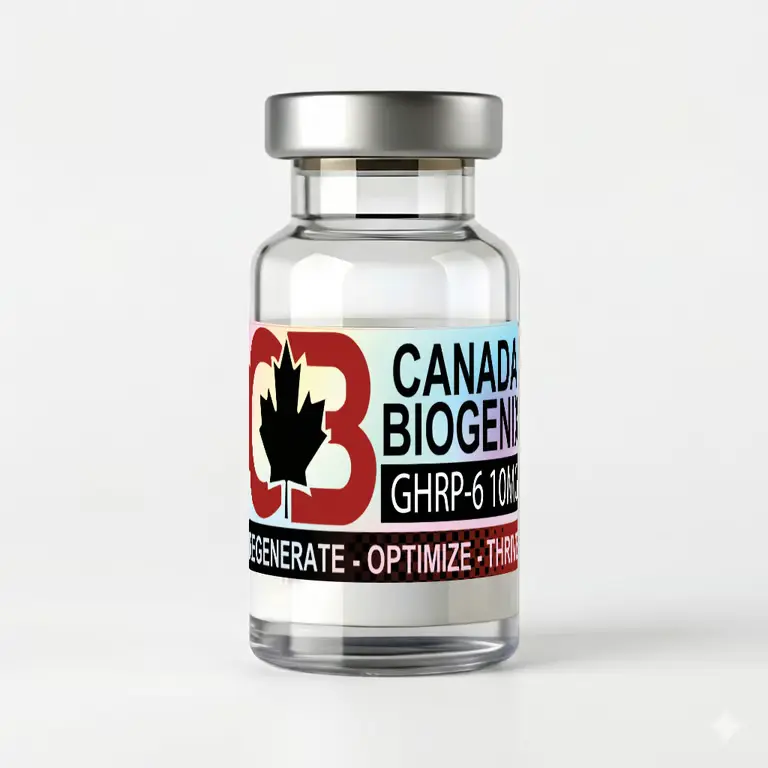
GHRP-6 10 mg is a synthetic growth hormone secretagogue attracting research interest for its potential influence on pulsatile growth hormone release, ghrelin-receptor activity, appetite signalling and endocrine interactions.
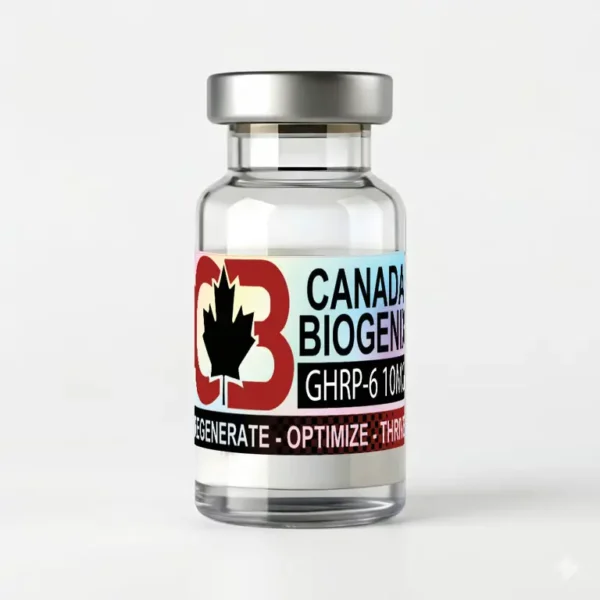
GHRP-6, short for growth hormone-releasing peptide 6, is a synthetic peptide containing six amino acids. Its sequence is His–D-Trp–Ala–Trp–D-Phe–Lys-NH2.
It acts as an agonist of the growth hormone secretagogue receptor type 1a, or GHSR-1a. This receptor is commonly called the ghrelin receptor. By engaging this pathway at the hypothalamus and pituitary, GHRP-6 has produced clear, pulse-like growth hormone responses in experimental research.
The same receptor system also participates in hunger, energy balance and neuroendocrine signalling. As a result, GHRP-6 10 mg offers a particularly interesting model for studying the connection between growth hormone release and appetite-related biology.
Early human studies found that GHRP-6 produced a measurable, dose-related growth hormone response. This makes it a useful compound for examining natural pulse-based GH-axis regulation.
GHSR-1a activation connects GHRP-6 with ghrelin and neuropeptide-Y signalling. Researchers value this pronounced hunger response when exploring appetite and energy-balance mechanisms.
Because GHRP-6 and GHRH analogues act through different receptors, researchers have observed a considerably larger experimental GH response when both pathways are activated together.
GHRH analogues signal through the GHRH receptor, while GHRP-6 signals primarily through GHSR-1a. In one human experiment, either compound alone produced a similar GH response, while the combined response was more than four times the area-under-the-curve value observed with either one alone. This is strong evidence of complementary signalling in that controlled setting, not proof of a general-purpose product stack.
| Research area | Encouraging observation | Evidence level | Important context |
|---|---|---|---|
| Growth hormone release | Human studies have reported clear GH responses following experimental GHRP-6 exposure. | Early controlled human studies | A hormonal response does not establish muscle, fat-loss or recovery outcomes. |
| GHRH-pathway synergy | Combined GHRH and GHRP-6 produced a substantially larger GH response than either compound alone. | Human endocrine experiment | The result supports complementary receptor pathways, not a validated administration protocol. |
| Appetite signalling | Ghrelin-receptor activation is associated with hunger and neuropeptide-Y pathways, giving GHRP-6 a prominent appetite signal. | Mechanistic, animal and limited human evidence | The size and consistency of appetite effects can vary across experimental conditions. |
| ACTH, cortisol and prolactin | Growth hormone secretagogues can reveal broader pituitary and hypothalamic interactions. | Human and preclinical endocrine research | GHRP-6 is generally considered less hormonally selective than Ipamorelin. |
| Recovery and tissue viability | GHRP-family research has generated encouraging cytoprotective and tissue-viability signals. | Primarily laboratory and animal studies | Human healing, athletic recovery and performance benefits have not been established. |
The positive scientific interest around GHRP-6 10 mg spans several connected areas:
Together, these findings make GHRP-6 a compelling research compound. They do not establish clinical benefits for muscle growth, fat loss, appetite disorders, sleep or recovery.
Hunger is one of the most recognizable research characteristics of GHRP-6. GHSR-1a is the same receptor activated by ghrelin, a naturally occurring hormone involved in meal initiation, reward and energy regulation. Growth hormone secretagogues have also been linked to hypothalamic neuropeptide-Y activity.
This creates a positive rationale for research involving appetite, feeding behaviour and the relationship between energy availability and endocrine signalling. It also means that GHRP-6 is not simply interchangeable with every other GH secretagogue.
The appetite response may be useful in one experimental model and unwanted in another, particularly when body-weight or metabolic outcomes are being measured. Therefore, study design and outcome selection are essential.
Published GHRP-6 studies have used different experimental routes, quantities, sampling windows and subject populations. Early research included oral and parenteral exposure, while laboratory and animal models used their own study-specific methods.
No standardized human dose, cycle length, injection schedule or product-specific administration protocol has been established. The 10 mg designation describes the total laboratory quantity in the vial and should not be interpreted as a dose or administration instruction.
The available literature has not established a complete long-term safety profile for GHRP-6. Reported or biologically plausible research effects include increased hunger and changes involving growth hormone, glucose regulation, ACTH, cortisol and prolactin.
Responses can vary with age, nutritional state, body composition and baseline endocrine function. Repeated stimulation may also behave differently from a single controlled exposure, and long-term human outcome data remain limited.
Overall, the endocrine findings are strong enough to support continued investigation. However, more controlled human research is needed before conclusions can be drawn about body composition, performance, recovery, sleep, appetite support or long-term safety.
| Research product | Primary pathway | Main distinction |
|---|---|---|
| GHRP-6 10 mg | GHSR-1a / ghrelin receptor | Prominent GH and appetite-signalling research profile |
| Ipamorelin | GHSR-1a / ghrelin receptor | More selective secretagogue profile in comparative preclinical research |
| CJC-1295 No DAC | GHRH receptor | Shorter-acting GHRH-pathway research analogue |
| CJC-1295 + Ipamorelin | GHRH receptor + GHSR-1a | Dual-pathway blend using a more selective GHSR agonist |
These products have distinct research profiles. Combining compounds does not guarantee additive or synergistic outcomes, and validated human stacking protocols have not been established.
Research-use notice: GHRP-6 10 mg is presented for laboratory research and analytical discussion only. It is not intended to diagnose, treat, cure or prevent disease, or for human or animal use. This information is not medical advice or an administration guide.