
Peptide reconstitution is the process of dissolving lyophilized (freeze-dried) peptide powder into a liquid solvent to create a usable solution for research applications. Proper reconstitution ensures peptides remain bioactive, maintain their intended concentration, and deliver reliable results. Poor technique can compromise peptide integrity, reduce solubility, introduce contamination, or cause denaturation before your research begins.
The good news is that the process is straightforward once you understand the core principles: selecting the right solvent, maintaining sterile technique, calculating accurate concentrations, and storing the reconstituted solution properly.
Successful peptide reconstitution requires specific equipment designed to maintain sterility and preserve peptide stability.
Core equipment you’ll need:
The quality of your equipment directly affects your results. Needles that are too large create excessive pressure in the vial; needles that are too small make injection difficult and increase collapse risk.
Sterile water is water sterilized through filtration or autoclaving with no additives. Once opened, it has a short shelf life because it provides no resistance to bacterial growth.
Bacteriostatic water contains benzyl alcohol (typically 0.9%) as a preservative, inhibiting bacterial growth and extending shelf life. It’s the preferred solvent for most peptide reconstitution work because it keeps reconstituted peptide solutions stable longer and reduces contamination risk from multi-dose vials. Always verify your peptide’s compatibility with your chosen solvent before reconstituting.
The reconstitution process follows a logical sequence designed to minimize contamination, preserve peptide integrity, and ensure accurate dosing.
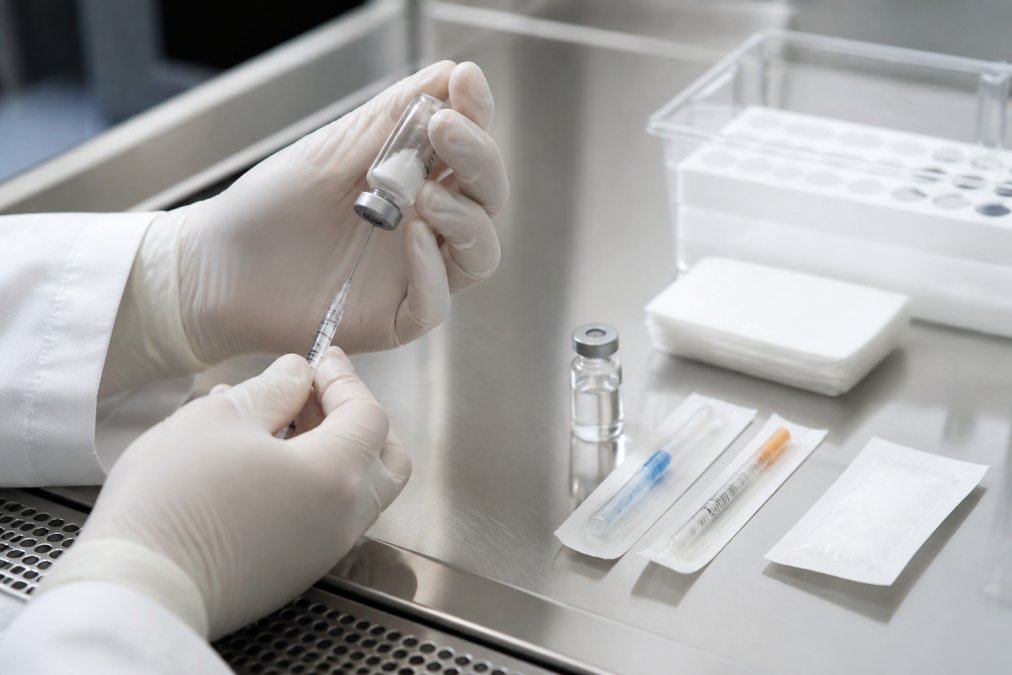
Step 1: Prepare your workspace. Set up in a clean, controlled environment. If you have access to a laminar flow hood, use it. Otherwise, work on a clean, disinfected surface away from air currents and dust.
Step 2: Inspect the vial. Examine your peptide vial for damage, leakage, or degradation. The powder should appear uniform in color. If the vial is cracked, the seal is compromised, or the powder shows discoloration, do not proceed.
Step 3: Calculate your reconstitution volume. Determine how much solvent you need to achieve your target concentration.
Step 4: Draw the calculated volume of solvent into your syringe. Use a sterile syringe and needle. Draw slightly more than you need as a buffer.
Step 5: Sanitize the vial stopper. Proper sanitization is non-negotiable for aseptic technique.
Step 6: Inject the solvent into the peptide vial. Insert the needle through the sanitized stopper at a slight angle. Inject slowly and steadily.
Step 7: Allow the peptide to dissolve. Remove the needle and set the vial aside. Most peptides dissolve within 5-15 minutes at room temperature. Do not shake vigorously.
Step 8: Verify dissolution. The powder should be completely dissolved. If particles remain, gently roll the vial between your palms or let it sit for another few minutes.
Step 9: Verify concentration and pH. If your protocol requires it, measure the pH using pH paper or a calibrated meter.
Step 10: Aliquot if needed. If you plan to use your peptide solution over time, divide it into smaller aliquots before storing to reduce contamination risk from repeated needle insertions.
Never open a lyophilized peptide vial unless you’re ready to reconstitute immediately. Once the seal is broken, the peptide begins absorbing moisture from the air, accelerating degradation. Avoid touching the stopper with bare hands; use clean, sterile gloves at all times.
Inspect the vial for vacuum pressure. Many lyophilized peptide vials maintain a slight vacuum when sealed. When you first insert a needle, you may hear a small hiss as air enters the vial, this is normal and indicates the seal was intact.
Most peptides dissolve passively within 5-15 minutes. Patience is better than aggression. Vigorous shaking introduces air, which can oxidize sensitive peptides. After dissolution is complete, the solution should be clear or slightly turbid. If you see visible particles or cloudiness that doesn’t resolve after 30 minutes, precipitation may have occurred, indicating the peptide may not be fully soluble at your chosen concentration or the solvent may be incompatible.
Proper vial stopper sanitization is the cornerstone of aseptic technique. A contaminated stopper introduces bacteria, fungi, or endotoxins directly into your peptide solution.
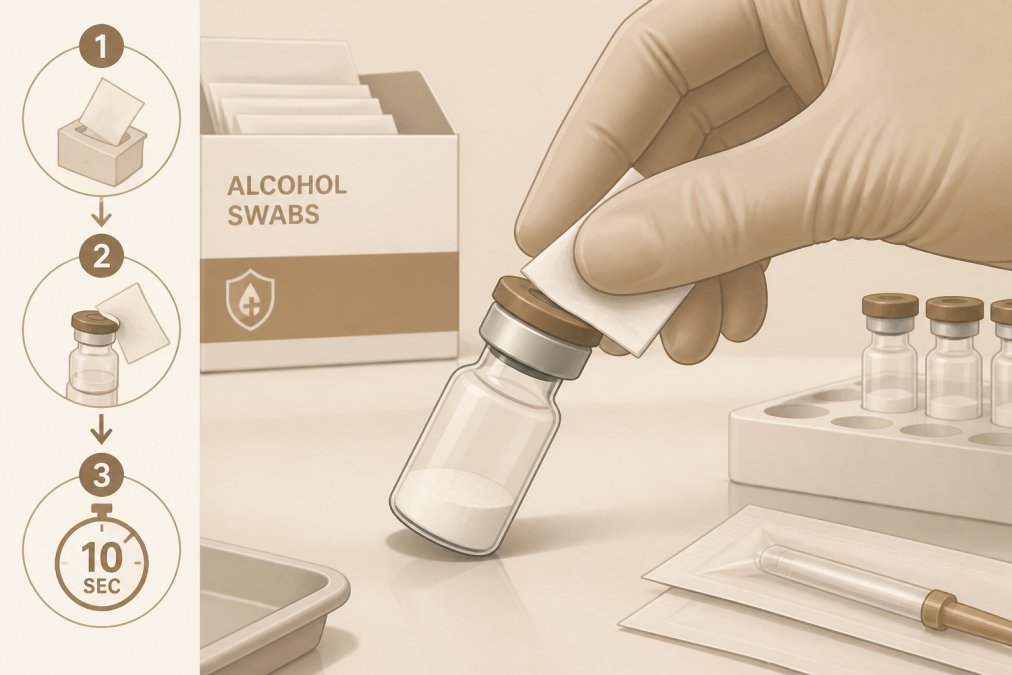
The standard sanitization protocol:
Inspect the stopper. Visually examine it for cracks, discoloration, or visible contamination. If damaged, request a replacement vial.
Use 70% isopropyl alcohol. This concentration is the gold standard. Concentrations below 50% are ineffective; concentrations above 90% evaporate too quickly.
Apply the alcohol swab. Use a fresh, sterile swab. Wipe the entire stopper surface in a circular motion, starting from the center and moving outward.
Allow adequate contact time. The alcohol must remain on the stopper for at least 30 seconds to effectively kill microorganisms.
Allow the alcohol to evaporate completely. Wait 30-60 seconds after your final wipe for air-drying.
Do not touch the sanitized stopper. Treat it as a sterile surface. If you accidentally contaminate it, re-sanitize before proceeding.
Accurate dosage calculation is where theory meets practice. A small error in concentration can invalidate your entire experiment.
The basic formula for concentration is:
Concentration (mg/mL) = Total Peptide Mass (mg) / Total Solvent Volume (mL)
For example: If you have a 10 mg peptide vial and you reconstitute it with 1 mL of bacteriostatic water, your concentration is 10 mg/mL.
Working backward from target concentration:
If you want a final concentration of 5 mg/mL from a 10 mg peptide vial:
Volume needed = Total Peptide Mass / Target Concentration
Volume needed = 10 mg / 5 mg/mL = 2 mL
Calculating a specific dose:
If your reconstituted solution is 10 mg/mL and you need a 2 mg dose:
Volume to use = Desired Dose / Concentration
Volume to use = 2 mg / 10 mg/mL = 0.2 mL = 200 micrograms (μg)
Common unit conversions:
Concentration conversions:
If your peptide is expressed in micrograms per milliliter (μg/mL) and you need milligrams per milliliter (mg/mL):
mg/mL = μg/mL ÷ 1,000
Example: 5,000 μg/mL = 5 mg/mL
Dosage by body weight:
Many protocols specify dosage as micrograms per kilogram of body weight (μg/kg). To calculate the actual volume to administer:
Example: A 70 kg subject receiving 10 μg/kg of a 100 μg/mL solution:
| Calculation Type | Formula | Example |
|---|---|---|
| Concentration from mass and volume | mg/mL = mg / mL | 10 mg ÷ 2 mL = 5 mg/mL |
| Volume needed for target concentration | mL = mg ÷ target mg/mL | 10 mg ÷ 5 mg/mL = 2 mL |
| Dose volume from concentration | mL = desired dose ÷ concentration | 2 mg ÷ 10 mg/mL = 0.2 mL |
| Dosage by body weight | μg = μg/kg × kg | 10 μg/kg × 70 kg = 700 μg |
| Unit conversion | mg = μg ÷ 1,000 | 5,000 μg ÷ 1,000 = 5 mg |
How you store your lyophilized peptide before reconstitution directly affects how much potency survives until you use it. Unopened lyophilized peptide vials should be stored at 2-8°C in a standard laboratory refrigerator. Never store lyophilized peptides at room temperature for extended periods; peptide degradation roughly doubles for every 10°C increase in temperature.
Protect vials from light exposure. UV radiation and visible light can cause photodegradation in certain peptides. Store vials in their original packaging or in a dark container. Keep vials sealed until you’re ready to reconstitute.
The cold chain, the unbroken sequence of refrigeration from manufacture to your laboratory, determines peptide viability.
Storage temperature windows:
When peptides arrive, check the packaging for signs of temperature exposure. Some suppliers include temperature-monitoring stickers that change color if the package exceeded a certain temperature. If your package shows signs of heat exposure, contact your supplier immediately.
For long-term storage beyond 6 months, consider ultra-cold storage at -20°C or -80°C. At these temperatures, peptide degradation is negligible for years.
Lyophilized peptides have a theoretical shelf life measured in years when stored properly. Most suppliers provide a recommended expiration date on the vial label, assuming proper storage.
Denaturation, the unfolding or structural breakdown of the peptide, is the primary degradation mechanism. It occurs when peptides are exposed to heat, extreme pH, oxidation, or mechanical stress. Prevention is simpler than recovery.
Most peptides are stable at pH 4-8. When you reconstitute your peptide, verify the pH of your final solution if your protocol requires it. Bacteriostatic water typically has a pH around 5.5-7, which is acceptable for most peptides.
Issue: Peptide powder won’t dissolve completely.
Possible causes: Peptide may be hydrophobic, solvent may be incompatible, concentration may be too high, or the peptide may be degraded. Verify you’re using the correct solvent and check your peptide’s technical documentation. Try warming the vial slightly (to 25-30°C) and allowing more dissolution time. If the peptide still won’t dissolve, dilute the solution further with additional solvent.
Issue: Cloudy or turbid solution after reconstitution.
This indicates precipitation or aggregation. Gentle agitation sometimes resolves this. If cloudiness persists, dilute the solution further. Some peptides naturally form suspensions rather than clear solutions; check your peptide documentation.
Issue: Difficulty injecting solvent into the vial.
Excessive pressure suggests the vial is sealed too tightly or you’re using a needle that’s too small. Use a larger-gauge needle (25 gauge instead of 30 gauge).
Issue: Inconsistent results between batches.
Document every step of your reconstitution process: solvent source, temperature, timing, and storage conditions. Use the same solvent brand and lot number if possible. Verify that your bacteriostatic water hasn’t been open for more than 30 days.
Issue: Suspected contamination (cloudiness, odor, or visible particles).
Do not use a contaminated solution. Discard it safely according to your facility’s protocols. Review your sanitization technique. Ensure you’re using fresh alcohol swabs, allowing adequate contact time, and waiting for complete evaporation before injection.
Peptide reconstitution is a skill that improves with practice and attention to detail. Each step serves a purpose. Skipping steps or rushing the process is where most errors occur.
Canada BioGenix supplies premium-quality lyophilized peptides designed for research applications, backed by rigorous quality standards and Certificates of Analysis that document purity and identity. Proper reconstitution ensures you get the full value from that investment. If you have questions about reconstituting your peptides or need guidance on storage and handling, our team is here to support your research success.
The volume depends on your target concentration. For a 1 mg/mL solution, use 10 mL of bacteriostatic water. For 2 mg/mL, use 5 mL. Measure the water carefully with an insulin syringe and add it slowly to the lyophilized peptide vial. Let the solution sit for 5-10 minutes to allow complete dissolution before use. Always use bacteriostatic water for peptides intended for multiple doses, as it contains benzyl alcohol to prevent bacterial growth.
A peptide reconstitution calculator simplifies the math: (desired concentration in mg/mL) × (vial volume in mL) = bacteriostatic water volume needed. For example, if you want 1 mg/mL from a 10 mg vial, add 10 mL of water. Many researchers create simple spreadsheets or use online calculators designed for peptide labs. Canada BioGenix recommends verifying calculations manually before reconstituting to avoid dosing errors. The key is consistency: always use the same formula and double-check your math.
Degradation occurs through denaturation, oxidation, and bacterial contamination. Use sterile technique throughout: sanitize the vial stopper with an alcohol swab, work in a clean environment, and use sterile syringes and insulin needles. Add bacteriostatic water slowly to minimize foaming and air exposure. Keep the vial cool during reconstitution and store reconstituted peptides at 2-8°C immediately after. Avoid repeated freeze-thaw cycles, which damage peptide structure. Always use research-grade compounds from verified suppliers to ensure stability.
Reconstituted peptides should be stored at 2-8°C (refrigerator temperature) for short-term use (2-4 weeks) and -20°C (freezer) for long-term storage (months to years). Maintain a consistent cold chain to prevent denaturation. Never allow peptides to warm above 8°C during storage or transit. Lyophilized peptides (powder form) can be stored at room temperature in a cool, dry place before reconstitution. Always check the Certificates of Analysis from your supplier for specific storage recommendations, as some peptides have unique stability profiles.
Sterile water lacks the preservative (benzyl alcohol) that bacteriostatic water contains. Use bacteriostatic water for multi-dose vials or storage longer than a few days, as it prevents bacterial growth. Sterile water is acceptable only for single-dose use immediately after reconstitution. Bacteriostatic water is the industry standard for research peptides because it maintains sterility and prevents contamination. Always verify your supplier's recommendations on the Certificate of Analysis.
The formula is: Volume (mL) = Peptide Mass (mg) ÷ Desired Concentration (mg/mL). For a 30 mg vial at 3 mg/mL concentration, divide 30 by 3 to get 10 mL of bacteriostatic water. Write this calculation down before reconstituting. Many researchers use micrograms for smaller doses: convert milligrams to micrograms (1 mg = 1000 mcg) for precision. Double-check your math twice to avoid reconstitution errors that waste expensive research-grade peptides.
Wipe the rubber stopper with a 70% isopropyl alcohol swab using firm, circular motions for 10-15 seconds. Allow the alcohol to air dry completely (30-60 seconds) before inserting the needle. This removes bacteria, dust, and surface contaminants. Never touch the stopper with bare fingers after sanitizing. Use a fresh alcohol swab for each reconstitution to maintain aseptic technique. This step is critical for preventing bacterial contamination and maintaining peptide stability throughout storage.
Reconstituted peptides stored at 2-8°C typically remain stable for 2-4 weeks when using bacteriostatic water and proper aseptic technique. Frozen reconstituted peptides (-20°C) can last 6-12 months or longer. Shelf life depends on peptide type, solvent purity, storage temperature consistency, and pH balance. Lyophilized peptides (powder) last 1-2 years at room temperature if stored in a cool, dry place. Always reference your Certificate of Analysis for specific stability data. Avoid repeated freeze-thaw cycles, which accelerate denaturation and reduce usable shelf life.
This article was written using GrandRanker