Top 5 Most Popular Research Peptides in Canada (2026)
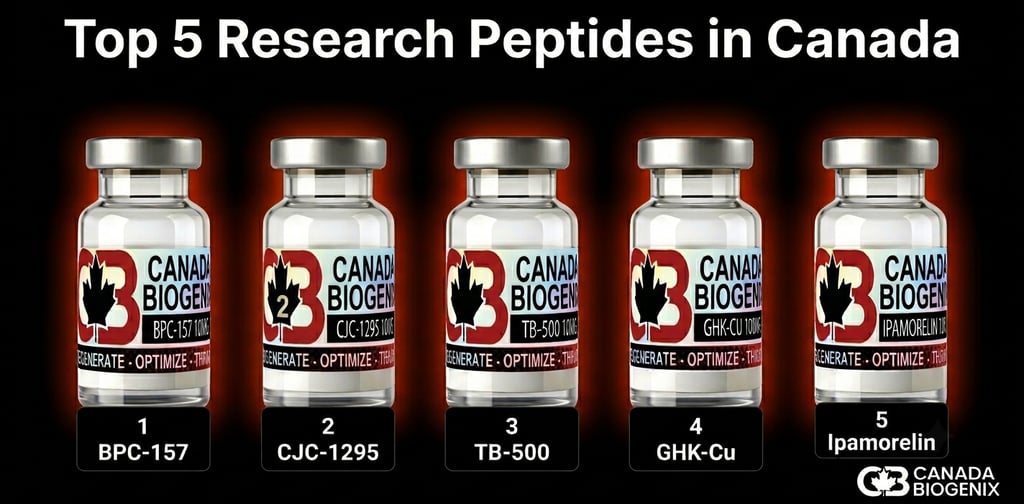
What are the most searched and researched peptides in Canada in 2026? Discover the top 5 — BPC-157, CJC-1295, TB-500, GHK-Cu, Ipamorelin — with honest research overviews by Canada Biogenix
Haider Ali
6/24/20269 min read
Canada's research peptide community has grown dramatically in recent years and with it, the volume of Canadians searching for accurate, honest information about which compounds are being most actively studied and why.
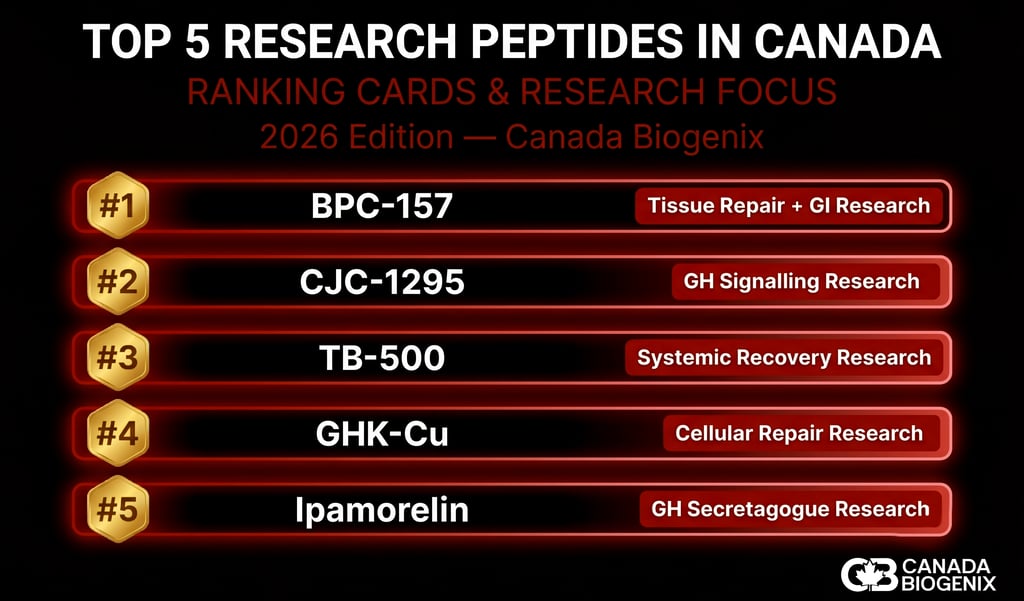
In this guide, we rank the 5 most popular research peptides in Canada in 2026 based on Canadian search volume, scientific literature, and community interest. For each compound, we give you an honest overview of what the research actually says not what the hype suggests.
Research Purposes Only: All peptides discussed are for laboratory and scientific research purposes only. Canada Biogenix makes no therapeutic claims. Nothing here constitutes medical advice.
Related: Peptide Research in Canada Complete Guide Full overview of how research peptides are studied in Canada (canadabiogenix.com/blog/peptide-research-canada-complete-guide)
1.BPC-157: Canada's Most Searched Research Peptide
#1 BPC-157 Body Protective Compound 157
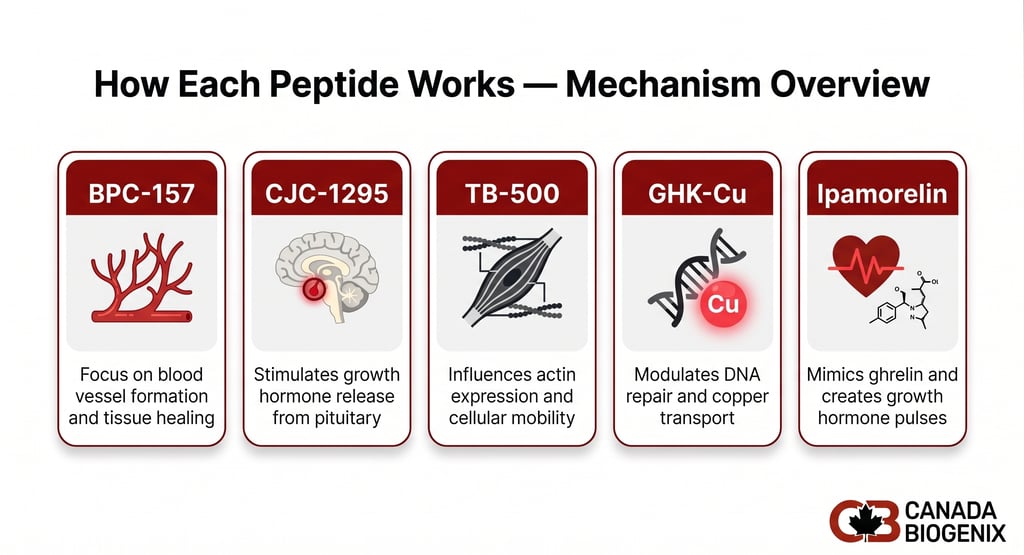
Mechanism: 15-amino-acid synthetic peptide angiogenesis, fibroblast activation, nitric oxide pathway interactions
Research Focus: Tissue repair, GI health, tendon and ligament research, inflammation pathway modulation
Canada Search 2026: Peak search volume most searched research peptide in Canada 2026
Why Canadians Research It: Broadest preclinical research profile of any recovery peptide studied across GI, tendon, cardiac, and neurological pathways in animal models
BPC-157 has held the top position in Canadian research peptide interest for three consecutive years — and in 2026, its search volume continues to climb. The reason is simple: it has one of the most comprehensive preclinical research profiles of any research peptide currently available in Canada.
Originally derived from a protective protein found in gastric juice, BPC-157 has been studied in animal models for an unusually wide range of biological pathway interactions — from gastrointestinal tissue repair to tendon healing to angiogenesis and beyond.
What BPC-157 Research Has Found
Animal studies have examined fibroblast proliferation cells responsible for collagen production
GI tissue protective pathway interactions extensively studied in rodent models
Angiogenesis new blood vessel formation observed in multiple preclinical studies
Anti-inflammatory marker modulation documented in animal research
One of the most searched compounds among Canadian athletes and fitness researchers
Research Honesty: BPC-157's angiogenic properties require careful consideration in some research contexts particularly cancer biology. All research should be conducted with appropriate scientific methodology.
Related: BPC-157 Complete Research Overview — Deep dive into BPC-157 preclinical research findings (canadabiogenix.com/blog/bpc-157-canada-recovery-healing-research)
Related: TB-500 vs BPC-157 Full Comparison — How BPC-157 compares to TB-500 in recovery research (canadabiogenix.com/blog/tb-500-vs-bpc-157-canada-recovery-research)
2.CJC-1295: Growth Hormone Signalling Research
#2 CJC-1295 Growth Hormone Releasing Hormone Analog
Mechanism: Synthetic GHRH analog stimulates sustained GH release through pituitary gland signalling pathways
Research Focus: Growth hormone signalling, body composition research, lean tissue studies, IGF-1 pathway interaction
Canada Search 2026: Very High most searched GH peptide in Canada 2026
Why Canadians Research It: Only GHRH analog with both sustained (DAC) and pulsatile (no DAC / Mod GRF 1-29) research forms giving researchers two distinct protocol options
CJC-1295 is Canada's most researched growth hormone pathway peptide and its position at #2 reflects the enormous Canadian interest in GH signalling research, body composition science, and the downstream IGF-1 pathway interactions that CJC-1295 is studied for.
As a synthetic analog of Growth Hormone Releasing Hormone (GHRH) the natural signal from the hypothalamus that instructs the pituitary gland to release growth hormone CJC-1295 has been studied in animal models for its ability to produce more sustained GH elevation compared to natural GHRH, which has a very short half-life.
CJC-1295: Two Research Forms
CJC-1295 with DAC (Drug Affinity Complex) extended half-life, sustained GH release in animal models
CJC-1295 without DAC (Mod GRF 1-29) shorter half-life, pulsatile GH release research
Researchers choose between these based on their specific GH signalling protocol design
What CJC-1295 Research Has Explored
Sustained GH and downstream IGF-1 elevation in rodent models
Body composition markers lean tissue versus fat tissue ratios in animal studies
Recovery pathway activity in preclinical models with tissue stress
Often studied in combination with Ipamorelin for dual-pathway GH stimulation
Related: Best Peptides for Muscle Growth in Canada CJC-1295, Ipamorelin, IGF-1 LR3 and more complete muscle research guide (canadabiogenix.com/blog/best-peptides-muscle-growth-canada)
3.TB-500: Systemic Recovery Research
#3 TB-500Thymosin Beta-4 Synthetic Analog
Mechanism: Actin-binding interactions G-actin sequestration affecting cellular mobility and systemic tissue repair pathways
Research Focus: Systemic tissue regeneration, cardiac research, muscle and tendon repair, neurological pathway interactions
Canada Search 2026: High and rapidly growing in Canada 2026
Why Canadians Research It: Unique systemic research profile studied across more tissue types than almost any other recovery peptide, including cardiac and neurological pathways not covered by BPC-157
TB-500 earns its place at #3 through a research profile that is uniquely systemic meaning its studied interactions in animal models span multiple tissue types in a way that few other research peptides match. While BPC-157 leads in GI and tendon-specific research, TB-500's actin-pathway interactions have been studied across cardiac, muscular, neurological, and connective tissue models.
The foundation of TB-500 research is its interaction with G-actin the monomeric building block of actin filaments, which form the structural scaffold inside cells. By interacting with G-actin, TB-500 has been studied for how it potentially influences cell migration toward damaged tissue a fundamental aspect of biological repair processes.
What TB-500 Research Has Explored
G-actin binding and its relationship to cell migration in preclinical models
Cardiac tissue repair research in rodent injury models
Muscle and connective tissue repair pathway interactions
Neuroprotective interaction studies in animal research
Anti-inflammatory pathway modulation observed in preclinical models
Related: TB-500 vs BPC-157 Complete Comparison Which recovery peptide does research support? Full comparison. (canadabiogenix.com/blog/tb-500-vs-bpc-157-canada-recovery-research)
4.GHK-Cu: Cellular Repair and Anti-Aging Research
#4 GHK-Cu Copper Peptide Glycyl-L-Histidyl-L-Lysine Copper
Mechanism: Copper-binding tripeptide interacts with gene expression, antioxidant pathways, collagen synthesis, and cellular repair mechanisms
Research Focus: Skin biology, cellular repair, antioxidant pathway research, gene expression studies, DNA repair research
Canada Search 2026: Rapidly growing in Canada fastest rising peptide in 2025-2026
Why Canadians Research It: Only naturally occurring peptide in this top 5 found in human plasma. Has one of the most scientifically interesting gene expression research profiles of any peptide currently studied.
GHK-Cu (Copper Peptide) is the fastest-growing research peptide in Canada's search data climbing dramatically in 2025 and continuing into 2026. The reason? A genuinely remarkable preclinical research profile that spans skin biology, cellular repair, antioxidant science, and notably cancer biology research.
Unlike the other peptides in this top 5, GHK-Cu is naturally occurring found in human plasma, saliva, and urine. Its concentration is known to decline with age, which has made it a subject of significant anti-aging and longevity research interest.
What GHK-Cu Research Has Explored
Collagen and glycosaminoglycan synthesis pathway interactions in skin research
Antioxidant enzyme activity stimulation superoxide dismutase and other pathways
DNA repair mechanism interactions at cellular level
Gene expression studies some in vitro research has examined GHK-Cu's interactions with cancer-related gene expression patterns
Wound healing pathway research across skin, collagen, and connective tissue models
Anti-inflammatory marker interactions in preclinical studies
Research Note: GHK-Cu's gene expression research profile particularly in vitro cancer biology cell studies is one of the most scientifically interesting areas in current peptide research. These are cell-level findings only.
5.Ipamorelin: Selective GH Secretagogue Research
#5 Ipamorelin Selective Growth Hormone Secretagogue
Mechanism: Ghrelin receptor agonist stimulates GH release through ghrelin pathway with high selectivity profile
Research Focus: Growth hormone secretagogue research, body composition studies, selective GH pulse research
Canada Search 2026: Very High most searched alongside CJC-1295 in Canada
Why Canadians Research It: Selectivity profile sets it apart preclinical research suggests GH stimulation without significant cortisol interaction, unlike older secretagogues. Most commonly searched alongside CJC-1295 as a research stack.
Ipamorelin rounds out Canada's top 5 research peptides and its position here is almost inseparable from CJC-1295. In Canadian search data, "CJC-1295 Ipamorelin Canada" is consistently one of the highest-volume combined peptide search terms, reflecting how frequently these two compounds are researched and studied together.
What makes Ipamorelin scientifically distinctive is its selectivity profile. As a ghrelin receptor agonist, it stimulates GH release through a pathway different from CJC-1295's GHRH receptor mechanism but with a studied selectivity that preclinical research suggests may avoid the cortisol and prolactin interactions associated with older GH secretagogues like GHRP-6.
What Ipamorelin Research Has Explored
GH pulse stimulation via ghrelin receptor distinct from GHRH receptor pathway
Selectivity profile minimal cortisol interaction observed in animal studies
Body composition markers in rodent models lean tissue and fat tissue ratios
Recovery-related pathway interactions in preclinical muscle stress models
Combination research with CJC-1295 dual pathway GH stimulation studies
Why CJC-1295 + Ipamorelin Are Studied Together: CJC-1295 stimulates GH through GHRH receptors. Ipamorelin stimulates GH through ghrelin receptors. Studying both together means two different GH release pathways are activated simultaneously producing a more comprehensive GH signalling research protocol than either compound alone.
How These 5 Peptides Compare
Q: What is the difference between these top 5 peptides?
→ Each of the top 5 peptides works through a completely different mechanism: BPC-157 through angiogenesis and GI pathways, CJC-1295 through GHRH receptors, TB-500 through actin binding, GHK-Cu through gene expression and copper interactions, and Ipamorelin through ghrelin receptors. They are complementary not competing.
Here is a quick summary of how each compound differs based purely on research mechanism and focus area:
1. BPC-157
Mechanism: Angiogenesis + GI pathways + fibroblast activation | Best For: Localized tissue and GI repair research
2. CJC-1295
Mechanism: GHRH receptor sustained GH stimulation | Best For: GH signalling and body composition research
3. TB-500
Mechanism: Actin-binding systemic cellular repair | Best For: Multi-tissue systemic recovery research
4. GHK-Cu
Mechanism: Copper-binding + gene expression + antioxidant | Best For: Skin, cellular repair, anti-aging research
5. Ipamorelin
Mechanism: Ghrelin receptor selective GH pulse | Best For: Selective GH secretagogue research, often with CJC-1295
How to Source These Peptides in Canada
Q: Where can I find these top 5 peptides in Canada?
→ Source from a Canadian supplier that provides independent third-party COA documentation, verifies 98%+ purity, offers domestic Canadian shipping, and maintains research-use-only positioning. Canada Biogenix carries all 5 of these compounds meeting these standards.
All five of the peptides in this list are available through Canada Biogenix independently tested, research-grade quality, domestically shipped across Canada.
When sourcing any research peptide in Canada, these non-negotiable standards apply regardless of which compound you are ordering:
Independent third-party COA — HPLC tested, batch-specific, from accredited lab
Minimum 98%+ purity verified — not just claimed
Domestic Canadian shipping — no customs complications
Research-use-only positioning — no therapeutic claims on supplier site
Transparent sourcing — supplier knows manufacturing origin
Related: How to Buy Peptides Safely in Canada Complete Guide COA verification, red flags, quality standards explained (canadabiogenix.com/blog/how-to-buy-peptides-safely-canada)
Related: Browse All Research Peptides Canada Biogenix Research-grade peptides available across Canada (canadabiogenix.com/peptides)
Frequently Asked Questions: Top Peptides Canada 2026
Q: What is the most popular research peptide in Canada?
→ BPC-157 is consistently the most searched and most discussed research peptide in Canada in 2026. It has the broadest preclinical research profile of any recovery peptide studied across GI, tendon, cardiac, and angiogenesis pathways in animal models.
Q: Are these top 5 peptides legal in Canada?
→ All five are available in Canada as research compounds for laboratory and scientific research purposes. None are approved by Health Canada as pharmaceutical drugs for human therapeutic use. Always source from suppliers maintaining research-use-only positioning.
Q: What is the difference between CJC-1295 and Ipamorelin?
→ CJC-1295 is a GHRH analog stimulating GH through GHRH receptors producing sustained GH elevation. Ipamorelin is a ghrelin receptor agonist stimulating GH through a different pathway producing more pulsatile GH release with a selective profile. They are most frequently studied together for dual-pathway GH stimulation research.
Q: Why is GHK-Cu growing so fast in Canada?
→ GHK-Cu is growing rapidly because its research profile spans multiple high-interest areas simultaneously skin biology, anti-aging science, antioxidant research, and some cancer biology cell studies. Its status as a naturally occurring peptide that declines with age also aligns with growing Canadian interest in longevity and cellular health research.
Q: Can these peptides be studied together?
→ Some combinations are widely studied together in preclinical research particularly CJC-1295 + Ipamorelin (dual GH pathway) and BPC-157 + TB-500 (complementary recovery mechanisms). Multi-compound research adds complexity and requires appropriate scientific methodology.
Q: Where can I get all 5 of these peptides in Canada?
→ Canada Biogenix carries all five BPC-157, CJC-1295, TB-500, GHK-Cu, and Ipamorelin as research-grade compounds with independent third-party COA documentation. Domestic Canadian shipping available nationwide at canadabiogenix.com/peptides
Final Thoughts: Canada's Top 5 Research Peptides in 2026
The five peptides in this guide represent the leading edge of Canadian research peptide interest in 2026 each with a distinct mechanism, a specific research focus area, and a genuine scientific rationale for the attention they receive.
BPC-157 leads through sheer research breadth. CJC-1295 and Ipamorelin dominate the GH signalling space. TB-500 brings systemic recovery research depth. And GHK-Cu is the fastest-rising compound its multi-pathway research profile making it one of the most scientifically interesting peptides in the entire category.
As always: all of this is preclinical science. Promising, interesting, and actively studied but not yet translated into proven human clinical outcomes for most applications. That honesty is something we think every Canadian researcher deserves to hear.
Explore all five research-grade peptides independently tested, domestically shipped at canadabiogenix.com/peptides Canada's trusted research peptide source.
Related: Browse All Research Peptides Canada Biogenix All top 5 peptides available research grade (canadabiogenix.com/peptides)
Related: How to Buy Peptides Safely in Canada Complete quality and sourcing guide (canadabiogenix.com/blog/how-to-buy-peptides-safely-canada)
Related: Best Peptides for Muscle Growth in Canada CJC-1295, Ipamorelin, IGF-1 LR3 and more (canadabiogenix.com/blog/best-peptides-muscle-growth-canada)
DISCLAIMER: This content is for educational and informational purposes only and does not constitute medical advice. All peptides discussed are supplied by Canada Biogenix strictly for laboratory and scientific research purposes. None are approved by Health Canada for human therapeutic use. Canada Biogenix makes no medical or therapeutic claims. Always consult a qualified healthcare professional for health-related decisions.