
Last Updated: August 4, 2026
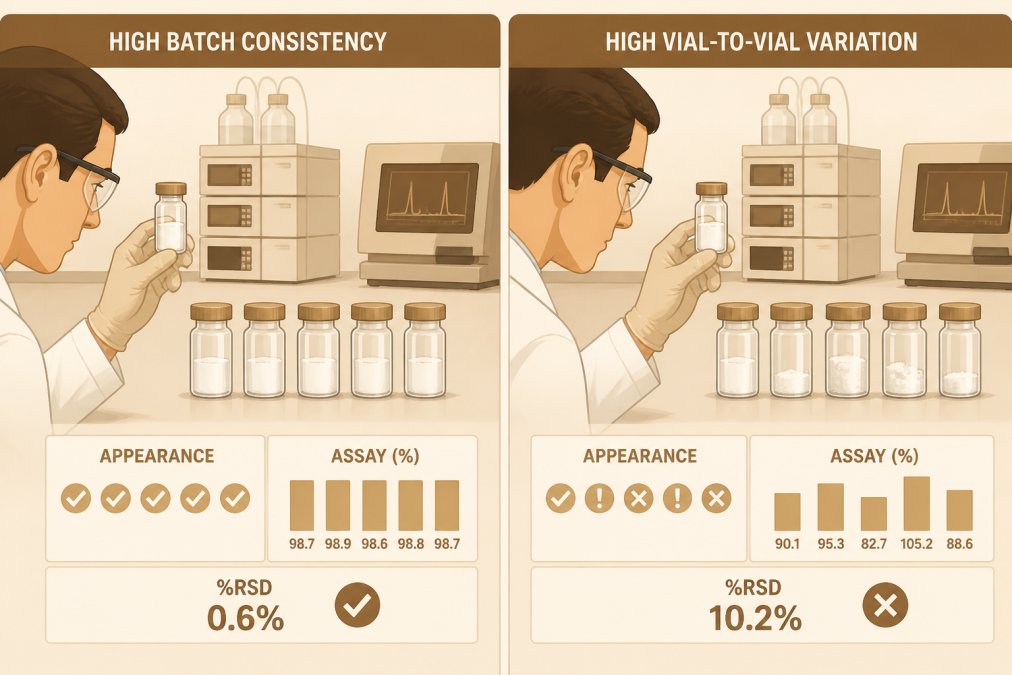
Batch consistency is fundamental to reliable research. When peptide batches lack consistency, vial-to-vial variation introduces uncontrolled variables that compromise reproducibility. Even small variations in purity or molecular integrity can shift experimental outcomes in ways that appear random but are entirely preventable.
Reproducibility is the cornerstone of scientific validity, and batch consistency makes it possible. When you repeat an experiment weeks later with peptides from a different batch, the compounds should behave identically if both batches meet the same specifications. Research on analytical testing standards shows vial-to-vial variation within a single batch can range from 2-8% depending on manufacturing controls. Over multiple experiments, these variations accumulate into noise that masks real effects.
Vial-to-vial variation refers to differences in peptide composition between individual vials within the same manufacturing lot. This occurs during synthesis, purification, and reconstitution, where even tiny deviations in temperature, timing, or handling create measurable differences. In a dose-response study, inconsistent vial concentrations mean you’re testing slightly different concentrations, not identical ones, creating systematic error that appears random.
Peptide purity is expressed as a percentage, typically ranging from 90% to 99.5%+, representing the fraction of active compound versus impurities and byproducts. The difference between 95% and 99% purity is significant: that 4% gap represents 40 milligrams of non-peptide material per gram of product.
Canadian research standards align with international pharmaceutical norms. While Canada lacks a single government certifying body for peptide purity, suppliers typically follow Health Canada’s guidance on pharmaceutical quality and international standards like USP and European Pharmacopoeia.
Polydispersity measures the distribution of molecular weights within a batch. Low polydispersity (PDI < 1.2) means consistent synthesis; high polydispersity (PDI > 1.5) indicates poor synthesis control. Both purity and polydispersity affect batch consistency.
A 99% pure peptide is not necessarily better than 98% pure if the impurities differ. Certificates of Analysis (CoAs) are critical, they list not just purity percentage but the identity and quantity of specific impurities. A CoA showing "99% pure, 0.8% TFA, 0.2% water" tells you exactly what’s in your vial.
Polydispersity directly impacts batch consistency. During synthesis, some molecules may lose amino acids while others retain protecting groups. Real batches typically have PDI values between 1.05 and 1.3. Higher values indicate more variation and less consistency, directly affecting results in mass spectrometry, binding assays, and structural studies.
Batch consistency begins upstream with raw material sourcing. Amino acids and reagents vary in purity depending on supplier. A manufacturer sourcing from low-cost suppliers will see more batch-to-batch variation than one using pharmaceutical-grade materials from premium suppliers. Even from the same supplier, different lots have slightly different properties that propagate through synthesis and affect the final peptide.
A Certificate of Analysis should contain specific data: purity percentage (measured by HPLC or mass spectrometry), polydispersity index, molecular weight confirmation, water content, and detailed breakdown of identified impurities. A batch showing 99% purity with impurities listed as "0.6% TFA, 0.4% water" suggests clean synthesis and thorough purification. One showing 98% purity with "0.8% unknown organic compound, 0.7% salt, 0.5% water" suggests incomplete characterization and poor quality control.

The CoA date matters, a purity measurement from three years ago tells you nothing about current batch status. Batch traceability is the ability to trace your specific vial back to its manufacturing run, raw materials used, and testing data generated. A supplier providing batch-specific CoAs with lot numbers, synthesis dates, and testing dates offers traceability.
High-Performance Liquid Chromatography (HPLC) measures purity by separating peptide molecules based on physical properties as they move through a column. Mass spectrometry (MS) confirms molecular weight and identifies impurities by mass-to-charge ratio. A complete CoA includes both HPLC and MS data. HPLC alone can miss structural isomers or impurities with similar retention times. MS alone cannot quantify purity without HPLC. Together, they provide comprehensive characterization.
Batch traceability means you can answer: When was it synthesized? Which facility made it? Which raw material lots were used? When was it tested? What were the exact results? If your supplier cannot answer these questions with documentation, you lack true traceability.
Lot-specific data refers to testing results for your exact batch, not averages for the product line. A supplier saying "our peptides are typically 99% pure" provides product-level data. One providing a CoA showing "Batch 2026-0847: HPLC purity 99.1%, tested 2026-08-02" provides lot-specific data.
Impurities affect research outcomes through several mechanisms. Some are chemically inert, adding noise to measurements. Others are biochemically active, interfering with binding, catalysis, or cellular uptake. Residual TFA is a common impurity used during purification; in some experiments it’s irrelevant, but in pH-sensitive reactions or cell-based assays, it significantly affects results.
Synthetic byproducts from incomplete coupling reactions represent another impurity class. During synthesis, if coupling efficiency is 99% per step, a 50-amino-acid peptide will accumulate 39% incomplete sequences. Degradation products accumulate over time, especially with room temperature storage or light exposure.
Compound stability refers to how long a peptide remains chemically unchanged under storage conditions. Trace metals catalyze oxidation. Water content matters because hydrolysis requires water. Residual acids or bases shift pH, affecting stability; peptides are most stable at neutral pH.
Researchers encounter several recurring problems: vial-to-vial variation within a single batch where reconstitution yields different concentrations, batch-to-batch drift where results gradually shift over months, cross-contamination when facilities produce multiple peptides without thorough cleaning, and incomplete characterization when suppliers provide purity percentages without identifying impurities.
Effective quality control begins with raw material specifications requiring pharmaceutical-grade or HPLC-grade materials. In-process monitoring during synthesis tracks temperature, reaction time, and coupling efficiency. Post-synthesis testing must be comprehensive and batch-specific: HPLC analysis for purity, mass spectrometry for molecular weight, and water content analysis. Documentation and traceability systems ensure every vial links to manufacturing data.
An effective SOP specifies: sampling protocol, reconstitution method (exact solvent, volume, temperature, mixing time), testing sequence, acceptance criteria (minimum purity, maximum water content, acceptable polydispersity), documentation requirements, and deviation handling. An SOP transforms batch verification from ad-hoc testing into standardized, repeatable process.
Complete batch records should include synthesis date and facility, raw material lot numbers, synthesis parameters, purification method, final yield, HPLC chromatogram and purity calculation, mass spectrometry data, water content measurement, storage conditions, and testing date with analyst signature. Analytical testing requirements depend on application. For basic research peptides, HPLC and mass spectrometry are typically sufficient. For cell-based assays or animal studies, additional testing may include endotoxin levels and sterility testing.
Once manufactured and tested, peptide quality depends entirely on storage and handling. Peptides are vulnerable to hydrolysis, oxidation, and thermal decomposition. Hydrolysis occurs faster at elevated temperatures and non-neutral pH. Oxidation targets amino acids with reactive side chains; methionine, tryptophan, and cysteine are particularly vulnerable. Thermal decomposition accelerates at higher temperatures; reaction rates double for every 10°C increase.
Most peptides should be stored at -20°C or colder; -80°C is recommended for long-term storage. Peptides at -80°C remain stable for years, while those at -20°C may show measurable degradation after 12 months. Light exposure degrades peptides through photochemical reactions. UV light is particularly damaging. Amber vials protect better than clear vials.
Moisture accelerates hydrolysis and enables microbial growth. Peptides should be stored desiccated, either as lyophilized powder or in solvent with minimal water content. Freeze-thaw cycles damage peptides by concentrating salts and impurities as ice crystals form. If storing in solution, avoid repeated freeze-thaw cycles by aliquoting into single-use portions.
Peptides shipped across Canada must survive transit conditions including temperature fluctuations, vibration, and pressure changes. Proper shipping requires thermal packaging with temperature-control packs. Dry ice maintains -78°C, ideal for stability. Gel packs maintain 2-8°C, acceptable for short transit (24-48 hours).
A reputable supplier includes shipping data: what packing method was used, what temperature was maintained, dispatch and expected arrival times. Upon arrival, inspect packaging for intact insulation, cold or frozen temperature-control packs, and evidence of leakage or damage. Document condition before opening and contact the supplier immediately if concerns arise.
Batch inconsistency creates experimental noise that obscures true effects. When researchers switch from inconsistent to consistent batches, their coefficient of variation typically drops 20-40%. That reduction in noise means real effects become statistically significant sooner, requiring fewer replicates to achieve statistical power.
A controlled research environment standardizes known variables: temperature, equipment, procedures. But batch inconsistency is an unknown variable you don’t know exists until results diverge for no apparent reason. Reducing experimental error requires addressing both known and unknown sources of variation. Researchers using high-consistency peptides from suppliers emphasizing batch traceability and detailed characterization report fewer unexplained results, higher statistical power, and greater confidence in findings.
Many researchers accept supplier claims at face value. But claims are not data. Data is a specific measurement of a specific batch at a specific time, documented in a Certificate of Analysis. Instead of "How pure are your peptides?" ask "What is the HPLC purity of Batch 2026-0847?" Suppliers offering genuine batch consistency answer with specific data, providing CoAs with batch numbers, testing dates, and detailed results.
Batch consistency determines whether your research succeeds or fails. When peptides vary from vial to vial or batch to batch, experimental results become unreliable. Canada BioGenix supports your research by providing peptides with verified batch consistency, detailed Certificates of Analysis for every lot, and transparent documentation of manufacturing quality and purity standards. Start with peptides you can trust, and eliminate batch inconsistency as a source of experimental error.
Batch consistency refers to uniformity across all vials within a single manufacturing lot, ensuring that every vial delivers the same purity, potency, and composition. Purity measures the percentage of the target peptide versus contaminants, while consistency ensures that this purity level remains stable vial-to-vial. A batch might claim 99% purity, but if vial-to-vial variation exists, some vials could be 98% and others 99.5%, creating experimental variability. Consistency is the foundation of reproducibility in research.
A genuine CoA should include lot-specific data with traceable manufacturing information, HPLC or mass spectrometry results, and reference standards used for testing. Look for third-party analytical testing rather than in-house results alone. The document should list specific impurities detected, residual solvents, and water content. Cross-reference the analytical methods used (HPLC retention times, mass spectrometry ionization techniques) against industry standards. Legitimate suppliers provide CoAs for every batch, not blanket certifications, and allow you to request independent verification through accredited Canadian testing facilities.
Temperature fluctuations, light exposure, and humidity during transit can degrade peptides and compromise batch integrity. Peptides are sensitive to freeze-thaw cycles, so inconsistent cold chain management introduces vial-to-vial variation even if the original batch was consistent. Reliable suppliers use insulated packaging with temperature monitoring, ship via expedited services, and provide tracking data. Request that your supplier confirms shipping timeframes and temperature ranges for your location. Upon arrival, store vials immediately at the recommended temperature (typically -20°C or -80°C) to halt degradation and maintain the consistency you paid for.
Batch consistency directly affects how your body responds to the compound. Inconsistent batches mean unpredictable dosing and effects, making it impossible to determine what's actually working. If one vial is 95% pure and another is 99% pure, you're not receiving the same dose, and your results become unreliable. For injury recovery and fitness goals, consistency ensures you get the same therapeutic effect every time you use the product. This is why quality control protocols and batch traceability matter regardless of whether you're in a formal research setting or managing personal health outcomes.
This article was written using GrandRanker