
Last Updated: August 24, 2026
Molarity is the number of moles of solute dissolved in enough solvent to make one litre of total solution. For research peptides, calculating molarity accurately is essential because it determines the concentration of your working solution and directly affects experimental reproducibility and results. This guide from Canada BioGenix walks you through the process step-by-step.
When working with lyophilized peptides, you’re dissolving a complex mixture that includes counter-ions, residual water, and potentially salt content from manufacturing. Understanding how to calculate molarity means accounting for all these variables, not just the peptide mass itself.
The fundamental molarity formula is:
Molarity (M) = moles of solute ÷ litres of solution
Or, expressed another way:
M = (mass in grams ÷ molecular weight) ÷ volume in litres
For peptides, you must adjust the numerator for purity and counter-ion content before dividing by molecular weight. Your final volume must be measured precisely using a volumetric flask, not an approximation.
To calculate molarity for research peptides, you need four key pieces of information:
The molecular weight of a peptide is the sum of the masses of all amino acid residues plus the terminal groups. This is not the same as the mass of your lyophilized powder, which includes water, salts, and counter-ions.
Your Certificate of Analysis (CoA) is the authoritative document for your specific batch. Before you calculate molarity, verify these three items on your CoA:
If your CoA does not list molecular weight, you can calculate it by summing the residue masses of each amino acid in the sequence, then adding 18 for terminal groups. However, supplier-provided values are always preferable.
If you need to calculate molecular weight from scratch, start with the standard amino acid residue masses. Each amino acid contributes its residue mass (not its full molecular weight, because water is removed during peptide bond formation) (peer-reviewed research). Sum all residue masses for your sequence, then add 18 Da for the terminal H and OH groups.
Example: A tripeptide of Ala-Gly-Leu would be calculated as:
71.04 + 57.02 + 113.16 + 18 = 259.22 Da
This calculated value should match the molecular weight listed on your CoA. If there’s a significant discrepancy, contact your supplier.
Now that you understand the variables, here’s how to calculate molarity for research peptides in practice.
Start with the molecular weight from your Certificate of Analysis. Do not round it; precision matters. If you’re calculating MW yourself, use the amino acid residue table and add 18 for terminal groups.
Your purity percentage tells you what fraction of your lyophilized powder is actual peptide. If your CoA states 95% purity, then 95% of the mass you weigh is peptide; the remaining 5% is water, salt, or other impurities.
Adjust your effective mass by multiplying by the purity fraction:
Effective peptide mass = measured mass × (purity % ÷ 100)
Example: You weigh 10 mg of lyophilized peptide with 95% purity.
Effective peptide mass = 10 mg × 0.95 = 9.5 mg
Counter-ions (such as TFA, acetate, or chloride) are bound to your peptide during synthesis and remain in the lyophilized powder. Your CoA typically reports this as "TFA content: X%."
If your CoA states "TFA content: 15%," you must subtract this from your effective mass:
Corrected peptide mass = effective mass × (1 − TFA fraction)
Example: Your 10 mg sample is 95% pure peptide and contains 15% TFA.
Effective peptide mass = 10 mg × 0.95 = 9.5 mg
Corrected peptide mass = 9.5 mg × (1 − 0.15) = 8.075 mg
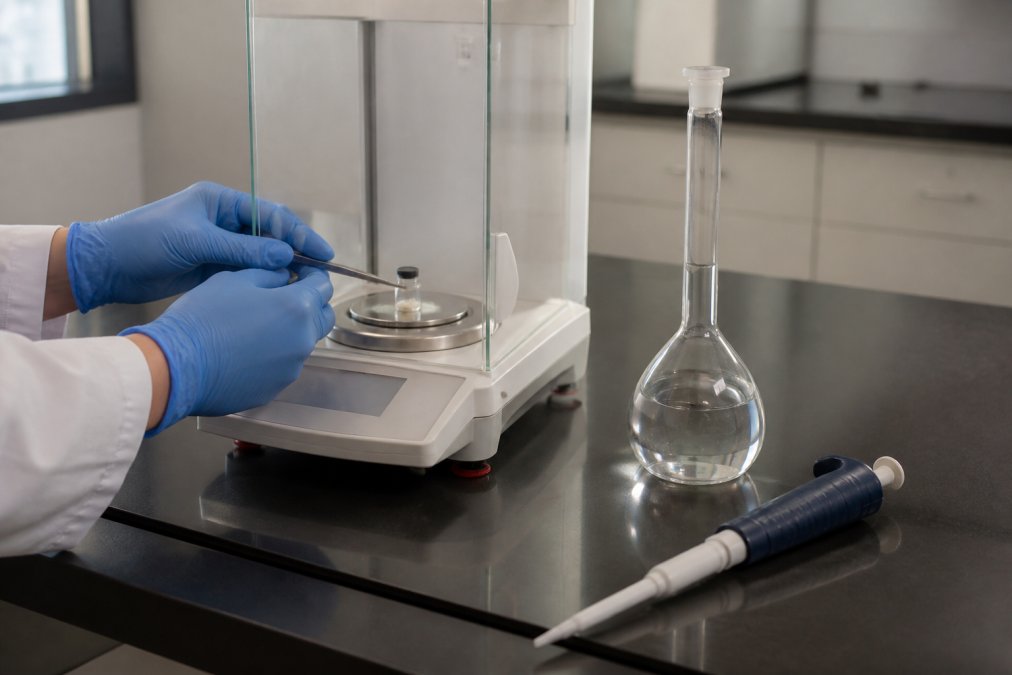
Convert your corrected peptide mass to moles using the molecular weight:
Moles = corrected mass (in grams) ÷ molecular weight (in g/mol)
Convert your mass from milligrams to grams first. Using the previous example:
Corrected peptide mass = 8.075 mg = 0.008075 g
Molecular weight = 1,234.5 g/mol
Moles = 0.008075 ÷ 1,234.5 = 0.00000654 mol = 6.54 micromoles (µmol)
Measure your final solution volume in a calibrated volumetric flask. Do not estimate or use a graduated cylinder. If you reconstitute your peptide in a 10 mL volumetric flask, your final volume is 0.010 L.
Now calculate molarity:
Molarity = moles ÷ volume (in litres)
M = 0.00000654 mol ÷ 0.010 L = 0.000654 M = 654 µM
Your research peptide solution is 654 micromolar (µM).
Converting between mass (milligrams) and molarity (micromolar) is one of the most common tasks in peptide work.
Micromolar (µM) = 10⁻⁶ M = 0.000001 M
Millimolar (mM) = 10⁻³ M = 0.001 M
Nanomolar (nM) = 10⁻⁹ M = 0.000000001 M
For research peptides, micromolar is the most common working unit. The relationship between mass and molarity is:
Concentration (µM) = (mass in mg ÷ MW) × (1,000,000 ÷ volume in mL)
Example 1: 5 mg peptide, MW 1,200 g/mol, dissolved in 10 mL
Concentration = (5 ÷ 1,200) × (1,000,000 ÷ 10) = 417 µM
Example 2: 10 mg peptide with 90% purity and 12% TFA, MW 1,500 g/mol, dissolved in 20 mL
Corrected mass = 10 × 0.90 × (1 − 0.12) = 7.92 mg
Concentration = (7.92 ÷ 1,500) × (1,000,000 ÷ 20) = 264 µM
Calculating molarity is only the first step. How you reconstitute your peptide, the solvent you choose, and your pipetting technique all affect whether your final concentration matches your calculation.
Peptides vary widely in solubility depending on their amino acid composition. Hydrophobic peptides may not dissolve well in water alone. Hydrophilic peptides dissolve readily.
Common solvents for peptide reconstitution include:
Check your supplier’s technical data sheet or CoA for solubility recommendations specific to your peptide.

Lyophilized peptides contain residual water trapped in the powder matrix, typically 2-8% by mass (peer-reviewed research). When you weigh your lyophilized peptide, this bound water is included in your measured mass. Your purity percentage on the CoA accounts for this; it reflects the fraction of the total lyophilized mass that is peptide versus impurities.
You do not need to subtract bound water separately. However, store lyophilized peptides in a desiccated container or at −20 °C to prevent moisture uptake, which would increase total mass and throw off your concentration calculation.
Accurate pipetting is critical. A 1% error in your final volume translates directly to a 1% error in your calculated molarity.
Even experienced researchers make mistakes when calculating molarity for research peptides.
Peptides degrade over time, especially if stored improperly (room temperature, humid conditions, repeated freeze-thaw cycles) (peer-reviewed research). If your peptide has been stored for months or years, your actual active concentration may be lower than your calculation predicts. Request stability data from your supplier or ask whether a degradation correction factor should be applied.
This is the single most common source of error. Many researchers weigh their peptide and calculate molarity without subtracting the counter-ion mass, resulting in a calculated concentration that is 10-30% higher than actual. Always check your CoA for counter-ion content. At Canada BioGenix, we provide this information on every batch.
Molarity (M) is moles per litre of solution. This is what you calculate when you use a volumetric flask.
Molality (m) is moles per kilogram of solvent. This is rarely used in peptide work.
For peptide research, always work in molarity, not molality.
After you’ve calculated molarity and prepared your solution, verify that your result is reasonable.
Your measurement precision depends on your equipment:
Your overall concentration uncertainty is roughly the sum of these errors. If you weigh with ±2% uncertainty and measure volume with ±1% uncertainty, your final concentration has roughly ±3% uncertainty. This is normal and acceptable for most research applications.
Before using your reconstituted peptide, cross-check your calculation against your CoA:
Calculating molarity for research peptides requires attention to detail, but the process is straightforward once you understand the variables. By accounting for purity, counter-ions, and using calibrated equipment, you can prepare solutions with confidence. When you’re ready to order research peptides, Canada BioGenix provides detailed Certificates of Analysis with all the information you need, molecular weight, purity, counter-ion content, and batch-specific data, so your calculations are accurate from the start. Reach out to our team to discuss your reconstitution needs and get access to premium-quality peptides backed by transparent, verifiable testing.
A: Molarity (M) = moles of solute / liters of solution. For peptides, first determine the molecular weight from your Certificate of Analysis, multiply by purity percentage, then divide the peptide mass in grams by the molecular weight to get moles. Finally, divide moles by your final volume in litres. This accounts for the actual amount of active peptide in your solution.
A: Divide the mass in milligrams by the molecular weight, then divide by your final volume in litres and multiply by 1,000,000 to convert to micromolar (µM). For example, 5 mg of a peptide with molecular weight 1,000 Da reconstituted in 5 mL (0.005 L) equals (5 ÷ 1,000) ÷ 0.005 × 1,000,000 = 1,000 µM. Always account for purity by multiplying mass by the purity percentage before this calculation.
A: Purity directly impacts the actual amount of active peptide. A 90% pure peptide means only 90% of the vial's weight is the desired compound; the rest is salt, water, or other impurities. Multiply your peptide mass by the purity percentage (as a decimal) before calculating moles. Ignoring purity overstates your true concentration.
A: Your Certificate of Analysis should list counter-ion content (such as trifluoroacetic acid or acetate). Subtract the counter-ion mass from your total peptide mass to find the true peptide mass, then use that corrected value in your molarity calculation. This correction prevents overestimating concentration.
This article was written using GrandRanker