
Last Updated: August 29, 2026
Most reconstituted peptides remain stable for 28 days when stored in a refrigerator, though some formulations extend to 60 days under optimal conditions (peer-reviewed research). Shelf life depends on storage temperature, the diluent used, and aseptic technique during handling. Temperature fluctuations, improper diluent selection, and microbial contamination are the three factors that accelerate degradation most rapidly.
Temperature is the single most critical variable controlling reconstituted peptides shelf life. Most reconstituted peptides are stable between 2°C and 8°C, which is standard refrigerator temperature.
Refrigeration at 2-8°C slows hydrolysis, oxidation, and deamidation, the three primary degradation pathways. Most peptides maintain acceptable potency for 28 days, with many remaining stable for 60 days with proper aseptic technique.
Freezing at -20°C or below extends shelf life to 6 months or longer (peer-reviewed research). However, freeze-thaw cycles damage molecular structure through ice crystal formation. If you freeze reconstituted peptides, divide them into smaller aliquots before freezing and use one aliquot at a time without refreezing.
Room temperature storage (20-25°C) accelerates all degradation pathways 5-10 times faster than refrigeration (peer-reviewed research). Most reconstituted peptides lose measurable potency within 7-10 days at room temperature. Room temperature storage is acceptable only for short-term use during an experiment or a single day of sampling. Temperature fluctuations between 15°C and 25°C create additional thermal stress that accelerates degradation.
The diluent you choose dramatically affects reconstituted peptides shelf life. Bacteriostatic water contains benzyl alcohol, a preservative that inhibits microbial growth. Sterile water lacks this preservative and offers no protection against bacterial or fungal contamination once the vial is opened.
When you reconstitute a peptide with bacteriostatic water, the benzyl alcohol prevents microorganisms from colonizing the solution, extending shelf life by preventing microbial degradation. Most reconstituted peptides in bacteriostatic water remain stable for 28 days at 2-8°C.
Sterile water offers no such protection. Once you puncture the vial with a needle, bacteria and fungi can enter. Even with perfect aseptic technique, some microbial spores will inevitably contact the solution. In sterile water, these microorganisms multiply unchecked, consuming the peptide and producing metabolic waste that further degrades the solution. Reconstituted peptides in sterile water typically remain stable for only 7-14 days, even under refrigeration.
Degradation progresses gradually, and early signs are visible if you know what to look for. Catching degradation early lets you decide whether the peptide is still suitable for your research.
Perform a visual inspection every time you retrieve a vial from storage using a bright, consistent light source.
A healthy reconstituted peptide solution is clear and colorless or slightly pale yellow. No visible particles, cloudiness, or precipitate should be present. White, gray, or tan particles settling at the bottom or suspended throughout indicate peptide aggregation triggered by pH changes, oxidation, or thermal stress. Discard the vial. Cloudiness or hazy appearance indicates either peptide aggregation or microbial contamination. A color shift from colorless to yellow, brown, or any other color indicates oxidation or chemical degradation. Separation into distinct layers or liquid accumulation at the top indicates microbial growth or severe aggregation.
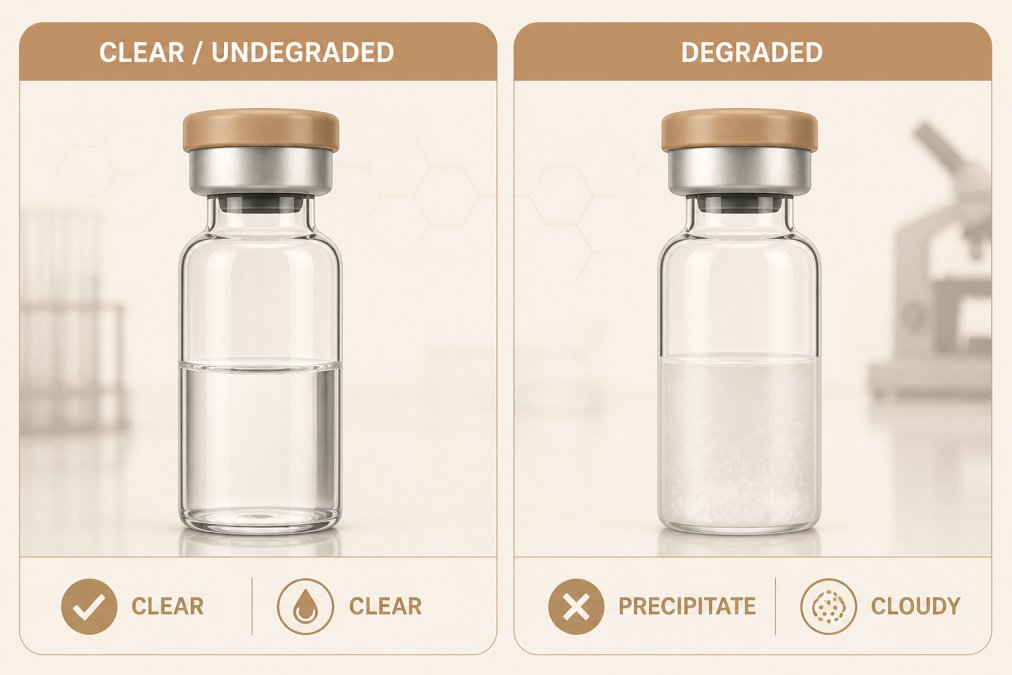
Visual inspection catches obvious degradation, but subtle potency loss occurs before visible signs appear. Deamidation removes amino groups from the peptide chain without causing visible changes. Hydrolysis breaks peptide bonds, fragmenting the molecule into smaller pieces that no longer function as intended. These fragments don’t always precipitate visibly; the solution can look clear while potency has dropped 20-30%.
If you notice weaker results than expected or inconsistent outcomes across multiple uses from the same vial, assume degradation has occurred and prepare a fresh batch.
The vial stopper is the primary entry point for contaminants. Every needle insertion creates a small puncture where bacteria and fungi can enter. Proper sanitization of the stopper before each use prevents microbial contamination and extends reconstituted peptides shelf life significantly.
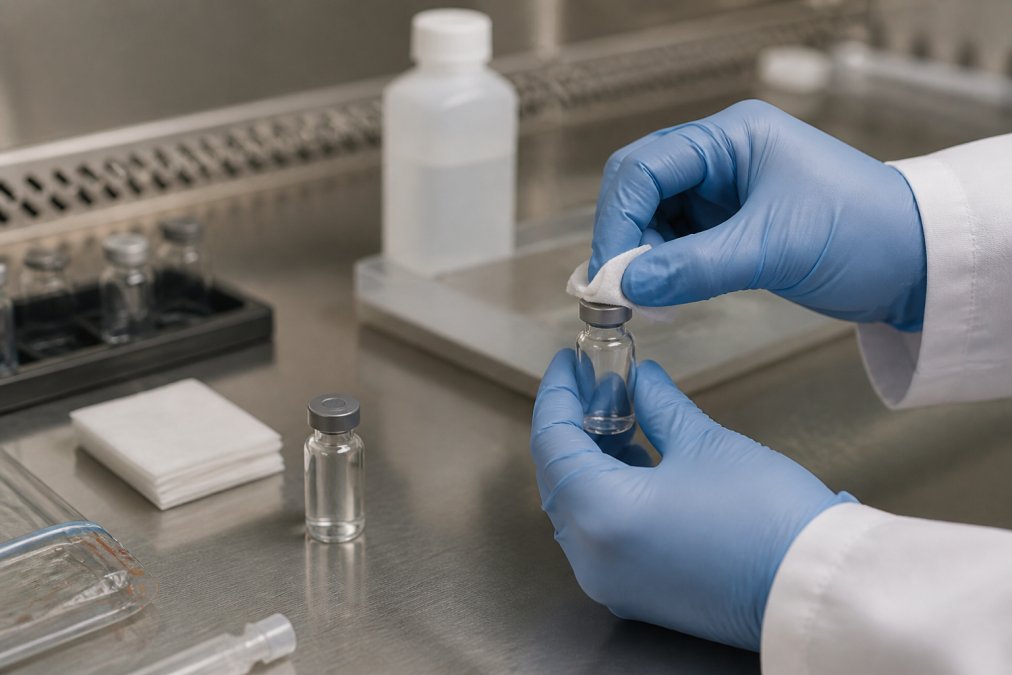
Wash your hands with soap and water for at least 20 seconds before touching the vial stopper, or use an alcohol-based hand sanitizer. Wear clean nitrile gloves.
Sanitize the stopper with a 70% isopropyl alcohol swab. Wipe the entire exposed surface of the rubber septum with firm, circular motions for at least 10-15 seconds. Allow the alcohol to air dry completely, typically 30 seconds to 1 minute. Do not blow on the stopper to speed drying.
Always use a fresh, sterile needle for each access to the vial. Insert the needle at a slight angle, pushing through the rubber smoothly without twisting. Twisting damages the rubber and creates larger puncture sites where contaminants can enter.
Store the reconstituted peptide vial with the needle still inserted if you plan to use it again within a few hours. This prevents repeated punctures to the same location and reduces total entry points for contaminants. If you’re finished for the day, remove the needle, sanitize the stopper again, and refrigerate.
Three chemical pathways dominate degradation: hydrolysis, oxidation, and deamidation. Light exposure and thermal stress amplify all three.
Hydrolysis breaks the peptide bonds that link amino acids together. Water molecules attack the bonds, fragmenting the peptide chain. Hydrolysis accelerates at higher temperatures and in solutions with pH imbalance. Every 10°C increase roughly doubles the hydrolysis rate. Refrigeration slows it dramatically.
Oxidation occurs when dissolved oxygen reacts with vulnerable amino acids in the peptide, particularly those containing sulfur or aromatic rings. Oxidation changes the peptide’s chemical structure, reducing or eliminating its biological activity. Oxidation accelerates in the presence of light, heat, and metal ions. Using amber or opaque vials reduces light exposure and slows oxidation significantly.
Deamidation removes amino groups from asparagine and glutamine residues in the peptide chain. This changes the charge and structure without breaking the peptide into fragments, so the solution remains clear. However, deamidation eliminates or severely reduces the peptide’s biological function. Maintaining neutral pH (around 7.0-7.4) and cool storage temperatures slows deamidation.
All three pathways are temperature-dependent. Refrigeration at 2-8°C reduces the rate of all three by 80-90% compared to room temperature.
Light, particularly ultraviolet (UV) light, accelerates oxidation and photodegradation of peptides. Store reconstituted peptides in opaque or amber vials, not clear vials. If your peptides arrive in clear vials, transfer them to amber vials immediately after reconstitution.
Thermal stress and temperature fluctuations accelerate all degradation pathways. A peptide stored at a steady 4°C remains stable much longer than one stored at 4°C one day and 15°C the next. Avoid storing peptides near heat sources: sunlit windows, radiators, or laboratory equipment that generates warmth. Keep the refrigerator door closed as much as possible.
| Scenario | Storage Method | Expected Shelf Life | Key Considerations |
|---|---|---|---|
| Daily use in laboratory | Refrigerator at 2-8°C, bacteriostatic water | 28-60 days | Sanitize stopper before each use; minimize thermal fluctuations |
| Weekly or less frequent use | Refrigerator at 2-8°C, bacteriostatic water | 28-60 days | Store in back of refrigerator away from door; use fresh needle each time |
| Long-term storage (months) | Freezer at -20°C, bacteriostatic water | 6+ months | Divide into single-use aliquots before freezing; never refreeze thawed portions |
| Short-term bench work (hours) | Room temperature, bacteriostatic water | 7-10 days | Keep in dark location; minimize light and heat exposure; use within 24 hours if possible |
| Emergency or temporary use | Room temperature, sterile water | 3-7 days | High contamination risk; use only if refrigeration is unavailable; expect reduced shelf life |
Scenario 1: Daily laboratory use. Reconstitute your peptide in bacteriostatic water and store it in the refrigerator at 2-8°C. Sanitize the stopper with 70% isopropyl alcohol before each access. This approach maintains stable shelf life for 28-60 days.
Scenario 2: Infrequent use. If you use the peptide only once or twice per week, refrigeration is still the best choice. Store the vial in the back of the refrigerator, away from the door where temperature fluctuates most. Shelf life remains 28-60 days.
Scenario 3: Long-term storage. If you need to store reconstituted peptides for months, freezing at -20°C is necessary. Divide the reconstituted peptide into small aliquots in separate vials immediately after reconstitution. Freeze the aliquots. When you need to use one, thaw it completely and use the entire contents. Never refreeze. This extends shelf life to 6 months or longer.
Scenario 4: Bench work or short-term use. If you’re performing an experiment requiring the peptide at room temperature for several hours, keep the vial in the darkest, coolest location available. Use bacteriostatic water. Expect shelf life to be only 7-10 days after the first access.
Scenario 5: Emergency or temporary storage. If refrigeration is unavailable, reconstitute with bacteriostatic water and store in the coolest, darkest location you can find. Shelf life drops to 3-7 days because room temperature accelerates all degradation pathways.
Extending the shelf life of reconstituted peptides comes down to three controllable factors: temperature, diluent selection, and aseptic technique. Refrigeration at 2-8°C is the foundation. Bacteriostatic water provides antimicrobial protection that sterile water cannot. Proper sanitization of the vial stopper prevents contamination that would otherwise accelerate degradation.
At Canada BioGenix, we supply premium-quality research peptides and reconstitution products specifically designed to support stable storage and extended shelf life. Our peptides are sourced from carefully selected manufacturing partners who maintain rigorous quality standards, ensuring that what you receive is ready for immediate reconstitution and reliable long-term storage. When you combine our high-purity compounds with the storage practices outlined in this guide, you maximize both shelf life and research consistency. Get started with Canada BioGenix and experience the difference that quality compounds and dependable service make in your research outcomes.
Reconstituted peptides stored in a refrigerator at 2-8°C typically remain stable for 14-28 days, depending on the diluent used and storage conditions. Bacteriostatic water extends shelf life compared to sterile water because its antimicrobial agent inhibits microbial growth. Proper vial sanitation and minimal air exposure further protect potency. Always verify the manufacturer's guidance for your specific peptide, as individual molecular structures and pH stability vary.
Visible signs include cloudiness, precipitate formation, discoloration, or particles suspended in the solution. Performance degradation may manifest as reduced potency or weaker results in your research. Chemical degradation occurs through hydrolysis, oxidation, and deamidation, processes that break down the amino acid sequence. If you notice any visual changes or inconsistent results after storage, the peptide should not be used. Proper storage temperature, diluent choice, and protection from light minimize these degradation pathways.
Freezing can extend shelf life to 3-6 months or longer, but it introduces risks. Repeated freeze-thaw cycles cause ice crystal formation that damages the molecular structure and reduces bioavailability. If you choose to freeze, do so only once and thaw slowly in a refrigerator. Most research protocols recommend refrigeration at 2-8°C as the safer option for routine use. Freezing is best reserved for long-term storage when you do not plan frequent access to the vial.
Bacteriostatic water contains benzyl alcohol or a similar antimicrobial agent that prevents microbial growth and contamination, extending shelf life to 28 days or more. Sterile water lacks this protection, so reconstituted peptides typically degrade faster, often within 7-14 days, because bacteria and fungi can proliferate. The choice of diluent directly impacts how long your reconstituted peptides remain potent. Bacteriostatic water is the preferred choice for extended storage and repeated vial access in research settings.
This article was written using GrandRanker