
Semax 10 mg is an ACTH-derived heptapeptide attracting research interest for its potential influence on BDNF and TrkB signalling, attention, memory, neuroplasticity, stress resilience and protection against ischemic or oxidative neural injury.

Semax is a synthetic seven-amino-acid peptide with the sequence Met–Glu–His–Phe–Pro–Gly–Pro, commonly written as MEHFPGP. Its first four amino acids come from the ACTH(4–7) fragment, while the Pro–Gly–Pro tail improves resistance to enzymatic breakdown and extends biological signalling.
Although Semax was developed from an adrenocorticotropic-hormone fragment, it is not considered corticotropic and has not shown the adrenal-stimulating hormonal activity associated with full-length ACTH. Instead, its research profile centres on neurotrophic, neuromodulatory, antioxidant and neuroprotective pathways.
Semax was developed by researchers at the Russian Academy of Sciences and has a history of regional clinical study and use in neurological settings. International research interest now focuses on how its BDNF, TrkB, NGF, dopamine, serotonin and gene-response effects may influence cognition and neural resilience.
Semax research has repeatedly identified effects on brain-derived neurotrophic factor, its TrkB receptor and related growth-factor pathways involved in learning and neuronal adaptation.
Small human studies have produced encouraging findings involving attention, short-term memory and brain-network activity, particularly during mental fatigue.
Human stroke-rehabilitation research and multiple ischemia models support continued investigation of functional recovery, inflammation, vascular signalling and neuronal survival.
| Pathway | Research observation | Potential significance |
|---|---|---|
| BDNF and TrkB | Animal research found increased hippocampal BDNF protein, BDNF gene expression and TrkB-receptor activation. | Provides a plausible link to learning, memory, synaptic plasticity and neuronal survival. |
| Dopamine and serotonin | Preclinical studies indicate modulation of monoamine metabolism and related neural-response pathways. | Supports research into attention, motivation, mood and adaptation to cognitive demand. |
| Inflammation and oxidative stress | Ischemia models found reduced expression of inflammatory genes and changes in antioxidant and cell-survival pathways. | May help neural tissue tolerate metabolic stress and limit secondary injury. |
| Vascular and repair signalling | Gene-expression studies reported effects on vascular-development, extracellular-matrix and tissue-repair pathways after focal ischemia. | Supports investigation of perfusion, recovery and neurovascular remodelling. |
| Research area | Encouraging finding | Evidence level | Interpretation |
|---|---|---|---|
| Stroke rehabilitation and BDNF | A 110-participant study reported that Semax alongside early rehabilitation increased plasma BDNF and was associated with faster functional and motor recovery. | Human clinical research | An important positive signal, although the trial was regionally conducted and needs broader replication. |
| Acute ischemic stroke | An earlier 30-participant study reported improved neurological and functional measures when Semax was added to standard care. | Small human clinical study | Supports neuroprotection research but does not establish stand-alone treatment. |
| Brain-network activity | A placebo-controlled fMRI study in 24 healthy participants found measurable changes in default-mode-network connectivity after intranasal Semax. | Small placebo-controlled human study | Demonstrates central nervous-system activity without proving a specific cognitive benefit. |
| Attention and short-term memory | An 11-participant pilot study reported better attention and short-term-memory performance, with the clearest effects during fatigue after a prolonged work period. | Very small human pilot study | Encouraging nootropic signal that requires modern, adequately powered confirmation. |
| Ischemia and neuronal survival | Multiple animal studies reported reduced neural damage, improved survival signalling and favourable gene-expression changes after cerebral ischemia. | Extensive preclinical research | Provides mechanistic depth behind the human neurological-recovery findings. |
Investigating sustained attention, information processing and mental performance during fatigue or cognitive demand.
Studying BDNF/TrkB-dependent plasticity, short-term memory, learning acquisition and adaptive synaptic change.
Examining motor recovery, functional rehabilitation and neurovascular repair following cerebral ischemia.
Exploring protection from hypoxia, oxidative stress, excitotoxicity, inflammation and other forms of cellular challenge.
Together, these areas make Semax 10 mg a compelling research tool for studying both cognitive performance and the biological mechanisms that help neural tissue respond to stress and injury.
| Feature | Semax | Selank |
|---|---|---|
| Peptide origin | ACTH(4–7)-derived peptide with a Pro–Gly–Pro tail | Tuftsin-derived peptide with a Pro–Gly–Pro tail |
| Primary research emphasis | Cognition, neurotrophic signalling and neuroprotection | Calmness, stress response and emotional regulation |
| Highlighted mechanisms | BDNF, TrkB, NGF, monoamines and ischemia-response genes | GABAergic gene expression, enkephalin metabolism and neuroimmune signalling |
| Shared research interest | Stress-cognition interaction and adaptive neural signalling | Stress-cognition interaction and adaptive neural signalling |
The two peptides share a stabilizing Pro–Gly–Pro sequence but are not interchangeable. Semax 10 mg is generally positioned around cognitive and neuroprotective pathways, whereas Selank 10 mg places greater emphasis on calm and stress-response research.
Published Semax studies have primarily examined standardized intranasal research preparations. Laboratory and animal studies have also used other routes. Exposure, stability and biological effect can differ substantially with the formulation and route.
The literature contains study-specific amounts and schedules for neurological and cognitive experiments. However, these protocols belong to particular preparations, populations and controlled research settings and should not be copied onto a different product.
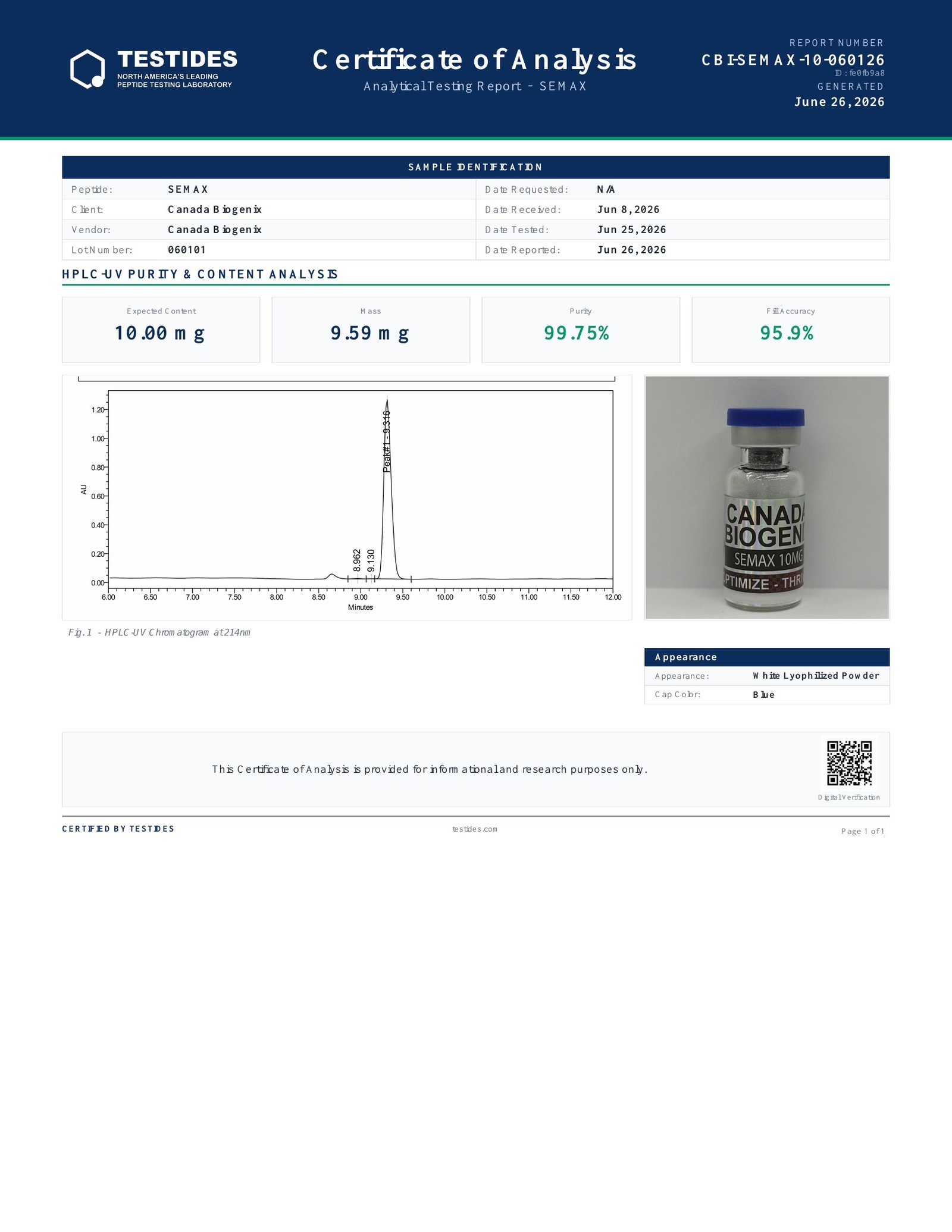
The 10 mg designation describes the total laboratory quantity in this vial. It is not a dose, cycle length, nasal-spray formula, reconstitution method or administration instruction. Canada Biogenix does not provide a human-use protocol for Semax 10 mg.
Semax has a broader human evidence base than many experimental cognitive peptides. Encouraging neurological-recovery findings, measurable effects on plasma BDNF and brain-network activity, and a substantial preclinical literature all support continued scientific interest.
However, much of the human research is regionally concentrated, several reports are small or available mainly in Russian-language journals, and independent international replication remains limited. Large modern multicentre trials have not established a broadly accepted clinical regimen for healthy cognition, neurodegenerative disease or general performance enhancement.
Overall, Semax remains an investigational research compound. Its existing findings are most persuasive as evidence of promising neurotrophic and neuroprotective activity rather than a guarantee of a particular cognitive or neurological outcome.
| Research product | Primary pathway | Research emphasis |
|---|---|---|
| Semax 10 mg | BDNF, TrkB and neurotrophic signalling | Cognition, neuroplasticity and neuroprotection |
| Selank 10 mg | GABA and neuroimmune signalling | Calmness, stress resilience and cognition |
| NAD+ 500 mg | Cellular redox and energy metabolism | Cellular energy and healthy-aging research |
| SS-31 10 mg | Mitochondrial cardiolipin and redox signalling | Mitochondrial protection and cellular resilience |
Semax 10 mg is supplied for qualified laboratory research and analytical applications. It is not represented as an approved therapeutic product, and this page does not provide medical advice, a treatment recommendation or a human administration protocol.