
Last Updated: September 4, 2026
Peptides are fragile molecules. Their amino acid sequences can degrade rapidly when exposed to light, heat, or moisture, which is why understanding how to protect peptides from light exposure is essential for anyone handling research compounds. This guide explains the science behind photodegradation and gives you a practical, step-by-step system for keeping your lyophilized powder and reconstituted peptides stable.
The core principle is straightforward: light exposure can break the chemical bonds in a peptide’s structure, rendering it less effective or completely useless for research. Below, we’ll cover storage temperatures, container choices, sanitization methods, and how to spot degradation before it ruins your work.
Light protection is not optional for peptide research; it is a fundamental requirement for maintaining molecular integrity. Peptides are light-sensitive by nature, and exposure to UV light or even standard fluorescent light can trigger photodegradation. This process alters the peptide’s chemical structure, which can change its bioavailability and compromise your experimental results.
The damage is often cumulative and invisible. A vial left on a lab bench for a few hours may not show immediate signs, but the molecular damage is already underway. Research-grade peptides are typically shipped as lyophilized powder specifically because the dry state is more stable, yet even this form remains vulnerable to light.
Photodegradation is the process where light energy breaks the chemical bonds within a peptide’s amino acid sequence. To understand why light protection is non-negotiable, it helps to understand the mechanism at the molecular level.
When peptides are exposed to UV light (particularly wavelengths between 280-320 nm), photons transfer energy to aromatic amino acids such as tryptophan, tyrosine, and phenylalanine (peer-reviewed research). This energy excites electrons to higher energy states, creating reactive oxygen species (ROS) including singlet oxygen and hydroxyl radicals. These highly reactive molecules then attack the peptide backbone and side chains, causing oxidative cleavage of peptide bonds. The result is fragmentation, the long-chain peptide breaks into smaller, inactive pieces, or cross-linking, where peptides bond to each other and aggregate into insoluble clumps.
Visible light, including fluorescent tubes common in labs and homes, also contributes to this process, though less aggressively than UV. The cumulative effect is what makes storage discipline critical: a vial left on a bench under standard fluorescent lighting for a few hours may not show visible damage, but molecular degradation is already underway. The damage is often invisible until the peptide is used and fails to perform as expected.
Moisture sensitivity compounds the problem significantly. Water in the storage environment can accelerate hydrolysis of the peptide backbone, especially when combined with light exposure. This is why lyophilized powder must be kept in airtight containers with desiccant packets, the dry state slows both photodegradation and hydrolysis. Once reconstituted, the peptide is suspended in aqueous solution, making it far more vulnerable to both light and thermal degradation.
A common misconception is that reconstituted peptides stored in the dark are safe from degradation. In reality, the aqueous environment itself accelerates breakdown, which is why reconstituted peptides have a much shorter shelf life (days to weeks) compared to lyophilized powder (months to years when properly stored). The combination of light exposure and moisture is what creates the most rapid degradation pathway.
The ideal storage temperature for lyophilized peptides is typically between -20°C and -80°C for long-term stability (the NIH). Many research protocols recommend freezing the lyophilized powder immediately upon receipt if you do not plan to reconstitute it within a few weeks. Refrigeration at 2-8°C is acceptable for short-term storage of some peptides, but it is not a substitute for freezing.
For reconstituted peptides, the guidance changes. Most reconstituted peptides should be stored at 2-8°C and used within a short window, often days to weeks depending on the specific peptide and its amino acid sequence. Repeated freeze-thaw cycles are a leading cause of degradation, so aliquot your reconstituted peptide into single-use volumes before freezing whenever possible.
The cold chain matters from the moment a peptide leaves the manufacturer until you use it. If you are ordering from a supplier, ask about their shipping methods.
Amber-colored vials are the standard for light-sensitive compounds because the amber glass filters out the UV and blue light wavelengths that cause the most damage. If your peptide arrives in a clear vial, transfer it to an amber vial or store the clear vial inside an opaque storage box. Never leave clear vials exposed to light.
Airtight containers serve a dual purpose: they block light and control moisture. Lyophilized powder is hygroscopic, meaning it actively absorbs water from the air. Exposure to ambient humidity can cause the powder to cake or degrade before you even reconstitute it. Store vials in a sealed container with a desiccant packet to maintain a dry environment.
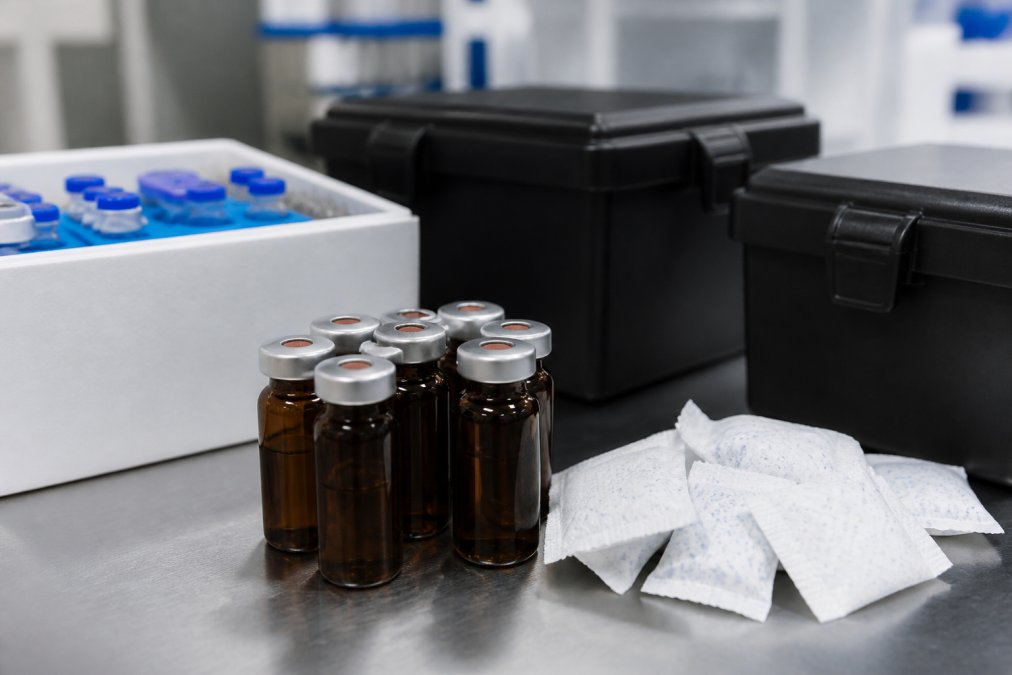
Foil pouches offer another layer of protection for individual vials. Many manufacturers ship peptides in foil pouches for this reason. If you receive your peptides this way, keep them in the pouch until you are ready to use them. The pouch provides a barrier against both light and moisture.
Sanitizing the vial stopper before each use prevents contaminants from entering your peptide solution. The stopper is the most common entry point for bacteria and other contaminants, especially after the vial has been opened and reconstituted.
This process is critical for maintaining peptide stability and preventing microbial growth. For research peptides, maintaining sterile conditions during handling is a core part of good laboratory practice and ensures that your results are not compromised by contamination.
Visual inspection is your first line of defense against using degraded peptides, but knowing what to look for requires understanding what different types of degradation produce.
Lyophilized Powder Degradation
Intact lyophilized peptide powder should appear as a dry, fluffy cake or fine powder, typically white, off-white, or pale yellow depending on the amino acid composition. Discoloration is often the first visible sign of degradation:
Reconstituted Peptide Degradation
Once dissolved, peptide solutions are more fragile and show degradation differently:
Field-Testing Your Storage Setup
Beyond visual inspection of the peptide itself, you can verify that your storage containers and transit methods are truly protecting peptides from light. This practical test catches storage failures before they ruin expensive material:
Light-proof test: Place a piece of UV-sensitive paper or a UV indicator card inside your storage container (available from laboratory suppliers). Expose the container to normal lab lighting for 24 hours. If the indicator shows color change, light is penetrating your container and you need a more opaque solution.
Temperature stability test: Use a small data logger (temperature-recording device) inside your cooler, freezer, or transit container during a typical storage or travel period. Record the minimum and maximum temperatures. If they fall outside your target range (e.g., -20°C ±5°C for frozen storage), adjust your setup.
Moisture test: Place a silica gel desiccant with a color indicator (blue when dry, pink when saturated) in your storage container alongside a test vial of lyophilized peptide. After one week, check whether the desiccant has changed color. If it has, your container is not airtight or the ambient humidity is too high.
These simple tests take minimal time and can save you from discovering storage failures only after you have lost an entire batch.
Transporting peptides requires the same vigilance as storing them. Whether you are moving vials between labs or traveling with them, light exposure and temperature control remain the primary concerns. Use an insulated cooler with ice packs for any trip longer than a short commute, and keep vials in opaque containers to block light.
For air travel, peptides should be carried in your cabin luggage rather than checked baggage. Cargo holds can experience extreme temperatures, and checked bags are more likely to be delayed or lost. If you are traveling internationally, check the regulations for transporting research compounds, as requirements vary by country.
Field-testing storage solutions is a practical way to verify that your transport method works. Place a vial in your cooler setup with a small temperature logger, leave it for the duration of a typical trip, and check whether the temperature stayed within the recommended range. This simple test can save you from losing an entire batch to thermal degradation during transit.
Airtight containers are especially important during travel, as pressure changes in aircraft cabins can affect vial integrity. Ensure that vial caps are tight and that vials are cushioned to prevent breakage. When you arrive at your destination, inspect each vial for damage before use.
Protecting peptides from light exposure is a non-negotiable part of responsible research practice. From amber vials and airtight storage to strict temperature control and proper sanitization, every step in your handling protocol affects the integrity of your final results.
The challenge is consistency. It takes discipline to maintain proper storage conditions day after day, especially when you are managing multiple compounds. Canada BioGenix supports Canadian researchers by providing premium-quality research peptides and reconstitution products, backed by carefully selected manufacturing partners who meet strict quality and purity standards. With dependable service and a focus on consistency, we help ensure your research starts with material you can trust. Explore our range of research peptides and lab compounds to see how we support your work.
Yes, peptides are highly photosensitive. UV light and even fluorescent light can trigger photodegradation, which breaks down the amino acid sequence and compromises molecular integrity. Exposure to direct sunlight or intense artificial light can degrade peptides within hours. The rate depends on peptide type, concentration, and light wavelength. Lyophilized powder is more resistant than reconstituted solutions, which degrade faster when exposed to light. Proper storage in amber-colored vials and opaque containers significantly slows this process.
Most lyophilized peptides remain stable at room temperature (20-25°C) when protected from light and moisture in airtight containers with desiccant. Reconstituted peptides should be refrigerated at 2-8°C to slow thermal degradation and oxidation. For extended shelf life beyond 6-12 months, freeze lyophilized peptides at -20°C or below. Always check product-specific guidelines, as some peptides benefit from cold chain management during transit and storage. Temperature fluctuations accelerate degradation, so maintain consistent conditions.
Visual signs include discoloration (yellowing or browning), cloudiness in reconstituted solutions, or visible particulates. Degraded peptides may show reduced solubility or form precipitates. Performance changes, reduced bioavailability, slower results, or inconsistent outcomes, suggest chemical structure damage. If you suspect degradation, avoid using the batch and contact your supplier. Proper storage in amber vials and protection from UV light exposure prevents these issues from occurring.
Use a sterile alcohol wipe (70% isopropyl alcohol) to clean the rubber stopper before inserting a needle or removing liquid. Wipe in a circular motion for 10-15 seconds and allow it to air dry completely. Never touch the cleaned surface with bare hands. For maximum protection, use new sterile alcohol wipes for each vial. Proper sanitization prevents contaminants from entering the vial and maintains vial integrity. Store cleaned vials immediately in airtight, light-protected containers with desiccant to prevent moisture reabsorption and maintain stability.
This article was written using GrandRanker