
Last Updated: September 5, 2026
Peptide research hinges on one fragile assumption: that the lyophilized powder in the vial matches the label. Third party peptide testing services are the only way to verify that assumption without relying on a supplier’s word. At Canada BioGenix, we have long argued that independent verification is not a luxury but a core component of scientific rigor.
The gap between a manufacturer’s claim and a lab’s finding can be significant. Many researchers have received a COA showing high purity, only to have an independent test reveal a different story. Sending samples to an external lab removes the conflict of interest inherent in self-reporting. Below, we’ll show you how these services work, what the metrics mean, and how to build a verification protocol that protects your data integrity.
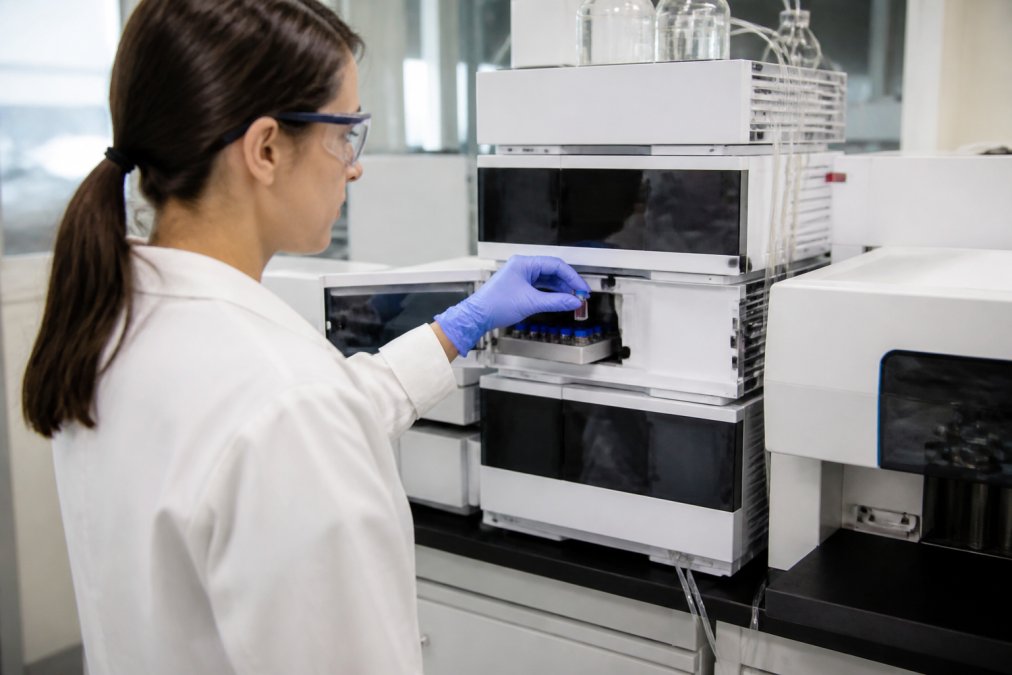
The gold standard for peptide purity testing combines two complementary techniques. HPLC quantifies purity by separating components, while mass spectrometry confirms the molecular weight and identity of the peptide. Together they answer the two questions that matter most: how much of the target peptide is present, and is it actually the right molecule.
HPLC works by pushing a dissolved peptide sample through a column under high pressure. Different compounds travel at different speeds, producing distinct peaks on a chromatogram. The retention time of each peak helps identify the compound, while the area under the peak indicates its relative abundance. A purity reading of 98% means that 98% of the detectable material eluted as the target peak, with the remainder spread across impurity peaks (PubMed).
Mass spectrometry measures the mass-to-charge ratio of ionized molecules, generating a precise molecular weight for the peptide. This value is compared against the theoretical molecular weight calculated from the amino acid sequence. A match confirms identity; a mismatch signals a synthesis error, truncation, or the presence of a different compound entirely. This step is essential because HPLC alone cannot distinguish between two peptides with similar retention times.
A legitimate certificate of analysis is a formal document, not a marketing sheet. Reading a peptide COA begins with locating three core values: purity percentage, molecular weight confirmation, and net peptide content. The purity percentage reflects the HPLC result, while the identity section should report the observed molecular weight alongside the expected value. Net peptide content accounts for counterions and residual moisture that can inflate a raw weight measurement.
A trustworthy COA should also list the analytical methods used, the instrumentation, the analyst, and the date of analysis, and reference a batch or lot number matching the vial you received. A COA lacking these details, or providing only a purity number without methodological context, offers limited assurance.
| COA Element | What It Tells You | Red Flag If Missing |
|---|---|---|
| Purity percentage | HPLC result of target peak | No method cited |
| Molecular weight | Identity confirmation | No expected value listed |
| Net peptide content | Actual peptide vs. salt/water weight | Only raw weight shown |
| Batch/lot number | Traceability to your vial | No match to product |
| Test date & analyst | Recency and accountability | Undated or anonymous |
A simple identity check is not the same as a full release panel, and the price difference reflects the depth of analysis and instrument time. Here is a practical breakdown of common tiers offered by Canadian analytical labs.
The lab dissolves a small portion of your sample and runs it through a mass spectrometer to confirm the molecular weight matches the expected sequence, catching gross synthesis errors such as a missing amino acid or a completely wrong peptide.
This most common tier for research labs combines the identity check with an HPLC purity run, giving you the purity percentage and the confirmed molecular weight.
Modeled on pharmaceutical release protocols, this tier includes HPLC purity, mass spec identity, and adds tests for specific impurities, residual trifluoroacetic acid (TFA) from synthesis, and often a water content (Karl Fischer) test to determine true net peptide weight.
A common pattern is to run a Tier 3 panel on a new batch from a new supplier, then drop to Tier 2 for subsequent batches. The first purchase verifies manufacturing quality; the second verifies batch-to-batch consistency. Spending $1,000 once to validate a supplier is cheaper than repeating a $5,000 study because of a bad batch.
Turnaround time also matters: Tier 1 results often return in 2-3 business days, Tier 2 in 5-7 days, and Tier 3 can take up to two weeks. Factor this lead time into your experiment planning.
The right tier depends on your research’s risk tolerance. For exploratory assays, a Tier 1 check may suffice; for published data or studies informing clinical decisions, a Tier 3 panel is the defensible choice.
A fabricated COA is a real hazard, with consequences ranging from wasted funds to compromised research. The first step in spotting a fake is verifying the laboratory actually exists. Many fraudulent COAs cite labs with no website, address, or phone number. A quick check of the lab’s credentials, including whether it lists peptide testing as a core service, often resolves the question.
Examine the document itself. Real COAs contain specific technical language, instrument names, column specifications, and detailed chromatogram data. Vague documents stating only a purity number should raise immediate suspicion. Cross-reference the batch number on the COA with the label on your vial; if they do not match, the document is worthless. A legitimate lab will also allow you to verify results directly, not just through the supplier’s website.
The distinction comes down to regulatory oversight and the depth of the quality assurance protocol. Research-grade testing typically confirms purity and identity through HPLC and mass spectrometry, sufficient for basic laboratory studies. Pharmaceutical-grade testing operates under current Good Manufacturing Practice (GMP) standards, with validated methods, full contaminant screening, and complete documentation for regulatory compliance (Health Canada’s Good Manufacturing Practices).
For most research applications, research-grade testing is appropriate. The key is matching testing depth to your intended use. A researcher studying receptor binding kinetics needs confidence in both purity and identity; one screening dozens of compounds for a preliminary assay may rely on identity confirmation alone. Understanding this distinction helps you allocate your testing budget where it has the most impact.
The success of third-party testing depends as much on what happens before the sample reaches the lab as on the instrumentation itself. A poorly prepared sample can degrade during transit, leading to false purity readings and wasted money. Here is a practical submission protocol.
Lyophilized powder is always preferred. Peptides in dry, lyophilized form are stable at ambient temperature for weeks. If testing a powder, do not reconstitute it before sending. Weigh out 1-2 mg into a clean, pre-weighed microcentrifuge tube. Most labs require a minimum of 1 mg for a full HPLC + MS panel, but some require up to 5 mg for comprehensive testing.
Shipping a solution is riskier. If you must ship a reconstituted peptide, buffer composition matters. Avoid detergents like Tween or Triton, which produce massive HPLC peaks that obscure your peptide. Phosphate-buffered saline (PBS) is generally acceptable, but volatile buffers like ammonium acetate are preferred because they evaporate during mass spectrometry. Always confirm buffer compatibility with the lab before shipping.
Peptides degrade through hydrolysis and oxidation, both accelerated by heat. For lyophilized samples, standard padded envelopes usually suffice for 2-3 day courier transit. For solutions, use an insulated box with a frozen gel pack. Do not use dry ice unless the lab requests it, as extreme cold can fracture the vial.
When results come back, do not just glance at the purity number. Walk through this checklist:
A failed test does not automatically mean the supplier is fraudulent. Before contacting them, rule out sample handling errors. Did the sample sit in a hot truck for three days? Was the buffer compatible? If you suspect degradation during shipping, request a replacement sample and re-test before drawing conclusions.
If the result is reproducible, contact the supplier with the lab report in hand. Most reputable suppliers will offer a replacement or refund when presented with independent data. This is where your testing investment pays for itself.
This protocol transforms third-party testing from a passive check into an active quality control system that protects your research timeline and budget.
Establishing a routine for third party peptide testing services is the most direct way to protect your research’s integrity. Independent verification, combined with reading a COA critically and spotting fraudulent documentation, separates a dependable workflow from one built on trust alone. The upfront cost of testing is minimal compared to the cost of experiments built on compromised material.
At Canada BioGenix, we support this standard by carefully selecting our manufacturing partners to ensure every product meets strict quality and purity standards, and we provide batch-specific documentation for our premium-quality research peptides. For researchers who want to verify independently, we encourage submitting samples to an accredited third-party laboratory. Get started with Canada BioGenix and build a research protocol grounded in transparency, consistency, and dependable quality assurance.
Yes. Third party peptide testing provides independent verification that a product contains the stated peptide in the claimed quantity and purity. Manufacturer-supplied Certificates of Analysis are not always reliable, as some labs have been found to publish inflated purity results. Independent testing protects your research integrity by confirming batch consistency and catching potential contamination before it affects your work.
The most common peptide purity testing methods are High-Performance Liquid Chromatography (HPLC) and Mass Spectrometry. HPLC separates components and quantifies purity, while Mass Spectrometry confirms the molecular weight and identity of the peptide. You can submit a sample to an independent lab and request a Certificate of Analysis. Look for a purity percentage, a clear chromatogram, and the testing method used.
A Certificate of Analysis (COA) lists the peptide name, batch number, testing date, and the analytical methods used. Focus on the purity percentage, which should typically be above 95% for research-grade peptides. Check the identity confirmation section to verify the molecular weight matches the expected value. Review the chromatogram for a single dominant peak, which indicates minimal impurities or truncated peptide fragments.
Several independent laboratories in North America accept samples from Canadian researchers. Costs for testing depend on the depth of analysis. Some suppliers, like Canada BioGenix, provide batch-specific Certificates of Analysis from their manufacturing partners, which you can verify by submitting your own sample to a third-party lab for confirmation.
This article was written using GrandRanker