In stock
For alcohol swabs Canada customers can conveniently order online,
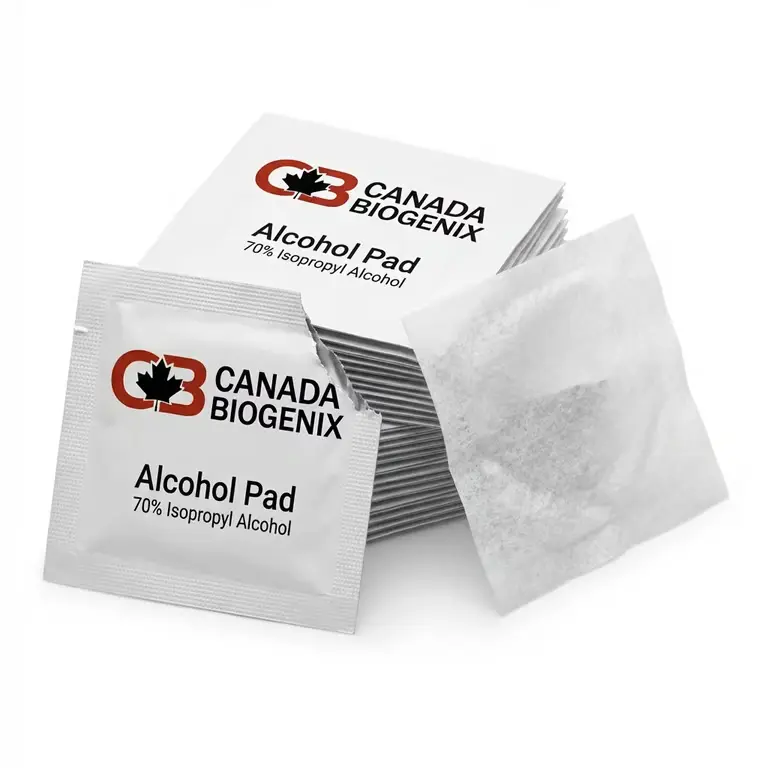
Canada Biogenix offers ready-to-use pads containing 70% isopropyl alcohol for preparation
of intact skin, vial closures and compatible non-porous surfaces. Each pack contains
50 individually prepared pads for clean, organized single-preparation workflows.
Alcohol swabs are small, ready-to-use pads saturated with an isopropyl-alcohol-and-water
solution. The pre-moistened format provides a controlled amount of alcohol without requiring
a separate bottle, cotton pad or pouring step.
When selecting alcohol swabs Canada laboratories, researchers and other
preparation environments can source, individually packaged pads offer a convenient way to
maintain an organized supply of fresh, single-use preparation materials.
Isopropyl alcohol—also called IPA or rubbing alcohol—acts quickly against many vegetative
bacteria, fungi and enveloped viruses when the surface remains adequately wet for the
applicable contact time. It is a disinfectant or antiseptic preparation agent, not a
complete sterilization method.
The water in a 70% formulation is not simply a filler. It supports protein denaturation,
improves penetration of microbial cells and slows evaporation compared with nearly pure
alcohol. Those properties can provide more useful surface contact than a highly concentrated
solution that evaporates almost immediately.
Public-health biosafety guidance identifies approximately 70% ethyl or isopropyl alcohol
in water as an effective general-purpose disinfectant for many common microorganisms.
However, performance still depends on adequate wetting, contact time, organic debris and
the organism involved.
Friction helps lift surface material while spreading the alcohol across the preparation area.
Alcohol disrupts proteins that many microorganisms require for structure and normal function.
Isopropyl alcohol can disturb lipid membranes, contributing to activity against susceptible microbes.
Allowing the prepared area to dry gives the alcohol time to act and prevents wet alcohol from being carried into the next step.
| Preparation Area | General Role | Important Limit |
|---|---|---|
| Intact Skin | Reduces transient surface contamination before a compatible procedure | Allow to dry completely and follow professional instructions |
| Vial Closures | Provides friction and alcohol contact across the stopper surface | Use a fresh pad and allow the closure to dry before entry |
| Small Non-Porous Surfaces | Convenient spot preparation where alcohol is compatible | Confirm the equipment manufacturer permits isopropyl alcohol |
| Visible Soil or Residue | May help with light surface residue | Heavy organic material should be cleaned before disinfection |
Do not use a packet that is open, punctured, leaking, dried out or past the labelled expiry date.
Open the swab immediately before preparation. Avoid touching the portion of the pad that will contact the surface.
Wipe the defined area using the technique and contact time required by the applicable procedure or product label.
Do not wipe the alcohol away, blow on it or fan it. Allow the prepared area to dry completely before continuing.
A 70% alcohol swab can rapidly reduce many susceptible microorganisms, but it does not
reliably destroy every organism or bacterial spore. It also cannot compensate for a dirty
preparation area, contaminated equipment, damaged packaging or poor handling.
Alcohol preparation should therefore be treated as one component of a broader
contamination-control process. Clean hands, intact supplies, fresh single-use equipment,
appropriate contact time and responsible disposal all remain important.
Keep unused swabs sealed in their original package so the alcohol does not evaporate and the pad remains protected.
Isopropyl alcohol is flammable. Store and use swabs away from flames, sparks, smoking materials and excessive heat.
Avoid eyes, mouth and other mucous membranes. Do not ingest, and do not apply to open wounds unless the product label specifically authorizes it.
Keep out of reach of children and pets. Follow the temperature and expiry information printed on the package.
Water helps alcohol penetrate cells, denature proteins and remain on the surface longer.
Nearly pure alcohol can evaporate very quickly, so a 70% solution is often more practical
for general preparation and disinfection.
No. They can reduce many susceptible microorganisms but do not provide validated
sterilization and are not reliably sporicidal.
Yes. Allowing the area to air dry supports the required alcohol contact time and prevents
wet alcohol from being carried into the next preparation step.
Alcohol swabs are commonly used to prepare compatible vial closures. Apply friction with
a fresh pad and allow the stopper to dry fully before entry, following the vial’s handling
instructions.
A fresh pad should be used for each distinct preparation area. Reusing a pad can move
contamination between surfaces and provides less predictable alcohol coverage.
Discard it. A dry pad cannot deliver the intended alcohol concentration or wet-contact period.
Do not apply them to an open wound, damaged skin, eyes or mucous membranes unless the exact
product label and qualified instructions specifically permit that use.
Only use isopropyl alcohol on equipment when its manufacturer confirms compatibility.
Alcohol can damage certain screens, coatings, plastics, adhesives and finishes.
Yes. The alcohol and its vapour can ignite. Keep the packet and wet pad away from flames,
sparks, smoking materials and heat until the prepared area and discarded pad are dry.
Follow local waste requirements. Never flush a pad. If it contains blood or potentially
infectious material, use the disposal method required by the applicable workplace,
laboratory or healthcare procedure.
Shop alcohol swabs Canada customers can order from Canada Biogenix,
along with compatible measurement, preparation and research supplies. Each package contains
50 convenient 70% isopropyl alcohol pads for organized single-use preparation.
Product-information notice:
This page provides general information about 70% isopropyl alcohol, surface preparation,
storage and contamination-control principles. Follow the product label and the applicable
healthcare, laboratory, workplace or equipment-manufacturer procedure. This overview does
not replace professional medical or infection-control guidance.