In stock
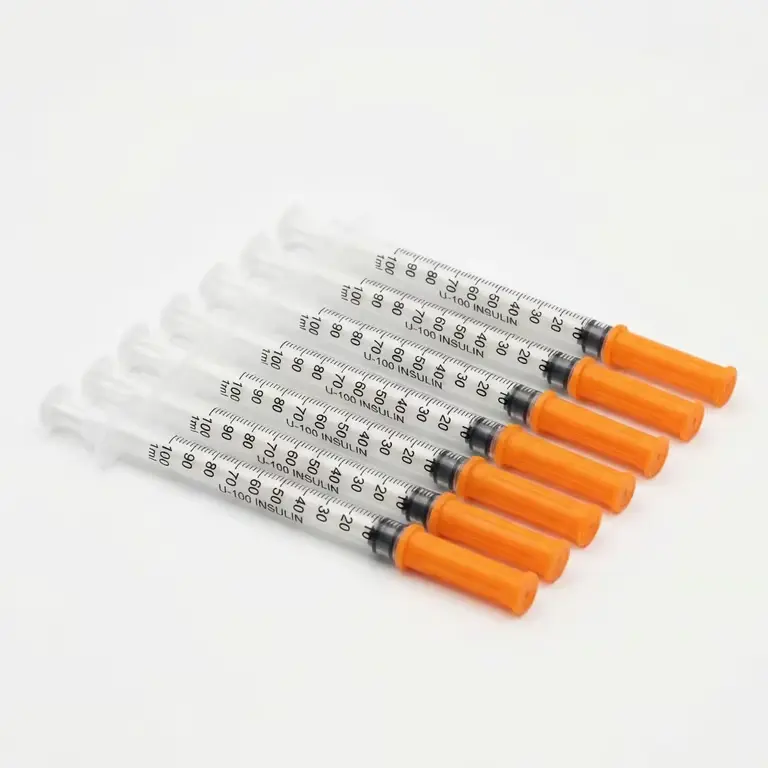
1 mL 30G insulin syringes combine a 100-unit barrel with a fine 30-gauge, 5/16-inch needle. The compact 10-pack format provides a practical option when clear volume measurement, controlled handling and responsible single-use disposal matter.
Insulin-style syringes are compact, graduated liquid-measurement devices with an integrated fine-gauge needle. The barrel on this format holds up to 1 millilitre, which is the same physical volume as 1 cubic centimetre or 1 cc.
The 100-unit scale is conventionally associated with U-100 insulin, where 100 insulin units occupy 1 mL. For any other liquid, the printed unit lines are only volume positions; they do not independently determine the amount of an active compound. Concentration and validated instructions must always control interpretation.
The full barrel represents one millilitre of liquid. “mL” and “cc” describe the same volume, although mL is the preferred modern notation.
The scale divides the 1 mL barrel into numbered unit positions. On a U-100 scale, the 100 mark corresponds with the full 1 mL capacity.
Gauge describes needle diameter. In the gauge system, a higher number indicates a finer needle, so 30G is thinner than 27G or 25G.
The short needle measures approximately 8 millimetres. Appropriate needle length depends on the intended application and qualified guidance.
| Marking or Term | Meaning | Important Distinction |
|---|---|---|
| 1 mL | One millilitre of physical volume | The syringe’s maximum nominal capacity |
| 1 cc | One cubic centimetre | Equal in volume to 1 mL |
| 100-unit mark | Full-scale position on a 1 mL U-100 barrel | Equals 1 mL only on this scale; it is not a universal dose |
| 30G | Needle-gauge designation | Describes diameter, not length or capacity |
| 5/16 inch | Needle length of approximately 8 mm | Appropriate depth depends on application and instructions |
Fine-gauge needles are designed to create a smaller puncture than lower-gauge, wider needles. For compatible low-viscosity liquids and appropriate applications, this can support controlled handling in a compact syringe format.
Finer is not automatically better for every purpose. Very viscous liquids may move slowly through a fine needle, and some tasks require different lengths, gauges or connection types. Product selection should match the liquid, intended technique and qualified instructions rather than gauge alone.
Check the syringe, cap and individual package where applicable. Do not use an item that is opened, wet, punctured, damaged or past its labelled expiry.
Keep the protective cap in place until the syringe is required. Avoid touching the needle or allowing it to contact an unclean surface.
A disposable syringe should not be reused or shared. Reuse can damage the needle and transfer contamination between containers or people.
Place the complete used syringe directly into a suitable puncture-resistant sharps container. Keep that container away from children and pets.
Keep unused syringes in their original packaging in a clean, dry location protected from moisture, excessive heat and direct sunlight.
Do not crush, puncture or unnecessarily open the packaging. An intact package protects the unused device until it is needed.
Store both unused syringes and the sharps container where children, pets and unauthorized users cannot reach them.
The manufacturer’s packaging, expiry date and handling directions take priority over general information on this page.
Used needles should never be left loose, placed in recycling or flushed. Public-health guidance recommends placing a used syringe directly into a rigid, puncture-resistant sharps container located close to the point of use.
Disposal programs vary by province and municipality. In New Brunswick and several other provinces, community pharmacy collection programs accept properly contained medical sharps. Confirm the current local program and return instructions before the container reaches its fill line.
| Feature | What It Influences | Selection Question |
|---|---|---|
| Barrel capacity | Maximum measurable volume and spacing between graduation marks | Does the required volume fit comfortably within the scale? |
| Graduation scale | How the liquid volume is read | Does the scale match the validated calculation method? |
| Needle gauge | Needle diameter and liquid-flow resistance | Is the liquid compatible with a fine 30G needle? |
| Needle length | Reach and intended application | Do qualified instructions specify an 8 mm needle? |
| Package condition | Cleanliness and device protection before use | Is every required package intact and within expiry? |
Yes. One cubic centimetre and one millilitre are equal volumes. The full capacity of this syringe is therefore described as either 1 cc or 1 mL.
It is the conventional scale used for U-100 insulin, in which the 100 mark corresponds with 1 mL. With other liquids, those markings indicate positions within the barrel and must be converted using the liquid’s known concentration.
No. A barrel marking represents a volume position. The amount of a medication, peptide or other dissolved material at that position depends entirely on concentration. Never transfer an insulin-unit interpretation to another solution without a validated calculation.
Yes. Thirty gauge is a fine needle diameter. Because gauge numbers work in reverse, a 30G needle is thinner than a 27G or 25G needle.
Five-sixteenths of an inch is approximately 8 millimetres. It is a short needle format, but suitability still depends on the intended application and professional instructions.
No. Disposable syringes are intended for one use only and should never be shared. Reuse can dull or deform the needle and can transfer contamination.
Do not use a syringe from packaging that is open, torn, punctured, wet or otherwise compromised. Follow the product label and discard questionable items safely.
Keep them in their original packaging in a clean, dry area away from excessive heat, moisture, sunlight, children and pets. Follow any additional conditions printed by the manufacturer.
Immediately place the complete used syringe into a suitable puncture-resistant sharps container. Never place loose needles in household garbage or recycling. Follow your provincial or municipal pharmacy-return program.
No. Viscosity, required volume, graduation scale, needle gauge and needle length must all be appropriate. Follow the relevant product documentation and qualified professional or institutional instructions.
Explore related Canada Biogenix supplies and educational tools for organized measurement, preparation and responsible handling.
Product-information notice: This overview explains general syringe specifications, measurement terminology, storage and sharps-disposal principles. It does not provide medical advice, select a needle for a particular person, calculate a medication dose or replace the product packaging and qualified professional instructions.