
Last Updated: July 28, 2026
Peptide reconstitution is the process of dissolving lyophilized (freeze-dried) peptide powder into a liquid solvent to create a usable solution at a specific concentration. Peptides arrive as dry powder because this form offers maximum stability during storage and shipping.
A poorly reconstituted peptide can clump, aggregate, or degrade before your research begins. Contamination during reconstitution can introduce bacteria or endotoxins that invalidate your entire experiment. Temperature fluctuations, improper agitation, or the wrong solvent choice can alter the peptide’s structure or reduce its potency.
Canada BioGenix provides premium-quality research peptides specifically formulated for reliable reconstitution, with detailed protocols tailored to each compound’s unique characteristics.
Before opening a single vial, assemble everything you’ll need. Working in a disorganized space compromises sterility and introduces unnecessary delays.
Essential materials and equipment:
A dull needle can create coring (rubber particles entering the vial), which contaminates your peptide solution. Invest in medical-grade, sterile equipment from reputable suppliers.
The solvent you choose fundamentally affects how your peptide behaves, how long it remains stable, and whether it’s suitable for your intended research application.
Bacteriostatic water contains 0.9% benzyl alcohol, which acts as a preservative and inhibits bacterial and fungal growth. For most research peptides, bacteriostatic water is the preferred choice because it prevents microbial contamination in your reconstituted solution, extending shelf life significantly.
Saline solution (0.9% sodium chloride) is isotonic and mimics the body’s natural electrolyte balance. Some peptides dissolve more readily in saline, and certain research protocols specifically call for saline to maintain osmotic balance. However, saline lacks the preservative properties of bacteriostatic water. Once reconstituted in saline, your peptide solution has a shorter usable window, typically 1-2 weeks in refrigeration before contamination risk increases substantially.
We recommend bacteriostatic water as the default choice unless your protocol explicitly specifies otherwise.
The actual reconstitution process follows a logical sequence. Each step builds on the previous one, and skipping or rushing any stage introduces risk.
Your workspace is the foundation of successful reconstitution. A contaminated environment ruins everything that follows.
Clean your work surface thoroughly with 70% isopropyl alcohol. Wipe down your laminar flow hood or biosafety cabinet according to manufacturer guidelines. If working without a hood, work in the cleanest, most still area available, away from air currents, open windows, or high-traffic zones.
Put on fresh nitrile gloves and avoid touching your face, hair, or contaminated surfaces once gloved. Gather all your materials within arm’s reach before opening anything. Open your bacteriostatic water or saline solution and verify the seal is intact and the liquid is clear. Any cloudiness, discoloration, or visible particles mean the solvent is compromised; discard it and use a fresh vial.
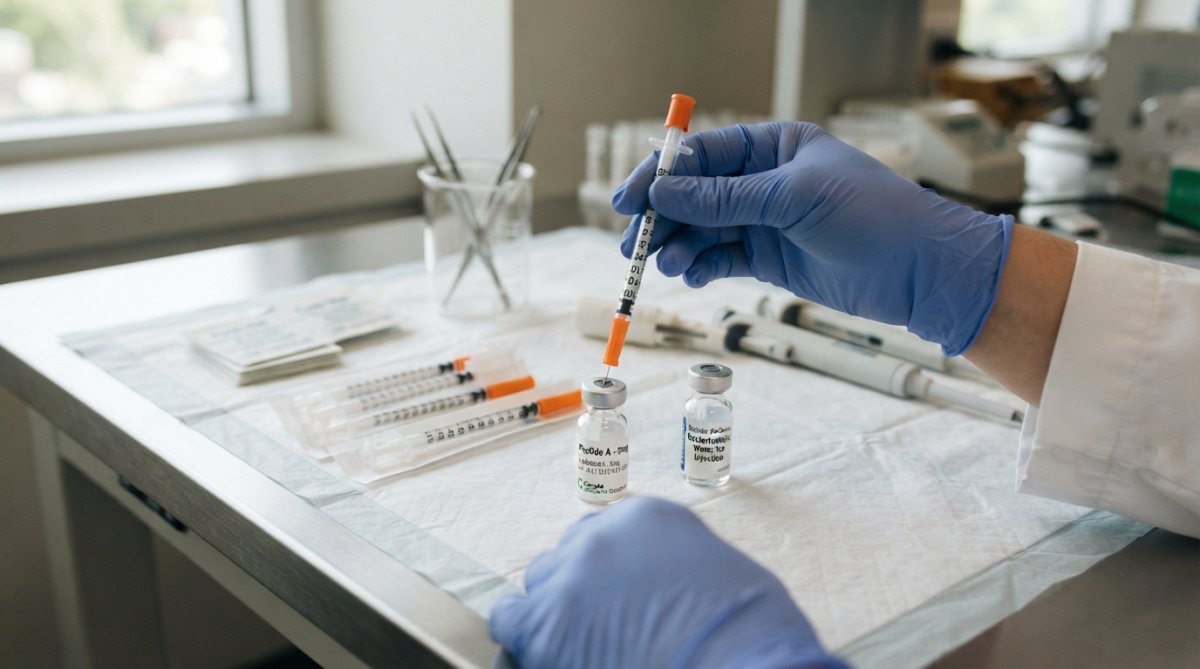
Step 1: Calculate your required volume (2 minutes)
Before touching the peptide vial, determine how much solvent you need. If your peptide vial specifies a concentration (for example, "reconstitute to 10 mg/mL"), use this formula:
Volume of solvent = peptide weight (mg) ÷ desired concentration (mg/mL)
If your vial contains 5 mg of peptide and you want 10 mg/mL concentration, you need 0.5 mL of solvent.
Step 2: Draw solvent into your syringe (3 minutes)
Using a sterile syringe and needle, draw your calculated volume of bacteriostatic water or saline. Draw slightly more than you need; you’ll lose a small amount to the needle hub. Insert the needle through the rubber stopper of the solvent vial at a slight angle, creating a small hole rather than punching straight through. This preserves the integrity of the rubber and reduces coring.
Step 3: Sterilize the peptide vial’s rubber stopper (1 minute)
Take an alcohol prep pad and firmly wipe the rubber stopper of your peptide vial using circular motions. Allow the alcohol to air-dry completely, which takes about 30 seconds.
Step 4: Inject solvent into the peptide vial (2 minutes)
Using a fresh sterile needle, insert it through the sterilized rubber stopper at a slight angle. Direct the needle tip toward the side wall of the vial, not straight at the powder. This prevents the solvent from splashing and helps the powder wet gradually rather than clumping. Inject your solvent slowly and steadily.
Step 5: Allow initial dissolution without agitation (5 minutes)
Do not immediately shake or agitate the vial. Let it sit undisturbed for several minutes. The peptide chains need time to hydrate and separate. Agitation at this stage often causes clumping because the peptide hasn’t fully rehydrated yet.
Step 6: Gentle agitation and mixing (3-5 minutes)
After the initial dissolution period, gently rock the vial back and forth. Do not shake vigorously. Vigorous shaking introduces air bubbles and can denature certain peptides. Rock the vial slowly for 1-2 minutes, then let it rest for another minute. Repeat this gentle rocking 2-3 times until the solution appears homogeneous and clear.
If your solution remains cloudy after gentle agitation, hold the vial under warm (not hot) running water for 30-60 seconds, then repeat gentle mixing. Never use a heat source directly; temperature control must be gradual.
Step 7: Verify complete dissolution (2 minutes)
Hold the vial up to light and examine it carefully. The solution should be clear or very slightly opalescent. If you see particles, cloudiness, or visible clumps, your reconstitution is incomplete. Return to gentle agitation or allow more time for dissolution.
Once the solution is clear, allow the vial to rest at room temperature for 10-15 minutes before transferring to storage.
Calculating the correct concentration is essential for reproducible research. The fundamental formula is:
Concentration (mg/mL) = Total peptide weight (mg) ÷ Total volume (mL)
If you have 10 mg of peptide and reconstitute it in 1 mL of solvent, your concentration is 10 mg/mL. If you use 2 mL of solvent instead, your concentration drops to 5 mg/mL.
Working backward from desired concentration:
If your protocol requires a 2 mg/mL solution and you have 20 mg of peptide, calculate the required solvent volume:
Volume = 20 mg ÷ 2 mg/mL = 10 mL
Canada BioGenix recommends using a simple calculator or spreadsheet template to document these calculations. Recording your reconstitution parameters creates a reference for future batches and helps you identify patterns if results vary across experiments.
Pharmaceutical-grade bacteriostatic water contains 0.9% benzyl alcohol as a preservative and is typically supplied in single-use or multi-use vials. Single-use vials are preferable because once opened, they’re used immediately and discarded, eliminating contamination risk.
When sourcing bacteriostatic water, verify that it’s specifically labeled for pharmaceutical or research use. The vial should display a lot number, expiration date, and certificate of analysis. Expired bacteriostatic water loses preservative potency and should not be used.
Canada BioGenix supplies pharmaceutical-grade bacteriostatic water specifically selected for peptide reconstitution. Our sourcing partners maintain strict quality standards, and every batch is tested for sterility and endotoxin levels. For research-grade peptides, endotoxin levels should be below 0.25 EU/mL (endotoxin units per milliliter).
Reconstituted peptide solutions are more fragile than lyophilized powder. Proper storage directly determines how long your reconstituted peptide remains viable.
Immediately after reconstitution, transfer your peptide solution to a clean, sterile vial if you’re not using it immediately. Many researchers divide the reconstituted solution into multiple small vials rather than storing one large vial. This approach reduces contamination risk because you’re not repeatedly accessing the same vial.
Refrigerator storage (2-8°C): Reconstituted peptides in bacteriostatic water typically remain stable for 2-4 weeks at refrigerator temperature. Check your specific peptide’s stability data, as some peptides degrade faster than others.
Freezer storage (-20°C): Freezing dramatically extends shelf life. Most reconstituted peptides remain stable for 3-6 months at -20°C. Some peptides tolerate -80°C storage and remain viable for 12+ months.
Room temperature storage: Avoid storing reconstituted peptides at room temperature for more than a few hours. Peptides degrade rapidly at elevated temperatures, and contamination risk increases substantially.
When freezing reconstituted peptides, allow them to reach room temperature before opening the vial. Temperature fluctuations cause condensation, which introduces water and potential contaminants into your solution. Remove the vial from the freezer and allow it to sit sealed at room temperature for 15-20 minutes before opening.
Avoid repeated freeze-thaw cycles. Each cycle introduces stress that can denature peptides. If you need to use your reconstituted peptide multiple times, divide it into small single-use aliquots before freezing.
Years of working with research peptides reveal patterns in what works and what consistently causes problems.
Clumping occurs when peptide powder doesn’t fully hydrate before agitation. Add solvent slowly, allow an initial dissolution period without agitation, then use gentle rocking rather than vigorous shaking. If clumping persists after 30 minutes of patient mixing, the reconstitution has likely failed; discard the batch and start fresh.
Contamination introduces bacteria, fungi, or endotoxins into your solution. Once contaminated, the peptide solution is unusable for research. Prevention requires consistent attention to sterile technique: sterile equipment, sterilized rubber stoppers, minimal vial access, and proper storage. Use a new sterile needle each time you access a vial.
Agitation damage occurs when peptides are shaken too vigorously. Vigorous shaking introduces air bubbles and mechanical stress that can denature peptide bonds. When in doubt, use gentle rocking rather than vigorous shaking.
Incorrect storage temperature degrades peptides faster than any other factor after reconstitution. Always store reconstituted peptides at 2-8°C or colder.
Most peptides function within a specific pH range. Outside this range, the peptide’s structure changes and its biological activity decreases. Bacteriostatic water typically has a pH around 5.5-7.0, which is suitable for most peptides. If your protocol specifies a particular pH, verify your solvent’s pH before reconstitution using pH paper or a calibrated pH meter.
Peptide degradation is accelerated by light exposure, oxidation, temperature fluctuations, hydrolysis, and microbial contamination. Store peptides in amber or opaque vials away from direct sunlight. Avoid repeated exposure to air; use nitrogen-purged vials for long-term storage if available. Maintain stable storage temperature and prevent microbial contamination through sterile technique.
Monitoring peptide stability is straightforward: observe the solution regularly. Clear, colorless solutions indicate stability. Cloudiness, discoloration, precipitation, or odor indicate degradation or contamination. Discard compromised solutions rather than attempting to salvage them.
Once you’ve used your reconstituted peptide or determined it’s no longer viable, proper disposal is essential for safety and environmental responsibility.
Reconstituted peptides are typically disposed of as chemical waste, not regular trash. For institutional research facilities, contact your environmental health and safety department for guidance. Typically, you’ll collect peptide solutions in a labeled waste container, and the facility handles disposal through licensed waste management services.
For independent researchers, contact your local hazardous waste disposal facility. Many areas have designated drop-off days for chemical waste. Never pour peptide solutions down the drain.
Reconstituting research peptides successfully requires attention to detail, proper equipment, and adherence to sterile technique. The process itself takes only 20-30 minutes, but the preparation and planning phase determines whether your reconstitution succeeds or fails. Canada BioGenix provides premium-quality research peptides with comprehensive reconstitution protocols tailored to each compound’s unique characteristics. Start with Canada BioGenix peptides and follow the protocols outlined in this guide to achieve consistent, reliable results in your research.
| Step | Duration | Key Focus |
|---|---|---|
| Workspace preparation | 5 minutes | Sterility, equipment assembly |
| Solvent drawing | 3 minutes | Preventing coring, maintaining asepsis |
| Vial sterilization | 1 minute | Alcohol drying completely |
| Solvent injection | 2 minutes | Slow, controlled delivery |
| Initial dissolution | 5 minutes | No agitation, allowing hydration |
| Gentle mixing | 3-5 minutes | Rocking motion, not vigorous shaking |
| Verification | 2 minutes | Visual inspection for clarity |
| Total time | 20-30 minutes | From start to storage-ready |
Bacteriostatic water is the preferred solvent for most research peptides in Canada due to its sterile formulation and ability to prevent bacterial growth. Alternatively, sterile saline solution works well for hydrophobic peptides that may have solubility challenges with water alone. The choice depends on your peptide's chemical properties, hydrophilic peptides dissolve readily in bacteriostatic water, while hydrophobic peptides may benefit from saline. Always verify your specific peptide's reconstitution requirements before selecting a solvent to ensure optimal results and stability.
To calculate concentration, use this formula: Concentration (mg/mL) = Peptide weight (mg) ÷ Total solvent volume (mL). For example, if you reconstitute 10 mg of lyophilized peptide in 1 mL of bacteriostatic water, your concentration is 10 mg/mL. A peptide reconstitution calculator Canada tool can automate this process and help verify your dosage calculations. Always account for the peptide's molecular weight and purity percentage when determining the actual concentration of active compound in your solution.
Reconstituted peptides stored in a refrigerator at 2-8°C typically remain stable for 2-4 weeks, depending on the specific peptide and solvent used. Freezer storage at -20°C or below can extend shelf life to several months. Peptide storage guidelines Canada recommend keeping reconstituted solutions in sterile, vacuum-sealed vials away from light and heat. Always check your peptide's Certificate of Analysis for stability data specific to your compound, as some peptides degrade faster than others due to their amino acid sequence composition.
Key mistakes include: vigorous agitation (which causes clumping and precipitation), using non-sterile equipment (risking contamination), selecting the wrong solvent for your peptide type, and failing to account for pH sensitivity during reconstitution. Many researchers also skip proper labeling of vials and storage conditions, leading to degradation. Research peptide handling best practices emphasize gentle mixing, aseptic technique throughout the process, and maintaining accurate records of reconstitution date and storage temperature to preserve peptide integrity and ensure reliable research results.
This article was written using GrandRanker