
Last Updated: July 30, 2026
Identifying the signs of degraded research peptides is critical for maintaining experimental integrity and protecting your research investment. At Canada BioGenix, we understand that even small changes in peptide quality can compromise months of work. Understanding what degraded research peptides look like and why they degrade gives you the knowledge to act quickly.
The first line of defense against using degraded research peptides is visual inspection. Your eyes can catch problems that might not show up until you’re deep into your experiment.
A clear or slightly off-white lyophilized peptide should remain that color throughout its shelf life under proper storage conditions. Yellowing, browning, or any shift toward amber or tan indicates oxidation, one of the most common degradation pathways for research peptides.
The Maillard reaction, a non-enzymatic browning process, can occur when peptides containing lysine or arginine residues are exposed to elevated temperatures or moisture. The speed of color change correlates with degradation progress. A vial that yellowed over six months probably retained some potency; one that turned brown in two weeks has likely lost significant activity.
Canada BioGenix recommends photographing your peptides when they arrive and storing the image with your batch records. This gives you a baseline for comparison when you retrieve the vial weeks or months later.
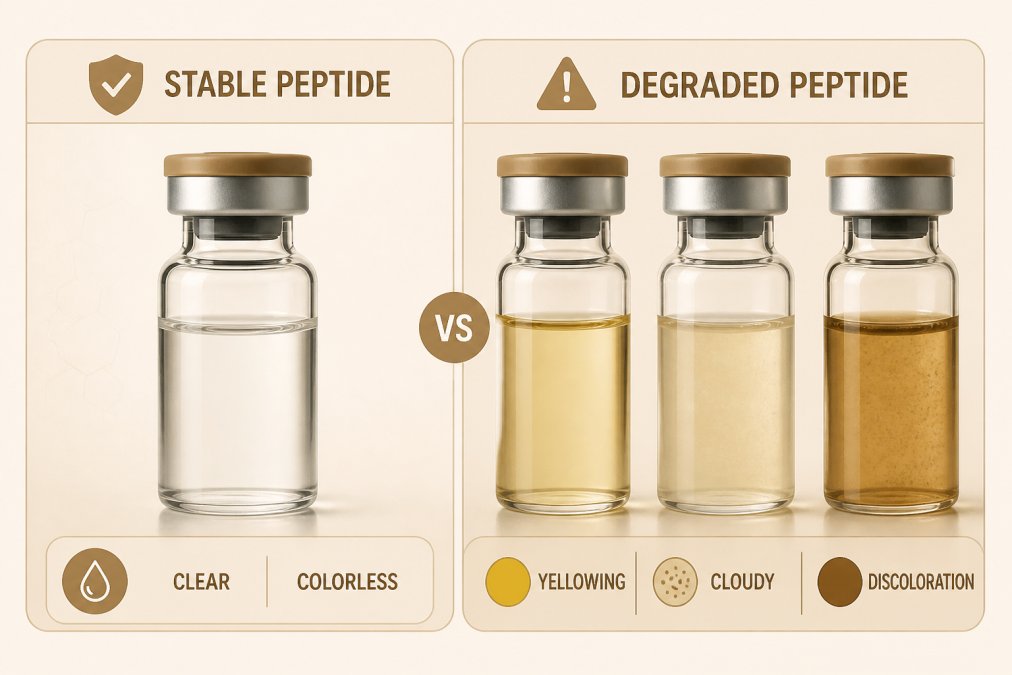
A lyophilized peptide powder should be uniform in appearance with no cloudiness, haziness, or visible particles once reconstituted. Cloudiness indicates microbial contamination, precipitation of degradation products, or incomplete dissolution.
Particulates visible to the naked eye are a red flag. These could be undissolved peptide fragments, bacterial growth, or aggregated peptide molecules. If cloudiness appears over time in stored solution, the peptide is likely undergoing hydrolysis or has been exposed to moisture.
Understanding why peptides degrade helps you prevent it and recognize it faster. Degradation follows predictable chemical pathways.
Oxidation is the most aggressive degradation pathway, especially for peptides containing methionine or cysteine residues. When exposed to oxygen, these amino acids become targets for free radical attack, causing structural instability that cascades through the entire molecule.
Oxidized peptides lose their three-dimensional shape and functional form. Prevention requires minimizing oxygen exposure: store lyophilized peptides under nitrogen or argon gas when possible, use bacteriostatic water purged with inert gas, and avoid repeated opening of vials. Temperature control is critical, a peptide stored at room temperature oxidizes roughly twice as fast as one at 4°C, and four times faster than one at -20°C.
Hydrolysis is the breaking of peptide bonds through reaction with water molecules. Once hydrolysis begins, the peptide chain is no longer intact, it’s fragments.
Hydrolysis accelerates in the presence of moisture, heat, and extreme pH. Reconstituted peptides in aqueous solution are always at some risk, which is why shelf life is typically measured in days or weeks, not months. You can infer hydrolysis from loss of potency and cloudiness. HPLC analysis will show a shrinking main peak and multiple smaller peaks, the signature of peptide bond cleavage.
Deamidation is the removal of an amide group from asparagine or aspartic acid residues. This slower process is insidious because it doesn’t always show obvious visual signs. The peptide may look fine but have lost critical functionality.
Deamidation is pH-dependent and temperature-dependent, accelerating dramatically at neutral to slightly alkaline pH (7-8) and elevated temperatures. The consequence is subtle but significant: the peptide’s charge changes slightly, altering how it interacts with receptors or enzymes in your experiment.
Shelf life depends entirely on storage conditions. A peptide kept in ideal conditions might remain stable for years; the same peptide stored carelessly might degrade in weeks.
Temperature is the single most important variable controlling peptide degradation. Every 10°C increase roughly doubles the rate of chemical degradation. Lyophilized peptides should ideally be stored at -20°C or colder. Room temperature storage should be avoided except for the few hours needed for reconstitution.
Temperature excursions damage shelf life disproportionately. A single 8-hour excursion to room temperature during shipping loses as much stability as weeks of storage at 4°C. Maintain a temperature excursion log recording date, time, temperature, and duration of any deviation from ideal storage. Canada BioGenix ships with temperature monitoring to track conditions during transit.
Lyophilized peptides are freeze-dried to remove water, which slows degradation dramatically. But they’re hygroscopic and absorb moisture from the air. Once moisture enters the vial, degradation accelerates exponentially.
Store lyophilized peptides in airtight vials with desiccant packets. Replace desiccant every 6-12 months for long-term storage. Keep vials sealed until ready to use. When reconstituting, use fresh bacteriostatic water. Once reconstituted, store solutions at -20°C or colder and use within 2-4 weeks.
Using degraded research peptides wastes the compound, your time, and can lead to false conclusions.
The most obvious effect of degradation is loss of potency. A peptide that was 95% pure when manufactured may be 75% pure after six months of suboptimal storage. That 20-point drop translates directly to a 20% reduction in active compound.
In dose-response experiments, this manifests as a right-shifted curve, the dose required to achieve a given effect appears higher than literature values. In binding assays or kinetic studies, degraded peptides produce ambiguous results. Fragments and modified peptides may have different binding affinities, creating a mixed population of species with different kinetic properties.
Verify peptide integrity before use. HPLC analysis is the gold standard, taking 30 minutes and costing far less than repeating an experiment with bad data.
Bacteria and fungi can grow in reconstituted peptide solutions, especially if storage conditions are warm and moist. Microbial enzymes can degrade peptides directly through protease secretion. Prevention requires sterile technique during reconstitution and storage in bacteriostatic water. Use reconstituted peptides within the recommended window and discard anything showing contamination signs.
You can’t rely on visual inspection or assumptions about storage history. You need data.
High-Performance Liquid Chromatography (HPLC) is the standard method for assessing peptide purity and detecting degradation. A fresh, high-purity peptide produces a single sharp peak on the HPLC chromatogram. As the peptide degrades, that main peak shrinks and smaller peaks appear, representing oxidized variants, hydrolysis fragments, and deamidated forms.
HPLC also reveals whether degradation is advancing over time. Canada BioGenix provides HPLC certificates of analysis (COAs) with every batch. If concerned about a batch stored for several months, request a fresh HPLC analysis.
Once you reconstitute a lyophilized peptide, degradation accelerates. Bacteriostatic water, sterile water containing 0.9% benzyl alcohol as a preservative, is the standard for peptide reconstitution. The benzyl alcohol inhibits bacterial growth without denaturing the peptide.
Use fresh bacteriostatic water from a reputable supplier and check the expiration date. After reconstitution, store the solution at -20°C or colder and use within 2-4 weeks. Freeze aliquots and thaw only what you need for each experiment. Repeated freeze-thaw cycles are less damaging than prolonged storage at warmer temperatures.
Degradation is inevitable over time, but you can slow it dramatically through deliberate storage practices. The goal is to minimize exposure to heat, moisture, and oxygen.
Ideal storage for lyophilized peptides is -80°C or colder in a dedicated peptide freezer with backup power and temperature monitoring. If -80°C isn’t available, -20°C is acceptable for storage up to 12 months. Above -20°C, shelf life drops sharply.
Invest in a quality freezer with a temperature alarm. Store vials in the freezer’s coldest zone, usually the back or bottom. Use opaque storage containers to block light. Label everything clearly with peptide name, batch number, date received, and date opened.
Thaw reconstituted peptides quickly in a 4°C refrigerator or on ice, never at room temperature. Minimize freeze-thaw cycles, as each cycle stresses the peptide structure.
Peptides can adsorb to plastic surfaces, especially at low concentrations. Use glass vials, not plastic, for long-term storage. For reconstituted solutions, glass vials with PTFE-lined caps are ideal.
For very dilute peptide solutions, add a carrier protein like bovine serum albumin (BSA) or gelatin. These proteins coat the container surface and prevent your peptide from contacting the glass or plastic directly, reducing adsorption losses.
Degradation is the breakdown of your peptide into smaller molecules or modified forms over time due to chemical or biological processes. A peptide that was 98% pure at manufacture and is now 85% pure due to storage problems has degraded.
Impurity is the presence of unwanted compounds that were never part of your peptide. These might be synthesis byproducts, salts, or contaminants introduced during manufacturing. A peptide that arrived at 92% purity due to manufacturing issues is impure, not degraded.
Degradation is your responsibility to prevent through storage and handling. Impurity is the manufacturer’s responsibility. HPLC analysis reveals both. If secondary peaks are growing while the main peak shrinks, degradation is occurring. If secondary peaks were present on day one and remain stable, you’re dealing with impurities.
Degraded research peptides compromise experimental integrity and waste resources. The good news is that degradation is largely preventable through deliberate storage practices, careful handling, and periodic verification of peptide quality.
Start with the basics: store at -20°C or colder, keep vials sealed until use, and minimize temperature excursions. Before beginning any critical experiment, run a quick HPLC analysis to confirm purity. Canada BioGenix provides detailed COAs with every batch and can arrange fresh purity testing if you need verification after storage. With consistent attention to storage conditions and regular quality checks, your peptides will remain stable and your experiments will yield reliable results.
Protecting your research peptides from degradation is an investment in experimental reliability. Canada BioGenix provides premium-quality research peptides with rigorous purity verification and detailed certificates of analysis. Our carefully selected manufacturing partners ensure consistent quality, and our team is available to answer questions about storage optimization, reconstitution protocols, and batch-specific stability data. Start with Canada BioGenix and gain confidence that your peptides will perform as expected throughout your research.
Degraded peptides often show visible discoloration, yellowing or browning, cloudiness instead of clarity, or visible particulates suspended in solution. In lyophilized form, degradation may appear as color changes or moisture clumping. However, not all degradation is visually obvious; some occurs at the molecular level. This is why visual inspection alone isn't sufficient, HPLC analysis and proper storage documentation provide definitive confirmation of peptide integrity.
Reconstituted peptides typically remain stable for 7-14 days when stored at 2-8°C (refrigerated), though stability depends on the specific peptide structure, reconstitution medium, and storage conditions. Peptides reconstituted with bacteriostatic water are more resistant to microbial contamination than those using standard water. Always document temperature excursion logs and store in sterile, sealed vials. For longer-term use, lyophilized (powder) forms last significantly longer, often 12-24 months or more when kept cool and dry.
Minor visual changes don't necessarily mean the peptide is unusable, but they signal potential molecular-level degradation. Oxidation, hydrolysis, and deamidation reduce potency and can skew experimental results. If you notice discoloration, cloudiness, or particulates, verify the batch with HPLC analysis before proceeding. Using degraded peptides may compromise research validity and waste time on unreliable data. When in doubt, contact your supplier for batch-specific Certificates of Analysis and testing verification.
Three primary pathways degrade peptides: oxidation (exposure to air damages molecular structure), hydrolysis (water breaks peptide bonds through covalent interactions), and deamidation (asparagine and aspartic acid residues lose their amide groups). Maillard reactions can also occur under warm, humid conditions, causing browning. Temperature fluctuations, moisture intrusion, and light exposure accelerate all three. Proper storage, cool, dry, dark conditions with temperature excursion logs, minimizes these chemical pathways and extends shelf life significantly.
This article was written using GrandRanker