
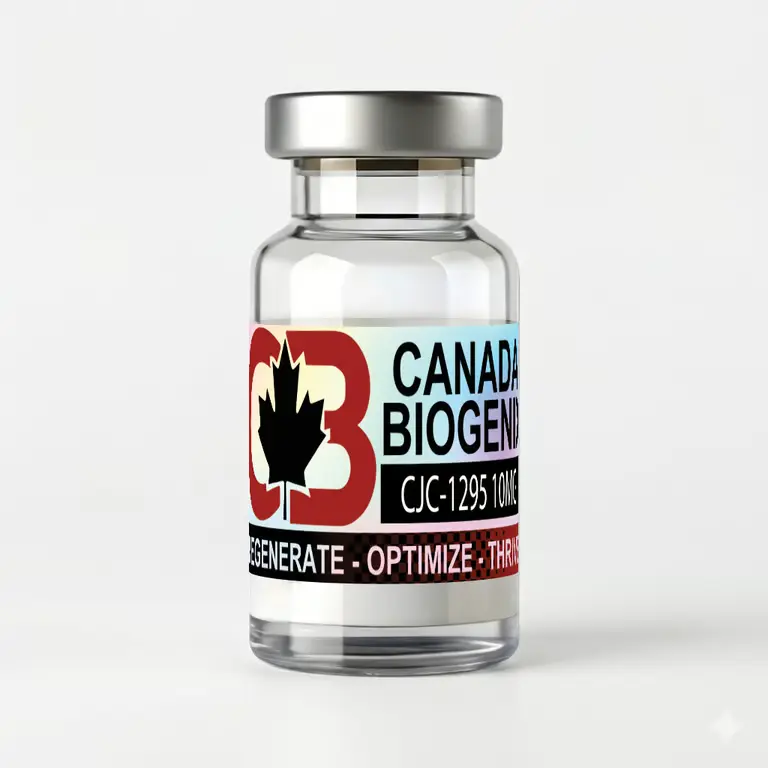
CJC-1295 10 mg No DAC, also called Modified GRF (1‑29), is a short-acting GHRH analogue attracting research interest for its potential influence on pulsatile growth-hormone and IGF‑1 signalling.
CJC-1295 No DAC is a synthetic analogue of growth hormone-releasing hormone, commonly abbreviated as GHRH. It is based on the first 29 amino acids of natural GHRH.
Researchers modified several amino acids to improve stability compared with unmodified GRF (1‑29). However, this version does not contain the Drug Affinity Complex that gives long-acting CJC‑1295 its multi-day activity.
CJC-1295 No DAC is designed to bind to GHRH receptors on somatotroph cells in the anterior pituitary.
Receptor activation may increase intracellular cyclic AMP signalling. As a result, stored growth hormone may be released in a pulse. Downstream GH activity can then influence hepatic and tissue-level IGF‑1 signalling.
Unlike direct growth-hormone administration, a GHRH analogue works through the pituitary signalling system. Therefore, its experimental activity depends on the responsiveness of that system.
| Feature | CJC-1295 No DAC | CJC-1295 with DAC |
|---|---|---|
| Common research name | Modified GRF (1‑29) | Long-acting CJC‑1295 |
| Albumin binding | No | Yes |
| Activity pattern | Short, discrete signalling | Sustained signalling over several days |
| Human evidence | Limited direct outcome data | Early pharmacodynamic human studies |
| Primary research use | GH pulse physiology | Prolonged GH and IGF‑1 elevation |
The short-acting format is of particular interest for research examining discrete GH release. This may allow researchers to explore signalling that more closely resembles the body’s naturally pulsatile pattern.
GHRH analogues have consistently demonstrated the ability to stimulate GH-related pathways. Furthermore, longer-acting CJC‑1295 with DAC produced substantial increases in GH and IGF‑1 biomarkers in early human studies.
Those DAC findings support interest in the overall mechanism. However, they do not establish identical magnitude or duration for the No-DAC version.
GH and IGF‑1 signalling are associated with protein turnover, connective-tissue activity and substrate metabolism. Consequently, CJC‑1295 is widely discussed in recovery and body-composition research.
Direct controlled human trials have not yet established that CJC‑1295 No DAC improves muscle mass, fat loss, sleep quality, skin appearance or athletic recovery.
CJC‑1295 No DAC and Ipamorelin approach growth-hormone signalling through different receptors. CJC‑1295 targets the GHRH receptor, while Ipamorelin is a selective ghrelin-receptor agonist.
Because these pathways may complement one another, the combination has become popular in experimental GH-release research. The proposed goal is a stronger pulse than either pathway might produce alone.
The published human studies reporting sustained GH and IGF‑1 increases used CJC‑1295 with DAC. They investigated weight-based subcutaneous doses, including 30 and 60 mcg/kg.
Those amounts should not be transferred to CJC-1295 No DAC. Removing the DAC changes albumin binding, half-life and the resulting exposure pattern.
The 10 mg vial size describes total laboratory quantity. It does not represent an individual dose.
Well-established target for pituitary GH release.
Promising research rationale for the short-acting format.
Human studies showed prolonged GH and IGF‑1 increases.
Direct human outcome research remains limited.
For prolonged albumin-bound activity, explore
CJC-1295 with DAC 5 mg.
For two-pathway GH-release research, explore the
CJC-1295 + Ipamorelin 10 mg blend.