

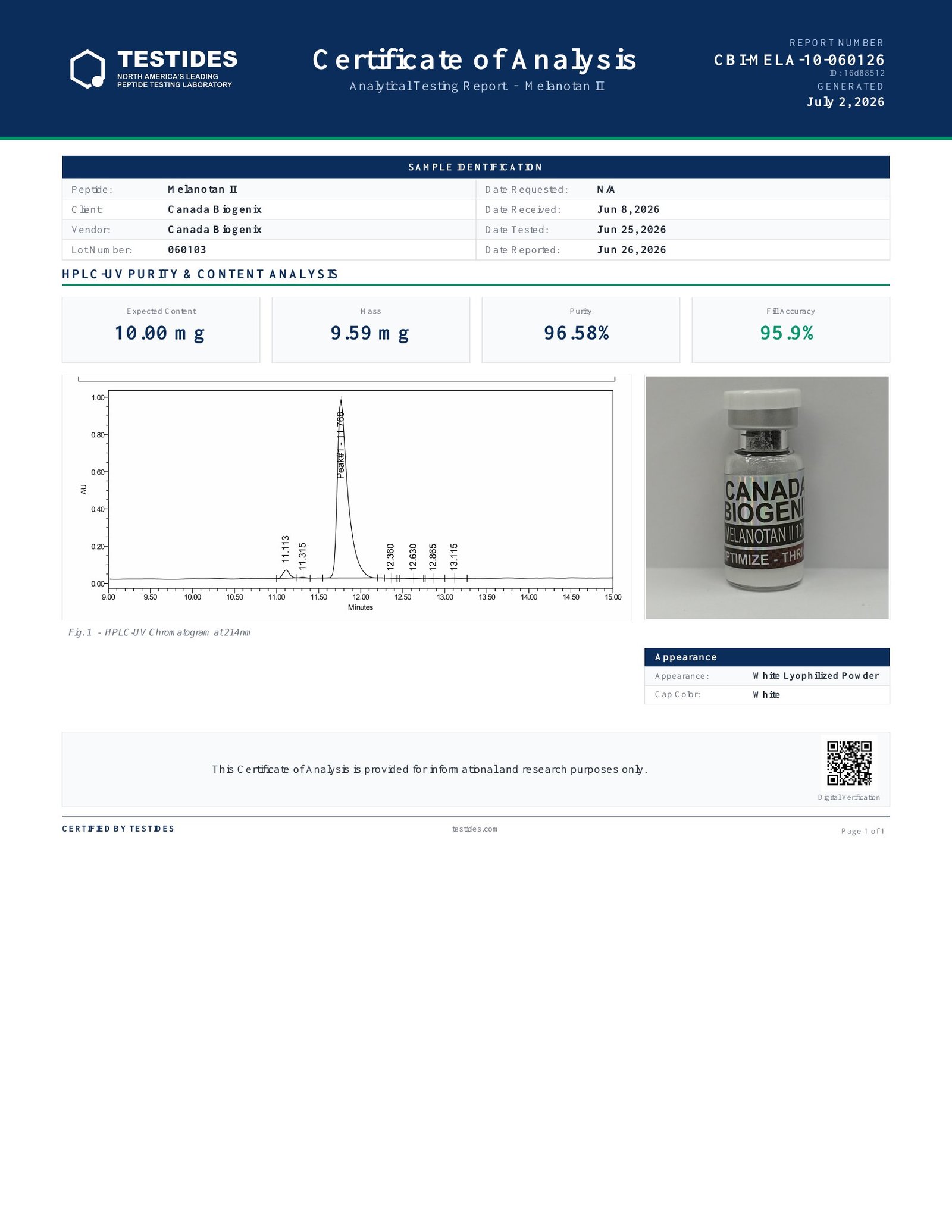
Melanotan II 10 mg, also called MT-2 or MT-II, is a cyclic α-MSH analogue attracting research interest for its potential influence on melanogenesis, pigmentation, central melanocortin signalling, appetite pathways and sexual-response biology.

Cyclic α-MSH Analogue
Cyclic Heptapeptide
MC1R, MC3R, MC4R and MC5R
Early Human and Preclinical Research
Melanotan II is a synthetic, cyclic analogue of alpha-melanocyte-stimulating hormone, commonly abbreviated α-MSH. It was designed to preserve the core melanocortin sequence in a compact, conformationally constrained structure.
The peptide is often described by the sequence Ac-Nle-cyclo[Asp-His-D-Phe-Arg-Trp-Lys]-NH₂. Its lactam ring helps stabilize the active conformation, producing strong activity across several melanocortin receptor subtypes rather than focusing predominantly on a single receptor.
This broad receptor profile is what makes Melanotan II 10 mg especially interesting as a laboratory research tool. MC1R is closely associated with pigment biology, while MC3R and MC4R contribute to central signalling involving energy balance, feeding behaviour and sexual-response pathways.
These receptors are G-protein-coupled receptors. Their activation can raise intracellular cyclic AMP and trigger downstream signals that differ by receptor subtype, tissue and experimental model.
| Research Area | Reported Finding | Evidence Context |
|---|---|---|
| Pigmentation | A pilot phase-I study reported measurable tanning activity after a short series of low experimental doses. | Very small early human study; useful as proof of biological activity, not definitive clinical evidence. |
| Sexual-Response Signalling | Controlled human studies observed erectile responses and increased sexual desire in a substantial proportion of participants. | Small double-blind crossover trials involving men with psychogenic or organic erectile dysfunction. |
| Appetite and Energy Balance | MC3R/MC4R activation has repeatedly reduced feeding behaviour in experimental animal models. | Mechanistically promising, but MT-2 is not supported by large controlled human weight-management trials. |
| Receptor Pharmacology | Binding and functional studies characterize MT-2 as a potent, non-selective agonist at MC1R, MC3R, MC4R and MC5R. | Strong mechanistic foundation across receptor and preclinical research models. |
The early human results are small but biologically persuasive. In the 1996 pilot phase-I investigation, researchers concluded that Melanotan II demonstrated tanning activity after only five low experimental exposures administered every other day. That observation supported the expected link between MT-2, MC1R activation and pigmentation.
Sexual-response studies also produced clear signals. In one double-blind, placebo-controlled crossover trial involving men with psychogenic erectile dysfunction, clinically apparent erections developed in eight of ten participants following MT-2. A later study involving men with organic risk factors found subjectively reported erections after 12 of 19 MT-2 administrations compared with one of 21 placebo administrations.
| Feature | Melanotan I / Afamelanotide | Melanotan II / MT-2 |
|---|---|---|
| Structure | Linear 13-amino-acid peptide | Cyclic seven-amino-acid peptide |
| Receptor Profile | More focused on MC1R and pigmentation biology | Broader activity at MC1R, MC3R, MC4R and MC5R |
| Research Emphasis | Photoprotection and pigmentation pathways | Pigmentation plus central appetite and sexual-response signalling |
| Clinical Development | Afamelanotide has an approved controlled-release implant formulation for a specific indication | Remains an experimental research compound without an approved MT-2 drug product |
Published human experiments have primarily examined subcutaneous administration and often expressed exposure relative to body weight. These schedules were created for tightly controlled, small clinical investigations—not as standardized instructions for a commercial research vial.
Moreover, the human literature varies by endpoint. Pigmentation studies, erectile-response studies and preclinical appetite experiments used different designs, populations, observation periods and outcome measures. Results from one research model should not be automatically transferred to another.
Melanotan II has a credible mechanistic foundation and several encouraging early human findings. Its strongest directly observed research areas are pigmentation and centrally mediated sexual response.
At the same time, participant numbers were small and long-term controlled safety data are lacking. Appetite and energy-balance findings are driven mainly by animal and receptor-pathway research rather than large human outcome trials.
Reported observations in the literature include nausea, flushing, reduced appetite, yawning or stretching, spontaneous erections and changes in the appearance of freckles or pigmented lesions. Rare case reports describe more serious events, but such reports cannot by themselves establish frequency or causation.
Melanotan II 10 mg is supplied as a research-grade compound for controlled laboratory investigation. Its broad melanocortin receptor activity makes it a compelling research tool for studying pigmentation, receptor pharmacology, energy-balance signalling and neuroendocrine pathways.
Research use only. Product information summarizes published scientific findings and does not constitute medical advice, an administration protocol or a guarantee of results.