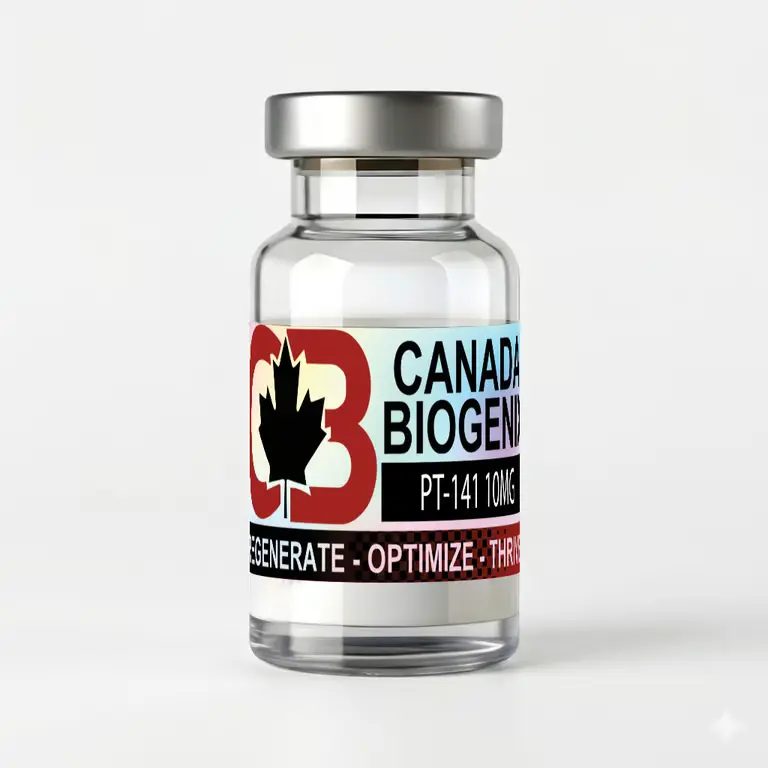
PT-141 10 mg, also known as bremelanotide, is a cyclic melanocortin-receptor agonist attracting research interest for its central influence on sexual desire, arousal and neurobehavioural signalling in female and male study populations.
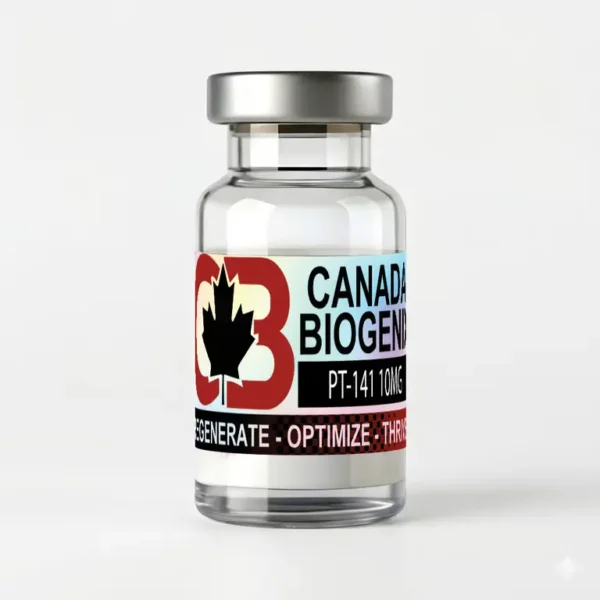
PT-141 is the research name for bremelanotide, a stabilized cyclic derivative of alpha-melanocyte-stimulating hormone, or α-MSH. It was developed from melanocortin-peptide research and is structurally related to Melanotan II, but it has a distinct carboxyl-terminal group and a different research and clinical profile.
Bremelanotide activates several melanocortin receptors, with sexual-response effects attributed mainly to MC3R and MC4R signalling in the central nervous system. This gives PT-141 10 mg an unusual position in sexual-function research: it acts primarily through neural desire and arousal pathways rather than directly increasing genital blood flow.
A specific prescription bremelanotide formulation is FDA-approved in the United States for acquired, generalized hypoactive sexual desire disorder in premenopausal women. That clinical approval provides substantial human evidence for the molecule, but it does not make a research vial equivalent to the approved formulation or extend the indication to men, postmenopausal women or general performance enhancement.
Two large randomized Phase 3 trials found statistically significant improvement in sexual desire and reduction in desire-related distress among premenopausal women with HSDD.
Bremelanotide does not supply testosterone, estrogen or another sex hormone. It investigates melanocortin pathways involved in motivation and sexual-response processing.
Early controlled studies reported increased erectile activity, including encouraging signals in some men who had responded inadequately to sildenafil.
Melanocortin receptors are G-protein-coupled receptors. MC3R and MC4R activation increases intracellular cyclic AMP and influences hypothalamic and limbic networks involved in motivation, reward, autonomic output and sexual response. The complete human mechanism remains under study, but the clinical and preclinical evidence supports a central melanocortin pathway rather than a direct hormonal or purely vascular effect.
| Research area | Encouraging observation | Evidence level | Important context |
|---|---|---|---|
| Female HSDD | The RECONNECT trials found improved desire scores and reduced distress compared with placebo. | Two randomized Phase 3 human trials | The trials involved premenopausal women with acquired, generalized HSDD and a regulated pharmaceutical formulation. |
| Patient-reported experience | Participants described increases in desire, physical arousal and satisfaction with their sexual experiences. | Human trial exit-study data | Responses were meaningful for some participants but were not universal. |
| Male erectile response | Early studies reported increased erectile activity in healthy men and men with erectile dysfunction. | Small Phase 1 and Phase 2 studies | Bremelanotide is not approved for male sexual dysfunction, and larger confirmatory trials are needed. |
| PDE5 non-response | One controlled study reported improved erectile-response measures in men who had responded inadequately to sildenafil. | Early human clinical research | This does not establish an unsupervised combination protocol or cardiovascular safety. |
| Receptor pharmacology | Binding studies demonstrate melanocortin-receptor agonism, with strong activity at MC4R and additional activity at MC1R, MC3R and MC5R. | Molecular and cellular pharmacology | Activity beyond MC3R and MC4R helps explain effects such as flushing and pigmentation. |
The positive scientific interest surrounding PT-141 10 mg spans several important areas:
| Feature | PT-141 / Bremelanotide | PDE5 inhibitors |
|---|---|---|
| Primary pathway | Central melanocortin receptors, especially MC3R and MC4R | Peripheral nitric-oxide and cGMP signalling |
| Research emphasis | Desire, arousal and centrally initiated sexual response | Genital blood flow and erectile mechanics |
| Hormonal action | Not a testosterone or estrogen replacement | Not a sex-hormone replacement |
| Key distinction | May influence the motivational component of sexual response | Requires sexual stimulation and supports the vascular response |
Because these pathways differ, one should not be described as a direct substitute for the other. Combination research requires specific safety monitoring and cannot be inferred simply from each compound’s individual mechanism.
The strongest evidence for bremelanotide comes from premenopausal women with acquired, generalized HSDD. In the two RECONNECT trials, the molecule produced statistically significant improvements in validated desire and distress measures. These findings led to approval of a specific prescription formulation in the United States.
Male research is promising but less mature. Early studies found measurable erectile responses in healthy men and men with erectile dysfunction, including some who had not responded adequately to sildenafil. These results support continued study of central melanocortin signalling in male sexual function.
However, evidence from female HSDD trials cannot automatically establish outcomes in men, and erectile-response findings do not prove improvement in libido, relationship satisfaction or every cause of sexual dysfunction. Population, outcome and formulation must be interpreted separately.
Bremelanotide research has used different formulations and routes. Early male studies often investigated intranasal preparations, while later female trials and the approved prescription product used a standardized subcutaneous formulation. Exposure and tolerability cannot be assumed to match across routes.
The clinical literature contains a labelled regimen for the FDA-approved prescription product. That regimen belongs to its specific formulation, indication, device and medical screening requirements; it should not be copied onto a research vial or generalized to men and other populations.
No product-specific human dose, reconstitution method, cycle length or administration schedule has been established for this research product. The 10 mg designation describes the total laboratory quantity in the vial and should not be interpreted as a dose or administration instruction.
The approved bremelanotide label and Phase 3 trials provide meaningful safety information. Nausea was the most frequent adverse event. Flushing, headache, vomiting and injection-site reactions were also reported, and nausea was significant enough for some participants to discontinue.
Bremelanotide can temporarily increase blood pressure and reduce heart rate. The prescription product is contraindicated in uncontrolled hypertension or known cardiovascular disease. Repeated exposure may also cause focal hyperpigmentation involving areas such as the face, gums or breasts, and pigmentation may not always resolve.
Melanocortin effects can also slow gastric emptying and alter absorption of certain oral medications. These findings are important pharmacology, not evidence that every research preparation shares the approved product’s purity, exposure or safety profile.
Overall, direct human trials strongly support continued interest in PT-141 10 mg and central melanocortin signalling. Conclusions outside the approved female HSDD population—including male sexual dysfunction, general libido enhancement and combination use—remain investigational.
| Research product | Primary pathway | Main distinction |
|---|---|---|
| PT-141 10 mg | Central melanocortin receptors | Desire, arousal and centrally initiated sexual-response research |
| Oxytocin 10 mg | OXTR signalling | Affiliation, social salience and neuroendocrine research |
| Kisspeptin-10 10 mg | KISS1R → GnRH → LH/FSH | Upstream reproductive hormone-axis research |
| Melanotan II 10 mg | Broad melanocortin-receptor agonism | Pigmentation, appetite and multi-receptor melanocortin research |
These compounds investigate distinct neuroendocrine pathways and should not be treated as interchangeable. Combining research compounds does not establish additive or synergistic outcomes.
Research-use notice: PT-141 10 mg is presented for laboratory research and analytical discussion only. It is not the FDA-approved Vyleesi autoinjector and is not intended to diagnose, treat, cure or prevent disease, or for human or animal use. This information is not medical advice or an administration guide.