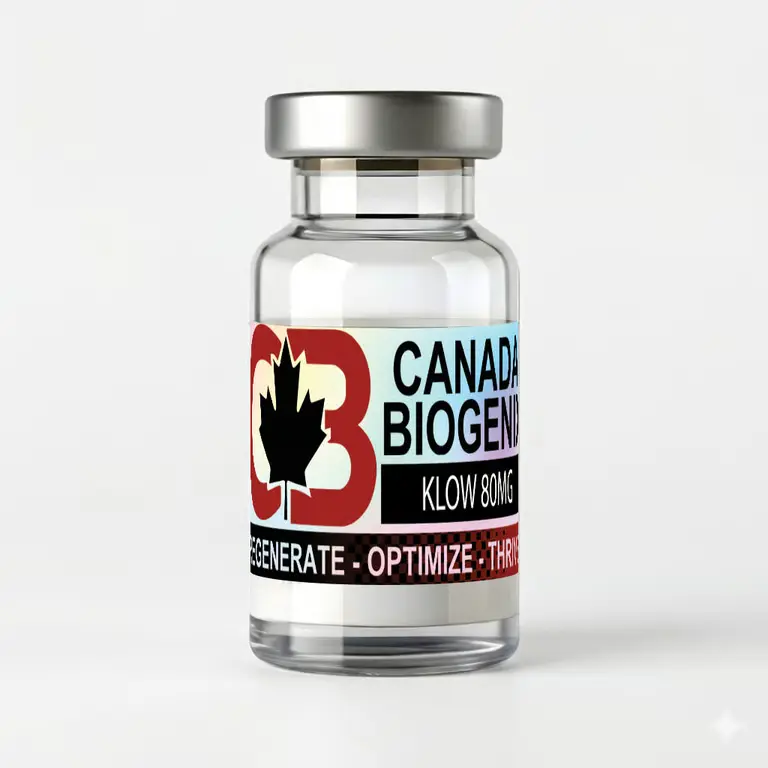
KLOW 80 mg combines GHK-Cu, BPC-157, TB-500 and KPV in one multi-pathway research formulation. Its design brings together encouraging areas of peptide research involving extracellular-matrix organization, cellular migration, vascular signalling, inflammatory pathways and epithelial-barrier biology.
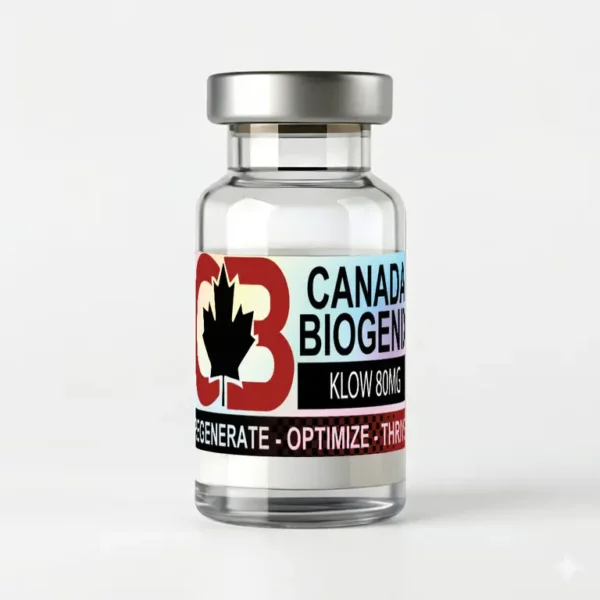
Four Research Peptides
80 mg Per Vial
Repair and Inflammatory Signalling
Component-Level, Primarily Preclinical
KLOW 80 mg is a co-formulated blend of four independently studied peptides. The standard 80 mg composition contains GHK-Cu 50 mg, BPC-157 10 mg, TB-500 10 mg and KPV 10 mg.
The formula expands the three-component GLOW research framework by adding KPV. This creates a broader experimental system in which matrix remodelling, cell movement, vascular-response pathways and inflammatory signalling can be considered together.
A naturally occurring copper-binding tripeptide studied for collagen and glycosaminoglycan signalling, fibroblast activity, antioxidant pathways and organized extracellular-matrix remodelling.
A synthetic pentadecapeptide with encouraging preclinical findings involving tendon-cell survival and migration, FAK-paxillin signalling, vascular responses and gastrointestinal integrity.
A thymosin-β4-related research peptide associated with actin biology. Related thymosin-β4 studies have reported cell-migration, angiogenesis and wound-organization activity.
An α-MSH-derived tripeptide studied for PepT1-mediated uptake, NF-κB and MAP-kinase signalling, inflammatory cytokines and epithelial-barrier models.
| Component | Encouraging Finding | Evidence Context |
|---|---|---|
| GHK-Cu | Reviews describe collagen, glycosaminoglycan, fibroblast, antioxidant and tissue-remodelling activity. | Laboratory, animal and limited topical human research. |
| BPC-157 | Tendon studies reported increased cell migration, spreading, survival and outgrowth through pathways including FAK and paxillin. | Cellular and animal models; very limited human evidence. |
| TB-500 / Tβ4-related | Thymosin-β4 research supports strong scientific interest in actin binding, cell migration, vascular development and wound organization. | Mechanistic and preclinical research is largely on thymosin β4, not the finished KLOW blend. |
| KPV | Cell and mouse-colitis studies found PepT1-mediated uptake, reduced NF-κB and MAP-kinase activation, and lower inflammatory cytokine expression. | Cellular and animal gastrointestinal models. |
| KLOW as a blend | The complementary mechanisms create a promising multi-pathway rationale for controlled comparative research. | The complete four-peptide formulation has not been validated in controlled human trials. |
The blend creates an interesting framework for tendon, ligament, muscle and extracellular-matrix studies that monitor both cell movement and tissue organization.
GHK-Cu and thymosin-related research offers a positive basis for examining fibroblast behaviour, collagen organization, angiogenic signals and wound closure.
BPC-157 and KPV are both prominent in preclinical gastrointestinal research, including mucosal integrity, epithelial responses and inflammation-associated pathways.
KPV adds a valuable NF-κB and cytokine-signalling dimension to structural-repair research involving the other three components.
| Feature | GLOW 70 mg | KLOW 80 mg |
|---|---|---|
| Components | GHK-Cu + BPC-157 + TB-500 | GHK-Cu + BPC-157 + TB-500 + KPV |
| Core framework | Matrix, vascular-response and cellular-migration research. | The same core framework plus inflammatory and epithelial-barrier signalling. |
| Added dimension | Three-component repair-pathway model. | KPV adds α-MSH-fragment, PepT1, NF-κB and cytokine research context. |
This makes KLOW 80 mg the broader experimental framework. The additional component expands the number of pathways available for study, although it does not by itself prove superior outcomes or synergy.
The 80 mg label describes the total research quantity in the vial. It is not an established administration amount. Because the four components have different molecular characteristics and literature bases, the formulation should be evaluated as a multi-variable experimental material.
The scientific rationale behind KLOW 80 mg is positive and biologically interesting. Each component reaches a different layer of repair or inflammatory biology, creating a useful platform for exploratory multi-pathway research.
However, most evidence comes from laboratory and animal research on the individual peptides. Human data are limited, and direct controlled research on the complete KLOW formulation is not yet available. In addition, much of the literature cited for TB-500 evaluates full-length thymosin β4 or related sequences rather than a commercial TB-500 blend.
KLOW 80 mg is supplied for analytical, laboratory and research applications. Clear blend composition and component-level evidence allow researchers to evaluate its multi-pathway design with appropriate controls.
For research use only. Not for human or veterinary use. This information is educational and does not constitute medical advice or establish safety, efficacy or an administration protocol.