TB-500 vs BPC-157 in Canada Which Recovery Peptide Does Research Support?
B-500 vs BPC-157 — what does the research say about these two popular recovery peptides in Canada? An honest, science-based comparison by Canada Biogenix.
Haider Ali
6/13/20268 min read

If you have spent any time researching recovery peptides in Canada, you have almost certainly encountered TB-500 and BPC-157 the two most searched and widely studied research peptides in the Canadian recovery science space. They are often mentioned together, frequently compared, and sometimes studied in combination.
But what does the research actually say about each and how do they differ? This guide gives you the honest, science-grounded comparison that Canadians exploring recovery peptide research deserve.
Research Purposes Only: All peptides discussed are for laboratory and scientific research purposes only. Canada Biogenix makes no therapeutic claims. Nothing here constitutes medical advice.
Related: Peptide Research in Canada Complete Guide Full overview of research peptides available in Canada (canadabiogenix.com/blog/peptide-research-canada-complete-guide)
1. What Is TB-500? Research Overview
Q: What is TB-500?
TB-500 is a synthetic peptide analog of Thymosin Beta-4 a naturally occurring protein found throughout the body. It is studied in preclinical research for its interaction with actin, a structural protein involved in cell movement, tissue repair, and inflammation modulation.
TB-500 gets its name from Thymosin Beta-4 (Tβ4) a 43-amino-acid protein originally isolated from the thymus gland. TB-500 is a shorter synthetic fragment of this protein, studied for how it interacts with actin polymerization a fundamental process involved in how cells move, divide, and repair tissue.
What TB-500 Research Has Explored
Interaction with G-actin building block of cellular structure
Anti-inflammatory pathway interactions in preclinical models
New blood vessel formation (angiogenesis) in animal studies
Cardiac, muscle, tendon, and connective tissue repair in rodent models
Neuroprotective interactions in animal research
Research Stage: TB-500 research is primarily preclinical animal models and cell studies. Limited human clinical data available. Animal findings do not automatically translate to human outcomes.
2. What Is BPC-157? Research Overview
Q: What is BPC-157?
BPC-157 (Body Protective Compound 157) is a synthetic 15-amino-acid peptide studied in preclinical research for tissue repair, gastrointestinal health, angiogenesis, and inflammation pathway modulation. It is the most searched research peptide in Canada.
BPC-157 stands for Body Protective Compound 157 a 15-amino-acid synthetic peptide originally derived from a protective protein found in gastric juice. Its unusual stability and broad preclinical research profile have made it one of the most actively studied compounds in the Canadian research peptide space.
What BPC-157 Research Has Explored
Tendon and ligament repair fibroblast activity and collagen pathway research
Gastrointestinal tissue interaction protective mucosal pathway research
Angiogenesis new blood vessel formation relevant to tissue healing
Anti-inflammatory pathway interactions in preclinical models
Nitric oxide system interactions in rodent research
Research Stage: BPC-157 research is primarily in animal models. Small number of limited human pilot studies exist but large-scale human clinical trials are still lacking.
3. TB-500 vs BPC-157 Key Differences
Q: What is the main difference between TB-500 and BPC-157?
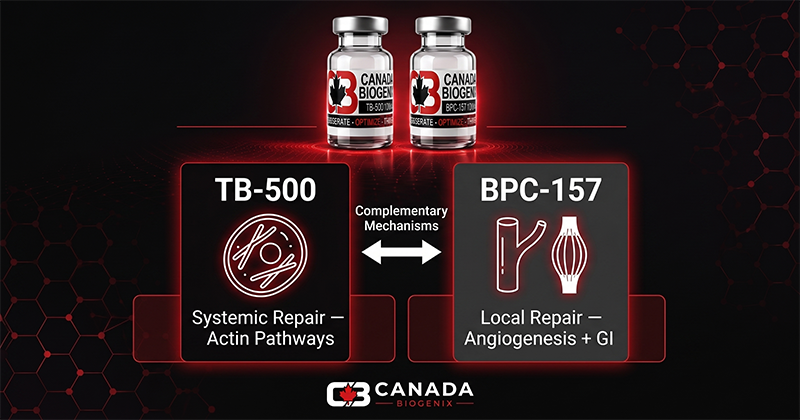
→ TB-500 is studied for systemic tissue repair through actin pathway interactions affecting multiple tissue types. BPC-157 is studied for more localized repair particularly GI tissue, tendons, and connective tissue plus angiogenesis. Different mechanisms, complementary research profiles.
Despite being frequently compared, TB-500 and BPC-157 are fundamentally different compounds. Here is a clear breakdown across key factors:
Origin:
TB-500: Synthetic analog of Thymosin Beta-4 naturally occurring in almost all human tissues
BPC-157: Synthetic peptide derived from a protective protein found in gastric juice
Primary Mechanism:
TB-500: Actin-binding interactions affects cellular mobility and systemic repair pathways
BPC-157: Angiogenesis, fibroblast activation, and nitric oxide pathway interactions
Research Scope:
TB-500: Systemic cardiac tissue, muscle, neurological, connective tissue in animal models
BPC-157: More localized GI tract, tendons, ligaments, connective tissue in animal models
GI Research Profile:
TB-500: Limited GI-specific research
BPC-157: Extensive GI research is BPC-157's original and strongest research area
Cardiac Research Profile:
TB-500: Present and notable in animal models
BPC-157: Limited cardiac-specific research
Human Clinical Data:
TB-500: Very limited primarily preclinical
BPC-157: Very limited small pilot studies only
4. What Does Research Say About Each Mechanism?
TB-500 The Actin Connection
The key to understanding TB-500 research is actin a protein that forms the structural scaffolding inside cells. Actin polymerization is essential for how cells move, divide, and repair damage. TB-500 has been studied for its interaction with G-actin the monomeric form which researchers believe influences cell migration toward damaged tissue.
In practical research terms: animal studies have examined whether TB-500's actin interactions translate to faster repair across muscle, tendon, cardiac, and connective tissue damage models. Results in rodent studies have been observed across multiple tissue types which is why TB-500 is often described as having a more systemic research profile.
BPC-157 The Angiogenesis and GI Connection
BPC-157 research profile centers on two primary mechanisms: angiogenesis (new blood vessel formation) and nitric oxide pathway interactions. New blood vessel growth is a natural part of tissue healing it brings oxygen, nutrients, and growth factors to damaged areas. Multiple animal studies have examined BPC-157's potential to stimulate this process.
BPC-157 origin in gastric juice research gives it a distinct GI research profile that TB-500 does not share. Multiple animal studies have examined its interaction with gastrointestinal tissue protective pathways, intestinal repair models, and mucosal integrity research.
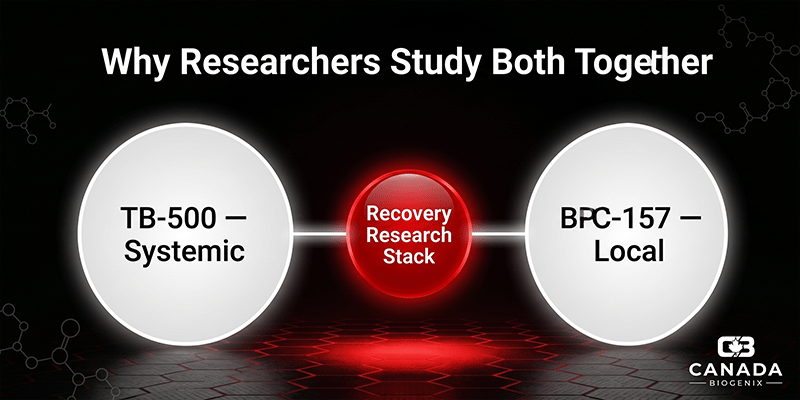
Research Insight: The different mechanisms of TB-500 and BPC-157 are precisely why they are often studied together. TB-500 influences cellular mobility and systemic repair. BPC-157 influences local angiogenesis and GI-related pathways. These mechanisms are complementary not competing.
5. TB-500 + BPC-157 Stack Research
Q: Why are TB-500 and BPC-157 studied together?
TB-500 and BPC-157 are studied together because their mechanisms are complementary — TB-500 addresses systemic cellular repair through actin pathways while BPC-157 addresses local angiogenesis and GI repair signalling. Together they represent the most discussed recovery research stack in the Canadian peptide community.
The TB-500 + BPC-157 combination is the most searched recovery peptide stack in Canada — and the preclinical rationale for studying them together is scientifically grounded.
Why the Combination Is Studied
Different receptor pathways — no known mechanism conflict in preclinical models
TB-500 systemic + BPC-157 localized = broader research coverage across tissue types
Both compounds have been independently studied for angiogenesis interactions
Animal recovery studies have examined both in multi-compound research protocols
What Preclinical Stack Research Has Observed
In rodent models examining musculoskeletal injury repair, researchers have noted that multi-compound protocols involving both TB-500 and BPC-157 showed interactions across both localized and systemic repair pathway markers. These are animal study observations — not confirmed human outcomes.
Important: Stack research adds complexity. Combining compounds introduces additional variables. Canadian researchers studying multi-compound protocols should approach this with appropriate scientific methodology.
Related: Best Peptides for Muscle Growth in Canada Complete muscle and recovery peptides overview (canadabiogenix.com/blog/best-peptides-muscle-growth-canada)
6. Complete Side-by-Side Comparison
Here is a comprehensive comparison of TB-500 and BPC-157 based on current preclinical research — covering every key factor Canadian researchers need to know:
Full Name
TB-500: Thymosin Beta-4 analog (43-amino-acid protein fragment)
BPC-157: Body Protective Compound 157 (15-amino-acid chain)
Research Origin
TB-500: Thymus-derived protein research
BPC-157: Gastric juice protein research
Primary Mechanism
TB-500: Actin-binding — cell migration and systemic repair
BPC-157: Angiogenesis + nitric oxide + fibroblast activation
Research Scope
TB-500: Systemic — multiple tissue types
BPC-157: More localized — GI, tendon, connective tissue
GI Research
TB-500: Limited
BPC-157: Extensive original and strongest research focus
Tendon Research
TB-500: Present in animal models
BPC-157: Extensive in animal models
Cardiac Research
TB-500: Present and notable in animal models
BPC-157: Limited
Anti-Inflammatory Research
TB-500: Present in preclinical models
BPC-157: Present in preclinical models
Human Data
TB-500: Very limited — primarily preclinical
BPC-157: Very limited — small pilot studies only
Often Studied With
TB-500: BPC-157 complementary mechanisms
BPC-157: TB-500 complementary mechanisms
Canada Search Trend 2026
TB-500: High and growing
BPC-157: Very High most searched recovery peptide
Note: All findings are from preclinical animal or cell studies. Neither compound is approved by Health Canada for human therapeutic use.
7. Which One Do Canadian Researchers Choose?
Q: Should I research TB-500 or BPC-157 — or both?
→ It depends on your research focus. For GI-related pathway research: BPC-157 has the stronger literature. For systemic repair and multi-tissue studies: TB-500 has broader scope. For comprehensive recovery pathway research: both are frequently studied together.
Here is a practical research focus guide based on the existing preclinical literature:
GI Tissue Research
Best Choice: BPC-157
Why: Strongest and most established preclinical GI literature
Tendon and Ligament Research
Best Choice: BPC-157 or Both
Why: Strong fibroblast and angiogenesis research profile
Systemic Multi-Tissue Research
Best Choice: TB-500
Why: Broader systemic actin-pathway research profile
Cardiac Tissue Research
Best Choice: TB-500
Why: More specific cardiac preclinical data available
Neurological Research
Best Choice: TB-500
Why: Neuroprotective interaction studies in animal models
Comprehensive Recovery Stack
Best Choice: Both Together
Why: Complementary mechanisms — different pathways addressed
Anti-Inflammatory Research
Best Choice: Both
Why: Both independently studied for inflammation modulation
Related: How to Buy Peptides Safely in Canada Complete sourcing and quality verification guide (canadabiogenix.com/blog/how-to-buy-peptides-safely-canada)
8. How to Source Quality TB-500 and BPC-157 in Canada
Q: Where can I find research-grade TB-500 and BPC-157 in Canada?
Source from a Canadian supplier that provides independent third-party COA documentation, verifies 98%+ purity via HPLC testing, offers domestic Canadian shipping, and maintains research-use-only positioning. Canada Biogenix carries both TB-500 and BPC-157 meeting these standards.
When sourcing TB-500 and BPC-157 for research in Canada, these quality standards are non-negotiable:
Independent third-party COA HPLC tested, batch-specific, from accredited lab
Minimum 98%+ purity verified not just claimed by manufacturer
Domestic Canadian shipping no customs risk, faster delivery
Research-use-only positioning no therapeutic claims on supplier site
Transparent sourcing supplier knows exactly where compounds are manufactured
Canada Biogenix carries both TB-500 and BPC-157 independently tested, research-grade quality, shipped domestically across Canada. Every product comes with third-party COA documentation as standard.
Related: How to Buy Peptides Safely in Canada Complete 2026 Guide Verify quality, COA, red flags and more (canadabiogenix.com/blog/how-to-buy-peptides-safely-canada)
Related: Browse Research Peptides Canada Biogenix Research-grade peptides available in Canada (canadabiogenix.com/peptides)
9. Frequently Asked Questions TB-500 vs BPC-157 Canada
Q: Is TB-500 or BPC-157 better for recovery research?
Neither is objectively better they have different mechanisms and research strengths. BPC-157 has stronger GI and tendon-specific research. TB-500 has broader systemic and cardiac research. Many Canadian researchers study them together for comprehensive recovery pathway coverage.
Q: Are TB-500 and BPC-157 legal in Canada?
Both are available in Canada as research compounds for laboratory and scientific research purposes. Neither is approved by Health Canada as a pharmaceutical drug for human therapeutic use. Source from suppliers that maintain consistent research-use-only positioning.
Q: Can TB-500 and BPC-157 be studied together?
Yes they are among the most commonly studied together in preclinical recovery research. Their mechanisms are complementary rather than competing. TB-500 works through actin-binding pathways and BPC-157 through angiogenesis and fibroblast pathways addressing different aspects of tissue repair research simultaneously.
Q: What purity should TB-500 and BPC-157 be for research?
Research-grade TB-500 and BPC-157 should be minimum 98% purity, verified by independent third-party HPLC testing. Always request a batch-specific COA from an accredited independent laboratory.
Q: How should TB-500 and BPC-157 be stored?
Store lyophilized powder at -20°C for long-term stability, or 4°C for short-term use within weeks. Keep sealed, away from light and moisture. Avoid repeated freeze-thaw cycles by aliquoting into single-use research portions.
Q: Where can I find TB-500 and BPC-157 in Canada?
Canada Biogenix supplies both TB-500 and BPC-157 as research-grade compounds with independent third-party COA documentation. Domestic Canadian shipping available across the country at canadabiogenix.com/peptides
Final Thoughts: TB-500 vs BPC-157 in Canada
TB-500 and BPC-157 are not rivals they are the two most complementary recovery research peptides in the Canadian market, each with a distinct but reinforcing preclinical profile.
BPC-157 brings one of the most studied localized repair profiles in peptide science particularly in GI and tendon research. TB-500 brings systemic breadth actin-pathway interactions studied across multiple tissue types. Together, they represent the most comprehensive recovery research stack available in Canada.
As always: the science is preclinical, the findings are promising rather than proven, and quality sourcing is non-negotiable.
Explore research-grade TB-500 and BPC-157 independently tested, domestically shipped at canadabiogenix.com/peptides Canada trusted research peptide source.
Related: Browse All Research Peptides Canada Biogenix Research-grade peptides available across Canada (canadabiogenix.com/peptides)
Related: How to Buy Peptides Safely in Canada Complete quality verification and sourcing guide (canadabiogenix.com/blog/how-to-buy-peptides-safely-canada)
Related: BPC-157 Recovery Research Full Overview Deep dive into BPC-157 preclinical research (canadabiogenix.com/blog/bpc-157-canada-recovery-healing-research)