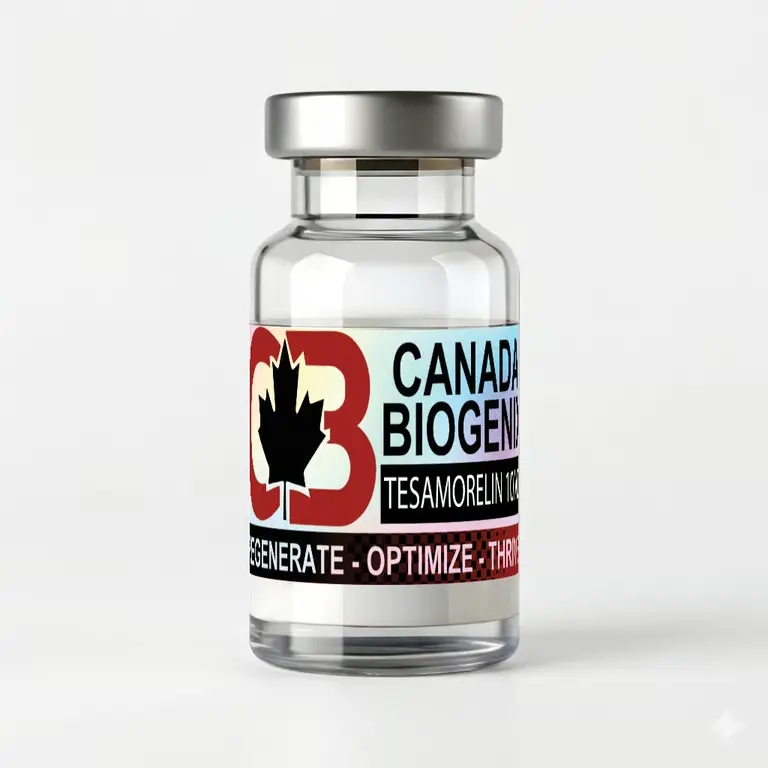
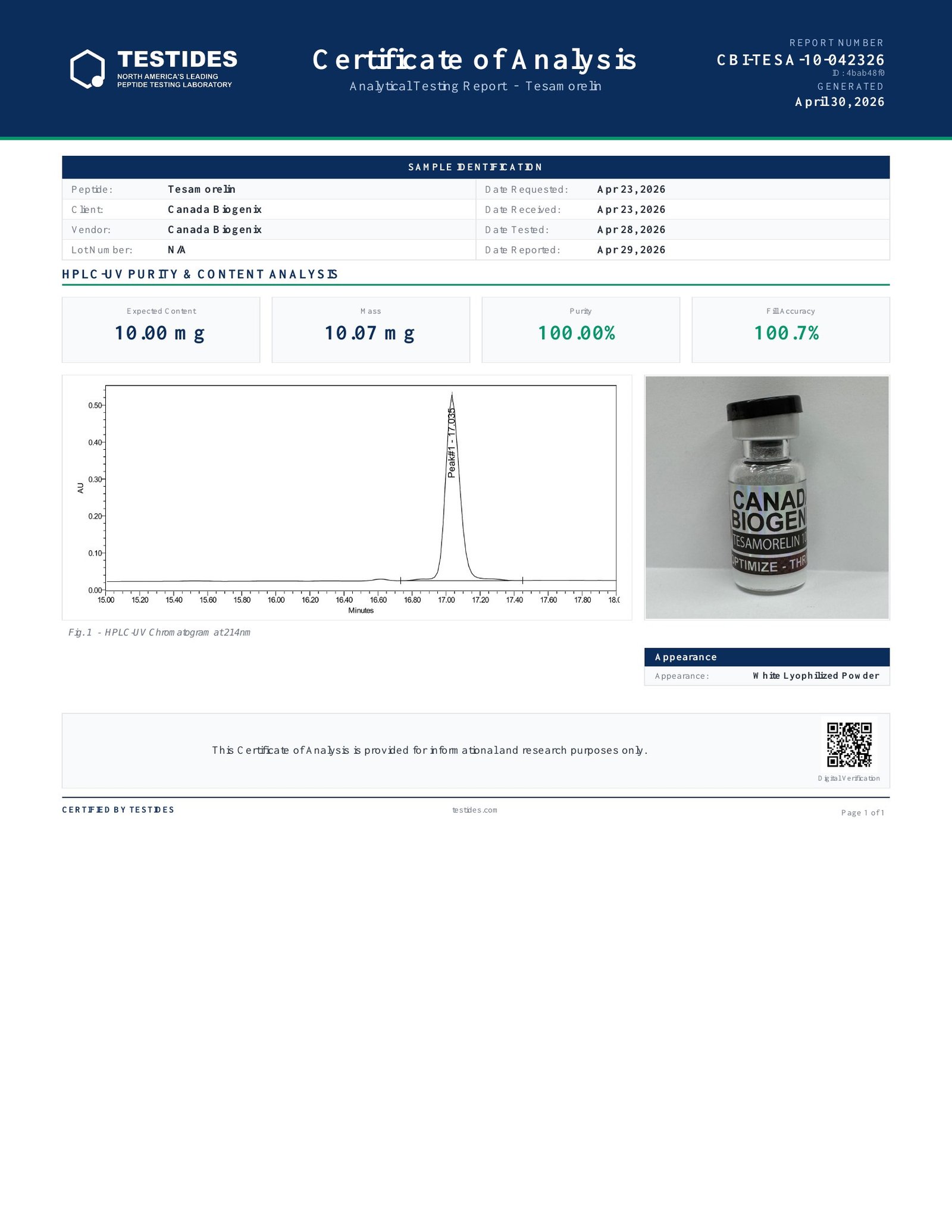
Tesamorelin 10 mg is a stabilized growth hormone-releasing hormone analogue supported by randomized human research on visceral adipose tissue. Its ability to stimulate endogenous growth hormone and IGF-1 has also created positive research interest in body composition, liver fat and metabolic signalling.
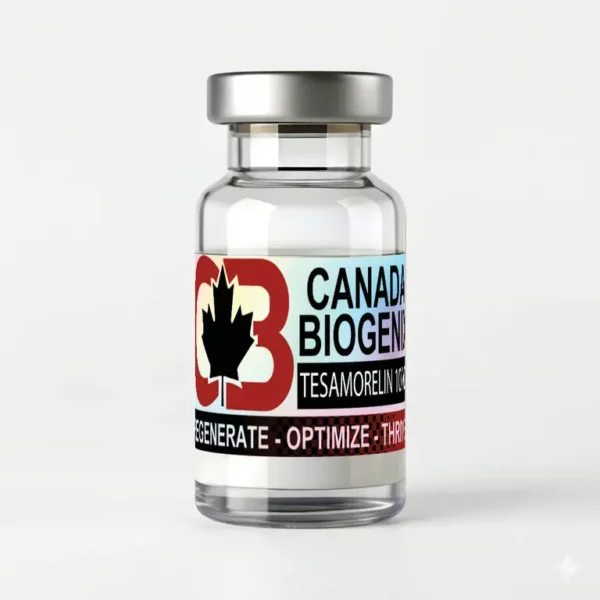
Tesamorelin is a synthetic version of the first 44 amino acids of human growth hormone-releasing hormone, also called GHRH or growth hormone-releasing factor. A small N-terminal modification helps protect the molecule from rapid enzymatic breakdown, giving it greater stability than native GHRH.
Rather than supplying growth hormone directly, it signals pituitary somatotroph cells to increase the body’s own pulsatile release of growth hormone. This raises downstream IGF-1 activity and supports lipolytic signalling. That pathway—and the unusually strong human evidence behind it—makes Tesamorelin 10 mg especially notable among research peptides associated with body composition.
Human trials found meaningful reductions in deep abdominal visceral fat, with less emphasis on subcutaneous or limb fat. This tissue-selective pattern is central to the compound’s research value.
By working through the GHRH receptor, the molecule promotes endogenous, pulsatile GH release and downstream IGF-1 signalling instead of introducing exogenous growth hormone.
Clinical studies have reported encouraging changes in liver fat, lean-body-mass measures and muscle quality, supporting continued metabolic and body-composition research.
The most persuasive findings come from adults with HIV-associated abdominal fat accumulation. These results are promising, although they should not be automatically generalized to healthy adults or every form of obesity.
| Research Area | Positive Finding | Interpretation |
|---|---|---|
| Visceral adipose tissue | Large Phase 3 studies reported approximately 15–18% average reductions in visceral fat over 26 weeks. | This is the clearest and best-replicated human finding for Tesamorelin. |
| Body composition | Studies found reductions in trunk fat alongside favourable lean-mass and skeletal-muscle measures in responders. | The evidence supports body-composition interest, but not a claim of dramatic scale-weight loss. |
| Liver fat | Randomized research reported reductions in hepatic fat and a lower rate of fibrosis progression in a studied HIV/NAFLD population. | An encouraging metabolic-liver signal that remains an active area of study. |
| GH and IGF-1 signalling | Dose-ranging and Phase 3 trials consistently demonstrated increases in IGF-1 through endogenous GH release. | Confirms engagement of the intended biological pathway. |
The bodybuilding interest around Tesamorelin has a logical biological foundation. GH and IGF-1 influence lipolysis, protein turnover, connective-tissue biology and body composition. Clinical studies have also reported favourable lean-mass and muscle-quality signals.
However, controlled studies have not established greater strength, muscle hypertrophy, athletic performance or faster injury recovery in healthy athletes. For now, those outcomes are best described as plausible research questions—not proven performance benefits.
Visceral fat is metabolically active and is associated with inflammatory and cardiometabolic signalling. Accordingly, a compound that preferentially reduces this compartment can be scientifically interesting even without causing large changes in total body weight.
In a randomized trial involving people living with HIV and non-alcoholic fatty liver disease, Tesamorelin reduced liver fat and was associated with less fibrosis progression. These positive findings support further investigation across metabolic-liver models.
These compounds overlap in downstream GH/IGF-1 biology, but they differ in receptor target, duration and depth of human evidence.
| Research Compound | Primary Signal | Research Distinction |
|---|---|---|
| Tesamorelin 10 mg | GHRH receptor | Stabilized 44-amino-acid analogue with randomized human evidence for visceral-fat reduction. |
| CJC-1295 10 mg | GHRH receptor | A shorter-acting GHRH-analogue research model without the same clinical visceral-fat evidence base. |
| CJC-1295 with DAC 5 mg | Long-acting GHRH receptor signal | DAC-mediated albumin binding provides a prolonged research signal and a distinct exposure profile. |
| Ipamorelin 10 mg | Ghrelin receptor / GHSR-1a | Uses a complementary receptor pathway to stimulate GH release, making it useful in comparative secretagogue research. |
| CJC-1295 + Ipamorelin 10 mg | GHRH + GHSR-1a pathways | A dual-pathway research blend designed to explore complementary GH-release signals. |
Research discussions often pair a GHRH analogue with a ghrelin-receptor agonist because the two pathways can converge on pituitary GH release. For example, Ipamorelin engages GHSR-1a, while Tesamorelin engages the GHRH receptor.
That complementary biology makes combination models scientifically interesting, but it does not guarantee better outcomes. Because the pathways share downstream GH and IGF-1 effects, combination studies should account for overlapping exposure and should not assume that protocols used with one pharmaceutical formulation transfer to another research material.
The 10 mg label describes the total quantity of research material in the vial. It is not a suggested dose, protocol or frequency.
FDA prescribing information applies only to the specifically approved EGRIFTA formulations, which have their own strengths, excipients, preparation instructions and medical supervision requirements. Canada Biogenix Tesamorelin 10 mg is a separate research product and should not be treated as interchangeable with EGRIFTA.
Tesamorelin 10 mg is presented as research material for qualified laboratory investigation. This educational overview summarizes published findings and does not provide medical advice, diagnosis, treatment instructions, dosing guidance or a guarantee of outcomes.