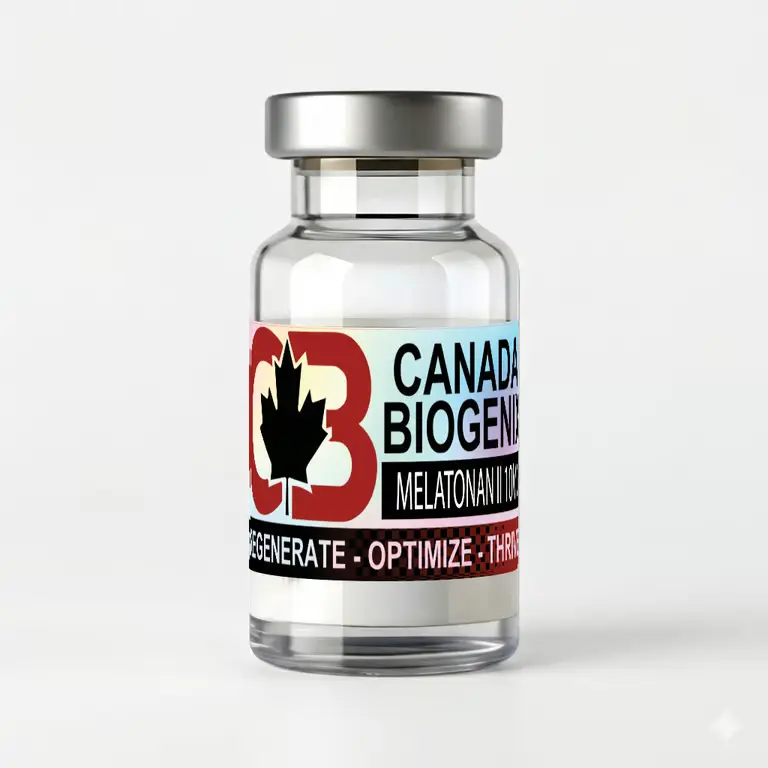
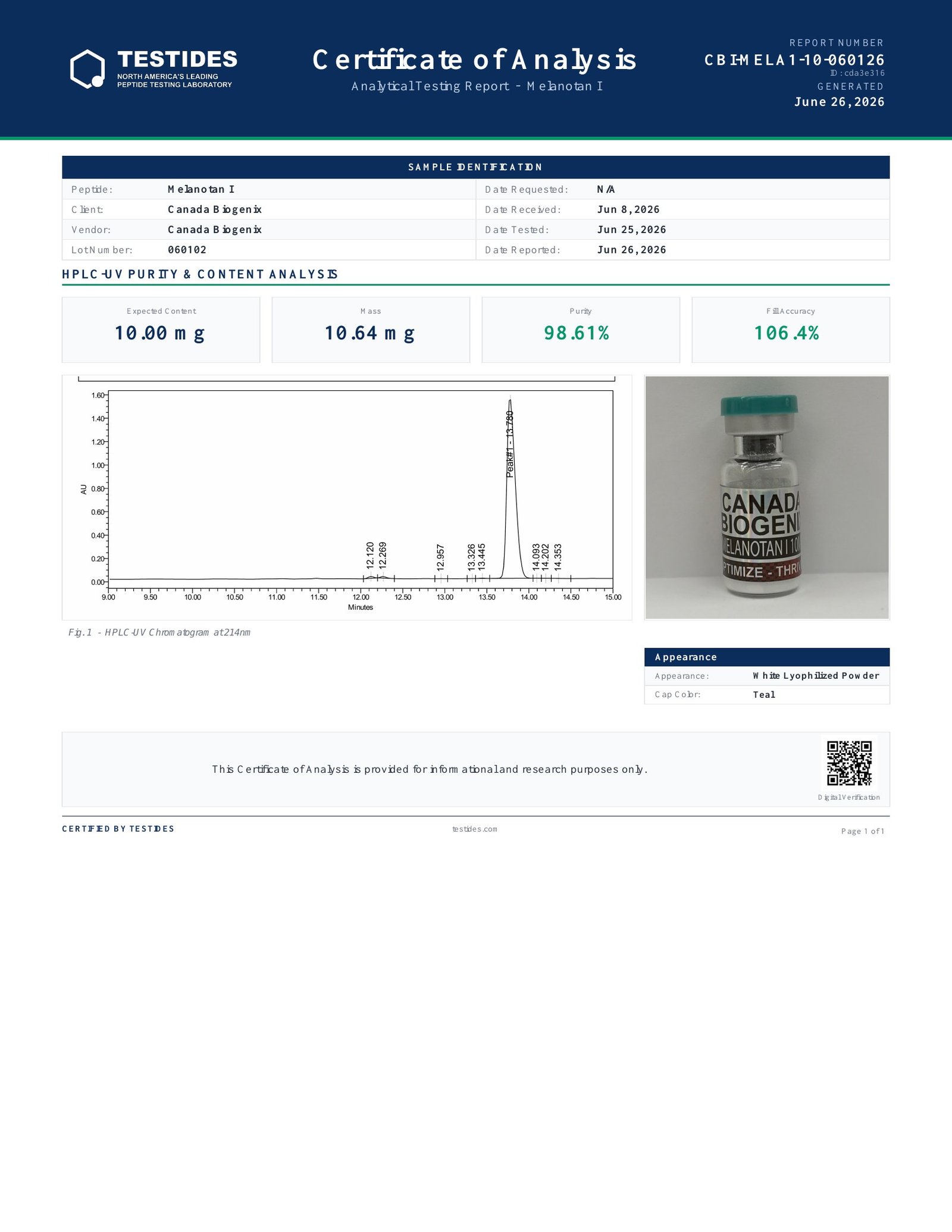
Melanotan I 10 mg, also called MT-1 or afamelanotide, is a synthetic α-MSH analogue with strong research support for melanocortin-1 receptor signalling, eumelanin production, pigmentation and photoprotection-related pathways.
Synthetic α-MSH Analogue
13-Amino-Acid Peptide
Melanocortin-1 Receptor
Controlled Human Research
Melanotan I is a linear synthetic analogue of alpha-melanocyte-stimulating hormone, usually abbreviated α-MSH. It is also known by the scientific name afamelanotide and by the sequence description [Nle4,D-Phe7]-α-MSH.
The molecule contains 13 amino acids. Two substitutions—norleucine at position 4 and D-phenylalanine at position 7—make it more resistant to rapid enzymatic breakdown and produce longer-lasting melanocortin activity than natural α-MSH.
Its main research target is the melanocortin-1 receptor, or MC1R, found on melanocytes. Activating this receptor increases signalling that favours production of eumelanin, the brown-black form of melanin associated with pigmentation and light absorption.
Melanotan I was the original development name for afamelanotide. Therefore, peer-reviewed afamelanotide research is highly relevant to understanding the peptide’s molecular mechanism and biological potential.
However, the approved pharmaceutical product SCENESSE is a proprietary, sterile, controlled-release 16 mg implant administered by specially trained healthcare professionals for adults with erythropoietic protoporphyria. A lyophilized 10 mg research vial is a different formulation and has not been shown to reproduce the implant’s release profile, pharmacokinetics, safety or clinical results.
Afamelanotide research shows that MC1R activation can increase eumelanin production independently of ultraviolet exposure. This makes the pathway especially useful for controlled studies that separate melanogenesis from the direct effects of UV radiation.
| Research Area | Encouraging Finding | Evidence Context |
|---|---|---|
| Pigmentation | Controlled volunteer studies reported significant increases in melanin density and visible pigmentation. | Human experimental research. |
| UV-response markers | Fair-skinned volunteer research found increased pigmentation alongside reduced UV-associated cellular damage markers. | Controlled human study. |
| EPP phototoxicity | Randomized studies found greater pain-free light exposure in adults with erythropoietic protoporphyria. | Phase III trials of a controlled-release implant. |
| Vitiligo research | Afamelanotide combined with narrowband UV-B produced faster and greater repigmentation than phototherapy alone in selected adults. | Randomized human research; not the approved indication. |
| Research-vial formulation | Provides a practical laboratory quantity for analytical and receptor-pathway research. | Not clinically equivalent to a pharmaceutical implant. |
The peptide offers a well-defined system for examining receptor activation, cAMP signalling, MITF regulation and tyrosinase-associated melanogenesis.
Human findings strongly support interest in pigmentation density, pigment distribution and the biological differences between eumelanin and pheomelanin pathways.
Research has explored light absorption, oxidative responses, DNA-damage markers and pain-free light exposure in photosensitive populations.
The positive vitiligo findings support continued investigation of melanocyte activation alongside controlled phototherapy and other repigmentation approaches.
In fair-skinned volunteers, the [Nle4,D-Phe7]-α-MSH analogue significantly increased pigmentation. Researchers also observed fewer UV-associated epidermal changes, supporting a positive connection between induced eumelanin and reduced experimental UV damage.
Phase III afamelanotide studies in erythropoietic protoporphyria then demonstrated a clinically meaningful MC1R pathway. In one pivotal study, median pain-free direct-sunlight exposure over 180 days was 64.1 hours with the pharmaceutical implant and 40.5 hours with vehicle. Another study reported 6.0 versus 0.75 hours under its more restrictive direct-sunlight measurement.
| Feature | Melanotan I / Afamelanotide | Melanotan II |
|---|---|---|
| Structure | Linear 13-amino-acid α-MSH analogue. | Shorter cyclic melanocortin analogue. |
| Primary research emphasis | MC1R, pigmentation and photoprotection-related pathways. | Broader melanocortin-receptor activity, including central pathways. |
| Human evidence | Extensive controlled research; approved afamelanotide implant for EPP. | Experimental studies but no approved MT-II medicine. |
| Best research fit | More selective pigmentation and MC1R framework. | Broader melanocortin-system exploration. |
| Research Setting | Format Studied | What It Establishes |
|---|---|---|
| Cell and receptor models | Direct laboratory exposure | MC1R mechanism and concentration-response signals. |
| Early human pigmentation studies | Investigational peptide formulations | Pigmentation and experimental UV-response findings. |
| EPP and vitiligo trials | Proprietary controlled-release implant | Clinical evidence for that formulation and supervised research setting. |
| Lyophilized research vial | No clinically standardized human protocol | The 10 mg vial cannot be treated as equivalent to the pharmaceutical implant. |
The 10 mg vial size describes total laboratory quantity. Clinical implant doses and schedules should not be converted into a protocol for a different formulation, release system or route.
The molecule underlying Melanotan I 10 mg has an unusually strong evidence profile. Human studies support its ability to activate pigmentation pathways, while phase III trials and real-world research demonstrate meaningful effects in EPP.
Pigmentation-related changes also require careful measurement. Pharmaceutical afamelanotide labelling notes possible generalized pigmentation and darkening of existing freckles or moles, making standardized imaging and skin monitoring relevant considerations in formal research.
Increased eumelanin is not a substitute for ordinary light-protection measures. Moreover, approved-drug safety data cannot establish the identity, release profile or safety of a differently manufactured research vial.
Melanotan I 10 mg is supplied for analytical, laboratory and research applications involving MC1R signalling, melanogenesis, pigment biology and photoprotection-related pathways.
For research use only. Not for human or veterinary use. This information is educational and does not constitute medical advice or establish safety, efficacy or an administration protocol.