
Last Updated: July 29, 2026
Understanding peptide shipping temperature requirements is critical for researchers who depend on stable compounds arriving in research-ready condition. This guide from Canada BioGenix covers the complete framework for protecting peptides during transit, storage, and handling, from lyophilized powders to reconstituted solutions. Degradation during shipping remains one of the most common causes of failed experiments and wasted research budgets. Below, we’ll show you exactly how temperature control works, what can go wrong, and how to verify your peptides arrived intact.
Temperature stability is the single most important factor in peptide preservation. Peptides are chains of amino acids held together by covalent bonds, and heat accelerates the breakdown of these bonds through hydrolysis and oxidation. The difference between a peptide that arrives at 95% purity and one that arrives at 70% purity often comes down to a single day of elevated temperature exposure.
Research-grade peptides typically require one of three temperature regimens during shipping: room temperature storage (for certain lyophilized peptides), refrigerated conditions at 2-8°C, or ultra-cold storage at -20°C or -80°C depending on the peptide’s composition and stability profile. The specific requirement depends on whether your peptide is lyophilized (freeze-dried powder) or reconstituted in solution, its molecular structure, and transit duration.
Most shipping failures occur not from extreme heat, but from inconsistent temperature. A peptide that sits at 15°C then warms to 20°C then cools to 10°C experiences more stress than one held steady at 20°C. Freeze-thaw cycles are particularly destructive, each cycle can reduce peptide viability by 5-15%.
Peptides degrade through two primary mechanisms: hydrolysis and oxidation. Hydrolysis occurs when water molecules break covalent bonds between amino acids, shortening the peptide chain and destroying its biological activity. This process accelerates exponentially with temperature, a peptide stored at 25°C degrades roughly twice as fast as one stored at 4°C, and three times faster than one at -20°C.
Oxidation is equally destructive. Amino acids like methionine and tryptophan are particularly vulnerable to oxidative damage, which alters their chemical structure and renders them inactive. Elevated temperature dramatically speeds oxidation. Light exposure compounds oxidative damage, which is why peptides are always shipped in opaque containers.
Shelf life expectations vary dramatically based on storage temperature. A lyophilized peptide stored at room temperature remains stable for 6-12 months. The same peptide at 4°C extends to 1-2 years. At -20°C, you’re looking at 2-5 years, and at -80°C, many peptides remain viable for 5+ years. These timelines assume the peptide never experiences temperature fluctuation.
During shipping, peptides face additional stressors beyond temperature: vibration from transport, humidity exposure (especially for lyophilized peptides), and potential bacterial growth if moisture is present and temperature rises above 15°C. Professional peptide shipping requires multiple layers of protection working together.
Peptides are short chains of amino acids, typically 2-50 amino acids in length. Their smaller size makes them more fragile than proteins, a single broken bond can render the entire molecule inactive.
The three-dimensional structure of a peptide is maintained by weak interactions: hydrogen bonds, hydrophobic interactions, and electrostatic forces. These structures are remarkably stable under ideal conditions but collapse under stress. Heat increases molecular motion, breaking these weak bonds. Freeze-thaw cycles create ice crystal formation that can physically damage peptide molecules. Oxidation changes the chemical structure of amino acid side chains, destroying the precise geometry the peptide needs to function.
Different peptide sequences have different vulnerability profiles. A peptide rich in hydrophobic amino acids is more prone to aggregation when exposed to temperature fluctuation. A peptide with multiple methionine residues is more vulnerable to oxidation. A peptide with many polar amino acids is more hygroscopic and absorbs moisture readily.
Degradation isn’t always immediately obvious. A peptide might lose 10-15% potency during shipping and still appear chemically intact under basic analysis. But in your research, that reduced potency translates to inconsistent results and wasted experimental time.
Lyophilized peptides are freeze-dried powders with water removed, leaving behind solid peptide. This format is more stable than liquid solutions, occupies less space, and can tolerate a wider range of temperatures. However, lyophilized peptides are hygroscopic, they actively absorb water from the air. When moisture enters the vial, hydrolysis begins immediately.
A lyophilized peptide stored in a sealed vial at room temperature can remain stable for 6-12 months. The same peptide exposed to humid air degrades in weeks. This is why lyophilized peptides are shipped in sealed vials with desiccant packets inside the vial and additional desiccant in the shipping box.
For short shipping durations (1-3 days within Canada), lyophilized peptides can often tolerate room temperature. For longer shipping durations, refrigerated conditions (2-8°C) are safer. For peptides that will be stored long-term after arrival, ultra-cold storage (-20°C or -80°C) is standard.
The critical factor during transit is seal integrity. If the vial’s cap isn’t perfectly sealed, moisture enters and degradation accelerates. Professional peptide suppliers use crimp-sealed vials with rubber septa that are nearly impossible to compromise.
Lyophilized peptides are dry powder. Reconstituted peptides are dissolved in a solvent, typically sterile water, bacteriostatic water, or saline solution.
Lyophilized peptides are more stable during shipping because the absence of liquid reduces hydrolysis risk. They can tolerate room-temperature shipping for short durations and have longer shelf lives (6-12 months at room temperature, 2-5 years at -20°C). The trade-off is that you must reconstitute them yourself before use, which adds a preparation step and introduces contamination risk if protocols aren’t followed.
Reconstituted peptides are ready to use immediately upon arrival, eliminating the reconstitution step. However, peptides in solution are far more vulnerable to degradation. The solvent can become contaminated with bacteria if temperature rises above 15°C. Hydrolysis accelerates in solution because water is the degradation agent. Oxidation accelerates because the peptide is exposed to dissolved oxygen. Reconstituted peptides absolutely require refrigerated shipping (2-8°C minimum) and typically have shelf lives of only 2-4 weeks at room temperature, 2-6 months at 4°C.
The decision between lyophilized and reconstituted usually comes down to your workflow. For shipping purposes, lyophilized is always safer because it tolerates a wider temperature range.
A peptide’s shelf life depends on four variables: storage temperature, initial purity, molecular composition, and packaging quality.
At room temperature (20-25°C), a lyophilized peptide typically remains at ≥90% purity for 6-12 months. Reconstituted peptides at room temperature degrade much faster, typically 2-4 weeks before bacterial growth becomes a concern. At refrigerated temperature (2-8°C), lyophilized peptides extend to 1-2 years, and reconstituted peptides to 2-6 months. At -20°C, lyophilized peptides typically remain stable for 2-5 years, and reconstituted peptides for 6-12 months. At -80°C, both formats can remain viable for 5+ years.
These timelines assume proper packaging. Exposure to light, humidity, or temperature fluctuation reduces shelf life by 20-50%. Repeated freeze-thaw cycles reduce shelf life by 5-15% per cycle.
The primary degradation factors are heat, light, humidity, and time. Heat accelerates hydrolysis and oxidation exponentially. Light drives oxidation of sensitive amino acids. Humidity enables bacterial growth and hydrolysis in lyophilized peptides.
Professional peptide shipping requires multiple layers of insulation and temperature control: inner vial → desiccant → cushioning material → insulated box → temperature-control element (ice pack or dry ice) → outer shipping box.
The insulated box itself is critical. Styrofoam (expanded polystyrene) is the standard because it provides excellent insulation at low cost. A 2-3 inch Styrofoam layer can maintain internal temperature within 2-3°C of the starting temperature for 24-48 hours, depending on external conditions. For longer shipping durations or extreme external temperatures, thicker insulation (4+ inches) is necessary.
Temperature-control elements vary by requirement. For room-temperature shipping, no active cooling is needed, just insulation to buffer against external temperature swings. For refrigerated shipping (2-8°C), gel ice packs are standard and maintain 2-8°C for 24-48 hours depending on pack size and insulation quality. For ultra-cold shipping (-20°C or colder), dry ice is used.
Ice packs should not directly touch vials, the extreme cold can damage peptide structure through rapid freeze-thaw cycles. Instead, ice packs are placed around the insulated inner box, creating a buffer zone. Desiccant packets are placed inside the vial cap and in the shipping box to absorb any moisture that might enter.
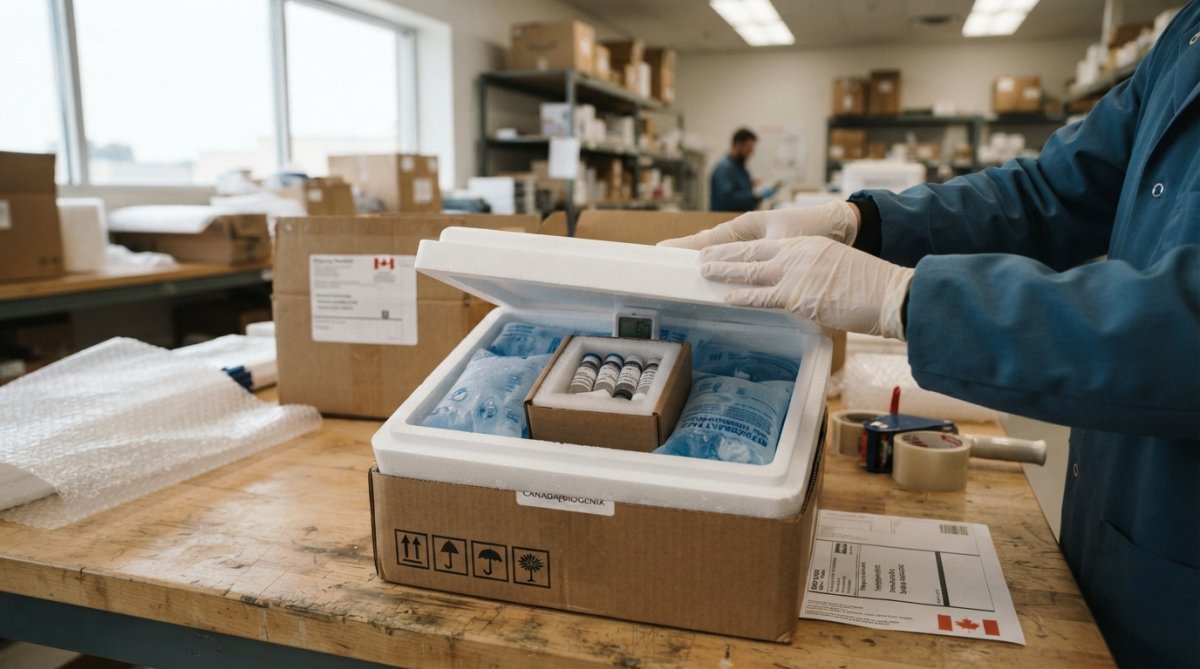
Insulation quality directly determines how long a peptide maintains its target temperature during transit. A 2-inch Styrofoam box provides basic protection for 24-hour shipments within temperate regions. A 3-inch box extends protection to 36-48 hours. A 4-inch box or vacuum-insulated box can maintain temperature for 48-72 hours even in hot conditions.
Desiccants are equally critical. Silica gel packets absorb moisture and prevent hydrolysis in lyophilized peptides. A single 5-gram packet absorbs approximately 1 gram of water before becoming saturated. For a standard vial of lyophilized peptide, one 5-gram packet inside the vial and one 10-gram packet in the box is typical. Color-changing desiccants (blue when dry, pink when saturated) allow you to verify that moisture absorption occurred during transit.
Cold chain protection means maintaining temperature consistency from manufacturing through your receipt and storage. Many professional peptide shippers now include temperature monitoring devices (data loggers) that record temperature throughout transit. You can review these logs to verify the peptide never exceeded its maximum temperature. If a temperature excursion occurred, you can immediately contact the supplier and request replacement before using the peptide in research.
For shipments within Canada, transit time is typically 1-3 business days. Standard insulated packaging maintains the target temperature for this duration.
A lyophilized peptide in a properly insulated box (2-3 inch Styrofoam) with ice packs can tolerate a 24-hour delay at room temperature with minimal degradation (typically <5% loss of potency). A 48-hour delay at room temperature results in 8-15% potency loss depending on the peptide’s composition. A 72-hour delay typically results in 20-30% potency loss.
The critical variable is external temperature. A 48-hour delay in winter (external temperature 0-10°C) results in much less degradation than a 48-hour delay in summer (external temperature 25-35°C).
Reconstituted peptides are more vulnerable to delay. A 24-hour delay at room temperature can result in 15-25% potency loss. A 48-hour delay risks bacterial contamination, especially if the external temperature rises above 20°C. If a reconstituted peptide is delayed more than 36 hours, it should be considered compromised and replaced.
When your peptide arrives, check the temperature-monitoring data if included. If the temperature exceeded the recommended range for more than a few hours, contact the supplier immediately.
Cold chain logistics refers to the coordinated system of temperature-controlled storage, handling, and transportation that maintains product integrity from manufacturer to end user. In Canada, this includes temperature-controlled storage at manufacturing facilities, insulated packaging with appropriate temperature-control elements, temperature monitoring during transit, rapid delivery, and documentation of temperature conditions throughout the chain.
Most Canadian peptide suppliers work with specialized logistics partners that understand these requirements. These partners maintain temperature-controlled vehicles, use appropriate insulation, and include temperature-monitoring devices in shipments.
For your part as the recipient, maintaining the cold chain continues after delivery. A peptide that arrived in perfect condition can degrade rapidly if left on a bench at room temperature. Lyophilized peptides should be stored at the temperature specified on the COA, typically 2-8°C or -20°C. Reconstituted peptides should be stored at 2-8°C immediately upon arrival. Ultra-cold peptides (-80°C) should be transferred to an -80°C freezer within hours of arrival.
Shipping duration within Canada typically ranges from 1-3 business days depending on origin and destination. For 24-hour shipments, standard 2-inch Styrofoam insulation with gel ice packs is sufficient for refrigerated peptides. For 48-hour shipments, 3-inch insulation is safer. For 72-hour shipments, 4-inch insulation or vacuum-insulated packaging is necessary.
Temperature monitoring during transit is increasingly standard. Many shippers include data loggers that record temperature every 15-30 minutes throughout the journey. When your peptide arrives, you can download the data and verify that temperature never exceeded the maximum threshold.
When receiving a shipment, inspect the packaging before opening. If the insulation is wet, damp, or visibly damaged, the seal may have been compromised. If ice packs are completely thawed, the internal temperature likely rose above the target range. If desiccant packets have turned pink, moisture entered the vial. Contact the supplier before using the peptide if you observe these warning signs.
Health Canada regulates peptides used for therapeutic purposes under the Therapeutic Products Directorate (TPD) and the Biologic and Radiopharmaceutical Drugs Directorate (BRDD). Research-grade peptides used for in vitro studies or animal research fall under different regulations.
For research peptides, Health Canada’s primary requirement is that they be labeled as "Not for Human Use" and that they meet stated purity and potency specifications. Suppliers must maintain batch-specific Certificates of Analysis documenting purity, identity, and potency.
Storage and shipping requirements are not directly regulated by Health Canada for research peptides, but they are specified by the supplier based on the peptide’s stability data. You, as the recipient, are responsible for maintaining proper storage conditions after receipt.
If you’re using peptides for research involving animals (in vivo studies), additional regulations may apply depending on the province. Animal research requires approval from an Institutional Animal Care and Use Committee (IACUC) in Canada. Always verify with your institution’s research compliance office before ordering peptides for animal studies.
Proper handling of peptides begins before they arrive and continues long after you receive them.
Before arrival: Plan your storage strategy. Ensure you have appropriate storage space at the recommended temperature (typically 2-8°C or -20°C). Don’t order a peptide and then realize you don’t have the freezer space.
Upon arrival: Inspect the package immediately. Check for visible damage, wetness, or desiccant color change. If any of these are present, photograph the damage and contact the supplier before opening the vial. Transfer the inner insulated box to your storage area without delay. If the peptide requires -80°C storage, transfer it to the ultra-cold freezer within 1-2 hours of arrival.
During storage: Store the vial in its original sealed container. Don’t transfer peptides to different vials unless absolutely necessary. Keep the vial sealed until you’re ready to use it.
Reconstitution best practices: When reconstituting a lyophilized peptide, use sterile, pyrogen-free water or bacteriostatic water as specified on the COA. Reconstitute in a biological safety cabinet or clean environment to prevent contamination. Use a sterile syringe and needle to withdraw the reconstituted peptide. After reconstitution, store the solution at 2-8°C and use within the timeframe specified on the COA (typically 2-4 weeks).
For lyophilized peptides, condensation inside the vial cap indicates moisture entered the vial and hydrolysis has begun. Discoloration suggests oxidation has occurred. Clumping or caking suggests moisture absorption and aggregation.
For reconstituted peptides, cloudiness or visible particles indicate bacterial growth or precipitation. A clear solution should remain clear. Discoloration (yellowing or browning) indicates oxidation.
If you observe any of these signs, do not use the peptide. Contact the supplier immediately with photographs. Most reputable suppliers will replace peptides showing signs of degradation, especially if the degradation occurred during shipping.
Each freeze-thaw cycle typically reduces peptide potency by 5-15%. Multiple cycles compound the damage. A peptide that undergoes 3-5 freeze-thaw cycles might lose 30-50% of its potency.
To minimize freeze-thaw damage, divide reconstituted peptides into small aliquots before freezing. Use only the aliquot you need for each experiment, and discard it after use rather than refreezing. For lyophilized peptides, freeze-thaw cycles are less of a concern because the peptide is already in solid form.
The most common mistake is underestimating how fragile peptides are. Researchers sometimes treat peptides like stable chemicals that can tolerate room-temperature shipping and casual storage.
A second common mistake is not verifying storage conditions immediately upon receipt. Peptides should be transferred to appropriate storage within 1-2 hours of arrival.
A third mistake is not using desiccant packets when storing lyophilized peptides long-term. Over time, even in a sealed vial, moisture can slowly accumulate.
A fourth mistake is reconstituting more peptide than needed. Reconstituted peptides degrade rapidly.
A fifth mistake is not documenting storage conditions. Keep a simple log of storage temperature, dates received, and dates used.
A sixth mistake is ignoring temperature-monitoring data if included with the shipment. If a data logger shows that temperature exceeded the maximum threshold, contact the supplier and discuss whether the peptide is still usable.
Peptide shipping temperature requirements boil down to one principle: minimize exposure to heat, light, moisture, and time, and maintain consistency in all conditions. The most common reason peptides arrive degraded is not catastrophic failure, but rather a series of small deviations that compound to significant potency loss.
Canada BioGenix understands these requirements intimately. We work with logistics partners that maintain rigorous temperature control, include temperature monitoring in every shipment, and use insulation appropriate to the peptide type and shipping duration. Our peptides arrive with Certificates of Analysis documenting purity and potency, and we stand behind our products with replacement guarantees if temperature excursions occur during shipping. Start protecting your research with peptides that arrive in perfect condition, contact Canada BioGenix today.
| Storage Condition | Lyophilized Shelf Life | Reconstituted Shelf Life | Ideal For |
|---|---|---|---|
| Room Temperature (20-25°C) | 6-12 months | 2-4 weeks | Short-term use, convenient access |
| Refrigerated (2-8°C) | 1-2 years | 2-6 months | Standard storage, moderate-term research |
| -20°C Freezer | 2-5 years | 6-12 months | Long-term storage, batch management |
| -80°C Ultra-Cold | 5+ years | 1-2 years | Extended storage, archival peptides |
Most research-grade peptides require shipment at -20°C or -80°C depending on stability profiles and reconstitution status. Lyophilized peptides are more stable and can tolerate brief ambient temperature exposure, while reconstituted peptides demand continuous cold chain protection. Temperature-controlled packaging with insulation, ice packs, or dry ice maintains these conditions during transit. Always verify your specific peptide's storage requirements with your supplier, as degradation risk increases significantly above 4°C for extended periods.
Lyophilized peptides are freeze-dried powders with significantly extended shelf life, often 12-24 months at -20°C, and can tolerate brief room-temperature exposure during shipping without major degradation. Reconstituted peptides (dissolved in bacteriostatic water or sterile water) are far more vulnerable to hydrolysis, oxidation, and bacterial growth, requiring strict cold chain maintenance throughout transit. Lyophilized peptides are preferred for shipping because their protein structure is stabilized in powder form, reducing solubility-related degradation.
Inspect the packaging upon arrival for signs of temperature breach (melted ice packs, moisture inside the vial). Visual indicators of degradation include discoloration, cloudiness in reconstituted solutions, or crystallization in lyophilized powders. If delays exceeded 48 hours at ambient temperature, contact your supplier for stability assessment. Real-world data shows lyophilized peptides remain viable after 3-5 day delays if insulation held; reconstituted peptides degrade rapidly beyond 24 hours without cold chain. Request a replacement batch if degradation is suspected.
Health Canada classifies research-grade peptides as controlled substances requiring proper documentation, labeling, and cold chain compliance for import and domestic distribution. Shipments must include accurate product declarations, purity certificates, and batch-specific Certificates of Analysis. Temperature-controlled packaging documentation may be required for regulatory compliance. Work with suppliers familiar with Health Canada peptide regulations to ensure your shipment meets all requirements and avoid delays or confiscation at borders.
This article was written using GrandRanker