

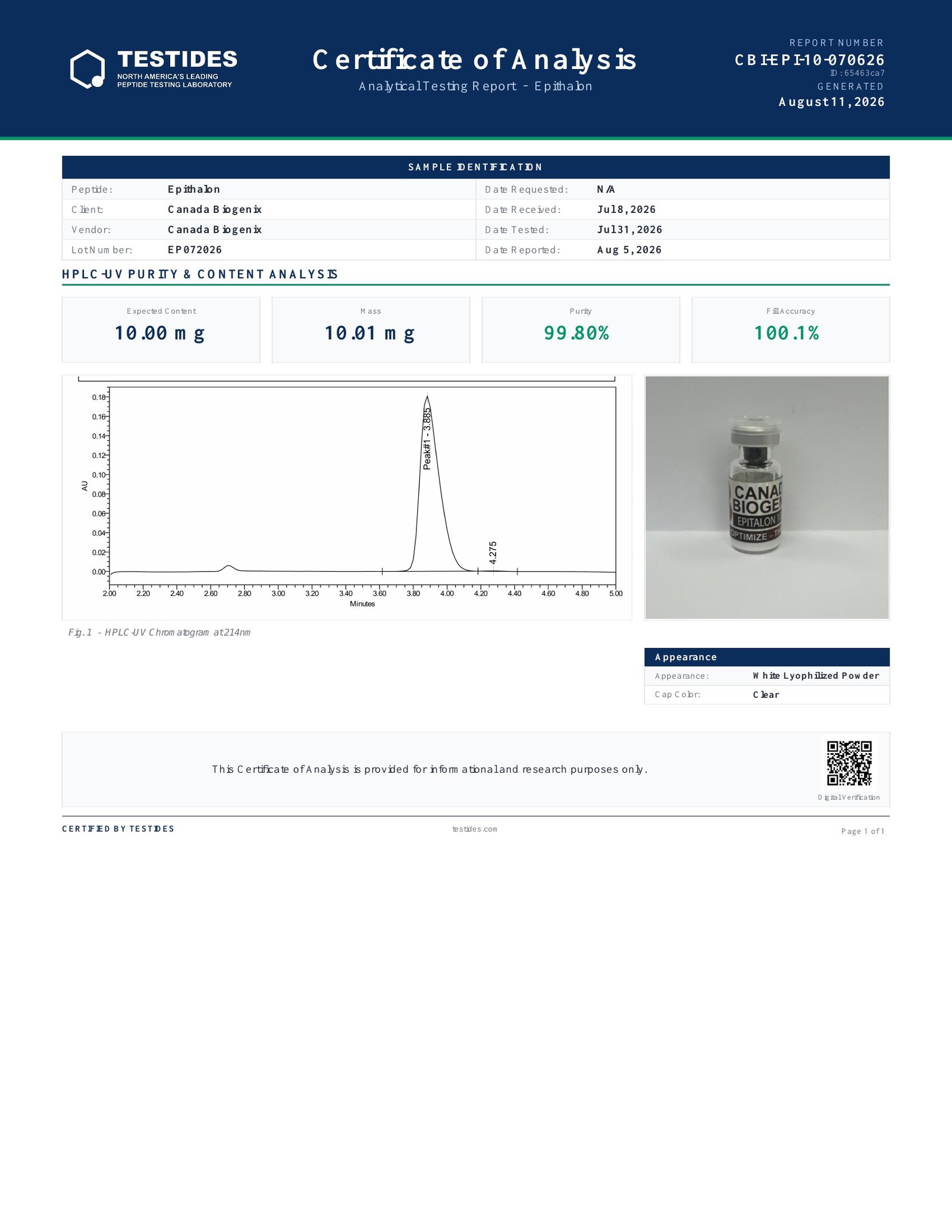
Epitalon 10 mg is a research-grade tetrapeptide attracting significant interest for its potential influence on telomerase activity, telomere biology, pineal signalling and cellular-aging pathways.

Epitalon, also written as Epithalon or Epithalone, is a synthetic peptide made from four amino acids: alanine, glutamic acid, aspartic acid and glycine. It is often identified by the short sequence AEDG.
The peptide was developed from research on epithalamin, a multi-peptide extract obtained from the pineal gland. Epitalon represents a defined synthetic tetrapeptide rather than the full glandular extract. This distinction matters because some well-known human longevity studies investigated epithalamin, not Epitalon itself.
Research interest in Epitalon 10 mg centres on telomerase activation, telomere maintenance, melatonin rhythms, oxidative-stress responses and the molecular biology of aging.
Cell studies have reported increased telomerase activity and longer telomeres after Epitalon exposure. These findings are especially interesting because telomeres help protect chromosome ends during cell division.
Research involving Epitalon and related pineal preparations has explored melatonin secretion and daily hormonal rhythms. This creates a positive rationale for studying age-related circadian changes.
Preclinical studies have examined antioxidant enzymes, chromosomal stability, gene regulation and cellular responses to age-related stress. Together, these pathways make Epitalon a broad gerontology research tool.
| Research area | Encouraging observation | Evidence level | Important context |
|---|---|---|---|
| Telomerase and telomeres | A 2003 study reported telomerase activation and telomere elongation in human somatic cells. | In-vitro human cell study | A cell-culture result does not demonstrate slower aging in a person. |
| Independent telomere research | A 2025 study again found longer telomeres in several human cell lines through telomerase upregulation or alternative lengthening activity. | Modern in-vitro study | The study included normal and cancer-derived cell lines, so biological effects are context dependent. |
| Melatonin rhythms | Pineal peptide studies reported improved nighttime melatonin patterns in older research subjects and aged monkeys. | Limited human and animal research | Some studies involved epithalamin or mixed pineal preparations rather than only synthetic Epitalon. |
| Lifespan models | A mouse study reported a longer maximum lifespan and improved survival among the longest-lived animals. | Preclinical animal study | Mean lifespan and body weight were not significantly changed in that experiment. |
| Oxidative stress | Animal research has reported changes in antioxidant enzymes and other markers of cellular stress resistance. | Animal and laboratory studies | Human antioxidant and health outcomes remain unconfirmed. |
The positive scientific interest around Epitalon spans several connected areas of cellular and aging biology:
These findings make Epitalon 10 mg a compelling longevity-research compound. They do not establish human anti-aging, disease-prevention or lifespan-extension benefits.
Telomeres are repeating DNA structures that help protect chromosome ends. They often become shorter as cells divide. Telomerase is an enzyme that can rebuild telomeric DNA, while some cells use a separate process called alternative lengthening of telomeres.
Early Epitalon research reported telomerase activation in telomerase-negative human fibroblasts. More recently, a 2025 study observed telomere-length changes across several human cell lines and found evidence involving both telomerase and alternative lengthening mechanisms.
This newer research strengthens the scientific case that Epitalon can influence telomere biology under laboratory conditions. However, telomere regulation is complex and varies by cell type. Therefore, longer telomeres in cultured cells cannot be translated directly into claims of whole-body rejuvenation or longer human life.
| Feature | Epitalon | Epithalamin |
|---|---|---|
| Composition | Defined synthetic AEDG tetrapeptide | Multi-peptide pineal gland extract |
| Research emphasis | Telomerase, telomeres and cellular signalling | Pineal function, aging and long-term clinical observations |
| Evidence interpretation | Directly relevant to the synthetic product on this page | Related background evidence that should not be treated as identical |
Published Epitalon research spans cell cultures, animal experiments and a limited number of human investigations. Study designs used different formulations, routes, quantities and schedules. In addition, some frequently cited protocols originate from epithalamin research rather than studies of the isolated AEDG tetrapeptide.
No standardized human dose, cycle length or administration schedule has been established for this product. The 10 mg designation describes the total laboratory quantity in the vial and should not be interpreted as an administration instruction.
Published Epitalon literature has not established a complete long-term safety profile. Large, independently replicated human trials are lacking, and research has not fully defined possible interactions, reproductive effects or risks in people with complex medical conditions.
Telomerase is also biologically context dependent. Telomere maintenance may support normal cell survival, while unusually active telomere-maintenance pathways can also occur in cancer cells. This does not prove that Epitalon promotes or prevents cancer. Instead, it shows why telomerase findings require cell-specific research and careful interpretation.
Overall, the available research is promising enough to justify continued investigation. At the same time, stronger human evidence is needed before conclusions can be drawn about aging, sleep, immunity, cancer risk or lifespan.
| Research product | Primary research theme | Main distinction |
|---|---|---|
| Epitalon 10 mg | Telomeres, pineal signalling and cellular aging | Synthetic AEDG tetrapeptide with direct telomere-research findings |
| DSIP 15 mg | Sleep architecture and neuroregulation | Nine-amino-acid peptide linked to slow-wave-sleep research |
| MOTS-C 20 mg | Mitochondrial and metabolic signaling | Mitochondria-derived peptide studied in energy and metabolic-aging pathways |
| GHK-Cu 100 mg | Copper signalling and tissue-remodelling research | Copper-binding tripeptide studied in collagen, repair and gene expression |
These products investigate distinct pathways. Combining research compounds does not guarantee additive or synergistic results, and validated human stacking protocols have not been established.
Research-use notice: Epitalon 10 mg is presented for laboratory research and analytical discussion only. It is not intended to diagnose, treat, cure or prevent disease, or for human or animal use. This information is not medical advice or an administration guide.